

AI Search Has a Trust Problem, but Better Brand Data Can Help Fix It
 Preferred source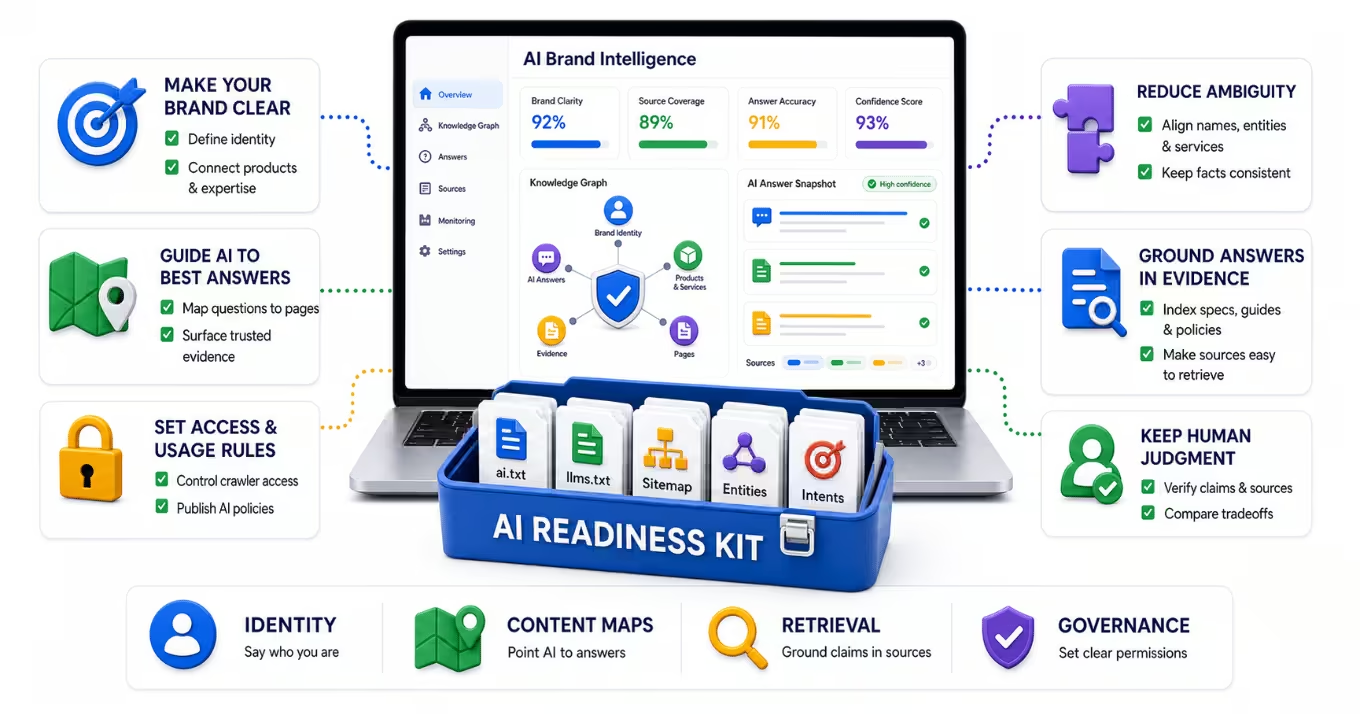
For more than two decades, traditional search engines presented users with a collection of results and asked them to choose.
You reviewed the headlines. You compared sources. You decided which website appeared credible enough to visit and which information deserved your trust.
AI search changes that process.
When someone asks ChatGPT, Claude, Gemini, or Perplexity a question, they may receive one synthesized answer instead of a page of competing links. The AI system gathers information, evaluates sources, connects ideas, and presents a conclusion.
That experience is faster and easier for the user.
It also means many of the decisions that once belonged to the person performing the search are now being made by the AI system. Gartner predicted that traditional search engine volume would drop 25% by 2026 as AI chatbots and virtual agents absorb queries that once went to a results page.
The question is no longer only whether your website ranks.
The question is whether an AI system understands your company well enough to include it in the answer.
AI Search Does Not Simply Look Up One Question
Suppose someone asks an AI assistant:
"What are the best commercial-grade work boots for construction crews?"
The system may not treat that as one simple search.
It can interpret the request as several related questions:
- Which work boots are most durable?
- Which brands perform well in demanding conditions?
- Which boots provide the best ankle support?
- Which models meet workplace safety requirements?
- Which materials hold up against water, mud, concrete, and daily wear?
- Which boots offer the best balance of durability, comfort, and price?
This process is often described as query fan-out, a technique Google has publicly documented in AI Mode, where a single question is broken into subtopics and a multitude of searches are issued simultaneously on the user's behalf.
The AI expands the original prompt into related research paths, gathers information from multiple sources, and combines the findings into a single response.
The user may never see every query that was performed. They may not know which sources were evaluated, which brands were excluded, or why one company received a recommendation while another did not.
They simply see the final answer.
That is what makes AI visibility so important.
It is also what makes accuracy, transparency, and responsible optimization essential. Research from Columbia's Tow Center for Digital Journalism found that AI search engines produced incorrect answers to more than 60% of test queries, and delivered those wrong answers with confidence.
What Happens When the AI Does Not Understand Your Brand?
Imagine a manufacturer called Iron Ridge Workwear.
Iron Ridge produces high-quality work boots designed for commercial construction crews. Its boots use reinforced stitching, slip-resistant soles, waterproof materials, and protective toe options.
The company has a strong product, decades of experience, and excellent customer feedback.
However, its website does not explain those facts clearly.
Product specifications are scattered across multiple pages. The company's history is buried inside an outdated About page. Important safety information appears only in downloadable PDFs. Product categories use internal terminology that customers and AI systems may not understand.
There is no clear machine-readable description of the company, its products, its areas of expertise, or the questions its website can answer.
A person may be able to explore the site and eventually understand the business.
An AI system has to piece the story together.
It may misunderstand the company's primary market. It may confuse commercial products with casual footwear. It may overlook important certifications or durability features. It may send users to a competitor whose website provides clearer information, even when that competitor does not offer the stronger product.
This is one of the biggest challenges in AI search.
The strongest company does not always become the recommended company.
The brand that is easiest for AI to understand may have the advantage.
The Difference Between Optimization and Manipulation
Generative engine optimization, commonly called GEO, focuses on improving a brand's visibility within AI-generated answers. The term comes from a 2023 Princeton-led research paper that found certain content strategies could boost visibility in generative engine responses by up to 40%.
Like traditional SEO, GEO can be used responsibly or irresponsibly.
Responsible GEO gives AI systems clearer, more accurate, and more verifiable information. It helps machines understand who a company is, what it offers, where it operates, and which questions it can answer.
Manipulative GEO attempts to manufacture authority.
A company may publish unsupported statistics, create artificial reviews, plant promotional content on low-quality websites, or repeat the same unverified claim across multiple sources.
The objective is not to help the AI understand the truth. It is to make the AI more confident in a preferred narrative.
That distinction matters.
AI search systems do not need more promotional noise. They need better information.
At Silverback Marketing, we believe the right approach is not to trick AI systems into recommending a company. The right approach is to remove unnecessary uncertainty so the system can accurately evaluate the company.
That is one of the reasons we developed the AI Readiness Kit.
Why We Developed the AI Readiness Kit
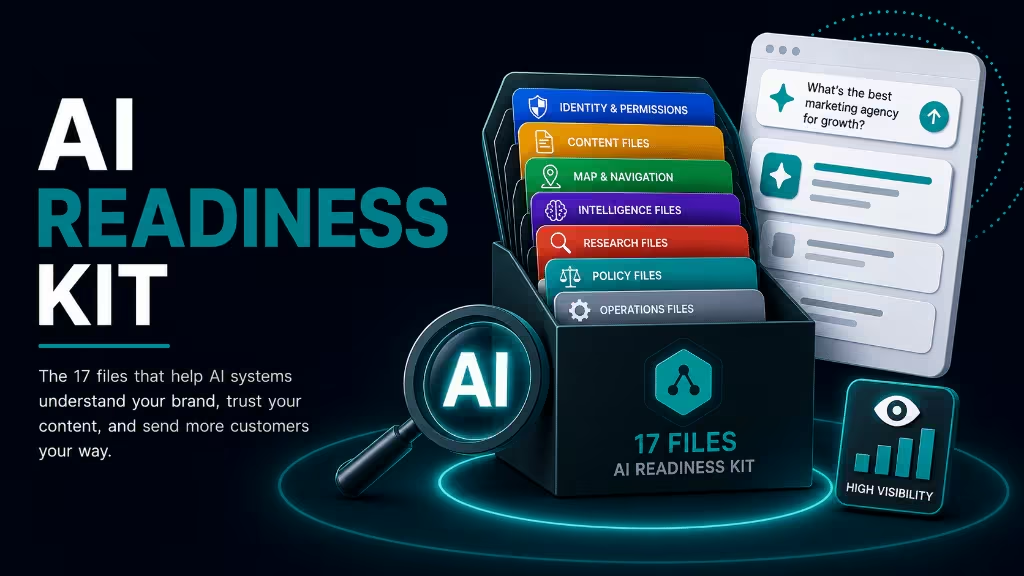
The AI Readiness Kit was created to help organizations tell AI systems exactly who they are before those systems are forced to guess.
It is a structured collection of files placed at the root of a website. Together, these files help AI crawlers, retrieval systems, coding agents, and language models understand the organization more accurately.
The kit helps define:
- The identity of the organization
- The products and services it provides
- The topics on which it has legitimate authority
- The questions its website can answer
- The pages that provide the best answer for each intent
- The entities, categories, and relationships within the site
- The rules governing AI access and training-data use
- The content available for retrieval and research
The purpose is not to create artificial authority.
The purpose is to make existing authority understandable.
For a company such as Iron Ridge Workwear, the kit could clearly define its commercial work boot categories, product specifications, safety features, industries served, warranty information, durability testing, and authoritative resources.
Instead of asking an AI system to infer those relationships from scattered webpages, the brand can provide a structured and consistent explanation.
The AI still decides how to use that information.
The company simply gives it better information to evaluate.
What the AI Readiness Kit Adds to a Website
A traditional website is primarily built for people and search engines.
An AI-ready website also considers how language models, retrieval systems, and automated research tools access and interpret information.
The AI Readiness Kit organizes that information across several connected categories.
Identity and Permissions
Files such as robots.txt and ai.txt help define which automated systems can access the website and what they should understand about the organization.
The distinction is important.
The robots.txt file primarily controls access. It tells crawlers which areas of the site they may visit.
The ai.txt file focuses on identity and AI usage. It can explain what the organization does, what it is known for, which topics it covers, and how its content may be used.
Together, these files establish a clearer front door for AI systems.
AI-Focused Content Summaries
The llms.txt and llms-full.txt files provide structured summaries created for large language models. The format was proposed by Answer.AI in 2024 and has since been adopted by documentation sites at companies including Anthropic, Cloudflare, and Stripe.
The shorter file acts as a concise map of the website. It introduces the company, organizes important sections, links to primary resources, and identifies common questions the site answers.
The expanded file provides deeper descriptions, supporting context, category information, and detailed answers.
For Iron Ridge Workwear, these files could make it immediately clear that the company manufactures commercial work boots rather than lifestyle footwear. They could explain which industries the products serve, how the product lines differ, and where an AI system can find supporting evidence.
Maps and Navigation
A standard XML sitemap tells crawlers which URLs exist.
An AI-focused sitemap can provide additional context, including what each page contains, what type of content it represents, and which subject it addresses.
This helps an AI system find the right page without having to interpret the entire site from scratch.
A product comparison question might be directed to a detailed buying guide. A safety question might be routed to a certification page. A durability question might be connected to testing documentation rather than a general product category.
Better routing can lead to better answers.
Entity and Intent Intelligence
The AI Readiness Kit includes structured intelligence files that describe the important entities within a website and connect user questions to the best available content.
An entity file can define products, services, categories, locations, people, and important business concepts.
An intent file can map real customer questions to the page that provides the strongest answer.
For example:
A question about waterproof commercial boots should lead to the waterproof product category or an appropriate comparison guide.
A question about slip resistance should lead to the relevant technical documentation.
A question about safety-toe options should lead to a page that clearly compares steel, alloy, and composite toe products.
Without this mapping, the AI must choose a destination on its own.
With it, the company provides a direct and useful path.
Retrieval and Research Files
Retrieval-augmented generation (RAG) systems search for relevant information before producing an answer.
The kit includes structured research indexes that can help these systems locate useful documents and ground answers in the company's actual content.
This matters because an AI answer should not rely only on general associations or outdated training data when current, authoritative information is available.
A structured retrieval index can help surface the correct warranty, product specification, comparison guide, service description, or policy document at the moment it is needed.
AI Policies and Transparency
Organizations also need to decide how they want AI systems to interact with their content.
A training-data policy can explain whether content may be used for model training, retrieval indexing, commercial applications, or other purposes.
An AI disclosure can explain how the organization uses artificial intelligence within its own operations.
These policies help establish expectations and create a more transparent relationship between brands, AI providers, and users.
AI readiness should not only be about visibility.
It should also be about governance.
Clear Information Is Not the Same as Guaranteed Placement
No file can force ChatGPT, Claude, Gemini, Perplexity, or another system to recommend a business.
The AI Readiness Kit is not a paid placement system, and it is not a shortcut around reputation, quality, expertise, or legitimate authority.
It does not replace:
- A strong website
- Helpful original content
- Accurate product information
- Technical SEO
- Structured data
- Third-party recognition
- Genuine customer reviews
- Trusted industry citations
- A clearly defined brand
- A product or service that performs well
What it does is reduce ambiguity.
It helps AI systems understand the business from information the business has deliberately organized and published.
That gives strong companies a better opportunity to be evaluated accurately.
Why Structured Brand Information Matters
AI systems make connections between entities, attributes, topics, claims, and sources.
When a company's information is incomplete or inconsistent, those connections become harder to establish.
One page may use a full legal business name. Another may use an abbreviation. A third may use a product brand without clearly connecting it to the parent organization.
Services may be described differently across landing pages. Locations may be missing from structured data. Product names may change between navigation menus, catalogs, and articles.
People can often resolve those inconsistencies through context.
Machines may not.
Structured brand information creates alignment between:
- The company name
- The brand name
- Products and services
- Leadership and subject-matter experts
- Geographic markets
- Industry categories
- Customer questions
- Supporting resources
- Policies and permissions
This alignment can improve more than AI visibility.
It can also strengthen technical SEO, content governance, internal linking, structured data implementation, website architecture, and future retrieval applications.
AI readiness is not a separate marketing trick.
It is an extension of good information architecture.
AI Search Still Requires Human Judgment
Better brand data can improve the information available to AI systems, but users should still evaluate the answers they receive.
A polished AI response can sound authoritative even when it is incomplete. The Tow Center study found that premium AI chatbots delivered confidently incorrect answers even more often than their free counterparts.
When a recommendation matters, users should ask better follow-up questions.
Instead of asking:
"What is the best commercial work boot?"
Ask:
"What are the top commercial work boot options for concrete construction, and what are the durability, safety, comfort, and cost tradeoffs?"
Then ask:
- What evidence supports these recommendations?
- Which options were considered but excluded?
- What are the weaknesses of the recommended product?
- Are the product specifications current?
- Which sources are independent of the manufacturer?
- Would the recommendation change for a different work environment?
- What safety certifications should I verify before purchasing?
These questions encourage comparison instead of blind acceptance.
AI can accelerate research, but people still need to evaluate the conclusion.
The Future of Search Is About Being Understood
Traditional SEO helped search engines discover, crawl, interpret, and rank webpages.
GEO expands that responsibility.
Brands now need to consider whether AI systems can accurately understand the organization as a complete entity.
That means defining more than keywords.
It means defining identity, expertise, relationships, products, services, locations, intent, evidence, policies, and authoritative resources.
The companies that succeed in AI search will not necessarily be the companies that publish the most content.
They will be the companies that communicate the clearest and most consistent version of the truth.
That is the real purpose of AI readiness.
It is not about controlling every answer.
It is about making sure AI systems have accurate, current, structured information before they form one.
Stop Letting AI Guess About Your Business
When AI systems cannot clearly understand your organization, they fill in the gaps using whatever information they can find.
That information may be incomplete, outdated, inconsistent, or influenced by competitors.
The AI Readiness Kit gives brands a structured way to explain who they are, what they offer, which questions they answer, and where AI systems can find the supporting information.
It helps turn a disconnected website into an organized source of machine-readable brand intelligence.
AI search is becoming a new front door for discovery.
The question is whether your business is ready when someone walks through it.
Frequently Asked Questions
Common questions about GEO, SEO, and AI-driven search visibility.
The AI Readiness Kit is a structured collection of machine-readable files, including llms.txt, ai.txt, entity and intent maps, retrieval indexes, and AI policy documents, placed at the root of a website. Together they give AI crawlers, language models, and retrieval systems an accurate, consistent description of who your organization is, what it offers, and which questions its content answers. Learn more at https://ai.silverbackmarketing.com.
robots.txt controls crawler access, meaning which areas of a site automated systems may visit. ai.txt sets permissions and expectations for AI usage, including whether content may be used for training. llms.txt is a structured, markdown-based summary of your site written specifically for large language models to read at inference time.
Query fan-out is the technique AI search systems use to break a single question into many related sub-queries, run them simultaneously, and synthesize the results into one answer. Google has described this as a core mechanism of AI Mode in Search. It means your content can be evaluated against questions the user never explicitly asked.
Generative engine optimization (GEO) is the practice of improving a brand's visibility within AI-generated answers, a term introduced in a 2023 Princeton-led research paper. Traditional SEO optimizes pages to rank in a list of results; GEO optimizes brand information so AI systems can accurately understand, cite, and recommend the organization inside a synthesized answer.
No. No file can force an AI system to recommend a business, and the kit is not a paid placement system. What it does is reduce ambiguity, giving AI systems accurate, structured, verifiable information so a strong company has a better opportunity to be evaluated correctly.
No. AI readiness complements, and depends on, a strong website, helpful original content, technical SEO, structured data, genuine reviews, and third-party recognition. Think of it as an extension of good information architecture, not a substitute for it.
Because AI systems answer with confidence even when they are wrong. A Columbia Tow Center study found AI search engines answered more than 60% of test queries incorrectly. Brands that publish clear, structured, machine-readable information give AI systems less room to guess, and less room to get the story wrong.