



Bananas, Bots, and Share of Voice: The Week in SEO, GEO, and AI Visibility July 13 to 17, 2026
 Preferred source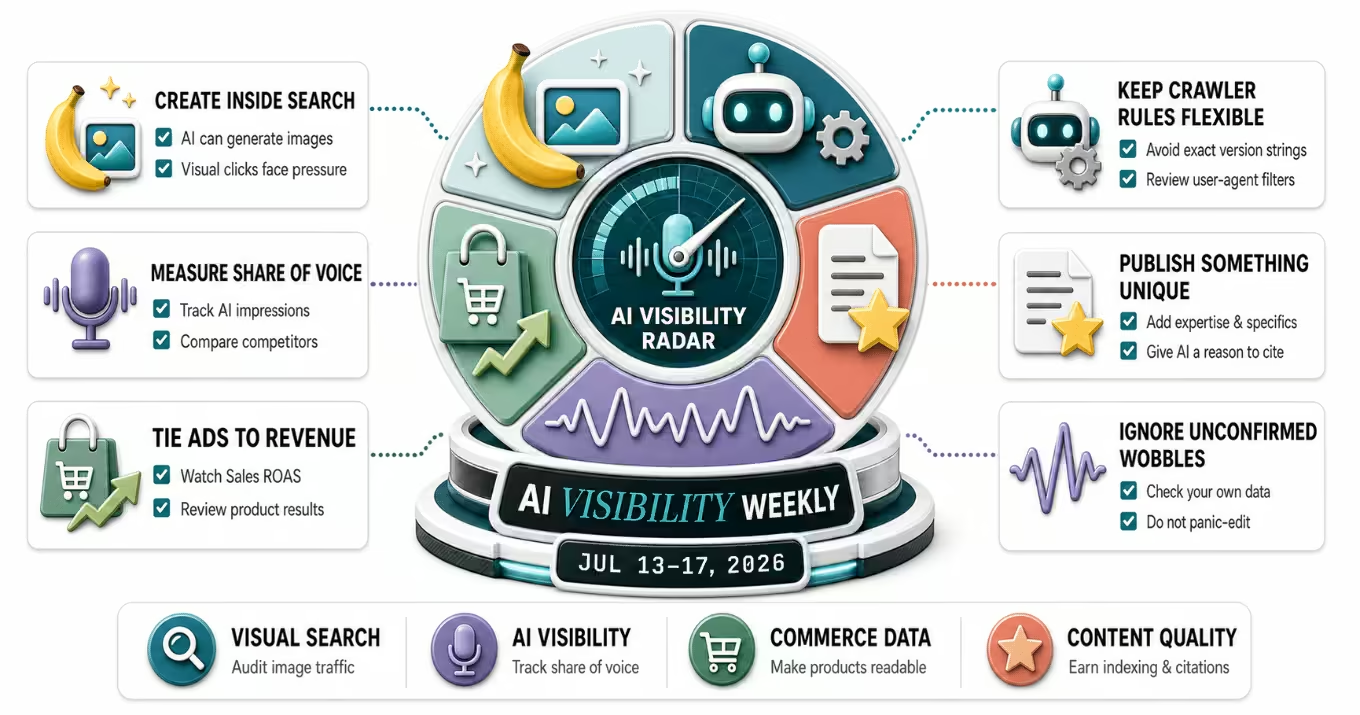
It was a quieter week for big algorithm drama and a louder one for the plumbing of AI search. Google put an image generator inside AI Overviews, quietly started grading how brands show up in its AI results, and reminded everyone that low-effort AI content still does not get indexed. OpenAI kept turning ChatGPT Ads into a real commerce platform. And the crawlers that feed all of this got a couple of housekeeping updates worth knowing about.
Here is everything that actually mattered for SEO, generative engine optimization, and AI visibility from July 13 to 17, with primary sources linked so you can verify each item yourself.
The one-paragraph version
Nano Banana lands in AI Overviews, and Google Images gets its biggest redesign in 25 years
The headline launch of the week came on July 14, timed to the 25th anniversary of Google Images. Google is adding image generation directly inside AI Overviews using its Nano Banana model, so you can turn a text prompt into an original image without leaving the results page. It also redesigned the Google Images homepage into a personalized, real-time gallery that behaves a lot more like a discovery feed (Search Engine Journal, 9to5Google). TechCrunch described the new Images experience as a Pinterest-style layout built around browsing and inspiration rather than a plain grid of links (TechCrunch).
Both features roll out on desktop in the United States, in English, over the coming weeks (Search Engine Land).
Why it matters for visibility: every feature that lets people create or consume content inside the results page is another reason they do not click through to yours. Visual search has been a meaningful referral source for a lot of publishers and ecommerce sites. If the answer to "show me a modern kitchen with green cabinets" becomes a generated image instead of a link to your photography, that is a channel worth watching closely.
Google quietly starts grading your AI visibility in Merchant Center
This is the sleeper story of the week for anyone in ecommerce. On July 14, Google began piloting an AI performance report inside Merchant Center that shows, in Google's own words, your performance "on AI Mode and AI Overviews" (Search Engine Roundtable). It is the first native, first-party look most retailers have had at how their products actually surface inside Google's AI shopping experiences.
The metric that jumps out is share of voice, which Google calculates as your AI impressions divided by the total impressions across you and your defined competitors for related queries. There is also a competitor average share, query frequency, and query type (Google Merchant Center Help). For now the report is a limited US pilot, it covers only organic AI traffic rather than paid, and it is expected to expand to Australia, Canada, India, and New Zealand in the coming months.
The bigger signal is philosophical. Google is starting to hand marketers a visibility scoreboard for AI results, not just a clicks-and-traffic scoreboard. That is exactly the kind of measurement GEO has been missing, and it hints at where reporting is headed across the whole industry.
ChatGPT Ads grows up as revenue metrics arrive
Also on July 14, OpenAI added Attributed Sales Value and Sales ROAS columns to the ChatGPT Ads manager, along with a new product-level report (Search Engine Roundtable). In plain terms, advertisers can now tie ChatGPT ad spend to actual revenue rather than just impressions and clicks.
The interesting wrinkle is the order of operations. Retail-grade metrics like ROAS are showing up before basics such as conversion rate, which tells you OpenAI is prioritizing ecommerce advertisers as it builds the platform out. For anyone thinking about where paid AI visibility is going, this is a clear sign that the AI answer box is becoming a monetized storefront, not just an organic summary.
OpenAI and Google both touched their crawler docs
Two small but useful updates for the technical crowd, both surfacing around July 14.
OpenAI clarified that its crawlers can update their user-agent version numbers, and that when fetching robots.txt it may use a user-agent with an added robots.txt marker, for example one that includes "OAI-SearchBot/1.4; robots.txt" (Search Engine Roundtable, OpenAI developer docs). If you write crawler rules or parse server logs, do not hard-code an exact version string, because it will change.
Separately, Google fixed a small typo in its own crawler documentation, removing a stray semicolon from the Google-InspectionTool user-agent string (Search Engine Roundtable). Minor, but if you had copied the old string into a filter, it is worth a look.
Google reminds everyone that AI-generated filler still does not get indexed
On July 16, Google's John Mueller and Martin Splitt used the latest Search Off the Record podcast to walk through the Search Console indexing report, and the quality conversation is the part SEOs should read twice. Mueller explained that when Google's systems have serious concerns about a site's overall quality, they simply crawl and index fewer of its pages, which is often what shows up as "crawled, currently not indexed" or "discovered, currently not indexed" (Search Engine Roundtable).
His framing on AI content was blunt and worth quoting: "That's not to say that all AI-generated content is bad. But sometimes you just run across websites where you're like, anyone could have written this. This tells me nothing." He also pushed back on treating this as a technical bug to fix. If Google is skipping a lot of your pages and there is no technical reason, the answer is usually to step back and honestly reassess quality, not to tweak a setting.
That advice lands squarely on the GEO conversation too. The same qualities that earn indexing, genuine expertise and something unique to say, are the qualities that get you quoted in AI answers.
An unconfirmed "7-Eleven" ranking wobble in the background
Heading into the week, the tracking tools lit up again. Around July 11, several volatility trackers registered a spike that the community half-jokingly nicknamed the "7-Eleven update," even though Google did not confirm anything. Notably, forum chatter stayed low, which made it hard to match the tool-reported movement to real-world impact (Search Engine Roundtable). That mismatch is worth reading as a signal in its own right: when the sensors spike but site owners are quiet, the movement often reflects SERP feature testing or layout changes rather than a broad ranking shift, because a real update produces loud, specific pain in the forums within a day. The usual guidance applies either way: do not make panic edits chasing an unconfirmed wobble, check whether your own numbers show ranking loss or just click redistribution, and wait for the dust to settle before reading your Search Console data as a verdict.
A few smaller items worth a bookmark
On the commerce side, Google told advertisers it will merge Google Shopping Ads and free listing policies into a single policy, and that local inventory ads will be turned on by default in Shopping campaigns, with a window to adjust the setting before August 31 (Search Engine Roundtable). Neither is dramatic on its own, but together they continue Google's steady march toward unifying its shopping surfaces so products flow more easily into AI-driven experiences. The default-on change deserves a calendar entry rather than a shrug: retailers with physical locations who do not want local inventory ads serving need to adjust the setting before the deadline, and retailers who do want them should verify their local feeds are accurate before Google starts using them automatically. Policy consolidations like this also tend to precede enforcement passes, so a quick review of your Merchant Center compliance now is cheaper than a suspension appeal later.
What we would do first
- Audit your visual search footprint. With image generation now inside AI Overviews, check how much traffic your images and product photography earn and stop treating visual search as an afterthought.
- Get into the Merchant Center AI report. If you sell products, share of voice against your competitors is about to become a number your boss asks about. Start watching it early.
- Make your pricing and product data machine-readable. AI shopping experiences reward structured, comparable data. Vague "contact us" pages give these systems nothing to surface.
- Re-read your own pages like a stranger would. Google spelled it out this week. If a page reads like anyone could have written it, it may never get indexed, let alone cited. Add the expertise, the specifics, and the point of view only you can provide.
- Do not chase unconfirmed volatility. The July 11 wobble had almost no community chatter behind it. Hold steady and rely on your own data.
Frequently Asked Questions
Common questions about GEO, SEO, and AI-driven search visibility.
The most consequential launch was Google adding image generation to AI Overviews using its Nano Banana model, alongside a full redesign of the Google Images homepage, announced July 14 for the 25th anniversary of Google Images. It matters because it deepens the pattern of users creating and consuming content directly on the results page rather than clicking through to websites. For marketers focused on measurement, the quiet standout was Google piloting a Merchant Center AI performance report, which for the first time shows retailers how their products perform inside AI Mode and AI Overviews, including a share-of-voice comparison against competitors. Rounding out the week, OpenAI shipped revenue attribution metrics for ChatGPT Ads, both OpenAI and Google published crawler infrastructure updates, and volatility trackers registered an unconfirmed ranking shake the community nicknamed the 7-Eleven update. Individually modest, together they read as every major platform building out the commercial layer of AI search at once.
It is a beta report Google began piloting on July 14, 2026 that shows how a retailer's products surface across Google's AI shopping experiences, including AI Mode and AI Overviews. The headline feature is a share-of-voice metric comparing your products' AI impressions against a defined competitor set, alongside competitor average share, query frequency, and query type, which makes it the first native instrument for answering whether AI surfaces show your products or your rivals' when buyers research a category. At launch it is a limited US pilot covering organic AI traffic only, with expansion to more countries expected in the coming months. The strategic signal is bigger than the feature: Google building competitive AI visibility reporting into Merchant Center confirms that AI shopping placement is becoming a measured, managed channel. Retailers should request access where available and begin baselining now, because share-of-voice data is most valuable when the trend line starts before competitors are watching theirs.
Not automatically, and Google's own engineers keep drawing the same line: the tool is not the problem, the output quality is. In Google's July 16 Search Off the Record podcast, John Mueller said not all AI-generated content is bad, but content that reads like anyone could have written it, with nothing unique or valuable, can trigger site quality concerns. The mechanism he described is worth taking seriously, because it operates at the site level rather than the page level: when quality concerns accumulate, Google crawls and indexes fewer pages across the domain, which often shows up in Search Console as growing counts of "crawled, currently not indexed." That means a library of generic AI output can quietly tax the visibility of your good pages too. The fix is editorial rather than technical: genuine expertise, unique information, and human accountability for accuracy. Used as a drafting accelerant under real editorial control, AI content carries no inherent penalty.
On July 14, OpenAI added Attributed Sales Value and Sales ROAS metrics to the ChatGPT Ads manager, plus a new product-level report. This lets advertisers connect ChatGPT ad spend to actual revenue rather than clicks and impressions, and the product-level view means ecommerce teams can see which items convert from conversational placements rather than judging the channel as a single line item. The direction matters more than the individual metrics: revenue attribution is the feature that moves an ad platform from experiment budgets to performance budgets, and OpenAI shipping it this early signals a deliberate build toward ecommerce advertisers. For teams already testing ChatGPT Ads, the practical move is wiring these metrics into your reporting now so you accumulate benchmark data while auction prices are still early. For teams on the sidelines, it is another sign that conversational surfaces are becoming accountable media, worth a measured test rather than indefinite observation.
Nano Banana is Google's image generation model, and this week Google integrated it into AI Overviews so users can turn a text prompt into an original image directly inside search results, launched alongside a redesigned Google Images homepage on July 14. It is part of Google's broader push to let people create and explore content on the results page rather than clicking out to other sites, which extends the zero-click pattern from answers into media. For marketers the implications run two directions. Image-driven discovery keeps moving inside Google's own surfaces, so product and brand imagery increasingly competes with generated visuals for attention on the results page. And the feature normalizes generative content inside search itself, which makes provenance signals like C2PA metadata and clean image structured data more relevant for brands that need their authentic visuals recognized as such. It is not a reason to change strategy this week, but it is a capability worth tracking as it expands beyond initial availability.
Google did not confirm one. Several third-party volatility trackers showed a spike around July 11 that the SEO community nicknamed the 7-Eleven update, but with unusually low webmaster chatter behind the tool readings, it was hard to confirm real-world impact, and that mismatch between sensors and forums is itself diagnostic: tracker movement without corresponding site-owner pain often reflects SERP feature shifts or test rollouts rather than a broad ranking change. The episode fits the year's established pattern of unconfirmed movements landing between Google's named updates. The standard playbook applies and is worth restating because volatility weeks generate pressure to act: avoid reactive changes while movement is unconfirmed, check whether your own Search Console shows ranking loss or merely click redistribution, segment any impact by page type and intent, and wait for stabilization before drawing conclusions. Decisions made on tracker screenshots during unconfirmed turbulence age badly far more often than patience does.
Sources
- Search Engine Journal: Google adds image generation to AI Overviews (opens in a new tab)
- Search Engine Land: AI Overviews now lets you create images (opens in a new tab)
- Google Merchant Center Help: AI performance report (opens in a new tab)
- Search Engine Roundtable: Merchant Center AI performance insights (opens in a new tab)
- Search Engine Roundtable: ChatGPT Ads sales value and ROAS (opens in a new tab)
- OpenAI developer docs: Bots and crawlers (opens in a new tab)
- Search Engine Roundtable: Crawled not indexed and content quality (opens in a new tab)