


Brands Are Raising Ad Budgets Over AI Search. Most Skip the Cheap Fix
 Preferred source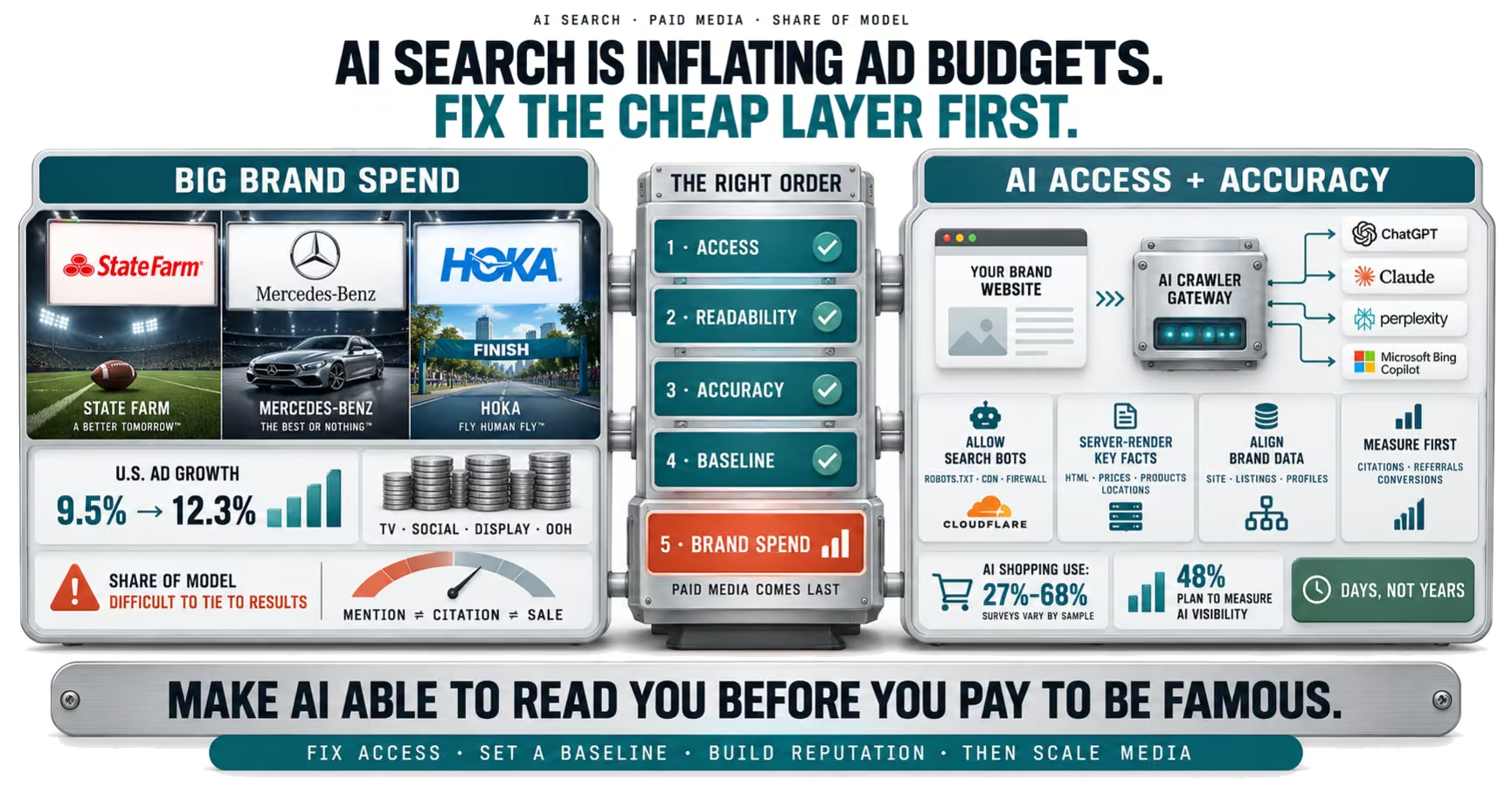
Three campaigns, one anxiety
The Digiday piece by Sam Bradley describes a pattern that will be familiar to anyone who has sat in a 2026 budget meeting. Brands are not only buying media to sell products this season. They are buying it to stay famous enough to be named when a shopper asks a chatbot what to buy.
| Brand | Campaign | AI search role |
|---|---|---|
| State Farm | Patrick Mahomes, college football season | Part of budget debates |
| Mercedes-Benz | Coco Gauff, after the U.S. Open | Named in coverage |
| Hoka | New York City Marathon, through fall | Hard to measure |
State Farm's head of marketing, Alyson Griffin, told Digiday that the company's ad spend had been essentially static for several years and that AI search concerns are part of current budget debates. Mercedes-Benz ran its Coco Gauff campaign across linear TV, paid social, display and digital out-of-home. Hoka ran a brand-forward marathon campaign through the fall. All three marketers declined to give budget details.
Read that carefully, because it is easy to overstate. Nobody in the piece says AI search is the only reason for these campaigns. Sports partnerships sell insurance, cars and shoes on their own merits. What is new is that "how we show up in AI answers" has become an argument that helps free up brand money.
The numbers behind the budget argument
The case for spending starts with consumer behavior, and the numbers depend heavily on who is asking and how.
| Source | Sample | AI shopping use |
|---|---|---|
| Dept | 2,600 shoppers | 61% in past 3 months |
| Attentive | 3,054 US adults | 68% in past 3 months |
| NielsenIQ | 21,000+ in 31 countries | 27% in past 3 months |
The 61% figure comes from a survey of 2,600 shoppers by digital agency Dept, as reported by Digiday. Attentive's 2026 State of AI in Retail report, fielded August 12 to 14, 2026, found 68% of US adults who had recently shopped used a general AI chatbot for at least one shopping task in the past three months. Attentive sells marketing software and has an interest in showing AI is reshaping shopping. NielsenIQ's Consumer Outlook, based on more than 21,000 consumers in 31 countries, found 27% had actively used AI tools to research or decide what to buy over the same period, while 55% said AI recommendations at least sometimes influence household and grocery purchases.
The spread from 27% to 68% is not a contradiction. US online shoppers are not the global population, and "used for at least one task" is a lower bar than "actively used to research or decide." Every figure points the same direction, though. AI is now a regular part of how people shop.
Ad buyers have noticed. The IAB's September 2026 outlook, drawn from more than 200 brand and agency decision-makers, raised its full-year US ad spend growth forecast from 9.5% to 12.3%. The IAB's release attributes the increase mainly to a strong first half helped by the Winter Olympics and FIFA World Cup. AI search shows up elsewhere in the survey: 44% of buyers named adapting to changing behavior, including AI-driven search, as their top investment challenge, and 76% said optimizing content for AI-generated answers is a top area of increased focus. Digiday reports that part of the forecast bump is credited to marketers spending to improve AI search performance, which is a fair reading, as long as nobody claims it is the main driver.
The part nobody can measure yet
Here is where the story gets more honest than the press releases. Asked whether the spend is working, the people closest to it hedge.
It's a combination of art and science… performance credibility and emotional connection.
That was Hoka's Allie Tsavdarides, VP of North America marketing, who told Digiday that directly linking share of AI search or share of model to results is difficult. Oliver Williams, head of digital performance at the agency Mediaplus, said his team is adding share of model and sentiment analysis to traditional upper-funnel metrics, but added that it is not being sold to clients as "a performance channel and it paying off immediately."
The industry knows its measurement is behind. In the same IAB survey, 86% of buyers said they are changing or expect to change how they measure performance because of conversational AI within 12 months, and 48% plan to measure brand visibility and citations within AI tools. Separate Digiday reporting from June 2026 found most marketers were steering money into content, creators, agencies and tools before paid AI media, and that none of the brands interviewed disclosed amounts.
Some first-party measurement now exists. In February 2026 Microsoft launched AI Performance in Bing Webmaster Tools, showing how often a site is cited in Copilot and Bing's AI summaries, which pages are cited and the grounding queries behind them. Bing calls it "an early step toward Generative Engine Optimization (GEO) tooling." It covers one ecosystem, but it is a real citation count, not a modeled estimate.
- Share of model is a sample, not a census. It depends on which prompts you run, on which platforms, on which day. Two vendors can report very different numbers for the same brand.
- A mention is not a citation. Being named in an answer and being linked as a source are different outcomes, and they need separate tracking.
- A citation is not a sale. None of the brands in Digiday's reporting tied AI visibility to revenue, so treat any vendor that claims a precise ROI with caution.
Why spending on brand is not a bad instinct
The brands are not wrong about what drives AI mentions. Large language models learn what a brand is known for from the text written about it, and that text follows fame.
Research by Google and Tracksuit, published in June 2026, found that for brands at about 30% awareness, each five-point rise in awareness came with roughly a five-point rise in share of search, with the strongest effect among low and mid-awareness brands. Google sells advertising and Tracksuit sells brand tracking, so both have a stake in the result. An Ahrefs study of 75,000 brands found branded web mentions correlated with AI Overview brand visibility at 0.664, far ahead of backlinks at 0.218. Ahrefs sells SEO tools, and correlation is not causation, but the pattern is consistent: the more people talk about a brand, the more AI systems repeat it.
That is the heart of the issue. Being named inside an AI answer, rather than tucked away as a footnote link, is mostly a reputation outcome. Reputation compounds over years. It does not jump because a budget line moved last quarter, which is why Williams told clients not to expect an immediate payoff. We made a related argument in Reddit, GEO and the DMOZ lesson: AI systems lean on proxies for credibility, and the only durable answer is to be credible in the first place.
The fix that takes days, not years
Reputation decides whether an AI system wants to name you. The mechanical layer decides whether it can read you at all. That layer is cheap, fast and often ignored.
Start with access. OpenAI's crawler documentation says sites that opt out of OAI-SearchBot "will not be shown in ChatGPT search answers." Anthropic's documentation, as reported by Search Engine Journal, warns that blocking Claude-SearchBot may reduce a site's visibility in Claude's search results. Both companies separate their search crawlers from their training crawlers, so you can allow one and block the other.
Then check what sits in front of your site. On July 1, 2025, Cloudflare changed its default to block AI crawlers unless they pay creators, and Nieman Lab reported that new domains are asked upfront whether to allow AI crawlers, on a network that serves traffic for about 20% of the web. That is a sensible protection for publishers. For a brand that wants to be recommended, a bot setting nobody reviewed can quietly undo a seven-figure campaign.
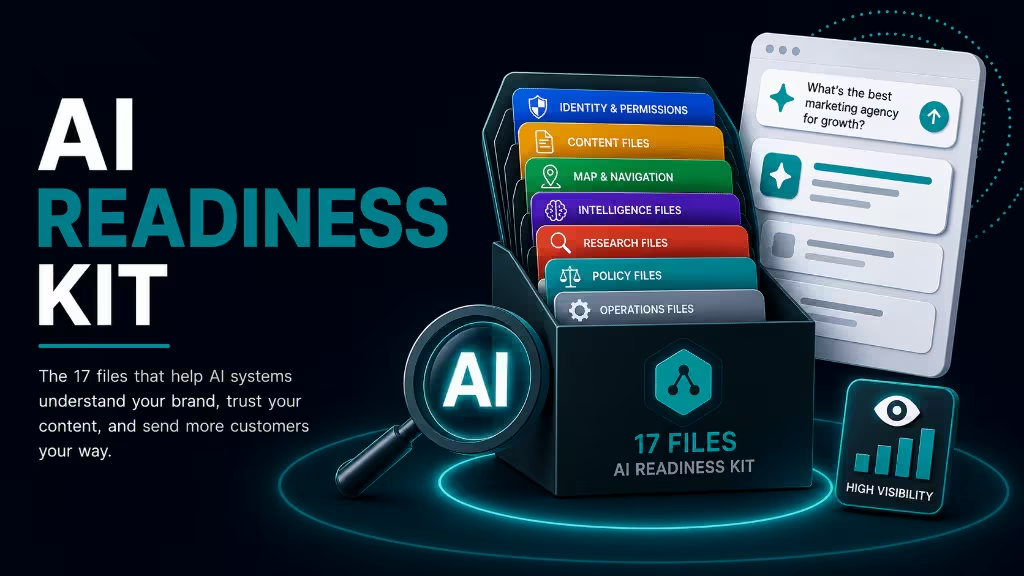
If you want a head start on the access layer, our free AI Readiness Kit generates a robots.txt with rules for the major AI crawlers, plus a deployment checklist your team can work through in an afternoon. It also produces optional files such as llms.txt. Google says those are not required for its AI features, so treat them as extras, and start with crawler access.
Next, check what crawlers can see. An analysis by Vercel and MERJ found that OpenAI's crawlers, Anthropic's ClaudeBot and PerplexityBot do not render JavaScript, and recommended putting critical content, metadata and navigation in the server's initial response. Vercel sells web hosting, but the finding is about how the bots behave, not about its product. If your prices, specs, locations or product names load only through client-side scripts, many AI systems never see them.
Finally, make the facts plain. Google says there are no special files or markup required to appear in AI Overviews or AI Mode, and that structured data should match the visible content. The goal is accurate, consistent facts in text a crawler can parse: what you sell, what it costs, where you operate, who stands behind it. Our guide to why businesses go invisible in AI search walks through each of these checks.
| Lever | Typical cost | Time to effect |
|---|---|---|
| Crawler access | Hours of work | Days to weeks |
| Server-rendered content | Development sprint | Weeks |
| Accurate on-page facts | Content update | Weeks |
| Earned reputation | Ongoing investment | Years |
| Paid brand campaigns | Media budget | Months to years |
The table is our estimate from client work, not a published benchmark, and your mileage depends on your stack. The ordering is the point. The first three rows cost a fraction of one sponsorship flight.
Put the spend in the right order
None of this argues against brand advertising. If awareness is your constraint, a Mahomes campaign may be the right call, and the Google and Tracksuit research suggests the earlier you invest, the bigger the return. The argument is about sequence.
Step one: make sure AI search crawlers can reach every page you want recommended. Step two: make sure the content those crawlers fetch carries your key facts in plain HTML, and that the facts are consistent across your site, your listings and your profiles. Step three: build a measurement baseline, citations in Bing's AI Performance report, a fixed prompt set across ChatGPT, Gemini, Perplexity and Claude, and AI referral traffic in analytics, the same baseline our SEO and GEO reporting is built around. Step four: invest in the reputation work that gets you mentioned, original research, expert voices, press and customer conversations. Step five: scale paid brand spend, with the baseline in place so you can see whether it moves anything.
Most of the spending in Digiday's story started at step five. That is how a company ends up raising budgets to defend against something it can describe in a meeting but not see on a dashboard.
Where to start
- Audit your bot access this week. Check robots.txt and any CDN or firewall bot settings for OAI-SearchBot, Claude-SearchBot, PerplexityBot and Bingbot, and document which you allow and why.
- Fetch your key pages without JavaScript. View the raw HTML of your top product, pricing and location pages. If the facts are missing, move them into the server-rendered response.
- Write down your canonical facts. List the names, prices, locations and claims you want AI systems to repeat, then make every page, listing and profile say the same thing.
- Set a citation baseline before the campaign. Connect Bing Webmaster Tools, run a fixed prompt set monthly across major assistants, and segment AI referrals in analytics.
- Tie brand spend to a measurable question. Before approving a campaign justified by AI visibility, agree on which metric should move, by how much and by when.
Brand fame and technical access are not competing priorities. One takes years and a large budget. The other takes days and a short checklist. Do the short checklist first, so that when the expensive campaign starts making people ask about you, every AI system they ask can read the answer.
Frequently Asked Questions
Common questions about GEO, SEO, and AI-driven search visibility.
Digiday reported on September 15, 2026 that marketers including State Farm, Mercedes-Benz and Hoka are using AI search concerns to argue for higher media budgets, on the theory that well-known brands get named more often in AI answers. The IAB's September 2026 outlook found 44% of ad buyers rank adapting to changing consumer behavior, including AI-driven search, as their top investment challenge.
Share of model is the share of relevant AI answers that mention or recommend your brand, usually measured by running a fixed set of prompts through tools like ChatGPT, Gemini and Perplexity. Digiday reported that Hoka's marketing VP called it difficult to link share of model to business results. The IAB found 48% of buyers plan to measure brand visibility and citations within AI tools.
Estimates vary widely. A survey of 2,600 shoppers by digital agency Dept, cited by Digiday, found 61% used an AI assistant for shopping research or decisions in the past three months, while NielsenIQ's survey of more than 21,000 consumers in 31 countries found 27% actively used AI tools to research or decide purchases over the same period. Differences in wording and sample explain much of the gap.
Only partly. The IAB raised its 2026 US ad spend growth forecast from 9.5% to 12.3% on September 10, 2026, citing a strong first half helped by the Winter Olympics and FIFA World Cup. Digiday reported that part of the increase is credited to marketers spending to improve AI search performance.
Most cannot. A December 2024 analysis by Vercel and MERJ found that OpenAI's crawlers, Anthropic's ClaudeBot and PerplexityBot do not render JavaScript. Content that only appears after client-side rendering may be invisible to those systems, so key facts belong in the server-rendered HTML.
Start with access and accuracy. OpenAI says sites that block OAI-SearchBot will not be shown in ChatGPT search answers, and Cloudflare changed its default in July 2025 to block AI crawlers unless site owners allow them. Confirm the right bots can reach you, put key facts in plain HTML, and then measure citations before raising brand budgets.
Sources
- Digiday: Marketers are using AI search concerns to argue for higher media budgets (opens in a new tab)
- IAB: IAB Raises 2026 U.S. Ad Spend Forecast to +12.3% YoY Growth, as Strong First Half Lifts Expectations (opens in a new tab)
- NielsenIQ: 55% of Consumers Now Use AI During Product Discovery (opens in a new tab)
- Attentive: 2026 State of AI in Retail Report (opens in a new tab)
- Digiday: The AI search boom is fueling content budgets before media buys (opens in a new tab)
- Bing Webmaster Blog: Introducing AI Performance in Bing Webmaster Tools Public Preview (opens in a new tab)
- LBBOnline: Brand Awareness Proven to Drive Share of Search, Google and Tracksuit Study Finds (opens in a new tab)
- Ahrefs: An Analysis of AI Overview Brand Visibility Factors (75K Brands Studied) (opens in a new tab)
- OpenAI: Overview of OpenAI crawlers (opens in a new tab)
- Search Engine Journal: Anthropic's Claude Bots Make Robots.txt Decisions More Granular (opens in a new tab)
- Cloudflare: Content Independence Day: no AI crawl without compensation (opens in a new tab)
- Nieman Lab: Cloudflare will block AI scraping by default and launches new Pay Per Crawl marketplace (opens in a new tab)
- Vercel: The rise of the AI crawler (opens in a new tab)
- Google Search Central: AI features and your website (opens in a new tab)
- Silverback Marketing: AI Readiness Kit (opens in a new tab)