



AI Visibility Is Built on SEO, Not a Replacement for It
 Preferred source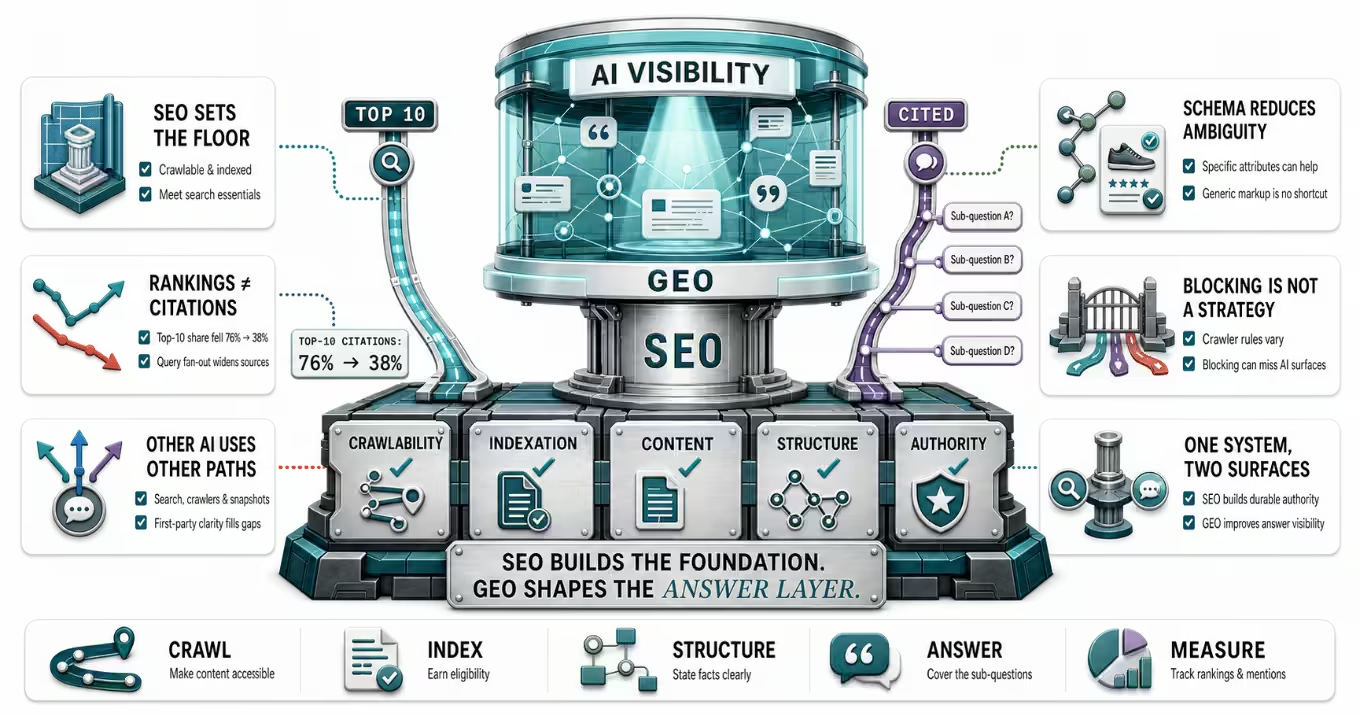
There is a version of this argument that AI marketing content has worn out: SEO is dead, GEO is the new discipline, throw out the old playbook. There is an opposite version that is just as tired: GEO is a rebrand, nothing has changed, keep doing exactly what you were doing in 2019. Neither one survives contact with what Google, OpenAI, and the independent researchers tracking this space are actually publishing.
The accurate version is less dramatic and more useful. AI visibility is built on top of the SEO foundation, not instead of it, but the relationship between the two has shifted in ways worth being precise about. Ranking well no longer predicts a citation the way it did eighteen months ago. Being invisible to a crawler still predicts invisibility everywhere else, with total reliability. Both of those things are true at once, and most of the confusion in this space comes from collapsing them into one claim.
What Google's own documentation actually requires
Start with the clearest statement available, because it comes directly from the source. Google's Search Central documentation on AI features and your website states plainly that "there are no additional requirements to appear in AI Overviews or AI Mode, nor other special optimizations necessary." To be eligible as a supporting link in either feature, a page "must be indexed and eligible to be shown in Google Search with a snippet, fulfilling the Search technical requirements." Google goes further: "You don't need to create new machine readable files, AI text files, or markup to appear in these features."
That is a direct answer to a question a lot of marketing teams are currently paying agencies to solve. For Google's own AI surfaces specifically, the technical bar is the same bar that has existed for years: allow crawling, get indexed, meet the Search essentials. Google's AI Overviews and AI Mode draw from the same index and the same ranking systems as classic Search results. There is no separate submission process, no special sitemap, no proprietary file format that opens a different tier of visibility inside Google's own AI features.
This is the part of the foundation that has not moved. If your pages are not crawlable and not indexed, nothing downstream of that matters, because there is nothing for any system, classic or generative, to work with.
Where the foundation stops predicting the outcome
Here is where it gets more interesting, and where a lot of GEO advice quietly overstates its case. Being indexed is necessary. It is no longer sufficient to predict who gets cited.
An Ahrefs analysis of 863,000 keywords and 4 million AI Overview URLs, covered by Search Engine Journal, found that in July 2025, 76 percent of AI Overview citations came from pages ranking in Google's organic top 10. By March 2026, that figure had fallen to 38 percent. Part of the gap likely reflects improved citation-detection methodology rather than a pure change in how Google selects sources, a caveat worth keeping in view rather than treating the headline number as flawless. Even accounting for that, the direction is consistent with a separate BrightEdge analysis the same outlet covered, which put top-10 overlap closer to 17 percent using different methodology. The correlation between conventional ranking position and AI citation has been loosening, not staying fixed the way older SEO wisdom would predict.
That pattern explains a lot of the frustration marketing leaders are currently expressing. A page can rank position two on a bread and butter category term and still lose the citation to a page ranking eleventh, because AI Overviews use a technique Google calls query fan-out, issuing multiple related searches across subtopics and pulling supporting pages from a wider set than a single results page would ever show. The system is optimizing for the clearest, most directly useful answer to a specific sub-question, not simply promoting whoever already won the ranking game for the parent keyword.
Independent testing backs up the indexation half of this outside Google's own properties too. A widely discussed experiment by SEO consultant Aleyda Solís, documented by Search Engine Journal, found ChatGPT unable to answer questions about a brand-new page until that page had been indexed by Google, at which point ChatGPT began quoting Google's exact search snippet rather than Bing's. Indexation status functioned as a hard gate in that test. But nothing in that same test suggested organic ranking position, once a page was indexed, played a meaningful role in whether it got quoted. Two different mechanisms, doing two different jobs, and conflating them is where most GEO panic comes from.
Why platforms outside Google play by a different rulebook
Google's guidance that you do not need special AI files applies to Google's own AI features, which is an important qualifier that tends to get dropped when people summarize it. ChatGPT, Perplexity, and other assistants are a different architecture entirely. They do not maintain a single, continuously updated public index the way Google does. Depending on the query and the platform, they retrieve from external search partners at the moment of the question, from periodic crawling of their own, or from whatever made it into a training snapshot that can be a year or more old by the time it ships.
That distinction is exactly why first-party structured signals still carry real weight for the platforms that are not Google. A page that clearly and explicitly states your pricing, your service area, your founding year, and what you actually do, in plain crawlable text, gives every one of these systems something authoritative to retrieve or train on instead of reconstructing an answer from a five-year-old directory listing or a competitor's comparison page. Google's own index doesn't need that extra layer of first-party clarity because it already has decades of crawling and ranking infrastructure to sort quality on its own. The platforms without that infrastructure are, functionally, still guessing more than people realize.
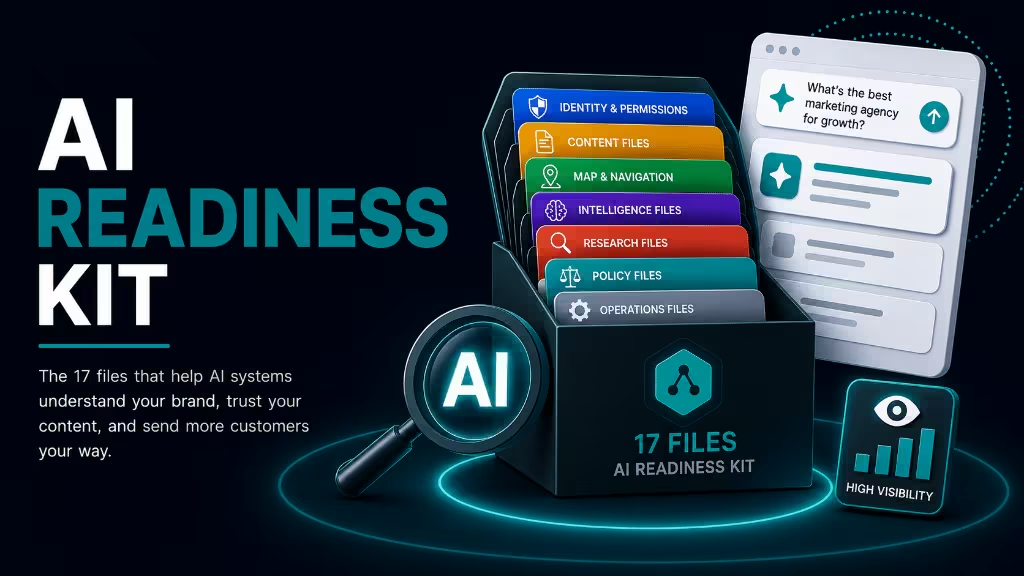
This is the specific gap the Silverback AI Readiness Kit is built to close. It is 18 files deployed to your site root that hand every major AI platform, not just Google's, a direct, structured, first-party account of your business. It is free, it takes roughly an afternoon to deploy, and it deliberately does not claim to replace the SEO fundamentals underneath it. It exists because the fundamentals alone do not reach every reader equally.
Structured data helps, but it is not a shortcut
Schema markup sits in contested territory right now, and the honest answer involves citing both sides. A cross-platform academic study on whether schema markup predicts AI citation found that pages implementing Product or Review schema with populated, specific attribute fields were cited at substantially higher rates than pages using only generic schema types such as Article or Organization, a gap wide enough to matter. At the same time, an Ahrefs test covered by Search Engine Roundtable tracked 1,885 pages that added JSON-LD schema between August 2025 and March 2026 against 4,000 matched control pages, and found no statistically significant citation increase on any platform. For AI Overviews specifically, treated pages actually saw a small but statistically significant decline.
Both findings can be true simultaneously, and reconciling them tells you something useful. Schema appears to help when it carries specific, verifiable attributes an AI system can lift directly into an answer: a concrete price, a rating count, a return window, the kind of thing a page already earning citations tends to have. Mechanically bolting generic JSON-LD onto a page that was already thin or already unclear does not appear to change outcomes. Structured data reduces ambiguity in what is already there. It does not manufacture authority that the underlying content does not have.
Blocking AI crawlers rarely does what teams think it does
A meaningful share of the web has responded to AI search by trying to shut the door. Analysis of robots.txt files across a large sample of sites found that nearly 45 percent block at least one major AI crawler outright, with GPTBot the single most commonly blocked bot.
The problem is that blocking accomplishes less than most teams assume. Separate reporting on AI crawler behavior found that a significant share of GPTBot disallow rules in robots.txt are simply not honored, and that blocking GPTBot specifically does not remove a site from Google's AI Overviews, because Google's own crawler operates under separate rules tied to Search itself. Blocking mostly filters out the crawlers that already respect robots.txt, which tend to be the well-behaved ones you would actually want parsing your content accurately in the first place. It is a control that feels protective and mostly is not.
What this means in practice
Put the pieces together and a clear, defensible position emerges. Crawlability, indexation, and structure are the floor. They are non-negotiable for every AI platform that touches your business, and Google has said so directly about its own systems. Ranking position, however, has become a weaker predictor of citation than it was even a year ago, which means chasing the top of the results page is no longer a reliable proxy strategy for AI visibility on its own. And for the AI platforms that do not share Google's index and ranking infrastructure, a clean, direct, first-party account of who you are and what you do fills a gap that pure SEO fundamentals were never built to close by themselves.
None of this is a reason to treat SEO and GEO as competing budgets, and the data above argues against that framing rather than for it. Most of the domains earning citations today built their authority through years of conventional SEO work. The answer layer sits on top of that foundation. It does not replace it, and it is not a shortcut around building it in the first place.
Growth in the space this shift describes is not hypothetical. Similarweb's 2026 research on AI search behavior found AI Overviews now appearing in more than 43 percent of US searches, up from roughly 15 percent a year earlier. That is the scale of audience now forming an impression of your business from whatever the foundation underneath your site actually supports. Whether that impression is accurate, current, and yours to control is still, in the end, a foundation problem before it is anything else.
If you want a straight read on what AI systems currently say about your business, and what it would take to fix the gaps, that is the starting point of our SEO and GEO work.
Frequently Asked Questions
Common questions about GEO, SEO, and AI-driven search visibility.
No. An Ahrefs analysis covered by Search Engine Journal found that the share of AI Overview citations coming from organic top-10 pages fell from 76 percent in July 2025 to 38 percent by March 2026. Being indexed and crawlable is still a requirement, but a top ranking no longer predicts a citation the way it once did.
According to Google's own documentation, no. Google states there are no additional technical requirements beyond standard indexing, and that you do not need new machine readable files, AI text files, or markup to appear in AI Overviews or AI Mode. That guidance is specific to Google's own AI features, which run on the same Search index as classic results.
ChatGPT and Perplexity do not maintain their own continuously updated web index the way Google does. A documented Search Engine Journal test found ChatGPT falling back to Google's search snippets for a page Bing had not yet indexed, showing how much it still leans on Google's index in practice. A clean, first-party account of your business gives platforms like this something accurate to draw from instead of stitching one together from directory listings and old mentions.
The evidence is mixed and worth taking seriously in both directions. One cross-platform academic study found pages with populated Product or Review schema cited at meaningfully higher rates than pages using only generic schema types. A separate large-sample Ahrefs test that added JSON-LD schema to 1,885 pages, covered by Search Engine Roundtable, found no statistically significant citation increase, and even a small decline for Google AI Overviews specifically. The honest read is that schema removes ambiguity and supports citation, but it will not manufacture authority or content quality that isn't already there.
Blocking is common but often ineffective. Analysis of robots.txt files across a large sample of sites found that nearly 45 percent block at least one major AI crawler, yet separate research found a significant share of GPTBot disallow rules are not actually honored, and that blocking GPTBot does not remove a site from Google's AI Overviews. Blocking mainly affects the crawlers that already respect robots.txt, which tend to be the ones you would want reading your content correctly.
What changed is the number of separate systems reading those signals and how unevenly they weight them. Twenty years of SEO built one shared vocabulary, crawlability, structure, authority, for one primary reader in Google. GEO is the same vocabulary spoken to several different readers at once, some of which do not share Google's index, do not update in real time, and do not agree with each other on who to cite.
No, and it is not designed to. The Silverback AI Readiness Kit is 18 free files deployed to your site root that give AI systems a direct, structured account of your business. It handles the mechanical layer of being described accurately. It does not build authority, earn citations, or replace the technical SEO and content work that has to exist underneath it.
Sources
- Google Search Central: AI features and your website (opens in a new tab)
- Google Search Central: Search essentials (opens in a new tab)
- Search Engine Journal: Google AI Overview citations from top-ranking pages drop sharply (opens in a new tab)
- Similarweb: AI search stats 2026, market share, referral and citation data (opens in a new tab)
- Search Engine Journal: ChatGPT appears to use Google Search as a fallback (opens in a new tab)
- SSRN: Does schema markup predict AI citation? A cross-platform empirical study (opens in a new tab)
- Search Engine Roundtable: Study says adding schema did not improve AI citations on Google, ChatGPT and more (opens in a new tab)
- TechnologyChecker.io: robots.txt across Cloudflare's network, AI crawler blocking analysis (opens in a new tab)
- PPC Land: Blocking AI crawlers doesn't stop citations, new data shows why (opens in a new tab)
- Silverback AI Readiness Kit (opens in a new tab)