





Google Sells AI. It Is Not Going to Punish You for Using It.
 Preferred source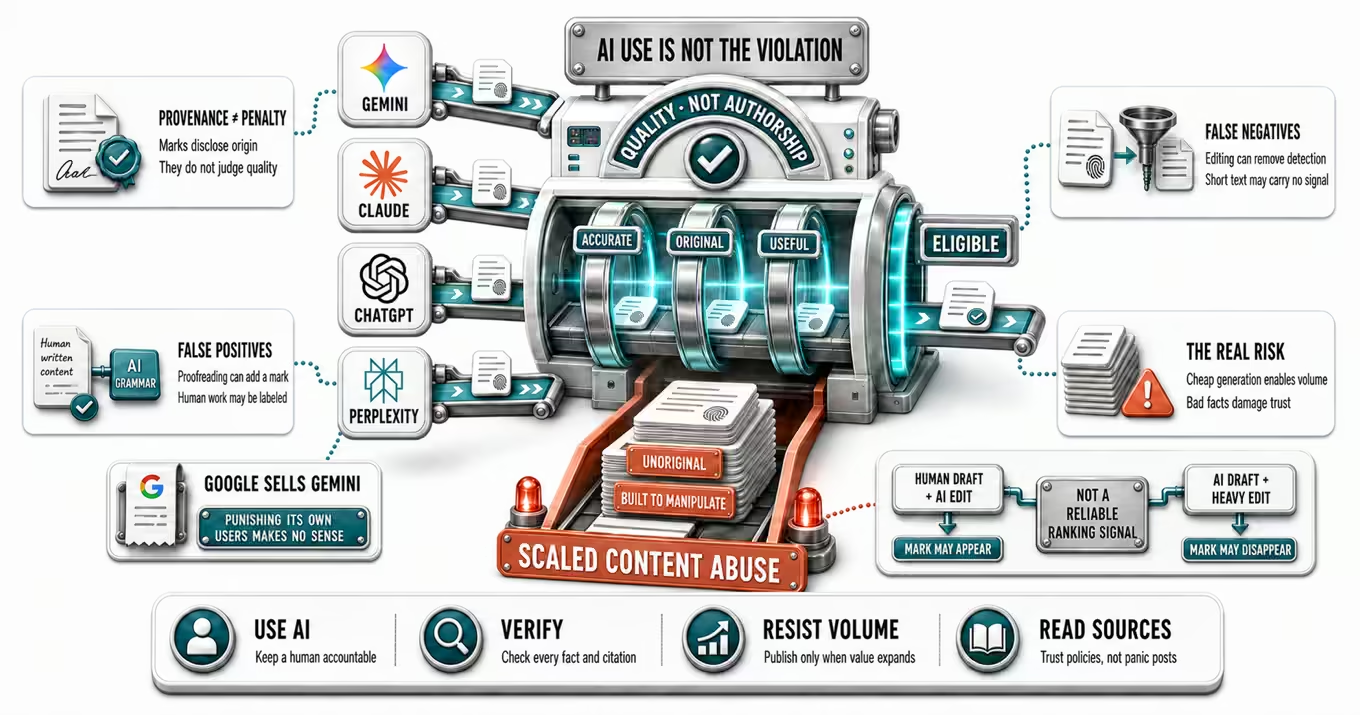
Anthropic published documentation explaining how Claude marks AI-generated content, and within days the take had already formed: the models are watermarking themselves, Google will read the watermarks, and everyone who used AI to write a blog post is about to get wiped out.
I have now read the actual documents. Anthropic's marking policy, Google's spam policies, Google's guidance on AI content, and Google DeepMind's own watermarking documentation. They do not support that conclusion. Several of them say close to the opposite, and one of them says something that makes the whole theory fall apart on inspection.
Here is what the documentation actually says, why the detection story does not work even in principle, and the part I find absurd about the premise.
What Anthropic Actually Announced
The marking commitment comes from European law, not from search. Anthropic signed the EU AI Act's Article 50(2) Code of Practice on Transparency of AI-Generated Content as a provider of both generative AI models and systems. Claude models launched on or after August 2, 2026 support machine-readable marking at launch, and Anthropic is working to add it to earlier models during the law's transition period.
Two mechanisms are involved. Generated text carries an embedded watermark woven into the text itself, which Anthropic says travels with the text when copied and pasted and may persist through some editing. Generated files such as .svg, .png and .jpg carry signed provenance metadata following the C2PA open standard. Marking applies worldwide, across the Claude Platform API, Claude, Claude Code, Claude Cowork and Claude Tag, and through cloud partners including AWS, Google Cloud and Microsoft Foundry.
That is a consumer transparency regime. It exists so people can get context about where content came from. It is not a ranking system, it was not built for search engines, and no part of it is addressed to Google.
Google's Spam Policy Has Never Been About Who Wrote It
Google settled this question publicly more than three years ago and has not moved since. In its February 2023 guidance about AI-generated content, Google stated plainly that appropriate use of AI or automation is not against its guidelines, and that its focus is the quality of content rather than how content is produced.
The policy people are actually afraid of is scaled content abuse, which Google introduced with the March 2024 core update and new spam policies alongside expired domain abuse and site reputation abuse. Read the definition in Google's spam policies carefully, because the wording is the whole argument: scaled content abuse is generating many pages for the primary purpose of manipulating Search rankings rather than helping users, producing large amounts of unoriginal content with little to no value, no matter how it is created.
Google went further in the announcement, saying the policy applies whether content is produced through automation, human effort, or some combination of human and automated processes. That sentence exists specifically to close the loophole in the other direction. Google was not trying to catch AI writers. It was making sure that hiring fifty offshore writers to produce the same worthless pages counts as the same violation.
The trigger is purpose and value. Authorship is not in the definition.
The Detection Problem Nobody Selling Fear Wants to Discuss
Here is where the theory collapses, and the evidence comes from Anthropic's own documentation rather than from me.
Anthropic states that a detected mark provides a signal that content was processed by Claude but is not fully conclusive. Then it explains why, and the explanation should end this conversation. Claude may not be the original author. People use Claude to proofread, translate, summarize and convert files, and the output can carry a Claude mark even if the underlying ideas, text or data originated from another source.
Sit with that. A watermark can appear on writing a human wrote, thought through and owns, because they ran it through a grammar pass. If Google demoted watermarked text, it would be demoting careful human writers for using a spellchecker.
Now the failure in the other direction. Anthropic lists the conditions under which Claude's own output carries no detectable mark: text generated by a model released before marking was supported, text that has been heavily edited, paraphrased, translated or mixed into other writing, passages too short to carry a reliable signal, and files whose metadata was stripped through format conversion, re-saving or screenshots.
Put the two failure modes side by side. False positives on conscientious writers who used AI to tidy their prose. False negatives on anyone who paraphrases the output or publishes in short chunks. That is exactly inverted from what a ranking signal needs to be. It would punish the people doing the work properly and miss the content farms entirely.
There is also a practical barrier that gets skipped in every version of this panic. Watermarks are keyed to whoever created them. Anthropic says it will support users and third parties in detecting Claude's marks and that details are forthcoming, but that infrastructure does not exist publicly yet. Google's position is similar in reverse: SynthID watermarks text generated by the Gemini app and web experience by adjusting the probability scores the model uses to pick each word, and Google has built a SynthID Detector portal that it describes as a collaboration currently open to journalists and media professionals for testing and feedback.
So there is no public, cross-vendor AI text detector. Google can read SynthID because Google built SynthID. It cannot read Anthropic's watermark or OpenAI's unless those companies hand over detection access. Which means the sentence "Google will detect AI content and punish you" reduces to "Google could detect Gemini content and punish you."
The Part I Find Absurd
Follow that to its conclusion, because it is worth saying out loud.
Google sells Gemini. At I/O 2026 the company launched a $100 per month AI Ultra plan and lowered its existing top tier from $250 to $200 per month. It has pushed Gemini into Workspace, into Gmail, into Docs. It watermarks the output of the product it is selling. It is actively encouraging hundreds of millions of people to write with a tool whose fingerprints only Google can read.
The fear theory requires Google to take the one AI vendor whose output it can identify with confidence, which is itself, and use that capability to demote the work of the customers paying it up to $200 a month. It requires Google to build a penalty that lands hardest on Gemini users and barely touches everyone else. No company does that. It is not a conspiracy question or an ethics question, it is an arithmetic question.
I want to be fair about the counterargument, because there is one. Google has never promised it will never use provenance signals for anything. Content provenance does matter for images and video, where C2PA metadata has real value in establishing whether something was manipulated. And a web filling up with unvetted synthetic text is a legitimate quality problem that Google has every reason to address. None of that is in dispute.
What is in dispute is the mechanism. Google addressing content quality by measuring value and originality is documented and has been enforced. Google addressing content quality by detecting authorship is neither documented nor mechanically workable nor commercially rational.
Which brings me to the tactic. Fear sells services. A threat that cannot be verified is close to a perfect product, because the client can never confirm they were at risk and can never confirm they were saved. If you are being sold detection proofing, humanization passes, or a premium for hand-written copy on the grounds that Google is about to come for AI text, ask for the documentation. Ask which policy, which page, which sentence. The answer will be a blog post citing another blog post.
What Would Actually Get You in Trouble
Something real does sit underneath all of this, and it deserves to be taken seriously.
AI did not create a detection risk. It created a volume risk. It made publishing 400 mediocre pages cost about what publishing four used to cost, and publishing 400 mediocre pages is the documented violation. Scaled content abuse enforcement has teeth and has visibly hit sites that leaned into volume without adding value. The tool did not cause that. The decision to ship unvetted volume did.
The same applies to accuracy. The way AI content actually damages a brand is not through a watermark. It is through a confidently wrong statistic, a fabricated citation, or a product claim nobody checked, published under your name and then quoted back at you by an AI assistant six months later. That is a trust problem and a legal problem, and no amount of paraphrasing fixes it.
The honest through line in Google's documentation is not "did a machine touch this." It is "did anyone take responsibility for this being accurate, original and worth reading."
What to Do Instead of Panicking
- Use AI, and keep a human accountable for every factual claim on the page. Make that accountability real rather than nominal. Someone should be able to defend every number and every citation in the piece without checking who wrote it.
- Do not scale publishing just because production got cheaper. That is the single behavior Google has actually written a policy against, and it is the one thing cheap generation makes tempting. If your content volume tripled this year and your topic coverage did not meaningfully expand, you are building toward the violation whether or not you used AI to do it.
- Fact-check with the same seriousness you would apply to a client deck. Every statistic gets a primary source. Every quote gets verified against the original document. This is the same discipline that makes content citable by AI assistants, which is the useful half of SEO and GEO work right now, so the effort pays twice.
- Read the primary documents before you act on a summary of them. Everything in this article came from six pages published by Google and Anthropic that anyone can read in under an hour. The gap between what those documents say and what the industry says they say is where a lot of budget gets wasted.
Frequently Asked Questions
Common questions about GEO, SEO, and AI-driven search visibility.
No. Google's position, stated in its February 2023 Search Central guidance, is that appropriate use of AI or automation is not against its guidelines. Google's spam policies target scaled content abuse, which it defines as generating many pages primarily to manipulate Search rankings rather than help users, and Google explicitly applies that policy no matter how the content is created. A page can be written entirely by AI and rank well, and a page can be written entirely by a human and be classified as spam.
Google can reliably detect text generated by its own Gemini models, because Google DeepMind embeds a SynthID watermark by adjusting token probability scores during generation. It cannot read watermarks from other vendors unless those vendors provide detection access, since watermarks are keyed to the company that created them. There is no public, cross-vendor AI text detector, and Google has never said it uses watermark detection as a ranking signal.
Yes. Anthropic signed the EU AI Act's Article 50(2) Code of Practice on Transparency of AI-Generated Content, and Claude models launched on or after August 2, 2026 support machine-readable marking at launch. Generated text carries an embedded watermark and generated files such as .svg, .png and .jpg carry signed C2PA provenance metadata. Marking applies worldwide across the Claude Platform API, Claude, Claude Code, Claude Cowork and Claude Tag.
Scaled content abuse is Google's spam policy covering the generation of many pages for the primary purpose of manipulating Search rankings rather than helping users. Google introduced it with the March 2024 core update alongside expired domain abuse and site reputation abuse. It explicitly applies whether content is produced through automation, human effort, or a combination of the two, which means the violation is defined by purpose and lack of value rather than by the tool used to write it.
There is no documented mechanism by which they would. Watermarking exists to satisfy EU AI Act transparency obligations, not to feed search rankings. Anthropic's own documentation states that a detected mark is not fully conclusive and that Claude may not be the original author, because output can carry a mark even when Claude only proofread, translated or summarized existing human writing. A signal that flags edited human work and misses paraphrased AI output would be unusable as a ranking factor.
Under Anthropic's marking system, text that Claude proofreads, translates or summarizes can carry the same watermark as text Claude wrote from scratch. Anthropic states directly that the output can carry a Claude mark even if the underlying ideas, text or data originated from another source. Under Google's guidelines this distinction does not matter anyway, because Google evaluates whether the finished page is original, helpful and trustworthy rather than which tools touched it.
Sources
- Anthropic: How Claude marks AI-generated content (opens in a new tab)
- Google Search Central: Google Search's guidance about AI-generated content (opens in a new tab)
- Google Search Central: Spam policies for Google Web Search (opens in a new tab)
- Google Search Central: What web creators should know about our March 2024 core update and new spam policies (opens in a new tab)
- Google DeepMind: SynthID (opens in a new tab)
- Google: Everything new in our Google AI subscriptions, fresh from I/O 2026 (opens in a new tab)