





Google Published Its AI Search Playbook. Here Is What It Says.
 Preferred source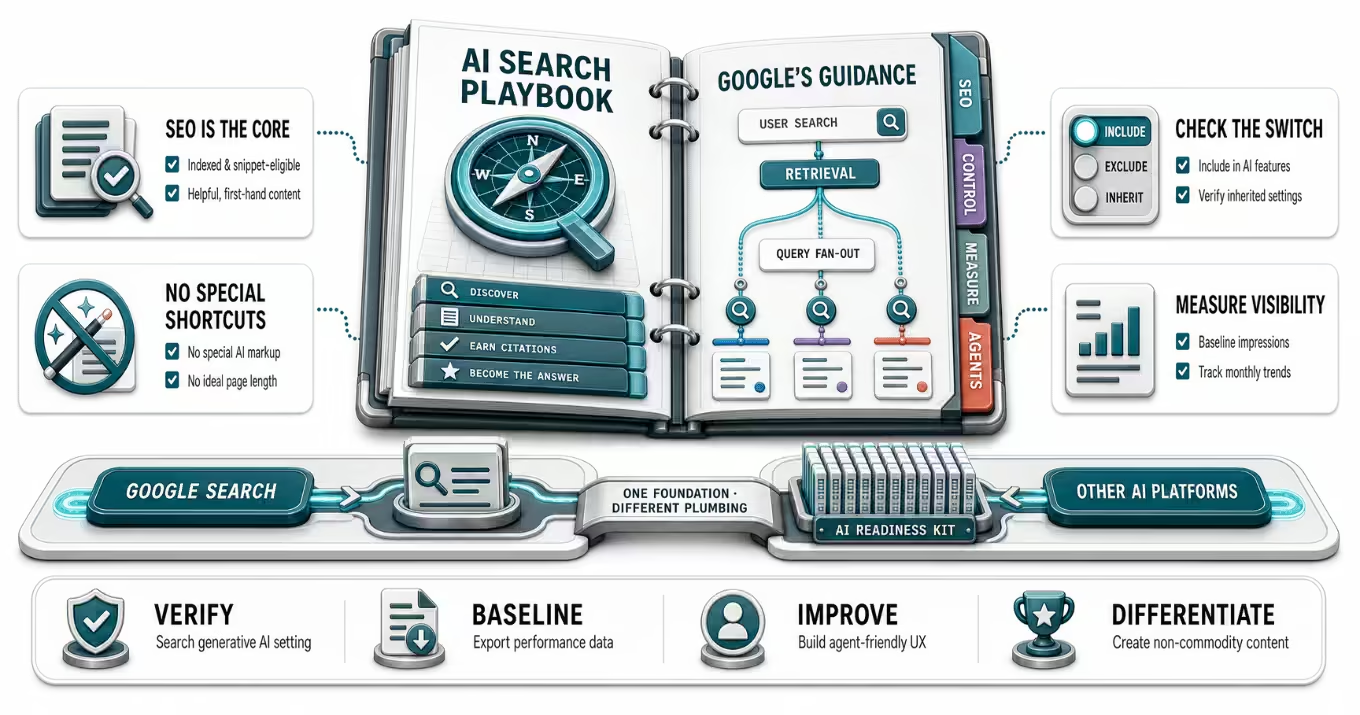
For about two years, the entire generative engine optimization conversation ran on inference. Nobody had official guidance, so everyone reverse-engineered behavior, ran small tests, and sold the results as a methodology. Some of it was careful. A lot of it was not.
That gap is now closed on the Google side. Google Search Central has published an official guide to optimizing your website for generative AI features, last updated on July 10, 2026. It is unusually direct. It names GEO and AEO by name, tells you which popular tactics do nothing, and points to two things Google shipped quietly alongside it that matter more than most of the advice: a report that finally measures AI visibility, and a switch that can turn it off entirely.
Here is what the guidance actually says, what it kills, and where it stops being the whole story.
Google says in writing that GEO is SEO
The guide addresses the terminology head on. "AEO" and "GEO," it says, are "both terms you may see used to describe work specifically focused on improving visibility in AI search experiences. From Google Search's perspective, optimizing for generative AI search is optimizing for the search experience, and thus still SEO."
The reasoning is architectural rather than rhetorical. Google's generative AI features are "rooted in our core Search ranking and quality systems," running on two techniques the guide defines explicitly. Retrieval-augmented generation, also called grounding, uses the core ranking systems to pull relevant pages from the Search index and generate a response supported by clickable links. Query fan-out generates a set of concurrent related queries to gather more than the original question would surface. Google's own example: a query about fixing a lawn full of weeds may fan out into "best herbicides for lawns," "remove weeds without chemicals," and "how to prevent weeds in lawn."
That second mechanism explains a frustration a lot of marketing leaders have been voicing. A page can hold a strong position on a head term and still lose the citation, because the system is assembling an answer from several narrower sub-questions rather than promoting whoever won the parent keyword. The eligibility bar itself has not moved. Both this guide and Google's longer-standing documentation on AI features and your website require the same thing: a page must be indexed and eligible to appear in Google Search with a snippet, meeting the Search technical requirements. What gets selected from that eligible pool is what changed.
Google also links its guidance on evaluating third-party SEO advice directly from the GEO paragraph, which is not subtle, and is worth reading in the spirit it was written.
The mythbusting section, and what it takes off the table
The guide includes a section titled "Mythbusting generative AI search: what you don't need to do." For anyone who has been sold a GEO retainer in the last eighteen months, it is the most useful 400 words Google has published this year.
On llms.txt and similar files: "You don't need to create new machine readable files, AI text files, markup, or Markdown to appear in Google Search (including its generative AI capabilities), as Google Search itself doesn't use them." Google goes on to say that maintaining such files for other services is fine and "will neither harm nor help your site's visibility or rankings in Google Search."
On chunking: there is no requirement to break content into small pieces, and no ideal page length. On rewriting for machines: you do not need to write in a specific way for AI systems, which can handle synonyms and meaning without exact phrase matching. On structured data: it "isn't required for generative AI search, and there's no special schema.org markup you need to add," though Google still recommends it for rich result eligibility.
The most consequential item is the one about mentions. Google explicitly flags "seeking inauthentic mentions" across the web as less helpful than it appears, and notes that its core ranking systems focus on quality content while separate systems block spam, with generative AI features depending on both. A meaningful share of the GEO service market is currently built on manufacturing exactly those mentions.
What the guide asks for instead is unglamorous and specific. It draws a line between commodity content, using "7 Tips for First-Time Homebuyers" as the example, and non-commodity content, using "Why We Waived the Inspection and Saved Money: A Look Inside the Sewer Line." The distinction is first-hand experience versus restating what already exists. It is the same argument Google has been making in its helpful content guidance for years, now applied to a new surface.
The switch most site owners do not know exists
Buried in the technical requirements is a sentence that should stop anyone skimming: in addition to the standard Search requirements, a site "must be included in Search generative AI features in Search Console to be eligible for display in generative AI features on Google Search."
That is a setting. It lives under Settings, then Search generative AI, and it has three states: include, exclude, or inherit from parent. Inclusion is the default for all properties, so most sites are fine. The risk sits in the inheritance behavior. A property inherits from its closest parent that stopped inheriting, which means a decision made once at the top-level domain quietly propagates down to every subdomain and path property underneath it. If someone in your organization excluded the domain during an AI backlash news cycle last year, your blog subdomain inherited that choice without anyone touching its settings.
Three clarifications from the documentation are worth holding onto, because they are routinely conflated. The control is not used as a ranking signal for the rest of Search. It does not affect AI training, which is governed separately through the Google-Extended crawler token. And it is not noindex, which removes you from Google Search entirely. Changes generally take effect within one to two days, with some content taking longer due to caching.
Check the setting. It takes ninety seconds and it is a binary gate on everything else in this article.
The measurement gap just closed, partly
The single biggest structural complaint about AI search has been that it left no trace. No impressions, no query report, nothing to take to a budget meeting. That is changing.
Search Console now includes a Generative AI performance report covering impressions from AI Overviews and AI Mode, grouped by pages, countries, devices, and dates, with export available. Google Discover has its own separate report. The usual performance report limits apply, including the 1,000-row cap.
Two caveats matter for anyone planning around it. Google is rolling the report out to a subset of website owners at a time, so its absence in your account does not mean zero visibility. And the documented dimensions are impression-based, which tells you where you appeared, not what was asked or what happened next. It is a real instrument rather than a complete one.
Google pairs the announcement with a pointed warning: be wary of third-party tools that promise ranking success or claim to use internal Google metrics, because no third-party tool has access to its internal ranking or AI systems. Given how many AI visibility dashboards launched in the past year, that line is doing a lot of work.
Where Google's guide stops and the rest of the market begins
Every statement above describes Google's own surfaces. That qualifier gets dropped constantly in summaries, and dropping it produces bad decisions.
The audience has fragmented faster than most planning assumes. Similarweb's 2026 tracking puts ChatGPT's share of worldwide generative AI web traffic at roughly 53 percent, down from about 76 percent a year earlier, with Gemini climbing past a quarter of the category and Claude growing fastest on a percentage basis. Citation presence in US ChatGPT prompts rose from about 1.6 percent in June 2025 to roughly 6.8 percent by May 2026, meaning source attribution itself is becoming more common, not less.
Those platforms do not run on Google's index or Google's ranking systems. They retrieve from search partners at query time, from their own periodic crawling, or from training snapshots that can be a year old on arrival. When Google says llms.txt does nothing, that is accurate and narrow. It describes one reader among several, and it is the reader with the most infrastructure for figuring you out unaided.
This is the specific and limited gap the Silverback AI Readiness Kit exists to close. It is 18 files deployed to your site root that hand every major AI platform a direct, structured, first-party account of your business, so the systems without Google's index have something accurate to draw on instead of assembling one from stale directory listings. It is free, it takes about an afternoon, and per Google's own documentation it will do nothing for your Google visibility. That is the honest pitch. It is plumbing for the platforms that need plumbing, and it does not replace the fundamentals underneath it.
The agent layer is now a design requirement
The final section of Google's guide covers agentic experiences, and it points to Chrome team guidance on building agent-friendly websites that deserves more attention than it has received.
Agents read your site three ways and cross-reference all of them: screenshots interpreted by a vision model, the raw DOM, and the accessibility tree, which the guidance describes as a high-fidelity map that strips visual noise to expose roles, names, and states. Relying on a single modality creates what the authors call a semantic gap. An agent seeing a styled div in the DOM does not know you configured it as a button.
The resulting checklist is refreshingly concrete. Use semantic button and anchor elements rather than modified div and span containers. Where that is not possible, supply role and tabindex. Set cursor: pointer, which reads as a strong actionability signal. Link labels to inputs with the for attribute. Keep layouts stable, because agents working from screenshots get confused when an add-to-cart button moves between product categories. Avoid transparent overlays and ghost elements, which can cause visual analysis to discard the nodes underneath. Keep interactive elements larger than eight square pixels so they are not filtered out.
The Chrome team's own summary is the part worth repeating internally: everything that makes a site agent-ready also makes it better for humans. This is accessibility work with a new commercial argument attached. Google's guide also flags emerging standards to watch, including the Universal Commerce Protocol for Search agents and WebMCP, currently in origin trial in Chrome.
What to do with this
Four things, in order of effort.
- Verify your Search generative AI control in Search Console, including on child properties that may be inheriting an old decision.
- Open the Generative AI performance report if your property has it, export a baseline now, and start a monthly cadence so you have trend data when someone asks.
- Audit your interactive elements against the agent-friendly checklist, which is a front-end ticket rather than a marketing project and pays off in accessibility regardless.
- Look honestly at your content and ask Google's actual question: is this non-commodity, or is it a competent restatement of what already exists?
The larger point is that AI visibility has stopped being a mystery discipline and started being documented infrastructure. Most of it is the technical and editorial work that has always been the job, now read by more systems with less patience. The parts that are mechanical should be automated and forgotten. The part that decides whether you deserve the citation, knowing what your company is actually the best answer for and saying it in language a real customer finds credible, has not become automatable and shows no sign of heading that way.
If you want a clear read on where your site currently stands across Google's AI surfaces and the platforms outside them, that is where our SEO and GEO work starts.
Frequently Asked Questions
Common questions about GEO, SEO, and AI-driven search visibility.
No. Google's official guide to optimizing for generative AI features states that you do not need to create machine readable files, AI text files, markup, or Markdown to appear in Google Search or its generative AI capabilities, because Google Search itself does not use them. Google adds that maintaining an llms.txt file will neither harm nor help your visibility or rankings in Google Search. That statement is specific to Google Search, and does not describe how other AI platforms retrieve information.
No. Google's guidance addresses the terms AEO and GEO directly and says that from Google Search's perspective, optimizing for generative AI search is optimizing for the search experience, and thus still SEO. Google's generative AI features are grounded in its core Search ranking and quality systems, which is why the same foundational practices apply.
Search Console now includes a Generative AI performance report that shows impressions from AI Overviews and AI Mode, broken out by page, country, device, and date. Google is rolling the report out to a subset of properties at a time, so not every site has access yet. A separate generative AI performance report covers Google Discover.
Yes. Search Console has a Search generative AI control under Settings that lets you include or exclude your site from AI Overviews, AI Mode, and generative AI features in Discover. Inclusion is the default. Excluding means you receive no impressions or traffic from those features, and Google notes changes generally take effect within one to two days. This control is separate from AI training, which is governed by the Google-Extended crawler token.
Google states plainly that structured data is not required for generative AI search and that there is no special schema.org markup you need to add. It still recommends keeping structured data as part of an overall SEO strategy because it supports eligibility for rich results. The honest read is that schema reduces ambiguity about what is already on the page rather than manufacturing visibility on its own.
Query fan-out is a set of concurrent, related queries the model generates to gather more information than the original question alone would surface. Google's own example is that a query about fixing a weed-filled lawn may fan out into searches for herbicides, chemical-free weed removal, and weed prevention. It is one reason a page can rank well for a head term and still lose the citation to a page that answers a narrower sub-question better.
Google's Chrome team guidance explains that agents read sites through screenshots, the DOM, and the accessibility tree, then cross-reference all three. Practical requirements include semantic button and anchor elements instead of styled div containers, role and tabindex attributes where semantic HTML is not possible, label elements linked to inputs with the for attribute, stable layouts, no transparent overlays covering interactive elements, and interactive targets larger than eight square pixels.
Sources
- Google Search Central: Optimizing your website for generative AI features on Google Search (opens in a new tab)
- Google Search Central: AI features and your website (opens in a new tab)
- Google Search Central: Search Essentials technical requirements (opens in a new tab)
- Google Search Central: Guidance on third-party SEO tools and advice (opens in a new tab)
- Google Search Central: Creating helpful, reliable, people-first content (opens in a new tab)
- Search Console Help: Generative AI performance report (Search) (opens in a new tab)
- Search Console Help: Search generative AI control (opens in a new tab)
- Google Search Central: Google-Extended and common crawlers (opens in a new tab)
- web.dev: Build agent-friendly websites (opens in a new tab)
- Chrome for Developers: WebMCP (opens in a new tab)
- Universal Commerce Protocol documentation (opens in a new tab)
- Similarweb: AI search stats 2026, market share, referral and citation data (opens in a new tab)
- Silverback AI Readiness Kit (opens in a new tab)