




Two Unconfirmed Updates and an Executive Exodus: The Week in SEO, GEO, and AI Visibility August 3 to 7, 2026
 Preferred source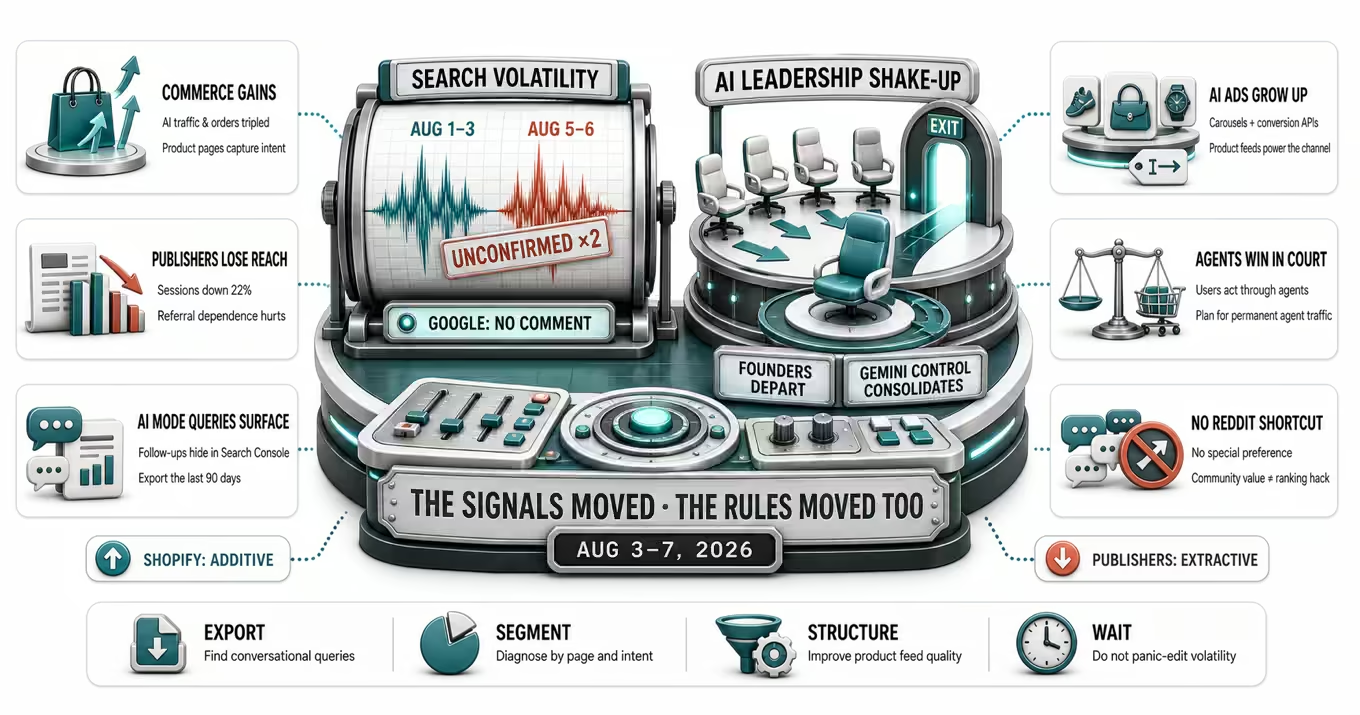
Some weeks the news is one big story with a clear headline. This was not one of those weeks. The search results moved twice, hard, with no confirmation from Google. The people who built Google's AI stack announced they were leaving. Shopify told investors AI search is making it money while publishers told investors AI search is taking theirs. And a UK tribunal decided that roughly 880,000 British advertisers are now, by default, plaintiffs in a class action against Google.
If you were watching rank trackers on Wednesday afternoon and thinking "something is very wrong," you were not imagining it. Here is what actually happened between Monday, August 3 and Friday, August 7.
Google's results shook twice in a week, and Google said nothing
Search Engine Roundtable flagged volatility starting Saturday, August 1, building through Monday, August 3. Then it happened again, bigger, into August 5 and 6, with Barry Schwartz writing that the chatter "seems consistent with a big Google Search algorithm update that is underway but at this point, Google has not yet confirmed it and may never confirm it." Third party trackers including Semrush Sensor, Sistrix, Algoroo, Mozcast and AccuRanker all spiked. The forum chatter was extreme in both directions: one site owner reported a 70% drop in Google traffic across every property, another reported traffic surging around 6 PM and turning into a highly successful day by close.
For context on how long the official silence has run, the last confirmed Google ranking update was the June 2026 spam update, which started June 14 and completed June 26. Since then there have been unconfirmed movements on July 11, July 18 and 19, July 24, August 1 to 3, and now August 5 and 6. That is five unnamed events in under a month.
Why it matters: the gap between what Google confirms and what site owners measure is now a working condition, not an anomaly. Stop waiting for a name before you diagnose. If your traffic changed on August 5, the absence of a Google blog post is not evidence that nothing happened. And one theory from the Roundtable thread is worth testing rather than dismissing: that Google is surfacing three or four pages from a single high authority domain before showing one result from a smaller site. If that pattern holds in your vertical, the fix is not another round of on-page tweaks. It is a question about whether you can win a domain-level authority contest at all.
The people who built Google's AI walked out the door
On August 5, Google announced that chief scientist Jeff Dean is leaving after 27 years. He is not leaving alone. Google senior fellow Sanjay Ghemawat, DeepMind vice president Oriol Vinyals, and Google Brain co-founder Quoc Le are going with him to start a new company, Discovery Loop, which Google is investing in. Separately, Demis Hassabis is moving from CEO of Google DeepMind to chair of that unit, while taking the title of chief scientist at Alphabet and spending more time on Isomorphic Labs. Koray Kavukcuoglu becomes senior vice president of Google DeepMind, reporting directly to Sundar Pichai, with responsibility for Gemini model development, frontier research, the Gemini app, and Google's AI developer platforms.
Alphabet shares fell roughly 4% on the announcement, as Search Engine Roundtable noted in its coverage. Bloomberg reported the shake-up also shifts AI decision-making power toward California and away from London.
Why it matters: executive churn is usually a story for the business press, not for marketers. This one is different for a specific reason: Kavukcuoglu now owns both Gemini model development and the Gemini app, reporting to the CEO. When the same executive owns the model and the surface it ships on, the pace of change on that surface tends to increase, not decrease. If you are building GEO strategy around how Gemini currently cites sources, treat that behavior as a moving target through the rest of 2026. None of this changes ranking systems this week, though. Do not attribute your August 5 traffic drop to Jeff Dean's resignation.
Shopify says AI search is additive. Publishers say it is extractive. Both have receipts.
This is the most interesting tension of the week, and it deserves to be stated fairly rather than resolved cheaply.
On Shopify's second quarter earnings call on August 5, president Harley Finkelstein said AI has become a "complement to search, rather than a substitute for it," as TechCrunch reported. The numbers he gave: AI-driven traffic and orders to Shopify stores tripled year over year in Q2. Traditional search sessions are up 1.3x over the past two years and still hold roughly a third of all storefront sessions. Half of all AI-referred sessions land directly on a product description page, which is 2.5 times the rate from traditional search. And 75% of AI-attributed purchases in Q2 happened outside the top 100 categories. Shopify reported revenue up 36% to $3.6 billion, beating estimates.
Finkelstein's explanation of the mechanism is the part worth quoting: "While search engines rank by popularity against a handful of keywords, AI agents make multiple calls into Shopify's catalog, working with richer structured data to match products with the buyer's specific intent, rather than just keywords."
Now the other side. On August 5, People Inc chief executive Neil Vogel told investors that Google made up about 21% of all traffic to the company's 19 core brands last quarter, compared to roughly two thirds at its peak. Sessions across those brands fell 22%. Vogel had told The Wall Street Journal last month that blocking Google's crawlers entirely was "100% on the table," and he walked that back slightly this week, saying People Inc is "clearly not turning this off now. But it is a tool that we can use." The reason he gave is the crux of the whole publisher problem: "if we were to turn off AI, we would turn off search." In the US, there is still no way to opt out of AI Overviews without leaving the search index. The UK's Competition and Markets Authority has told Google to separate its search and AI crawlers, and Google is testing that, but it has not reached US publishers.
Why it matters: these two companies are not contradicting each other. They are describing two different economic positions. Shopify's merchants sell a product at the end of the click, so an AI assistant that delivers a pre-qualified buyer straight to a product page is worth more per session, not less. Publishers monetize the session itself, so an AI assistant that answers the question and keeps the user is a direct subtraction. If your business converts on the page the AI sends people to, AI search is probably additive for you and you should be feeding it structured product data aggressively. If your business monetizes attention on the page, you are in the harder position and the honest planning assumption is that referral volume keeps declining while the value of each remaining visit goes up. People Inc's own numbers support that second half: sessions down 22%, session-based revenue down only 1%, because rates rose.
Google says Reddit gets no special preference
Google communications representative Jennifer Kutz told The Verge, in an article published this week about AI-driven spam on Reddit, that Reddit "gets no special preference" in Google's ranking systems, and that Google's AI search features do not aim to display content from any specific site or platform. Kutz added: "There will always be bad actors trying to game the system, in fact, spamming predates the internet, and fighting spam is a core expertise for us. We have strong protections against manipulation across Search, including our AI features, and we've kept results 99% spam-free for years."
Why it matters: the statement tells you what Google claims about its own mechanism: forum content ranks when the systems judge it helpful, not because it is forum content. Reddit's own traffic from Google has fallen, which several analysts attribute to the May core update and June spam update hitting its AI-translated pages rather than to AI Overviews. The practical read: the "just get mentioned on Reddit" tactic that has dominated GEO advice for two years rests on an assumption Google has now explicitly denied. Community presence still has value for brand mentions and citation surfaces. Treating it as a ranking shortcut is a strategy built on a hypothesis Google says is false.
Your Search Console has AI Mode data hiding in plain sight
A practical find this week. Search Console's generative AI performance reports still do not include query data. But the main Search performance report does, and it includes AI Mode queries mixed in with everything else. SEO Anastasia Kourou posted screenshots of queries like "yes," "yes go on," and "yes, pricing" appearing in her performance report, as Search Engine Roundtable covered. John Mueller from Google confirmed the mechanism, pointing to Google's documentation: "If a user asks a follow-up question within AI Mode, they are essentially performing a new query. All impression, position, and click data in the new response are counted as coming from this new user query."
Why it matters: those nonsense fragments are not tracking errors. They are the second and third turns of an AI Mode conversation where your page was cited, and they are sitting in a report you already have access to for free. This is the closest thing to conversational query data that Google currently gives anyone. Go pull the last 90 days of query data, filter for queries under three words that read like conversational replies, and for very long natural-language questions. What you find is a rough map of where you are showing up in AI Mode. It is imprecise and Google will probably tidy it up eventually, so harvest it now.
OpenAI's ad platform grew up this week
OpenAI emailed advertisers with a substantial set of ChatGPT Ads Manager updates. The headline is a multi-product carousel format for product feed campaigns, which showed multiple products from a single advertiser in one unit and went live by August 7. Alongside it: conversion-optimized cost-per-click campaigns in beta for product feed campaigns, the ability to clone existing CPC campaigns into oCPC campaigns or create them in bulk, dynamic URL macros including {campaign_id} and {ad_id}, a Triple Whale integration, Hightouch conversion API support, and pixel validation diagnostics. Two dates matter: automatic advanced matching becomes the default for existing web pixels on August 17, 2026, with an opt-out available before then, and ChatGPT Ads launch in Brazil and Mexico in the coming week.
Why it matters: carousels, bulk campaign creation, conversion APIs and third party measurement integrations are not experiments. That is the feature set of an ad platform being built for serious spend, and it says paid placement inside AI assistants is a real channel in 2026, not a 2027 problem. Note the through-line with the Shopify story: both run on product feeds. The structured catalog data you maintain for Merchant Center is turning into the same asset that powers AI assistant answers and AI assistant ads.
Two courtrooms, two decisions that will outlast the week
On August 5, the UK Competition Appeal Tribunal rejected Google's attempt to block a class action over search advertising, certifying it on an opt-out basis. The claim covers roughly 880,000 UK businesses and is estimated at around £5 billion. Opt-out matters: those advertisers are in the class unless they take action to leave. The ruling allows the case to proceed toward a trial on the merits and does not itself find that Google broke any law.
On August 4, the Ninth Circuit Court of Appeals overturned a lower court injunction that had barred Perplexity from running its agentic shopping tools on Amazon. The court found Amazon was unlikely to succeed on its claim that Perplexity's AI agents violated federal computer fraud law, reasoning that it was Perplexity's users, acting through the agents, who accessed Amazon's platform, not Perplexity itself. This is the first federal appeals court decision on whether AI agents acting for users can legally access online platforms. Amazon said it disagrees with the decision.
Why it matters: the Perplexity ruling is the more consequential one for anyone planning agentic commerce work. A federal appeals court has now said, at least at the preliminary injunction stage, that an AI agent acting on a user's instruction is legally standing in the user's shoes. If that reasoning holds, retailers cannot easily use computer fraud law to keep shopping agents off their sites, and the practical control points become robots directives, rate limiting, and commercial agreements. Plan for agent traffic as a permanent category rather than something that will be litigated away.
Housekeeping worth knowing
Google Ads will begin migrating automatically created assets and campaign-level broad match settings to AI Max starting September 1, 2026. Google Assistant shuts down on mobile devices on September 4, 2026, with Gemini replacing it on Wear OS, compatible headphones, and Android Auto. Google Trends now lets you compare up to 400 search terms across 8 groups, up from 125 across 5. And Gary Illyes clarified that Google's crawlers send HEAD, OPTIONS, PUT, PATCH and DELETE requests in addition to GET and POST, though those account for under 1.5% of total crawler requests and are triggered by JavaScript during rendering.
Three moves for the week ahead
- Pull your Search Console query export now, because it is free and the window may close. Grab 90 days, sort for very short conversational fragments and very long natural language questions, and build a working list of the AI Mode conversations your content is appearing in. That list is better GEO input than most paid tools will give you this quarter.
- Decide honestly which side of the Shopify and People Inc divide your business sits on. If a click ends in a transaction on your site, your priority is structured data quality: clean product feeds, accurate attributes, dimensions and specifications that let an agent match a buyer's actual constraint rather than a keyword. Finkelstein's car seat example is the whole brief. If your business monetizes the visit itself, spend your energy on what People Inc's numbers show still working: direct relationships, subscriptions, events, licensing, and rate premium on the traffic you keep.
- Resist making changes based on a single volatile week. Two unconfirmed movements in five days, with reversals reported inside them, is exactly the pattern where panic edits create permanent damage. Document what moved, segment by page type and query intent, and wait for results to settle. If you were down on August 5 and recovered on August 6, you probably watched a rollout, not a penalty.
- Put three dates in the calendar. August 17 for OpenAI's automatic advanced matching defaulting on for existing web pixels. September 1 for the Google Ads AI Max migration. September 4 for the Google Assistant shutdown, which matters if any of your voice or app surface work assumed Assistant would be there.
Frequently Asked Questions
Common questions about GEO, SEO, and AI-driven search visibility.
Google did not confirm any algorithm update during the week of August 3 to 7, 2026, but the SEO community observed two distinct waves of significant ranking volatility. The first began Saturday, August 1 and continued through Monday, August 3. The second and larger wave hit August 5 and 6. Search Engine Roundtable reported that the chatter was "consistent with a big Google Search algorithm update that is underway," and third party tracking tools including Semrush Sensor, Sistrix, Mozcast, Algoroo and AccuRanker all registered spikes. Google's last confirmed ranking update remains the June 2026 spam update, which ran from June 14 to June 26, 2026.
Jeff Dean, Google's chief scientist, announced on August 5, 2026 that he is leaving the company after 27 years to co-found a new company called Discovery Loop, which Google is investing in. He is joined by Google senior fellow Sanjay Ghemawat, DeepMind vice president Oriol Vinyals, and Google Brain co-founder Quoc Le. On the same day, Demis Hassabis moved from CEO of Google DeepMind to chair of the unit, while also taking the title of chief scientist at Alphabet. Koray Kavukcuoglu became senior vice president of Google DeepMind, reporting directly to Sundar Pichai and overseeing Gemini model development, frontier AI research, the Gemini app, and Google's AI developer platforms. Alphabet shares fell about 4% following the announcement.
For ecommerce, the current evidence points to helping. On its second quarter 2026 earnings call on August 5, Shopify reported that AI-driven traffic and orders to its merchants' stores tripled year over year, while traditional search sessions grew 1.3x over two years and still account for roughly a third of storefront sessions. Shopify president Harley Finkelstein described AI as "a complement to search, rather than a substitute for it." Shopify also reported that half of AI-referred sessions land directly on a product description page, 2.5 times the rate of traditional search, and that 75% of AI-attributed purchases in Q2 fell outside its top 100 categories. This differs sharply from publisher experience, where AI summaries have reduced click-through rates and referral traffic.
Yes, but not where you would expect. Google Search Console's generative AI performance reports do not include query data at all. AI Mode queries do appear in the main Search performance report, mixed in with regular search queries. In August 2026, SEOs began spotting conversational fragments such as "yes," "yes go on," and "yes, pricing" in their reports. John Mueller of Google confirmed the mechanism, citing Google's documentation, which states that when a user asks a follow-up question within AI Mode they are essentially performing a new query, and all impression, position and click data from that response is counted as coming from the new query.
Google says no. In comments to The Verge published in early August 2026, Google communications representative Jennifer Kutz said Reddit "gets no special preference" in Google's ranking systems and that Google's AI search features do not aim to display content from any specific site or platform. Kutz said Google's systems are designed to detect when user-generated content is helpful or low quality, and added that Google has "kept results 99% spam-free for years." Independent observers note that Reddit's traffic from Google has declined recently, which analysts including Glenn Gabe attribute to the May 2026 core update and June 2026 spam update affecting Reddit's AI-translated pages.
On August 4, 2026, the Ninth Circuit Court of Appeals overturned a lower court injunction that had barred Perplexity from operating its agentic AI shopping tools on Amazon's platform. The appeals court found Amazon was unlikely to succeed on its claim that Perplexity's agents violated the federal Computer Fraud and Abuse Act, reasoning that it was Perplexity's users, acting through the agents, who accessed Amazon's platform rather than Perplexity itself. This is the first federal appeals court ruling on whether AI agents acting on behalf of users can legally access online platforms. Amazon said it respectfully disagrees with the decision.
Sources
- Search Engine Roundtable: Google search ranking volatility heats up into August 5th and 6th (opens in a new tab)
- Search Engine Roundtable: Google search ranking volatility hits August 1st into August 3rd (opens in a new tab)
- Search Engine Roundtable: Daily search forum recap, August 3, 2026 (opens in a new tab)
- Search Engine Roundtable: Daily search forum recap, August 5, 2026 (opens in a new tab)
- Search Engine Roundtable: Daily search forum recap, August 6, 2026 (opens in a new tab)
- Search Engine Roundtable: Daily search forum recap, August 7, 2026 (opens in a new tab)
- Search Engine Roundtable: Google AI leadership changes, Jeff Dean leaves and Demis Hassabis role change (opens in a new tab)
- Search Engine Roundtable: Google says Reddit gets no special preference in Google Search (opens in a new tab)
- Search Engine Roundtable: Google shows AI Mode queries in Search Console, just not in generative AI reports (opens in a new tab)
- Search Engine Roundtable: ChatGPT Ads updates, oCPC, dynamic URLs, multi-product carousel and more (opens in a new tab)
- Search Engine Roundtable: Google crawlers send HEAD, OPTIONS, PUT, PATCH and DELETE requests (opens in a new tab)
- Search Engine Roundtable: Google Assistant shutting down on mobile devices on September 4 (opens in a new tab)
- Search Engine Roundtable: Google Ads to migrate ACA and campaign-level broad match to AI Max on September 1 (opens in a new tab)
- Search Engine Roundtable: Google Trends lets you compare 220% more search terms (opens in a new tab)
- TechCrunch: Shopify says AI search is driving more traffic and sales, not replacing Google (opens in a new tab)
- Press Gazette: People Inc not blocking Google "at the moment" as it rolls out digital subscriptions (opens in a new tab)
- CNBC: Google chief scientist Jeff Dean leaving company after 27 years (opens in a new tab)
- Axios: Google DeepMind CEO Demis Hassabis is stepping aside (opens in a new tab)
- Bloomberg: Google shifts AI leadership to California in race against Anthropic and OpenAI (opens in a new tab)
- Bloomberg: Google to face UK class action over search ad practices, tribunal rules (opens in a new tab)
- Reuters: Amazon loses US court ban on Perplexity's AI shopping tools (opens in a new tab)
- The Verge: Can Reddit fend off a new wave of AI SEO spam? (opens in a new tab)
- Search Engine Land: Google leadership changes with Jeff Dean out and Demis Hassabis role change (opens in a new tab)
- Search Engine Land: Google to auto-upgrade automatically created assets to AI Max (opens in a new tab)
- OpenAI Developer Docs: Conversion-optimized campaigns (opens in a new tab)
- Google Search Console Help: Performance report (Search) (opens in a new tab)