





Billions of Clicks and a Billion-Dollar Fine: The Week in SEO, GEO, and AI Visibility July 20 to 24, 2026
 Preferred source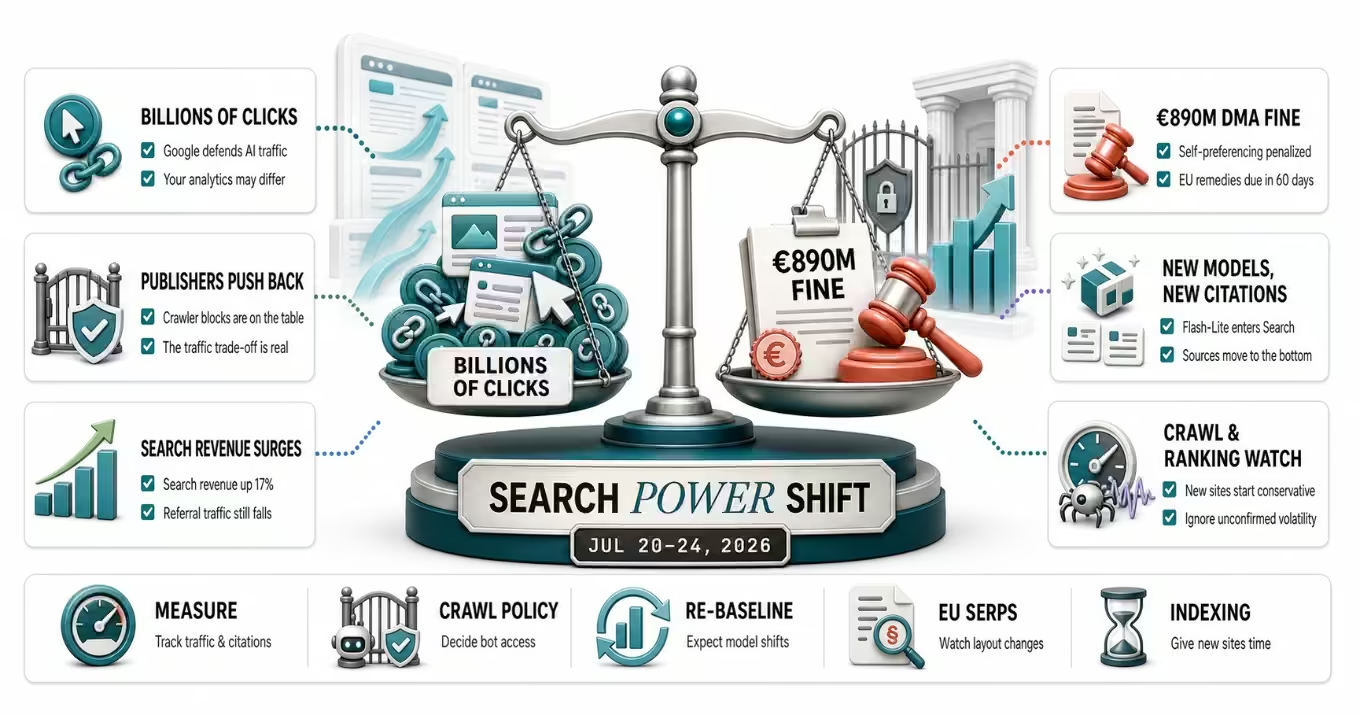
Some weeks in search are about product tweaks. This one was about power.
Google's head of search went public with a defense of AI search traffic. Major publishers responded by openly discussing whether to block Google entirely. Brussels handed down its first Digital Markets Act fine. Alphabet posted its biggest quarter ever. And underneath all of it, the rankings wobbled again.
Here is what actually mattered for SEO, generative engine optimization, and AI visibility from July 20 to 24, with sources linked so you can check every claim yourself.
Google's pitch is that it still sends billions of clicks
On Friday July 17, going into this week, Google's head of search Nick Fox posted that Google's AI features are "now sending billions of clicks to websites every week through AI features in Search alone," adding that Google has "designed our AI features in Search to connect people to websites" and continues to send billions of clicks to the web every day (Search Engine Roundtable). Liz Reid, VP of Google Search, reshared the message and said the AI features are helping people explore the web and connect with creators and publishers.
Read the phrasing carefully, because it is doing a lot of work. Google is not claiming it sends more clicks than before. It is claiming the absolute number is large. Those are different arguments, and the distinction matters when your own analytics show organic sessions falling.
The timing was not accidental. The statement landed days after the New York Times published a piece on how Google's AI search is imperiling the open web (The New York Times), and while the Press Gazette was reporting projections that Google search traffic to leading UK publishers could halve by the third quarter of 2027 (Press Gazette).
For anyone tracking their own AI visibility: Google's AI performance reports in Search Console still do not include click data. You can see impressions, but not what share of them turned into visits.
Publishers push back, and blocking Google is now on the table
Then the other shoe dropped. On July 23, the Wall Street Journal reported that several large publishers are seriously considering blocking Google from crawling their content, because the trade of content for traffic no longer pencils out (The Wall Street Journal, summarized by Search Engine Roundtable).
The quotes are remarkable. USA Today Co. chief executive Mike Reed said "it's time to take a stand and say enough is enough." People Inc. chief executive Neil Vogel said "turning them off and blocking them entirely is 100% on the table." Reuters president Paul Bascobert said the company is "certainly looking at the economic trade-offs between search and AI summaries." Politico has discussed limiting bot access to its free articles, and Reddit has reportedly discussed shutting off Google's access for AI use, with its content deal up for renewal.
Not everyone is ready to jump. The Economist's Josh Muncke put the counterargument plainly: "Google is a powerful force to be reckoned with. Traffic can be choppy and declining, but traffic is still traffic."
Why this matters beyond publishing: if large content sources start restricting crawler access, the pool of material feeding AI answers shifts. That changes which domains get cited, and it creates openings for brands that keep their content open and well structured. This is the year that "should we let AI crawl us" became a real strategy question rather than a hypothetical.
Brussels fines Google, and it is a first
On July 23, the European Commission fined Google 890 million euros, roughly one billion dollars, for breaching the Digital Markets Act (European Commission). It is the first time Google has been penalized under the DMA.
The penalty splits in two. About 460 million euros relates to Google favoring its own services in search results, including shopping, hotels, transport, and sports, over competing services. The remaining 430 million euros addresses Google Play restrictions that stopped developers from steering users toward cheaper offers elsewhere (CNBC). The Commission gave Google 60 days to fix the violations or face further penalties.
For search marketers in Europe, the practical question is what the remedy looks like. Self-preferencing changes tend to reshuffle how comparison and vertical results appear in the SERP, which can shift real estate for hotels, flights, and shopping in ways that affect visibility. Related, Google also rolled out hotel search changes in the EU this week tied to DMA compliance (Search Engine Roundtable).
Alphabet posts its biggest quarter ever
On July 22, Alphabet reported second-quarter revenue of 119.8 billion dollars, up 24% year over year and ahead of analyst expectations. Google Search and other revenue grew 17% to 63.3 billion dollars. Google Cloud jumped 82% to 24.8 billion, and YouTube advertising rose 13% to 11.1 billion (Alphabet investor relations, CNBC).
Hold that 17% search growth next to the publisher story above. Search revenue is climbing while many publishers report falling traffic. That is the decoupling in one line, and it is the strongest evidence that the current model works well for Google regardless of what happens to referral traffic. Nobody should expect the zero-click trend to reverse on its own.
Gemini 3.5 Flash-Lite rolls into Search
On July 22, Google confirmed that Gemini 3.5 Flash-Lite is rolling out in Google Search, where it powers agentic search experiences and very likely AI Overviews and AI Mode as well (Search Engine Roundtable, Search Engine Land). It came alongside a broader model release the day before that included Gemini 3.6 Flash and a security-tuned variant (Google, The New York Times).
Model swaps under AI Overviews are not cosmetic. When the model generating summaries changes, which sources it pulls and how it phrases answers can shift too. If your AI citations move over the next few weeks without any change on your end, this is a likely explanation.
AI Overviews and AI Mode launch in France
Google began rolling out AI Overviews, AI Mode, Search Live, and its new search box in France starting July 22, announced by Google search executive Rajan Patel. The rollout arrives ahead of the September deadline Google had signaled to French press publishers.
For anyone managing European visibility, France just became an AI search market. Baselines you set before this week are no longer comparable.
Citations move to the bottom in both Google and ChatGPT
A small test with real implications. Both Google AI Mode and ChatGPT are experimenting with placing citation cards at the bottom of the answer. AI Mode anchors users down to the citation card, while ChatGPT loads a citation overlay on click (Search Engine Roundtable).
Where a citation sits determines whether anyone sees it. Sources tucked below a complete answer get fewer eyes than sources shown inline. If both major platforms move this direction, the value of a citation shifts further away from clicks and toward brand impression and recall. Plan your measurement accordingly.
Google updates its crawl budget doc with a notable line
Google refreshed its "Optimize your crawl budget" documentation this week for clarity and consistency, and slipped in a useful detail: "Every site starts with the same default, conservative crawl capacity limit" (Search Engine Roundtable, Google Search Central).
That is a helpful expectation-setter for new sites and fresh migrations. Crawl capacity is earned through demonstrated server performance and demand, not granted upfront. If you just launched a rebuild and indexing feels slow, this is part of why.
Google's lawsuit against SerpApi is dismissed
A court granted SerpApi's motion to dismiss Google's scraping lawsuit, with US District Judge Yvonne Gonzalez Rogers dismissing the claims with leave to amend and giving Google 21 days to refile if it can show authorization from copyright owners (SerpApi, Search Engine Roundtable).
The ruling matters for the rank tracking and SERP data tools much of the industry runs on. It is not a final answer, since Google can amend, but it is a meaningful early result.
Ranking volatility, again
The trackers lit up over the weekend of July 18 and 19, with chatter picking up on Monday July 20. Interestingly, some SEOs reported that the movement looked like a reversal of the unconfirmed July 11 update, with sites that dropped then recovering now (Search Engine Roundtable). Google has not confirmed anything. The last confirmed updates remain the June 2026 spam update and the May 2026 core update.
Same advice as always. Unconfirmed volatility with reversal patterns is not a signal to rebuild your site. Wait for stability and read your own data.
Odds and ends worth knowing
A few smaller items from the week. ChatGPT was spotted showing two ads in the footer of results, another step in OpenAI's ad buildout (Search Engine Roundtable). Google Ads set a new limit on policy appeals, blocking appeals for decisions made more than six months prior as of July 21 (Search Engine Roundtable). Google Merchant Center picked up more AI features (Search Engine Roundtable). And OpenAI's agents reached 10 million users following the ChatGPT Work debut (Bloomberg).
Actions worth taking now
- Stop arguing about whether clicks are down and measure your own. Google's billions-of-clicks framing and your analytics can both be true. Segment AI-referred traffic, watch branded search volume, and track citations separately from sessions.
- Decide your crawler policy on purpose. With major publishers openly debating blocking Google, "we never thought about it" is no longer a defensible position. Know which bots you allow, why, and what you get in return.
- Expect your AI citations to move. A new model is powering Search and citation placement is being redesigned in two major platforms at once. Re-baseline your AI visibility tracking now so you can tell platform changes apart from your own performance.
- If you operate in Europe, watch the SERP. A DMA remedy on self-preferencing plus hotel search changes means the results layout for shopping, travel, and comparison queries may shift within 60 days.
- Be patient with new and rebuilt sites. Google just confirmed every site starts on the same conservative crawl limit. Slow initial indexing is expected, not a bug to chase.
Frequently Asked Questions
Common questions about GEO, SEO, and AI-driven search visibility.
No. Google did not confirm any ranking update that week. Third-party tracking tools registered volatility over the weekend of July 18 and 19, and some SEOs observed that the movement looked like a partial reversal of the earlier unconfirmed July 11 update. The most recent confirmed updates remain the June 2026 spam update, which ran June 14 to June 26, and the May 2026 core update, which ran May 21 to June 2.
Google says yes. On July 17, 2026, Google head of search Nick Fox stated that AI features in Search send billions of clicks to websites every week and that Search overall sends billions of clicks daily. Importantly, Google is asserting the absolute volume is large, not that it has increased. Independent studies and publisher analytics continue to show declining click-through rates when AI summaries appear, and Google's AI performance reports in Search Console still exclude click data, so site owners cannot directly compare AI and traditional search click-through rates.
Because the traditional exchange, content for referral traffic, is delivering less traffic than it used to. The Wall Street Journal reported on July 23, 2026, that executives at USA Today, People Inc., Reuters, and Politico are weighing whether to restrict Google's crawler access, with Reddit also reportedly discussing limiting access for AI use. Publishers say declining clicks make the trade no longer worthwhile. Some, like the Economist, argue that reduced traffic is still valuable traffic and are not pursuing a block.
The European Commission fined Google 890 million euros, roughly one billion dollars, on July 23, 2026, in the first penalty issued against the company under the Digital Markets Act. About 460 million euros covers Google favoring its own services in search results across shopping, hotels, transport, and sports, and about 430 million euros covers Google Play restrictions that prevented developers from steering users to cheaper offers elsewhere. Google was given 60 days to remedy the violations.
Gemini 3.5 Flash-Lite is a Google AI model that began rolling out in Google Search on July 22, 2026, powering agentic search experiences and likely AI Overviews and AI Mode. Model changes matter for AI visibility because the model generating an AI answer influences which sources it retrieves and cites. Brands may see their AI citation patterns shift after a model rollout without having changed anything on their own sites, so it is worth re-baselining visibility tracking after these updates.
Every site starts the same, then diverges. In its July 2026 update to the "Optimize your crawl budget" documentation, Google stated that every site begins with the same default, conservative crawl capacity limit. Crawl capacity then increases or decreases based on how well a site's server responds and how much crawl demand Google sees for its content. This is why newly launched or newly migrated sites often experience slower initial indexing, which is expected behavior rather than a technical fault.
Sources
- Search Engine Roundtable: Google sends billions of clicks weekly through AI Search (opens in a new tab)
- The New York Times: How Google's AI search is imperiling the open web (opens in a new tab)
- Press Gazette: Google traffic to leading UK publishers set to halve by Q3 2027 (opens in a new tab)
- The Wall Street Journal: Publishers thinking of cutting Google off (opens in a new tab)
- Search Engine Roundtable: Large publishers considering blocking Google Search (opens in a new tab)
- European Commission: Commission fines Google 890 million euros under the DMA (opens in a new tab)
- CNBC: Google slapped with one billion dollar fine under landmark EU law (opens in a new tab)
- Alphabet: Second quarter 2026 results (opens in a new tab)
- CNBC: Alphabet earnings takeaways (opens in a new tab)
- Search Engine Roundtable: Google Search using Gemini 3.5 Flash-Lite (opens in a new tab)
- Search Engine Land: 3.5 Flash-Lite rolling out in Google Search (opens in a new tab)
- Google: Gemini 3.6 Flash, 3.5 Flash-Lite, and 3.5 Flash Cyber (opens in a new tab)
- The New York Times: Google releases three new Gemini AI models (opens in a new tab)
- Search Engine Roundtable: Google AI Mode and ChatGPT test bottom card citations (opens in a new tab)
- Search Engine Roundtable: Google updates its crawl budget doc (opens in a new tab)
- Google Search Central: Managing crawl budget for large sites (opens in a new tab)
- SerpApi: The court granted our motion to dismiss (opens in a new tab)
- Search Engine Roundtable: Google lawsuit against SerpApi dismissed (opens in a new tab)
- Search Engine Roundtable: Ranking volatility July 18 and 19 (opens in a new tab)
- Search Engine Roundtable: Google hotel search updates in EU based on DMA (opens in a new tab)
- Search Engine Roundtable: ChatGPT showing two ads in footer of results (opens in a new tab)
- Search Engine Roundtable: Google Ads appeals limit set to six months (opens in a new tab)
- Search Engine Roundtable: Google Merchant Center gains more AI features (opens in a new tab)
- Bloomberg: OpenAI's agents reach 10 million users (opens in a new tab)