


Half the Searches, Half the Clicks: The Week AI Overviews Crossed the Line July 27 to 31, 2026
 Preferred source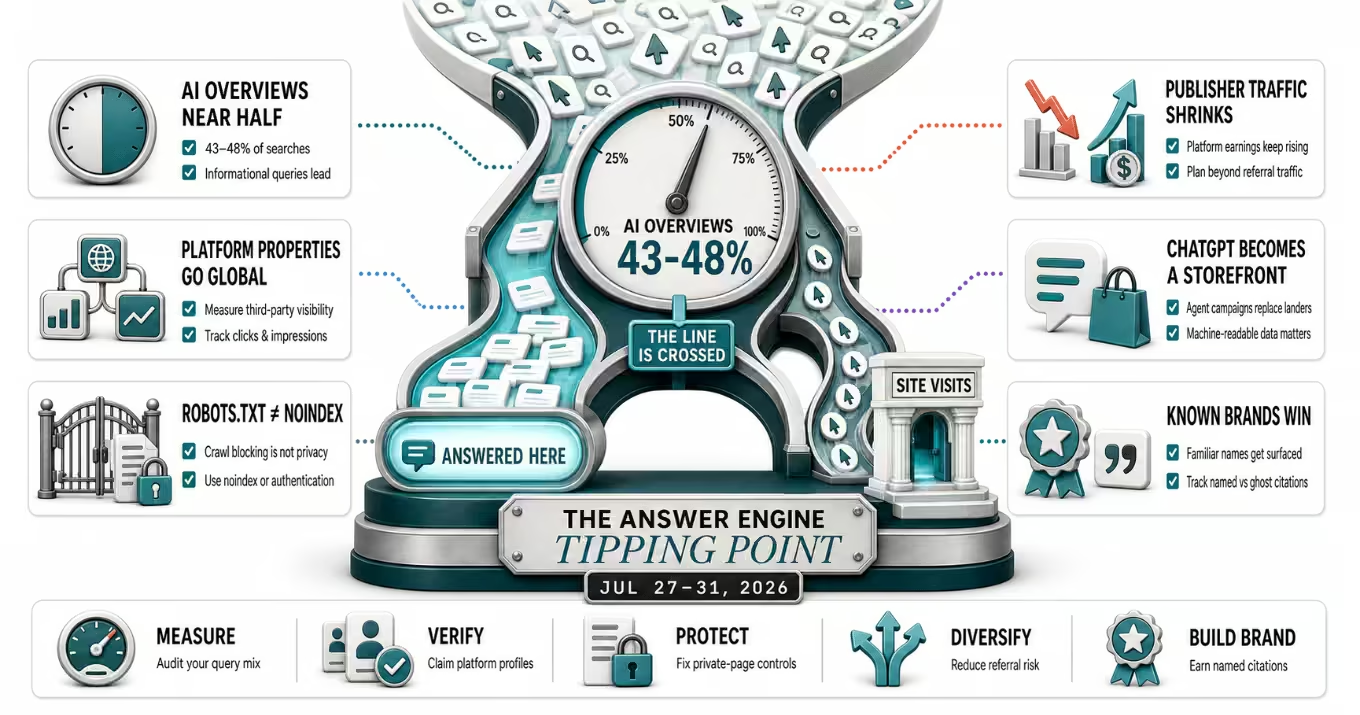
There is a moment when a trend stops being a trend and just becomes the way things are. This was that week for AI search. New measurement data landed showing that AI Overviews now appear on close to half of all Google searches, Google flipped on a tool that finally lets you measure your presence on platforms you do not own, and a very public privacy mess handed the whole industry a free lesson about the difference between blocking a crawler and hiding a page. Meanwhile the money kept moving. Microsoft and Google both reported strong quarters, OpenAI kept turning ChatGPT into a place you can buy things, and publishers kept warning that the traffic is not coming back.
Here is what actually happened between Monday, July 27 and Friday, July 31, and what it means if your job is to get found.
AI Overviews crossed the halfway line, and the data is not subtle
For a couple of years the honest answer to "how often do AI Overviews show up" was "it depends, and less than it feels like." That answer is expiring. Search Engine Roundtable, pulling from two independent data sets, reported on July 30 that AI Overviews now appear on about 43 percent of queries according to Similarweb and about 48 percent according to Semrush. A year ago the same measurements sat somewhere between 13 and 20 percent. Similarweb's own chart, posted to X, shows the line climbing from roughly 15 percent to 43 percent in a short window, with AI Mode visits rising even faster than that (TechCrunch).
The share is not evenly spread. Informational and how to queries trigger AI Overviews far more often than transactional or product queries, which is why an ecommerce manager and a B2B content lead can look at the same search engine and describe two different realities. And the surface is still spreading geographically. After launching in France in late July, AI Overviews reached about 27 percent of French search results within days, according to Semrush's Sensor tracking, closing the last major market that had been living without them.
Why it matters: when a feature shows up on nearly half of searches, planning around the average is a mistake. You need to know your own query mix. If your best keywords are informational, assume an AI Overview sits above your result more often than not, and that the click, if it comes at all, comes after the summary. If your money keywords are transactional, you have more runway than the scary headline number suggests, but that gap is exactly the kind of thing Google has been closing month after month. Measure AI Overview presence on your actual terms rather than trusting a blended percentage.
Search Console Platform properties goes global
On July 29, Google announced that Platform properties in Search Console is now fully live worldwide (Search Engine Land). The feature, which Google previewed earlier in the month, lets you claim and view how content you manage on third party platforms performs in Google Search. If you run an account on YouTube, TikTok, X, or Instagram, you can verify access and see the impressions and clicks that content earns in Search, all inside the same tool you already use for your website.
Google's John Mueller framed the verification model plainly in a public comment: you verify a folder or profile as the underlying entity that contains items, not an individual page, because a page is already the item itself (Search Engine Roundtable). In practice that means you are claiming your presence on a platform, then watching how it surfaces.
Why it matters: for years, the honest weakness of most GEO and "off site" strategy was that you could not measure it in Google's own numbers. You knew your YouTube videos and social posts showed up in Search, but you were guessing at the volume. Platform properties turns that guess into a report. If your brand shows up in Search through a creator video or a Reddit style discussion more than through your own pages, that is a strategic signal, not a footnote. This is Google quietly admitting that your visibility now lives across surfaces it does not host, and giving you a dashboard for it.
The Claude chat leak, and the robots.txt lesson buried inside it
The most instructive story of the week was not really about SEO, until it was. Reports surfaced, covered by Wired and others, that shared Claude conversations were turning up in Google and Bing results, exposing content people assumed was private. The fix, and the finger pointing, took a day. The useful part for marketers was the correction that followed.
As SEO veteran Glenn Gabe pointed out, a lot of the early coverage got the mechanics wrong. If you block a page with robots.txt and also add a noindex tag, search engines cannot see the noindex, because they are not allowed to crawl the page to read it. The two directives solve different problems. Robots.txt controls crawling. Noindex controls indexing. Block a URL in robots.txt and a search engine may still index the URL itself if it finds enough links pointing at it, and it will never see your noindex instruction sitting inside. Search Engine Land's framing was blunt: the chats got indexed because the pages were not blocked from search engines in the way people assumed.
Why it matters: this is one of the oldest technical SEO mistakes in the book, and a multibillion dollar AI company just made it in public. If you have pages you want kept out of search, from staging environments to internal tools to user generated content you never meant to expose, audit how you are excluding them this week. If the goal is "do not index this," you need the page crawlable with a noindex tag, or you need proper authentication, not a robots.txt disallow that quietly leaves the door unlocked.
Strong quarters for platforms, squeezed publishers
Earnings season made the split screen obvious. Microsoft reported its fiscal fourth quarter with search and advertising revenue up 10 percent, as Search Engine Roundtable noted, which is solid but a step down from the 12 percent of the prior quarter and the 16 and 21 percent it posted in quarters before that. Separately, TechCrunch reported that Microsoft logged a 3.2 billion dollar gain tied to its Anthropic investment, a reminder that the AI winners and the search incumbents are increasingly the same balance sheets.
Google, for its part, posted record earnings, and the coverage around it was pointed. The Seattle Times ran an opinion piece headlined "Google reports record earnings as publishers suffer, regulators dither." Editor and Publisher described publishers "approaching Google Zero," arguing that search referrals have plunged and that news sites should plan as if that traffic is never coming back. The pressure showed up in public markets too: Reddit shares fell about 7 percent after it flagged "choppy" search referrals, even as its overall results beat estimates, according to CNBC.
Why it matters: the business story and the marketing story are the same story. The platforms are monetizing AI answers and their own surfaces beautifully, and a meaningful slice of that value used to arrive at your site as a click. If you run a content business, the Editor and Publisher framing is the one to internalize: build for a world where a smaller share of impressions turns into visits, and where the visit that does happen is worth more because the person is further along. Diversify the ways you reach people, because leaning on a single search referral pipe is now a documented risk, not a hypothetical one.
OpenAI keeps turning ChatGPT into a storefront
While everyone watched Google, OpenAI spent the week building the commercial plumbing around ChatGPT. Search Engine Roundtable and Search Engine Land tracked a steady stream of ChatGPT Ads Manager updates through late July, including conversion focused bidding, geo exclusions, budget pacing changes, an expanding API, and new product ad formats. By Friday, July 31, OpenAI was testing a campaign type called "Agent" that sends a ChatGPT user into a Business Agent conversation on your site, a chat experience, rather than to a traditional landing page (Search Engine Roundtable).
The scale behind this matters. The Information reported that ChatGPT is nearing one billion weekly active users, and CNBC reported that OpenAI's CFO told staff annualized revenue in July topped all of the second quarter. This is not a science experiment anymore. It is an ad platform and, increasingly, a transaction surface.
Why it matters: the "Agent" campaign type is the tell. OpenAI is not just trying to run ads next to answers, it is trying to own the conversation that replaces your website visit. For marketers, that raises a real question about where your brand experience actually happens. If a buyer can research, compare, and start a conversation without ever loading your page, your structured data, your product feed, and your brand's machine readable clarity become the storefront. Start treating ChatGPT and other assistants as channels you design for, not just tools your customers happen to use.
AI rewards brands it already knows
If you needed one finding to anchor your GEO strategy, the week delivered it. Search Engine Land covered a new study concluding that AI models favor familiar brands in search, meaning the names a model already associates with a category are the names it tends to surface and recommend. Pair that with the "ghost citations" problem also making the rounds, where AI search cites your content but does not name your brand, and you get a clear picture of how AI visibility actually works: being the source is not the same as getting the credit.
There was a related tension worth flagging. As Google pushes for copyright protection over its own search results, including AI Overview answers, it responded to a complaint about a race based AI Overview response by blaming the websites it had sourced rather than the answer it generated (Search Engine Roundtable). You cannot fully own the output and fully disown it at the same time, and that contradiction is going to keep showing up as these systems make more consequential mistakes.
Why it matters: familiarity is a moat you can build. Brand mentions, consistent entity information across the web, and being cited in the places models trust all compound into the "this is a known name" signal that AI systems reward. The uncomfortable flip side is that if AI is citing your research without naming you, you are subsidizing a competitor's authority. Measure not just whether you are cited, but whether you are named, and treat brand building as a technical GEO input, not a soft branding nicety.
The practical follow-through
- Measure AI Overview presence on your own priority queries instead of arguing about the industry average. The 43 to 48 percent figure is real, but it hides enormous variation, and your strategy should be built on your query mix, not a headline. If your key terms are informational, plan for a summary above your result and optimize to be the cited source inside it. If they are transactional, use the runway you still have, but do not assume it lasts.
- Turn on Platform properties in Search Console and look at it honestly. If YouTube, a social profile, or a discussion platform is doing real work for you in Search, that changes where your next hour of effort should go. This is the first time Google has handed you numbers for the visibility that lives outside your own site, so use them.
- Audit your exclusions after the Claude chat mess. Walk through anything you believe is hidden from search and confirm you are using the right tool for the job. If you want something out of the index, make it crawlable with a noindex tag or lock it behind real authentication, and stop relying on a robots.txt disallow to do a job it was never designed to do.
- Invest in being a brand an AI already knows. Consistent entity data, earned citations in trusted sources, and steady brand mentions are now ranking inputs for AI systems, not vanity metrics. Watch for ghost citations, where your work gets used without your name attached, and treat closing that gap as real GEO work. The week's throughline is simple: search is becoming an answer engine, the measurement tools are catching up, and the brands that get named are the ones that win.
Frequently Asked Questions
Common questions about GEO, SEO, and AI-driven search visibility.
As of late July 2026, AI Overviews appear on roughly 43 to 48 percent of Google searches. Similarweb data put the figure at about 43 percent and Semrush measured about 48 percent, as reported by Search Engine Roundtable on July 30, 2026. That is up from the mid teens, roughly 13 to 20 percent, a year earlier. The rate is higher for informational and how to queries and lower for transactional or product searches, so the true number for any given site depends heavily on its specific keyword mix rather than the blended average.
Platform properties is a Google Search Console feature that lets you see how content you manage on third party platforms, such as YouTube, TikTok, X, and Instagram, performs inside Google Search. Google announced on July 29, 2026 that it is now fully live worldwide after an earlier limited preview. You verify your access to a profile or folder as the underlying entity, then view the impressions and clicks that content earns in Search, giving marketers a way to measure off site visibility inside Google's own reporting for the first time.
Shared Claude conversations were indexed by Google and Bing because the pages hosting those shared chats were not properly blocked from search engines, a story covered by Wired and Search Engine Land in late July 2026. The episode became a technical SEO lesson: robots.txt controls whether a search engine can crawl a page, while a noindex tag controls whether it can be indexed. If a page is blocked in robots.txt, crawlers never read the noindex instruction inside it, so the safest way to keep content out of search is to allow crawling with a noindex tag, or to require authentication.
Microsoft reported search and advertising revenue up 10 percent in its fiscal fourth quarter 2026 earnings, according to Search Engine Roundtable's July 30, 2026 coverage. That is a deceleration from 12 percent the prior quarter, and from 16 and 21 percent in earlier quarters. Separately, TechCrunch reported that Microsoft recorded a 3.2 billion dollar gain tied to its investment in Anthropic, underscoring how closely the major AI labs and search incumbents are now financially intertwined.
The "Agent" campaign type is a new ChatGPT Ads Manager format that OpenAI began testing around July 31, 2026, first reported by Search Engine Roundtable. Instead of sending a ChatGPT user to a traditional website landing page, an Agent campaign routes them into a Business Agent conversation, a chat experience, on the advertiser's site. It arrived alongside a broader wave of ChatGPT Ads updates including conversion bidding, geo exclusions, and new product ad formats, and it signals OpenAI's push to own the transaction, not just the ad placement, as ChatGPT approaches one billion weekly active users.
Yes. A study covered by Search Engine Land on July 31, 2026 found that AI models favor familiar brands in search, meaning they tend to surface and recommend names they already associate with a category. This connects to the "ghost citation" problem, where AI answers cite a source's content without naming the brand behind it. The practical takeaway for GEO is that brand familiarity, built through consistent entity data, earned citations in trusted publications, and steady brand mentions, functions as a ranking input for AI systems rather than a soft branding metric.
Sources
- Search Engine Roundtable: About half of Google searches have AI Overviews (opens in a new tab)
- Search Engine Roundtable: Daily search forum recap, July 30, 2026 (opens in a new tab)
- Search Engine Roundtable: Daily search forum recap, July 29, 2026 (opens in a new tab)
- Search Engine Roundtable: Daily search forum recap, July 31, 2026 (opens in a new tab)
- Search Engine Roundtable: Daily search forum recap, July 28, 2026 (opens in a new tab)
- Search Engine Roundtable: Daily search forum recap, July 27, 2026 (opens in a new tab)
- Search Engine Roundtable: Google Platform properties now fully live (opens in a new tab)
- Search Engine Roundtable: Bing Ads revenue up 10% (opens in a new tab)
- Search Engine Roundtable: ChatGPT Ads Business Agent campaign type (opens in a new tab)
- Search Engine Roundtable: Blocking internal search results and Google guidelines (opens in a new tab)
- Search Engine Roundtable: Google blames website for race-based AI Overview response (opens in a new tab)
- Search Engine Land: Search Console Platform properties are now globally live (opens in a new tab)
- Search Engine Land: Google indexed Claude chats (opens in a new tab)
- Search Engine Land: AI models favor familiar brands in search, study (opens in a new tab)
- Search Engine Land: Ghost citations, why AI search cites your content, not your brand (opens in a new tab)
- Wired: Private Claude chats exposed in Google and Bing search results (opens in a new tab)
- TechCrunch: Microsoft logs $3.2B from Anthropic investment (opens in a new tab)
- TechCrunch: Google's AI search is rapidly becoming the default (opens in a new tab)
- The Information: ChatGPT nears 1 billion weekly active users (opens in a new tab)
- CNBC: OpenAI CFO says July ARR topped all of Q2 (opens in a new tab)
- CNBC: Reddit shares sink 7% on choppy search referrals (opens in a new tab)
- The Seattle Times: Google reports record earnings as publishers suffer (opens in a new tab)
- Editor and Publisher: Approaching Google Zero (opens in a new tab)
- Reuters: Google rivals line up seeking damages after record fine (opens in a new tab)