



The Straight Line to #1 Is Gone. This Is What Replaced It.
 Preferred source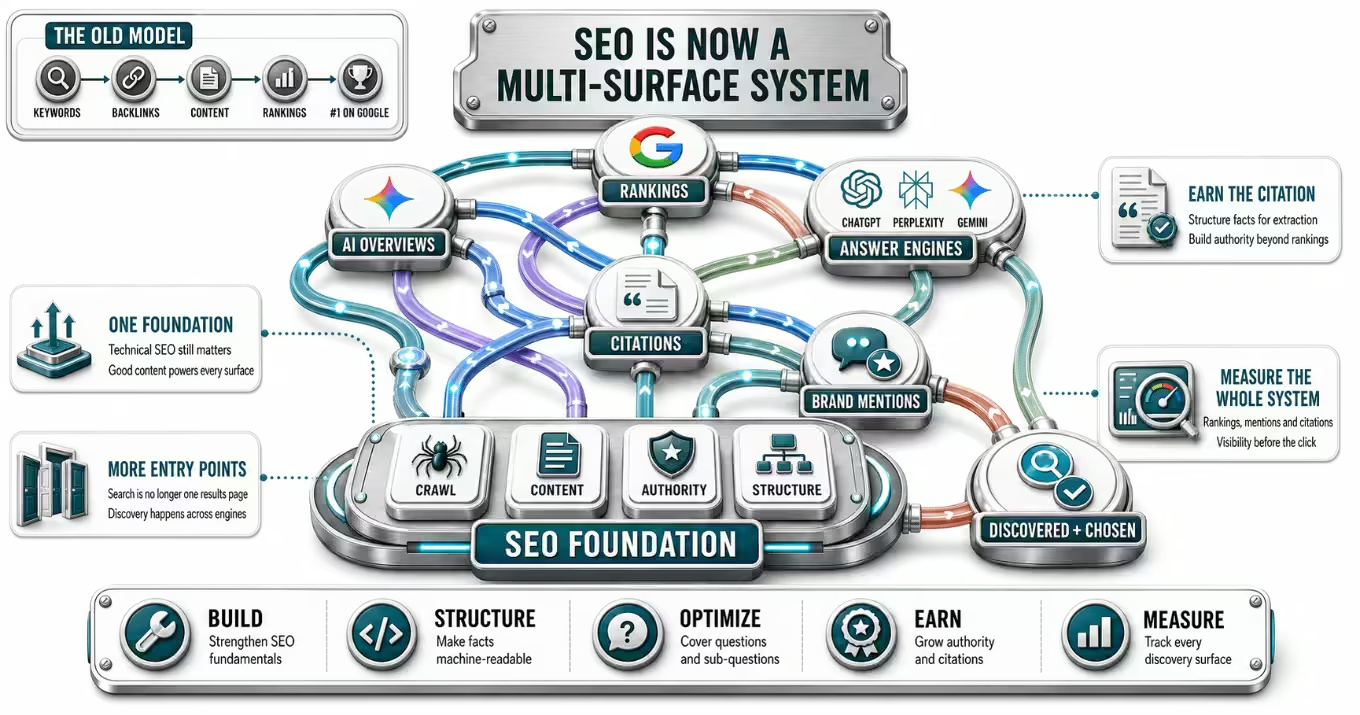
Almost everyone still carries the same mental picture of SEO. Keywords lead to backlinks, backlinks lead to content, content leads to rankings, rankings lead to clicks, and at the end of the line sits position one on Google. A tidy staircase. Do the work, climb the steps, collect the traffic.
That picture was always a simplification. In 2026 it is actively misleading, and the gap between the diagram in people's heads and the system they are actually competing in is where a lot of budget quietly disappears.
The real shape is messier and more interesting. One foundation now feeds several separate discovery surfaces at once. A person might meet your brand in a classic blue link, inside an AI Overview, in a ChatGPT answer that names you without linking you, or in a Perplexity citation they never click. Those are different doors into the same building, and they do not open with the same key. What follows is how the system actually works, what the evidence says about each surface, and the five moves that matter once you stop thinking in staircases.
The Old Model Was a Ladder. The New One Is a Network.
The ladder model had one useful property: every step led to exactly one next step. You could draw it, budget against it, and report on it with a single number.
The multi-surface model breaks that property in a specific way. Your foundational work, crawlability, content quality, authority and structure, no longer flows into one outcome. It flows into several, in parallel, and each surface applies its own selection logic on top. Google's ranking systems pick an ordered list. AI Overviews pick passages to synthesise and a handful of sources to cite. Answer engines like ChatGPT, Perplexity and Gemini retrieve, summarise and sometimes name a brand without linking anything at all. A page can be strong enough to rank and never get cited. It can get cited constantly and rank on page three.
This is the part worth sitting with, because it changes what "winning" means. Under the ladder model, visibility and traffic were nearly the same measurement. Under the network model they have come apart. You can be more visible than you have ever been and see fewer sessions, which is exactly the experience a lot of teams are having and misdiagnosing as an SEO failure.
What the Data Says About the New Entry Points
The most rigorous public evidence on how AI summaries change behaviour comes from Pew Research Center, which tracked the actual browsing data of 900 US adults across 68,879 unique Google searches in March 2025. It is worth flagging that this dataset is from 2025 and AI surfaces have expanded since, so treat it as a floor rather than a current reading.
The headline finding is stark. When an AI summary appeared, users clicked a traditional search result in 8% of visits. When no summary appeared, they clicked in 15% of visits, nearly twice as often. Clicks on the links inside the summary were rarer still, occurring in just 1% of visits. And users ended their browsing session entirely on 26% of pages with an AI summary, compared with 16% of pages without one.
Now the finding almost nobody talks about, which is the more actionable one. AI summaries are not distributed evenly across queries. They cluster hard around a specific query shape. Just 8% of one or two word searches produced an AI summary, but that rose to 53% for searches of ten words or more. Some 60% of queries starting with question words like who, what, when or why triggered a summary, and so did 36% of queries containing both a noun and a verb.
Read that as a map. The long, conversational, question-shaped queries are where AI surfaces dominate, and those are precisely the queries that carry research and comparison intent. Short head terms still behave much more like classic search. If your keyword strategy treats those two populations identically, you are applying one playbook to two different games.
One more number from the same study: 88% of AI summaries cited three or more sources, and only 1% cited a single source. Citation is not winner-take-all. There are several seats at the table for any given answer, which is a meaningfully better competitive structure than a ranked list where position one takes most of the value.
One Foundation Still Powers Every Surface
Here is where a lot of the current advice goes wrong. The multi-surface reality does not mean you need a separate AI strategy bolted onto an SEO strategy. It means the foundation now carries more weight, because the same work now has to satisfy more consumers.
Google is unusually direct about this. Its AI features documentation states that there are no additional requirements to appear in AI Overviews or AI Mode and no special optimisations necessary, pointing site owners back to standard SEO fundamentals. Google expanded on this in its May 2025 guidance on performing well in AI experiences on Search, which reads as a restatement of long-standing quality principles rather than a new checklist.
Take that seriously but read it precisely. Google is describing eligibility, not competitiveness. "No special optimisations required" means the door is not locked. It does not mean every page walks through it. The competitive question is whether your page is the most extractable, best-evidenced, most clearly-sourced answer available on the topic, and that is a content and structure question rather than a technical trick.
The four foundational inputs have not changed much: can machines reach the content, is the content good, does the domain carry authority, and is the information structured clearly enough to be understood without a human reading it. What changed is the payoff. A crawl blocker used to cost you rankings. Now it costs you rankings, AI Overview eligibility, and retrieval by every answer engine at once. Foundational neglect compounds in a way it did not five years ago.
It is also worth remembering that Google's spam policies still sit underneath all of this, and scaled content abuse, defined as generating many pages primarily to manipulate rankings rather than help users, applies no matter how the content is created. Multiplying thin pages to cover more surfaces is the single fastest way to damage the foundation the whole system runs on.
Structure Is How Facts Survive Extraction
If there is one new skill in this model, it is writing so that a machine can lift a fact out of your page without mangling it.
The clearest articulation of why this matters came from Shopify's second quarter 2026 earnings call, reported by TechCrunch. President Harley Finkelstein described the mechanical difference between search engines and agents: search engines rank by popularity against a handful of keywords, while AI agents make multiple calls into a catalogue, working with richer structured data to match products against a buyer's specific intent rather than just keywords. His example was a buyer asking for the best car seat that fits three across a sedan. Keyword search sees "car seat." An agent sees dimensions, vehicle type and a quantity constraint, and searches across all of them at once.
Shopify's numbers behind that: AI-driven traffic and orders tripled year over year, half of AI-referred sessions landed directly on a product description page, which is 2.5 times the rate of traditional search, and 75% of AI-attributed purchases fell outside its top 100 categories. Traditional search sessions still grew 1.3x over two years and hold roughly a third of storefront sessions, which is the part that supports the multi-surface reading rather than a replacement narrative.
The practical translation is not "add more schema." It is closer to this: every claim you want an engine to repeat should be stated once, plainly, in a form that survives being separated from the paragraph around it. Specifications, prices, eligibility criteria, dates, comparisons and definitions belong in unambiguous sentences and consistent structured data, not implied across three paragraphs of narrative. If a fact only makes sense in context, it will either be dropped or distorted when a model extracts it.
Earning a Citation Is Not the Same as Earning a Ranking
The economics underneath these surfaces are not symmetrical, and the infrastructure data makes that uncomfortably clear.
Cloudflare's analysis of crawl and referral behaviour found that training drove nearly 80% of AI bot activity by mid-2025, up from 72% a year earlier. Its crawl-to-refer figures, measuring how many pages a bot crawls for every visitor it sends back, were severe: Anthropic's crawler sat at roughly 38,000 crawls per referred visitor in July 2025, improved from 286,000 to one in January, while Perplexity ran at 194 crawls per visitor. Over the same window, Google referrals to news sites fell, with March 2025 down about 9% against January and April down 15%.
That is the honest shape of the citation economy. Being crawled is not being sent traffic, and for most answer engines the ratio is not close. Anyone promising that AI citations will replace your organic sessions one for one is selling something.
But it does not follow that citations are worthless, and the publisher data shows why. Press Gazette reported that People Inc saw Google fall to about 21% of traffic across its 19 core brands, down from roughly two thirds at peak, with sessions down 22%. Session-based revenue fell just 1%, because rates rose. Fewer, better-qualified visits were worth nearly as much as the larger volume that preceded them.
This is what "brand mentions" on a system diagram actually cash out to. When an assistant names you as one of three credible options, the person who then searches your brand directly arrives further along than any cold organic visitor ever did. The citation did not send the click. It shaped the decision before the click existed. That effect is real, it is hard to attribute, and pretending otherwise in either direction is how measurement conversations go wrong.
Measure the Whole System, Not Just the Click
Most reporting still describes the ladder, which is why so many dashboards show a business in decline that is actually holding steady.
Start with what is already free. Google Search Console includes AI Overviews and AI Mode data inside the main performance report rather than in a separate silo, and Google's performance report documentation explains that when someone asks a follow-up question inside AI Mode, that counts as a new query with its own impressions, position and clicks. The practical consequence is that conversational fragments and unusually long natural-language queries in your existing query export are a rough map of where you are appearing in AI surfaces. Imperfect, unlabelled, and available right now.
On the infrastructure side, Cloudflare's AI Insights on Radar now breaks AI bot traffic down by declared crawl purpose, separating training from search from user-triggered action, and publishes crawl-to-refer ratios by industry. That gives you an external benchmark for what is normal in your sector rather than guessing from your own logs.
Then add the layer no platform will hand you: how assistants actually describe your brand. Which competitors get named alongside you. Which sources get cited when your category comes up. Whether the description an assistant gives of your product is accurate. These are visibility measurements that exist before any click, and they are the only ones that behave sensibly when referral volume is falling for reasons that have nothing to do with your performance.
The reporting principle is simple to state and awkward to implement: measure presence on each surface separately, then measure business outcomes in aggregate. Do not try to attribute a subscription to an AI Overview citation. Do watch whether your presence across surfaces is rising while your qualified demand holds.
The Five Moves That Actually Matter
- Build. Strengthen the fundamentals, because they are now shared infrastructure. Crawl access, site health, content quality and genuine authority feed every surface simultaneously. This is the least fashionable work on the list and it has never paid back across more places at once.
- Structure. Make your facts machine-readable. State claims once, plainly, in forms that survive extraction, and keep structured data consistent with what a human sees on the page. The Shopify car seat example is the whole brief: an agent matching real constraints needs real attributes, not adjectives.
- Optimise for questions and their sub-questions. The Pew data is explicit that long, question-shaped queries are where AI surfaces concentrate. Cover the primary question and the follow-ups a real person would ask next, because in AI Mode those follow-ups are separate queries with separate chances to appear.
- Earn. Authority and citations still come from the unglamorous sources: original data, first-hand expertise, being referenced by publications that engines already trust. There is no shortcut here, and the fact that 88% of AI summaries cite three or more sources means there is more room at the table than a ranked list ever offered.
- Measure. Track every discovery surface, and separate visibility from traffic in your reporting so a fall in one does not get read as failure in the other.
None of this requires abandoning SEO. That is the point the two diagrams make better than any paragraph: the foundation did not get replaced, it got connected to more things. The teams struggling right now are mostly not doing bad SEO. They are doing perfectly good SEO and reporting on it with a picture of a staircase, then wondering why the numbers stopped making sense.
If you want a view of how your brand shows up across rankings, AI Overviews and answer engines as one connected system rather than four disconnected reports, that is the work we do in SEO and GEO. Start by drawing your own version of the second diagram. Most teams find at least one surface they have never measured at all.
Frequently Asked Questions
Common questions about GEO, SEO, and AI-driven search visibility.
It means a single body of work now feeds several independent discovery surfaces rather than one results page. The same crawlable, well-structured, authoritative content can produce a classic blue link ranking, an AI Overview citation, an answer engine mention in ChatGPT or Perplexity, and a brand reference inside a generated answer. The inputs are shared, the surfaces are separate, and a page can win on one while losing on another.
Yes, according to the most rigorous public dataset available. Pew Research Center analysed the browsing behaviour of 900 US adults across 68,879 Google searches in March 2025 and found users clicked a traditional search result in 8% of visits where an AI summary appeared, compared with 15% where it did not. Clicks on links inside the summary itself occurred in just 1% of visits, and 26% of users ended their browsing session entirely after an AI summary, against 16% without one.
Longer, question-shaped queries. Pew Research found that 8% of one or two word searches produced an AI summary, rising to 53% for searches of ten words or more. Some 60% of queries beginning with question words such as who, what, when or why triggered a summary, as did 36% of searches containing both a noun and a verb. Overall, 18% of the Google searches in the study produced an AI summary.
They are different objectives running on largely the same foundation. Traditional SEO optimises for position in a ranked list. Answer engine optimisation and generative engine optimisation target being extracted, cited and named inside a generated answer, which can happen without any ranking position at all. The underlying requirements of crawlability, accurate structured content and demonstrable authority are shared, which is why treating them as separate disciplines with separate teams usually wastes effort.
Google says no. Its AI features documentation states there are no additional requirements to appear in AI Overviews or AI Mode and no special optimisations necessary, directing site owners back to standard SEO fundamentals. That guidance describes eligibility rather than competitiveness, so the practical work sits in making your content the most extractable and best-evidenced answer available, not in a separate technical checklist.
Use several instruments, because no single one covers the system. Google Search Console includes AI Overviews and AI Mode data in the main performance report, and Google documents that follow-up questions inside AI Mode count as new queries. Cloudflare Radar publishes AI bot traffic broken down by crawl purpose and crawl-to-refer ratios by industry. Beyond those, track how assistants describe your brand, which competitors they name beside you, and which sources they cite, since those signals appear before any click exists to measure.
It matters more, because it is now load-bearing for several surfaces at once. A page that cannot be crawled cannot be ranked, summarised, cited or recommended. Technical health, content quality and authority remain the shared input to Google rankings, AI Overviews and answer engine citations, which means foundational work compounds across surfaces instead of paying off on just one.
Sources
- Pew Research Center: Google users are less likely to click on links when an AI summary appears in the results (opens in a new tab)
- Google Search Central: AI features and your website (opens in a new tab)
- Google Search Central: Top ways to ensure your content performs well in Google's AI experiences on Search (opens in a new tab)
- Google Search Central: Spam policies for Google Web Search (opens in a new tab)
- Google Search Console Help: Performance report (Search) (opens in a new tab)
- Cloudflare: The crawl-to-click gap, data on AI bots, training, and referrals (opens in a new tab)
- Cloudflare: A deeper look at AI crawlers, breaking down traffic by purpose and industry (opens in a new tab)
- TechCrunch: Shopify says AI search is driving more traffic and sales, not replacing Google (opens in a new tab)
- Press Gazette: People Inc not blocking Google 'at the moment' as it rolls out digital subscriptions (opens in a new tab)