





What Is SXO? The Discipline That Starts Where Ranking Ends
 Preferred source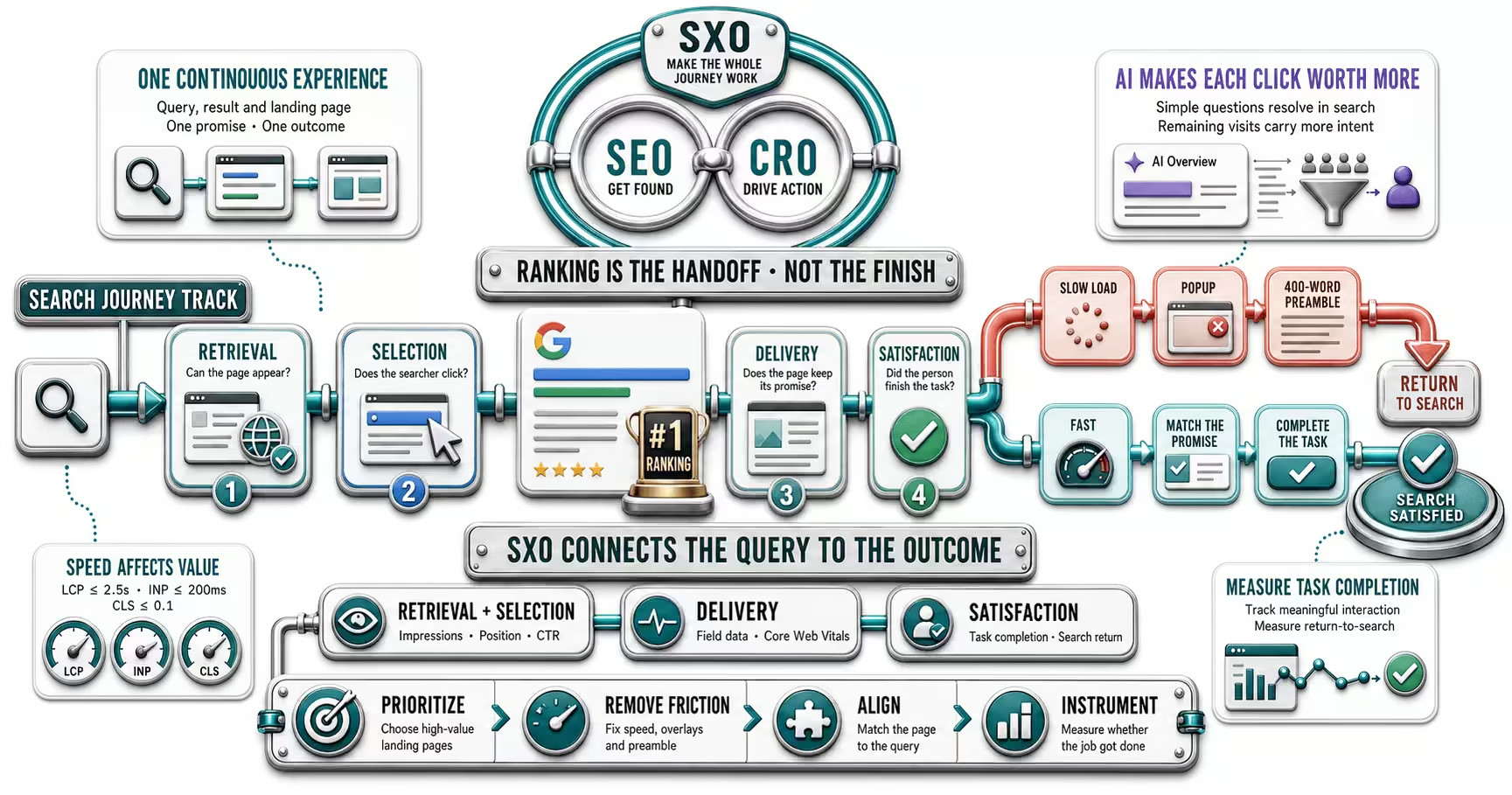
A page can rank first and still fail. Someone types a question, sees your result, clicks it, waits two seconds for a hero image to resolve, gets hit with a newsletter overlay, scrolls past four hundred words of preamble looking for the answer they were promised, and goes back to Google. The ranking worked perfectly. Everything after it did not.
That gap has a name now. SXO, or search experience optimization, is the practice of optimizing the whole path a searcher travels rather than just the part that ends when they click. It treats the query, the result, the landing page, and the task the person actually came to complete as one continuous experience with one measure of success: did they finish what they started?
This piece covers what SXO means, where the term came from, what Google does and does not reward, how SXO differs from SEO and CRO in practice, why AI search has made it considerably more urgent, and how to measure it without fooling yourself. One thing up front, because it matters for how you use the rest: SXO is an industry term, not a Google one. Google has never shipped a system, a report, or a piece of documentation called SXO. What it has published are all the component parts.
What SXO actually means
Search experience optimization is the discipline of making search work end to end for the person doing the searching. It spans three moments that most organisations treat as separate projects owned by separate teams.
The first is retrieval, which is whether you are eligible to appear at all. The second is selection, which is whether the searcher picks your result over the nine others and the AI summary sitting above them. The third is satisfaction, which is whether the page delivers on the promise that earned the click.
Traditional SEO reporting stops after the second moment. It tells you that a page moved from position seven to position three and that clicks rose accordingly. It cannot tell you that 60% of those new clicks bounced back to the results page within eight seconds, because that data lives in a different tool, owned by a different team, reviewed in a different meeting.
SXO is the argument that this split is artificial and expensive. A visit that ends in a return to search is not a win that needs better attribution. It is a failure that your ranking report is quietly recording as a success.
Where the term came from, and why now
SXO entered the vocabulary because two things happened to search at roughly the same time.
Google's ranking systems got measurably better at approximating satisfaction rather than just relevance. The helpful content guidance asks creators to self-assess against questions that have nothing to do with keywords: will someone reading your content leave feeling like they have had a satisfying experience, and will they leave feeling they have learned enough to achieve their goal? The same document asks whether you are writing to a particular word count because you heard Google prefers one, and answers its own question bluntly: no, it does not.
At the same time, the free ride on informational traffic ended. AI Overviews and AI Mode now resolve a large share of simple informational queries inside the results page. The clicks that still arrive at your site are increasingly the harder, higher-intent ones, which means each one is worth more and each wasted one costs more.
Put those together and the economics shift. When traffic was abundant, a mediocre landing experience was a rounding error you could out-volume. When traffic is scarcer and more valuable per visit, the landing experience becomes the constraint.
What Google actually rewards, stated honestly
This is where most SXO writing overclaims, so it is worth being precise about what is documented and what is inference.
Google's page experience documentation is unambiguous on one point: there is no single page experience signal. Its core ranking systems look at a variety of signals that align with overall page experience. Within that, Core Web Vitals are confirmed as used by ranking systems. The current thresholds, per web.dev, are 2.5 seconds or less for Largest Contentful Paint, 200 milliseconds or less for Interaction to Next Paint, and 0.1 or less for Cumulative Layout Shift, assessed at the 75th percentile of page loads and segmented across mobile and desktop. INP became a stable Core Web Vital in 2024, retiring First Input Delay.
Then comes the sentence most people skip. Google states that beyond Core Web Vitals, other page experience aspects do not directly help your website rank higher in search results, though they can make your website more satisfying to use, which is generally aligned with what its ranking systems seek to reward. Google also notes that good scores in the Search Console Core Web Vitals report do not guarantee good rankings, and that chasing a perfect score purely for SEO reasons may not be the best use of your time.
So the honest framing is this. SXO is not a ranking lever with a documented multiplier. Core Web Vitals are a real but modest input. Everything else in the page experience bucket earns its place because it improves the outcome rankings are trying to proxy for, and because it makes you money regardless of what happens in the SERP.
That last part is the argument that actually survives contact with a finance director. Google's own collection of Core Web Vitals case studies documents Vodafone Italy improving LCP by 31% and recording 8% more sales, Nykaa finding that a 40% LCP improvement led to 28% more organic traffic from tier two and tier three cities, Agrofy Market correlating a 70% better LCP with a 76% reduction in load abandonment, and Yahoo! Japan gaining a 15% uplift in page views per session after fixing layout shift. None of those are ranking claims. They are revenue and engagement claims, which is the point.
SXO versus SEO versus CRO
The cleanest way to hold the three apart is by what each one is accountable for when something goes wrong.
If nobody sees the page, that is an SEO problem. Crawling, indexing, canonicalisation, internal linking, and topical coverage all sit here. If people see the page and do not click, that is a selection problem, which sits in the overlap: title links, snippets, structured data eligibility, and brand familiarity all influence it. If people click and leave without doing anything, that is where CRO traditionally lives.
SXO's contribution is refusing to let those three sit in separate reports. It insists that a query and its landing page are a single unit that either works or does not, and that the only defensible measure of "works" is task completion.
This has an uncomfortable implication for how agencies and in-house teams are usually structured. The person who chose the target keyword is rarely the person who wrote the landing page headline, who is rarely the person who approved the interstitial that fires three seconds after load. SXO is as much an organisational fix as a technical one. If you take nothing else from this piece, take that.
It is also why we do not sell SXO as a separate product. At Silverback it is part of our SEO and GEO service as standard, not an upsell, because carving the ranking work away from the landing experience is precisely what creates the gap this article is about. Any agency that quotes you separately for the two has already introduced the problem.
Why AI search made SXO the whole game
Google published a guide to optimizing for generative AI features that reads, in places, like an SXO manifesto written by the search engine itself.
On the relationship between AI search and everything you already do, it states that from Google Search's perspective, optimizing for generative AI search is optimizing for the search experience, and thus still SEO. That is Google collapsing the distinction between search optimization and experience optimization in its own documentation.
The mechanics back it up. AI Overviews and AI Mode are rooted in Google's core Search ranking and quality systems, using retrieval-augmented generation to ground responses in indexed pages, and query fan-out to issue related queries alongside the original one. To be eligible at all, a page must be indexed and able to appear with a snippet. Providing a good page experience appears in the same guide as a technical recommendation, sitting next to crawlability and duplicate content.
Just as usefully, the guide tells you what to stop doing. You do not need llms.txt files or other special machine-readable markup, because Google Search does not use them. You do not need to chunk content into small pieces. You do not need to rewrite content specifically for AI systems, and structured data is not required for generative AI features, though it remains worthwhile for rich results. Chasing inauthentic mentions is called out directly.
Strip the tactics away and what remains is content with a genuine point of view, organised so a human can follow it, delivered on a page that does not fight the reader. That is the brief.
How to measure SXO without fooling yourself
Measure in three layers, and treat the first two as inputs rather than outcomes.
Retrieval and selection come from Search Console: impressions, average position, and click-through rate, plus the Generative AI performance report for visibility inside AI features. That report currently shows impressions, pages, countries, devices, and dates, but no clicks and no queries, so read it as a visibility trend rather than a performance number.
Delivery comes from field data, not lab scores. Use real user monitoring or the Chrome User Experience Report rather than a one-off PageSpeed Insights run, because Google assesses at the 75th percentile of real page loads and lab tools cannot measure INP at all without a real user to interact with the page.
Satisfaction is the layer almost nobody instruments, and it is the one that makes the whole discipline defensible. Track scroll depth to the point where the query is answered, time to first meaningful interaction, task completion rate by landing page, and return-to-search behaviour. If you build only one new metric this quarter, build the percentage of search-originated sessions that complete the job the query implied. It is harder to define than a bounce rate and infinitely more useful.
For the qualitative side, Google's search quality rater guidelines remain the best free framework for assessing whether a page meets the need behind a query. Raters have no direct effect on rankings, and rater data is not used in the algorithms, but the guidelines describe what Google is trying to reward, which makes them a good proxy for reviewing your own pages.
Where to start on Monday
- Audit your ten highest-value landing pages against Google's own questions. Pick them by revenue or pipeline contribution, not by traffic, then run each one through the page experience self-assessment: good Core Web Vitals, displays well on mobile, ads that do not distract from or interfere with the main content, no intrusive interstitials, and a visitor can easily distinguish the main content from everything else. Most teams find three or four obvious failures in the first hour.
- Read the first screen of each page against the query it targets. Ask one question: does this resolve the search, or does it warm up to resolving the search? Preamble is the single most common SXO defect and the cheapest to fix.
- Instrument task completion on those ten pages before you change anything, so you can prove the delta. The work is not glamorous and it will not produce a chart that spikes the week you ship it. It will, over a quarter, make every existing ranking worth more, which is a better trade than chasing new ones.
Frequently Asked Questions
Common questions about GEO, SEO, and AI-driven search visibility.
SXO stands for search experience optimization. It is the practice of optimizing the entire path a person takes through search, from the query they type, to the result they choose, to whether the page they land on actually resolves the thing they came to do. Traditional SEO is judged on whether a page ranks. SXO is judged on whether the searcher's task gets completed. It is an industry term rather than a Google one, and Google has never shipped a product, report, or ranking system called SXO. What Google does document are the component parts: Core Web Vitals thresholds, page experience self-assessment questions, and the helpful content guidance that asks whether someone leaves your page feeling they learned enough to achieve their goal. SXO is the operational name for treating those parts as one job instead of three separate backlog tickets owned by different teams.
SEO and SXO overlap heavily, and the difference is where each one stops measuring. SEO is largely concerned with eligibility and position: getting a page crawled, indexed, understood, and ranked for the right query. SXO carries the same work forward past the click and asks whether the landing experience satisfies the intent behind that query. In practice this means SEO owns the title link, the snippet, and the ranking, while SXO also owns what happens in the ninety seconds after someone arrives: whether the page loads fast, holds its layout, answers the question near the top, and makes the next step obvious. Google's own framing collapses the distinction. Its guide to generative AI search states that optimizing for generative AI search is optimizing for the search experience, and is therefore still SEO. SXO is best understood as SEO measured honestly, all the way to task completion.
No, and neither is page experience as a single unified signal. Google's page experience documentation is explicit that there is no one page experience signal, and that its core ranking systems instead look at a variety of signals that align with overall page experience. Core Web Vitals are confirmed to be used by those ranking systems, with good thresholds set at 2.5 seconds for Largest Contentful Paint, 200 milliseconds for Interaction to Next Paint, and 0.1 for Cumulative Layout Shift, measured at the 75th percentile of page loads. Google also states plainly that other page experience aspects beyond Core Web Vitals do not directly help a site rank higher, though they make a site more satisfying to use. The honest position is that SXO is not a lever you pull for rankings. It is a discipline that improves the things rankings are trying to approximate, and improves revenue whether or not rankings move.
Measure SXO in three layers, because no single metric captures it. Layer one is retrieval: impressions, position, and click-through rate in Search Console, plus the Generative AI performance report for visibility inside AI Overviews and AI Mode. Layer two is delivery: field Core Web Vitals from real users rather than lab scores, since Google assesses at the 75th percentile and lab tools cannot measure Interaction to Next Paint at all without real user input. Layer three is satisfaction, which is where most teams stop short. Track scroll depth to the answer, time to first meaningful interaction, task completion rate, and return-to-search behaviour. The single most useful SXO metric is the one almost nobody instruments: the percentage of sessions that arrive from search and complete the job the query implied. Rankings and Core Web Vitals are inputs. Task completion is the actual outcome SXO exists to move.
It matters more, not less. Google's guide to optimizing for generative AI features confirms that AI Overviews and AI Mode are rooted in its core Search ranking and quality systems, and that a page must be indexed and eligible to appear with a snippet before it can surface in those features. The same guide lists providing a good page experience among its technical recommendations, alongside crawlability and reducing duplicate content. It also debunks several popular tactics: you do not need llms.txt files, content chunking, or special schema markup to appear in Google's AI features. What remains is unique, non-commodity content organised so humans can follow it. That is an SXO brief written in Google's words. As AI answers absorb more informational clicks, the visits that still reach your site skew toward higher intent, which raises the cost of a page that ranks well and then disappoints.
Start by making the page answer its own query in the first screen, then remove whatever delays that answer. Google's page experience self-assessment asks whether visitors can easily distinguish the main content from everything else, whether the page avoids intrusive interstitials, and whether ads interfere with the main content. Those three questions alone will find most problems on a typical page. Next, fix the delivery layer against real user data: Vodafone Italy improved Largest Contentful Paint by 31% and recorded 8% more sales, while Nykaa found a 40% LCP improvement led to 28% more organic traffic from tier two and tier three cities. Then close the intent gap by rewriting the opening so it resolves the query directly rather than warming up to it. Finally, make the next step unambiguous. A satisfied searcher who cannot find what to do next is still a failed session.
Sources
- Google Search Central: Understanding page experience in Google Search results (opens in a new tab)
- Google Search Central: Optimizing your website for generative AI features on Google Search (opens in a new tab)
- Google Search Central: Creating helpful, reliable, people-first content (opens in a new tab)
- Google Search Central: Understanding Core Web Vitals and Google Search results (opens in a new tab)
- Google Search Central: Avoid intrusive interstitials and dialogs (opens in a new tab)
- web.dev: Web Vitals (opens in a new tab)
- web.dev: The business impact of Core Web Vitals (opens in a new tab)
- Google Search Console Help: Generative AI performance report (opens in a new tab)
- Google: Search quality rater guidelines (opens in a new tab)
- Google: PageSpeed Insights (opens in a new tab)