
Zuckerberg's Superintelligence Manifesto: A Marketer's Read
 Preferred source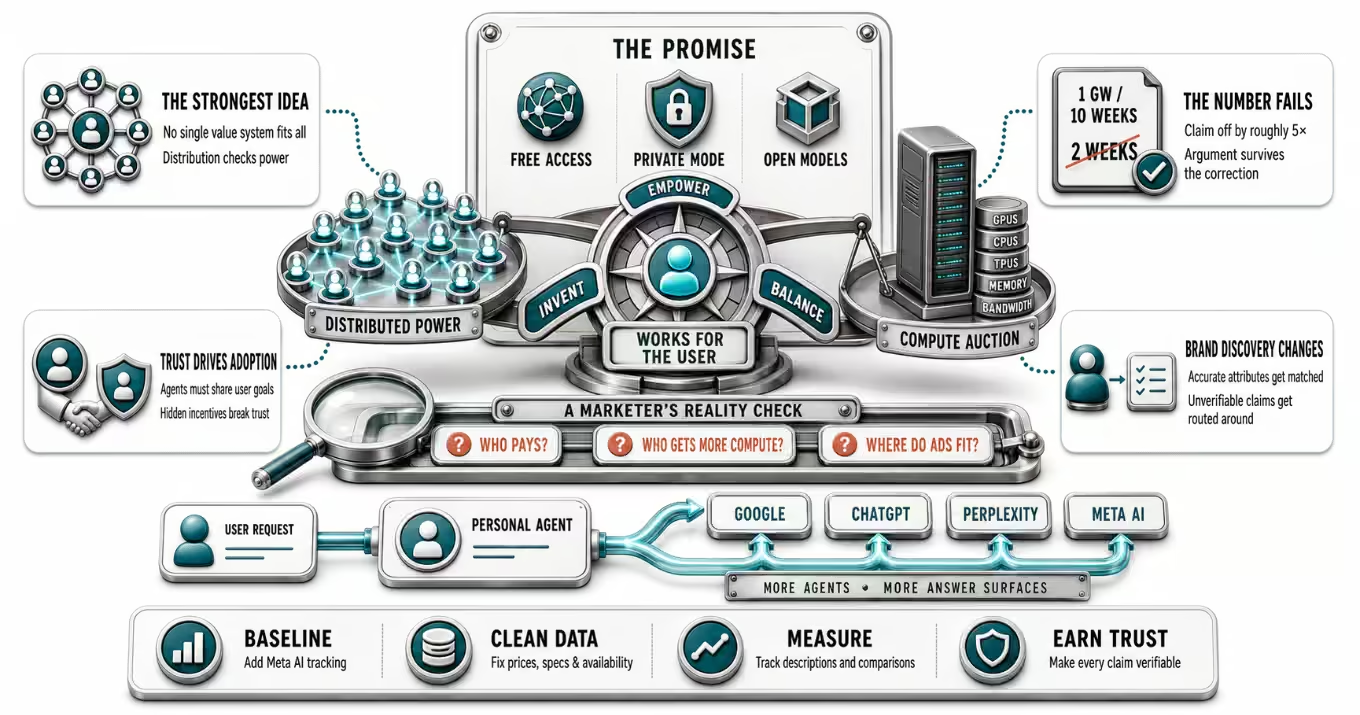
Mark Zuckerberg published a manifesto on Monday called The Future is for Everyone. It is not a product launch and it is not an earnings note. It is roughly 6,000 words of philosophy about who should get access to superintelligence, and it is the clearest statement yet of how the company that owns Facebook, Instagram and WhatsApp intends to compete in AI.
I read it twice. The first time as someone who finds the argument more interesting than I expected. The second time as someone who spends his working life figuring out how brands get found inside AI systems, which is a narrower lens but a useful one.
Here is the summary, the parts I think are right, the parts I think are weak, and the one number that does not survive a fact check. Then the part that actually matters for anyone doing this work: what happens to brand discovery if Meta is even half right.
What the Manifesto Actually Argues
Three claims carry the whole document.
First, individual empowerment is the source of prosperity. Zuckerberg's position is that progress has historically come from people with tools rather than from institutions alone, and he reaches for the Wright brothers, Faraday and the personal computer to make the point. Give more people more capability and you get more invention.
Second, invention rather than automation is the purpose of superintelligence. His framing is that early AI answered questions and did routine work, while the next phase discovers new things. The line he builds on is that the number of questions a person can ask in a day is limited, but the number of valuable things superintelligence can invent on your behalf is not.
Third, and this is the load-bearing one, balance of power is the foundation of safety. He rejects the idea that alignment can be solved by making one system benevolent, on the grounds that humanity is not a monoculture and no single system can serve opposing values at once. His alternative is distribution: give capable AI to enough people, businesses and labs that they check each other the way competing interests do in a democracy or a market.
The commitments attached to this are specific enough to hold him to. Free versions for billions of people. A dynamic auction for people who want more compute. A fully private mode where Meta itself cannot see your data. A resumption of open source model releases now that Meta Superintelligence Labs is running. And a governance change giving Meta's independent board the power to approve safety criteria for model releases, with Zuckerberg writing that he does not think it is in his, Meta's, or the world's best interests for him or anyone else to be a sole decision-maker on how superintelligence is deployed.
Where I Think He Is Right
The monoculture argument is the strongest thing in the piece, and I do not think it gets enough credit because of who is making it.
The dominant safety framing for three years has been that if we are careful enough and slow enough, we can align a very powerful system with human values. Zuckerberg's objection is not that alignment is too hard. It is that the target does not exist. Human values conflict in ways that are not resolvable by better engineering, so any single aligned system has to pick which values win. That is a real problem, and calling it a technical problem does not make it one. Whatever you think of Meta, that is a serious argument.
The superintelligent lawyer thought experiment clarifies it well. One person with a superintelligent lawyer produces injustice. Everyone with one produces something closer to fair. The asymmetry is the harm, not the capability.
I also think his reframing of alignment is operationally correct, and it is the part marketers should pay closest attention to. He defines alignment as an agent sharing the user's goals rather than the vendor's, and argues people will not delegate real tasks to an agent they suspect is working an angle. That is not idealism. It is a product observation. Trust is the constraint on adoption, and an assistant that quietly serves someone else's interests gets abandoned once users notice.
The governance concession deserves acknowledgment too. Handing an independent board approval rights over release criteria is a real check, and he is right that most frontier lab CEOs currently hold that authority personally. There is a limit: Meta is a founder-controlled company, so the board's independence has a ceiling. But it is more structure than most labs have committed to publicly, and he invites others to match it.
Where the Argument Gets Thin
Three places, in order of how much they matter.
Access is not the same as power. The entire balance-of-power case assumes that distributing superintelligence distributes leverage. But capability is metered by compute, and the document says so itself: free tiers for everyone, and a dynamic auction for those who want to pay for more. That means the balance of power tracks compute budgets, and a well-funded institution will simply buy more intelligence than a person will. The argument does not fail, but it is weaker than presented. Distribution flattens the curve. It does not flatten it to zero, and Meta runs the auction.
The document never says the word advertising. Meta funds itself almost entirely through ads. The manifesto promises free superintelligence to billions of people while defining alignment as serving the user's goals rather than the company's. Those two commitments are compatible, but only with mechanisms the document does not describe. I am not accusing anyone of bad faith here. I am saying that a philosophy of individual empowerment published by an advertising company should explain how the free tier is paid for, and this one does not. That is the single biggest gap for anyone in my line of work, because the answer determines whether a personal agent is a discovery surface brands earn their way into or one they buy their way into.
The jobs argument is asserted more than evidenced. He writes that recent statistics suggest individuals' capability growth could match or outpace automation, and then does not cite them. That is a load-bearing empirical claim presented without support. In fairness, the doom side of this argument is usually just as uncited, and he is careful to frame the outcome as depending on which kind of lab leads. But an unsourced statistic is an unsourced statistic, and I would apply the same standard to a client's deck.
I will add a smaller one on biological risk. His reasoning leans on the observation that bad actors have been able to synthesize harmful compounds for decades and it has rarely become a significant issue. Absence of past incidents is weak evidence about a capability that is currently changing. He does pair it with genuine humility and a commitment to adjust if harms emerge, which is more than a lot of policy writing manages. Reasonable people land in different places on how much precaution that warrants, and I do not think this piece settles it either way.
The One Number That Does Not Check Out
In the section on American leadership, the manifesto states that countries like China are bringing online more than a gigawatt of nuclear capacity every other week. That works out to roughly 26 GW a year.
The public data does not support it. EIA analysis published June 5, 2026, using International Atomic Energy Agency Power Reactor Information System figures, reports that China added 1.1 GW of nuclear capacity in 2025 and 2.2 GW in 2026 through May. As of May 2026, China had 60 operational reactors totalling 58.7 GW, with 36 more under construction that would add about 38.9 GW. The American Nuclear Society summarized the same analysis as an 87% increase over ten years.
So the real rate is closer to one gigawatt every ten weeks than every other week, off by roughly a factor of five.
I want to be fair about what this does and does not undermine. The underlying point stands easily: China builds energy and physical infrastructure far faster than the US does, it accounts for about half of all nuclear construction worldwide, and its average build time is around six years against a global average of nine. Permitting speed is a genuine competitive constraint. The argument survives. The statistic does not, and in a document this consequential I would have expected someone to check it.
What This Means If He Is Even Half Right
Now the part that changes how we work.
Strip away the philosophy and Meta is describing a personal agent, running across Facebook, Instagram, WhatsApp and glasses, that knows your goals and acts on your behalf. If that ships at Meta's distribution scale, it becomes a major answer surface almost overnight, and it will be the fourth one most brands have to account for after Google, ChatGPT and Perplexity.
Right now, almost nobody measures it. Brands that have built AI visibility programs are tracking ChatGPT, Gemini, Perplexity and AI Overviews. Meta AI is rarely in the reporting, partly because it has not driven meaningful referrals and partly because it is hard to see. That gap closes fast if personal agents arrive with billions of users attached.
The second implication is subtler and, I think, more important. Zuckerberg's alignment framing says the agent works for the user, not the vendor. If that holds, then getting recommended is not a placement you negotiate. It is a function of whether the agent, reasoning about a specific person's actual constraints, concludes your product is the right answer. That rewards structured, accurate, machine-readable information about what you actually sell and who it is actually for. It punishes positioning copy that cannot be verified.
Third: broadly released open weights mean more retrieval endpoints than you can enumerate. Your content will inform answers generated by systems that never send you a referral and never appear in your analytics. Attribution gets harder, not easier. The teams that cope will be the ones who stopped treating referral traffic as the only evidence of visibility and started measuring how they are described, cited and compared inside AI answers directly.
None of this is contingent on Meta winning. It is contingent on personal agents becoming a normal way people decide things, and that trend does not depend on any single company.
What I Would Do About It This Quarter
- Add Meta AI to your visibility tracking now, while it is cheap to do and before anyone asks for it. You want a baseline that predates the launch, not a scramble after it.
- Get your entity and product data clean. Not as an SEO checkbox, but because the mechanism Zuckerberg describes, an agent matching a person's actual constraints against real product attributes, only works on top of accurate structured information. If your specifications, availability, pricing and audience fit are vague or stale, an agent reasoning on the user's behalf will route around you. This is the same work that pays off across SEO and GEO generally, which is a good sign it is the right work.
- Stop treating referral traffic as the whole picture. Track how AI systems describe your brand, which competitors they name alongside you, and which sources they cite when they do. That is the measurement layer that survives whichever assistant wins.
- Read the manifesto yourself rather than the coverage of it. It is a company making its most expensive bet in public, and the argument is better than the cynical read suggests, even where the evidence behind it is thinner than it should be.
Frequently Asked Questions
Common questions about GEO, SEO, and AI-driven search visibility.
The Future is for Everyone is a philosophy document Mark Zuckerberg published on Meta's newsroom on August 10, 2026. It argues for three principles: individual empowerment as the source of prosperity, invention rather than automation as the primary purpose of superintelligence, and balance of power as the foundation of AI safety. It is not a product launch. It is Meta's case for distributing AI capability widely instead of concentrating it in a few labs.
He argues there is no technical way to build one superintelligence that is benevolent to everyone, because human values conflict and any single system would have to pick winners. His alternative is to distribute capable AI to as many people, businesses and labs as possible so they check each other, the way competing interests check each other in a democracy or a market. His illustration is that one person with a superintelligent lawyer creates unfairness, while everyone having one makes the courts fairer.
Yes, according to the manifesto. Zuckerberg writes that now that Meta Superintelligence Labs are up and running, the company will resume releasing some open source models soon. The word resume matters, because it confirms a pause had occurred. He also states that Meta believes restricting the current open source ecosystem would be a mistake, and that US policy on training data and distillation should change so American open source models can compete globally.
It points to a fourth major answer surface. If Meta ships personal agents to billions of people across Facebook, Instagram, WhatsApp and its glasses, brand discovery moves further away from ranking for a query and toward being retrievable and recommendable by an agent that already knows the user. Most brands currently measure their visibility in ChatGPT, Gemini, Perplexity and AI Overviews. Almost none measure how Meta AI describes them.
Not directly. The word advertising does not appear in the document. Zuckerberg commits to free versions accessible to billions of people, plus a dynamic auction mechanism for people who want to pay for more compute. He also defines alignment as an agent serving the person's goals rather than the company's. Given that advertising funds nearly all of Meta's revenue, how the free tier is paid for is the open question the document leaves unanswered.
The specific figure does not hold up. The manifesto states that countries like China are bringing online more than one gigawatt of nuclear capacity every other week, which would be roughly 26 GW per year. US Energy Information Administration analysis published June 5, 2026, drawing on IAEA Power Reactor Information System data, reports China added 1.1 GW in 2025 and 2.2 GW in 2026 through May. The broader point that China builds energy infrastructure faster than the US is well supported, but the rate is overstated by roughly a factor of five.