




Why AI Search Makes E-E-A-T More Important
 Preferred source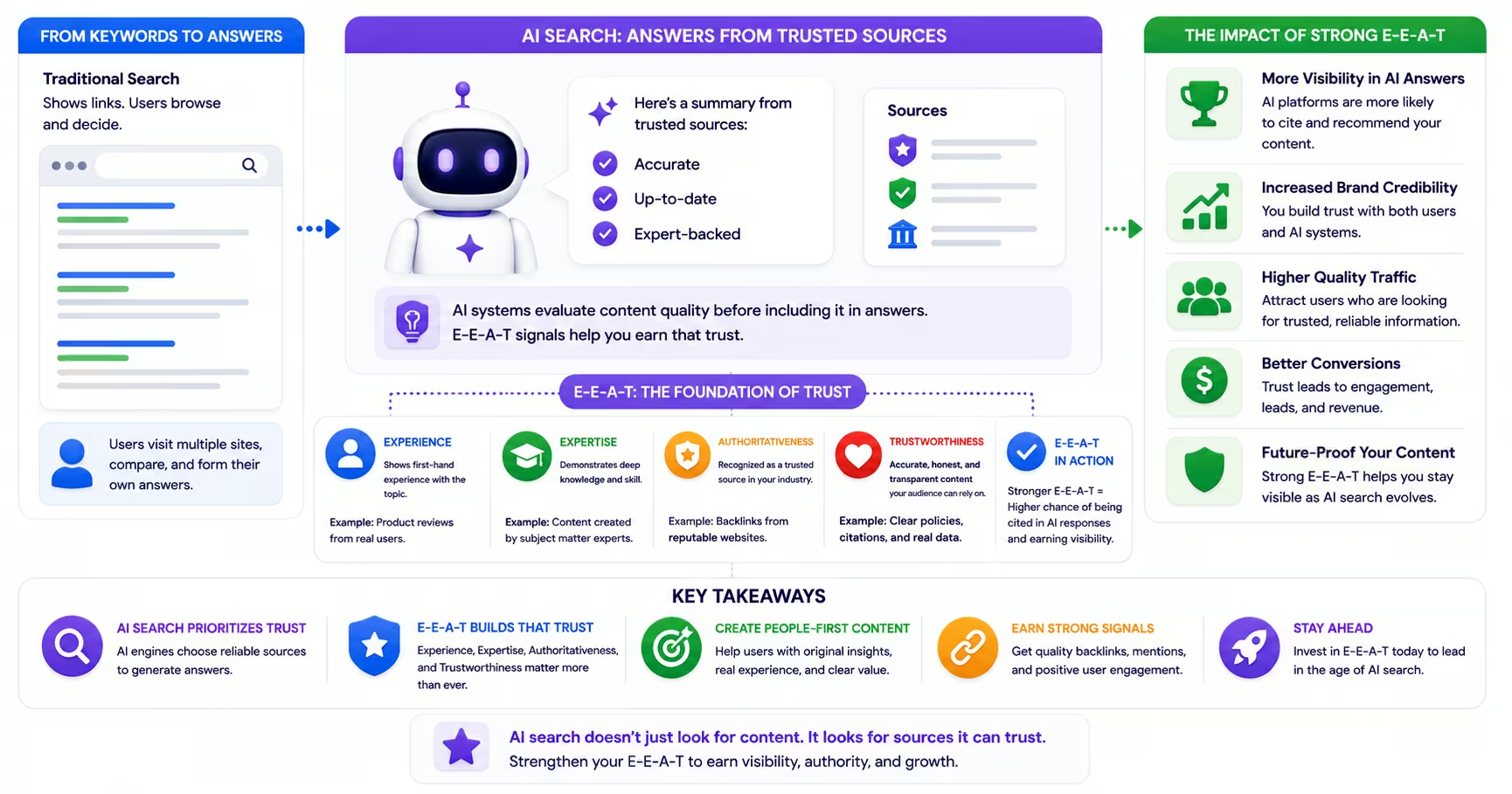
When Google introduced E-A-T, which it later expanded to E-E-A-T by adding Experience, the framework was intended to help human quality raters evaluate content. It was a guideline for manual review processes, not a directly measurable ranking signal in the same way that page speed or backlinks are. Many SEO practitioners treated it as aspirational rather than operational. Then AI search arrived and changed the math entirely.
AI-powered search systems do not produce a list of ten results and let users evaluate them. They synthesize a single answer, attribute it to a small number of cited sources, and present it as the authoritative response to the user's query. That shift is why GEO and E-E-A-T now overlap so directly. In that environment, E-E-A-T is no longer a quality guideline. It is an eligibility criterion. Sources that AI systems cannot confidently classify as authoritative, trustworthy, and experiential are not cited. The content simply does not appear in the answer. For any brand that depends on organic and AI search for visibility, building robust E-E-A-T signals has become one of the most strategically important investments in the content program, and a central focus of AI visibility work.
What E-E-A-T Actually Measures
Experience refers to whether the content reflects direct, first-hand engagement with the subject matter. A piece of content about running a restaurant written by someone who has run a restaurant carries an experience signal that a purely research-based piece from an outside writer does not. AI systems are increasingly capable of detecting this distinction, particularly when content includes specific, verifiable details that only practitioners would know.
Expertise refers to demonstrated knowledge of the subject domain. It is signaled through depth of coverage, technical accuracy, clear differentiation of the author's perspective from common knowledge, and verifiable credentials where applicable. Authoritativeness refers to recognition by other credible sources in the same domain, including backlinks from reputable publications, citations in industry resources, and mentions in third-party content. Trustworthiness refers to the overall reliability of the source, including clear ownership information, transparent editorial processes, accurate contact information, and consistent factual accuracy over time.
Why AI Raises the Stakes
Traditional search surfaces ten results per page and gives users the ability to evaluate credibility themselves by clicking through, reading, and choosing to trust or distrust a source. AI search removes that evaluation step. The AI does the credibility assessment on behalf of the user and presents only the sources it has deemed sufficiently authoritative. If your content does not pass the AI's credibility filter, it does not receive a citation, regardless of how well it ranks in traditional results.
The competitive consequence is stark. Google AI Overviews cite only a handful of sources per answer: one analysis of 1,000 AI Overviews found an average of 4.2 citations, with most answers drawing from between two and nine pages. In a query category where hundreds of pages compete, only those few citations receive the credibility endorsement that comes with being selected by the AI. And that selection pays: Seer Interactive's study of 25 million impressions found that brands cited in AI Overviews earn roughly 35 percent more organic clicks than non-cited brands in the same results. The authority gap between cited and non-cited content is becoming the most consequential divide in organic search performance.
Building the Experience Signal
Experience is the newest and in many ways the most distinctive dimension of E-E-A-T. Google added it to the framework in December 2022 precisely because research-only content had become easy to mass-produce, and its guidance has emphasized first-hand knowledge ever since. Content that reflects direct experience with a topic consistently outperforms content that merely reports what other sources have said, particularly in categories where AI systems are trying to identify the most trustworthy practitioner voice on a subject.
Building experience signals into content means prioritizing first-person perspective where appropriate, including specific and verifiable details that indicate the author has direct knowledge of the subject, citing original data or research conducted by your organization, and using case study or client outcome references that demonstrate real-world application. None of this requires fabrication. It requires surfacing the genuine experience that your team has and that currently exists in your organization but may not be visible in your content.
Expertise and Authoritativeness at the Page and Domain Level
Expertise signals operate at both the individual content piece level and the domain level. At the page level, the most impactful signals are named author bylines with verifiable credentials, publication and update dates on every article, citations to reputable external sources within the content, and structured depth on the topic that demonstrates mastery rather than surface-level coverage.
At the domain level, authoritativeness is built through consistent publication quality over time, the accumulation of backlinks from credible industry sources, coverage in third-party publications that are independent of your organization, and recognition from organizations or communities that AI systems classify as authoritative in your sector. This is where a proactive PR and thought leadership strategy directly supports your E-E-A-T program. Every credible third-party mention of your brand or your team's expertise is an authority signal that AI systems can detect and weight.
Trustworthiness is the foundation
Trustworthiness underpins the other three dimensions of E-E-A-T. Without it, neither experience, expertise, nor authoritativeness translates into AI citation authority. Trust signals include a transparent "About" page with clear organizational identity and contact information, a consistent track record of factual accuracy without retracted or corrected errors, a clear editorial process and disclosure policy for sponsored or affiliate content, positive reviews and ratings from credible platforms where applicable, and HTTPS implementation and security.
One commonly overlooked trust signal is content accuracy maintenance over time. AI systems increasingly prefer content that reflects current information, and outdated facts that remain uncorrected signal unreliability. An annual content audit that verifies the accuracy of statistics, regulatory references, and technical claims across your content library is both an E-E-A-T investment and a practical quality control measure.
Frequently Asked Questions
Common questions about GEO, SEO, and AI-driven search visibility.
E-E-A-T is not a single algorithmic signal with a defined weight, and Google has said as much directly. It is a framework of quality signals that influence multiple ranking systems, including helpful content evaluation, the quality rater guidelines that shape how those systems are trained, and the source selection AI engines perform when deciding which pages to cite. Think of it the way you would think of brand reputation: no single meeting builds it, but it shows up in every decision people make about you. In practice, pages with strong E-E-A-T signals consistently outperform those without, both in classic rankings and in AI citation frequency, even though no individual E-E-A-T checkbox directly boosts a position. Optimizing for the framework works because it aligns your site with what every one of those systems is trying to measure.
New sites should prioritize the signals they can establish immediately and completely, because those are fully within their control. That means named authors with real credentials and linked profiles, an About page that identifies the organization and the people behind it, accurate contact information, citations to credible primary sources in every substantive article, and transparent editorial policies. From there, pick a narrow topic area and cover it deeply rather than publishing broadly and thinly, because depth in one area is how a new domain earns topical authority before it has age. Third-party signals such as PR mentions, guest authorship, podcast appearances, and community participation grow over time and cannot be rushed. Patience and consistency produce results more reliably than shortcuts, most of which the ranking systems have already been trained to discount.
Yes, and the difference is formalized in Google's own guidelines. Google applies stricter E-E-A-T evaluation to YMYL content, which stands for "Your Money or Your Life" and covers categories where bad information causes real harm: health, finance, legal advice, insurance, and safety information. In these categories the credentialing bar for authorship is significantly higher, and content written by or reviewed by recognized practitioners has a measurable advantage over content with anonymous or generalist bylines. The accuracy standard for factual claims rises with the stakes as well. Outside YMYL, the framework still applies but the thresholds relax: a home improvement blog needs demonstrated hands-on experience more than formal credentials. The practical takeaway is to match your evidence of expertise to what a cautious reader in your category would actually want to see before trusting the advice.
Partially. Some E-E-A-T improvements are structural and can be made without rewriting a word: adding author bylines with credentials, completing your About and contact pages, adding publication and update dates, implementing Person and Organization schema, and linking author names to profiles that demonstrate their expertise. Those changes are worth making first because they are fast and they compound across every page at once. But the most meaningful E-E-A-T gains come from the content itself: the depth of coverage, the accuracy of claims, the first-hand experience the writing demonstrates, and whether statements are backed by cited evidence. Structural signals tell ranking systems who is speaking; the content proves whether they know what they are talking about. Sites that fix the packaging without improving the substance see limited and short-lived results.
Yes, backlinks from credible, industry-relevant sources directly support the Authoritativeness dimension of E-E-A-T, because they are third-party votes that your site is a recognized voice in its field. A link from a respected industry publication carries far more E-E-A-T value than dozens of links from general directories or low-authority blogs, and unlinked brand mentions in credible outlets carry weight with AI systems as well, since language models learn entity associations from the text they train on rather than from link graphs alone. Quality of referring domains matters much more than quantity for E-E-A-T purposes. The most durable way to earn these signals is publishing original data, first-hand analysis, or useful resources that journalists and practitioners in your industry want to reference.
Author E-E-A-T refers to the credibility signals attached to the individual who wrote the content: their credentials, publication history, professional recognition, and the consistency of their byline across the web. Domain E-E-A-T refers to the credibility of the website as an entity, including its overall backlink profile, reputation, transparency, and track record in its subject area. The two reinforce each other in both directions. A respected author lends credibility to a newer domain, which is why expert contributors are valuable, and an authoritative domain lends weight to a newer author publishing under its masthead. Both should be developed intentionally: give authors real profile pages with schema markup and external links to their work, and build the domain's reputation through consistent, accurate coverage of its core topics rather than one-off viral pieces.
E-E-A-T is a compounding authority signal, so the honest answer depends on which layer you are working on. Structural improvements such as authorship, schema, and organizational transparency can be implemented in weeks, and they are the fastest wins available. Content-level improvements show up as pages get recrawled and re-evaluated over one to three months. Domain-level authority and third-party recognition are the slow layer: they accumulate through months and years of consistent publishing, citations, and mentions, and they are also the layer competitors cannot copy quickly. A realistic expectation for meaningful E-E-A-T improvement at the domain level is six to twelve months of consistent, quality-focused effort. The compounding nature is the point: signals built honestly keep working long after the work is done.
Sources
- Google Search Central: E-E-A-T and quality rater guidelines (opens in a new tab)
- Google Search Quality Rater Guidelines (PDF) (opens in a new tab)
- Google Search Central: AI features and your website (opens in a new tab)
- Google Search Central: E-A-T gets an extra E for Experience (December 2022) (opens in a new tab)
- Digital Applied: 1,000 AI Overviews citation pattern study (opens in a new tab)
- Seer Interactive: AI Overviews impact on Google CTR (opens in a new tab)