



 Preferred source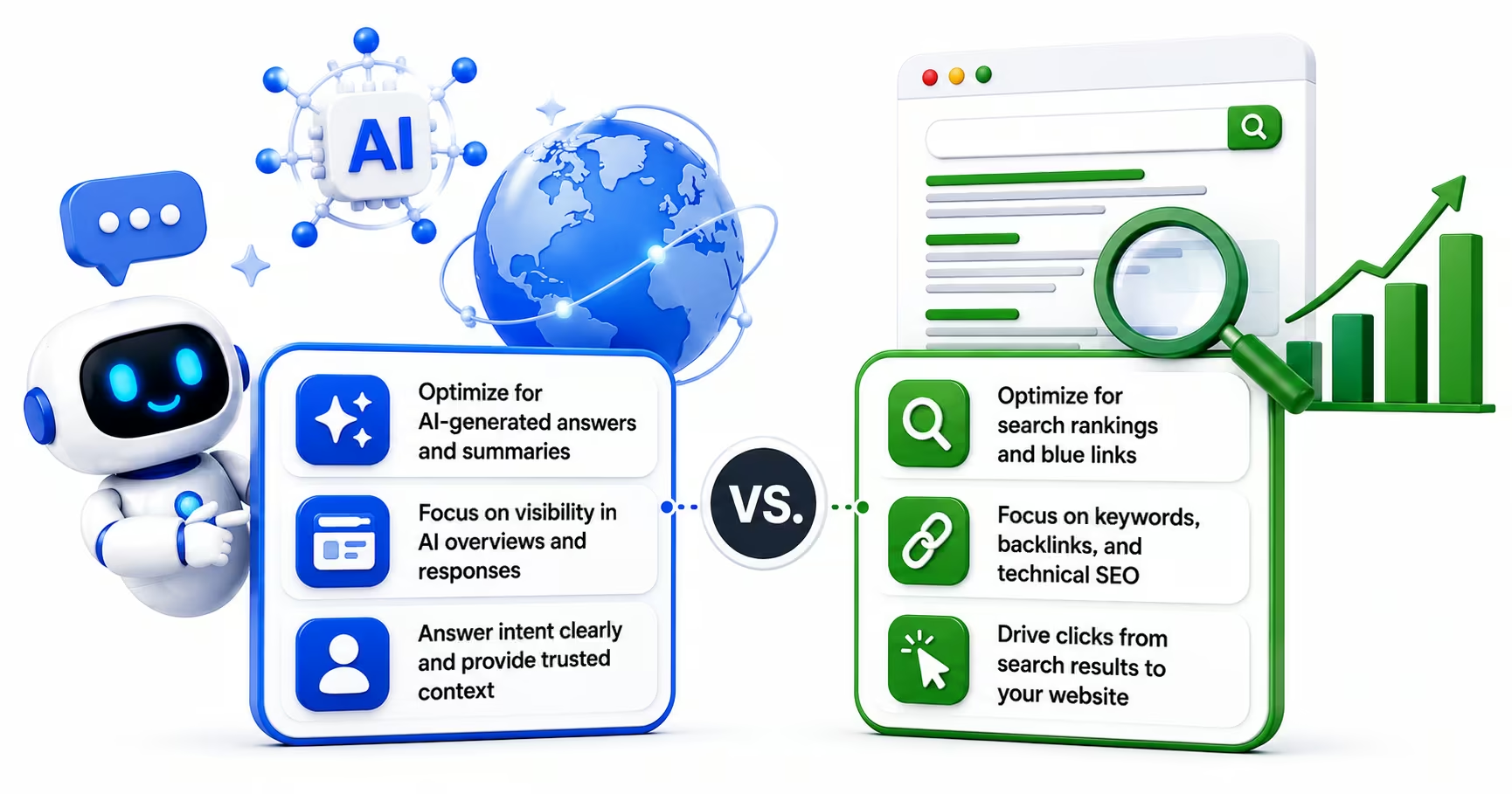
Search has changed more in the past two years than in the previous decade. For most of the internet's history, getting found online meant one thing: ranking on Google's blue-link results page. Optimize your content, earn backlinks, nail your technical setup, and traffic would follow. That playbook still matters. But it no longer tells the whole story.
A new category of visibility has emerged alongside traditional search: AI-generated answers. When someone asks ChatGPT, Perplexity, or Google's AI Overviews a question, those systems synthesize a response from sources across the web, citing some and ignoring others. The brands that get cited gain visibility, credibility, and traffic. The brands that don't are invisible in an increasingly large share of queries. Generative Engine Optimization, or GEO, is the discipline of earning those citations. This article explains what GEO is, how it differs from SEO, and how the two strategies work together to protect and grow your digital presence.
What Is Generative Engine Optimization?
Generative Engine Optimization is the practice of structuring, writing, and distributing content so that AI-powered search systems select it as a trusted source when generating answers. Where SEO asks "how do I rank higher in search results?", GEO asks "how do I get cited when an AI answers a related question?"
The distinction matters because the mechanics are different. Traditional search engines return a ranked list of links and let users choose where to click. Generative AI systems synthesize an answer and surface only a handful of citations, typically four to six, to support their response. If your content is not among those citations, you are absent from the conversation, regardless of your ranking position.
GEO expands beyond your own website in a way that SEO traditionally has not. AI engines pull from third-party forums, reviews, press mentions, industry publications, and social platforms to determine what brands and claims are trustworthy. Off-site authority signals have always mattered in SEO, but in GEO they are foundational. A brand that dominates its own site but has thin third-party coverage is unlikely to be cited reliably.
How Does Traditional SEO Work?
To understand the contrast, it helps to revisit what SEO actually does. Search engine optimization is the process of improving a website's visibility in organic search results by aligning content with what search algorithms reward: relevance, authority, user experience, and technical accessibility. A well-executed SEO program earns clicks from users who are already in the market for information, products, or services.
The core levers of SEO are keyword research, on-page content optimization, technical site health, backlink acquisition, and user experience signals like Core Web Vitals. Success is measured in rankings, impressions, organic traffic, and conversions. It is a well-defined, data-rich discipline with two decades of documented best practices behind it.
None of that goes away with AI search. In fact, a strong SEO foundation is a prerequisite for GEO success. Pages that rank well in traditional results are significantly more likely to be cited in AI Overviews than pages that do not rank. The two channels reinforce each other. But relying on SEO alone leaves substantial visibility on the table.
What Are the Key Differences Between GEO and SEO?
The most practical difference is what you are optimizing for. SEO optimizes for click-through from a ranked list of links. GEO optimizes for citation within a synthesized answer. The user journey looks different in each case, and so does the content that performs well.
GEO-optimized content tends to be more concise in its answers, more explicit about its sourcing, and more structured for machine parsing. AI systems favor content that leads with a direct definition or answer, uses clear heading hierarchies, includes schema markup, and demonstrates genuine expertise rather than keyword density. Broad, padded content that ranks through volume alone is far less likely to be cited than content that is precise, well-sourced, and authoritative.
Success metrics also diverge. SEO teams track keyword rankings, organic sessions, click-through rates, and conversion attribution from search traffic. GEO requires tracking citation frequency across AI platforms, monitoring brand mentions in AI-generated responses, and measuring the share of voice your content earns in AI answers for target queries. These are newer metrics, but they are increasingly important as AI Overviews appear for a growing share of commercial and informational searches.
The competitive set changes as well. In traditional SEO, you compete for position against other pages targeting the same keywords. In GEO, you compete for citation against a broader pool of sources that includes news outlets, industry publications, Reddit threads, and academic content, not just direct competitors. Building the kind of credibility that earns AI citations requires a distribution strategy that extends well beyond your own domain.
Why Does GEO Matter Right Now?
Informational queries account for the overwhelming majority of AI Overview triggers. That means the questions your prospects ask at the top of the funnel ("what is," "how does," "why should I") are exactly the queries where AI-generated answers are most likely to appear, and where your brand needs to be visible.
The commercial stakes are real. Seer Interactive's analysis of AI Overview click behavior found that brands cited inside Google AI Overviews earned a 35% higher organic click-through rate and a 91% higher paid click-through rate than brands that were not cited on the same queries. Being cited is not just a vanity metric. It is a meaningful traffic and authority signal that compounds over time. Brands that establish citation authority early will be increasingly difficult to displace as AI search solidifies into the default user behavior.
How Do SEO and GEO Work Together?
The most effective approach treats SEO and GEO as complementary, not competing, strategies. SEO builds the technical and authority foundation that makes GEO possible. Strong rankings, clean site architecture, fast load times, and quality backlinks all improve the probability of AI citation. GEO then extends that foundation with answer-first content structures, schema markup, off-site credibility, and explicit sourcing.
In practical terms, this means auditing your existing content for AI-readiness alongside traditional SEO metrics, building out topic clusters that address the informational queries your prospects ask at every funnel stage, implementing FAQ and Article schema across key pages, and actively cultivating third-party mentions through PR, guest content, and partnership strategies. Start with our SEO & GEO Audit Interactive Checklist or the companion audit guide if you need a structured starting point. Neither discipline replaces the other. Together, they give your brand the best possible chance of being found, cited, and trusted across every channel where your audience searches.
Frequently Asked Questions
Common questions about GEO, SEO, and AI-driven search visibility.
No, and framing them as a choice is the most expensive misunderstanding in the current landscape. SEO and GEO are complementary strategies running on largely the same foundation: crawlable content, clear structure, demonstrated expertise, and real authority. Strong organic rankings make AI citation more likely, because AI systems draw heavily from pages that already rank well for related queries, while GEO practices like answer-first structure and rigorous sourcing improve the overall quality signals that traditional rankings reward. The work compounds in both directions. The practical division is one of emphasis, not separate programs: SEO optimizes for position in a ranked list, GEO optimizes for being extracted, cited, and named inside generated answers, and a page built well competes on both surfaces at once. Companies running both in parallel consistently outperform those focusing on either alone, because they are visible wherever the buyer happens to be searching.
GEO applies to any platform that generates synthesized answers from web sources, which today means Google AI Overviews and AI Mode, ChatGPT Search, Perplexity, Google Gemini, Microsoft Copilot, and the growing field of assistants built on the same retrieval patterns. Each platform has its own citation personality: Google's AI surfaces lean on pages that already rank in its index, Perplexity cites sources prominently and favors clearly structured factual content, and ChatGPT blends trained knowledge with live retrieval when browsing is invoked. The encouraging reality for content teams is that the underlying signals are largely consistent across all of them: clear passage-level answers, credible sourcing, structured data, and genuine topical authority travel well between platforms. That consistency is why a platform-by-platform strategy is usually unnecessary. Build content that machines can confidently extract and attribute, then monitor each platform for how your visibility differs and tune at the margins.
Start with the manual method, because it is free and immediately revealing: query each AI platform with the questions your buyers actually ask, in a clean session, and record whether your brand is cited, which pages are referenced, and who appears alongside you. Done monthly across a consistent set of twenty or thirty queries, that sample becomes a trackable share-of-voice baseline. Google Search Console now folds AI Overviews impressions into its Performance report, so unusually long conversational queries earning impressions are often your pages surfacing in AI experiences. Purpose-built citation tracking tools are maturing quickly for teams that need scale, monitoring brand mentions across platforms programmatically. Watch your referral logs and analytics for AI-source traffic as well, keeping in mind that many citations produce influence without clicks. A brand mentioned in an answer shapes the decision before any visit happens, which is exactly why measuring citation presence matters beyond traffic.
Less than the industry's noise suggests. GEO favors content that leads with direct answers, uses clear heading structures organized around real questions, includes schema markup, cites credible external sources, and demonstrates genuine first-hand expertise. Every one of those practices also improves traditional SEO performance, so the overlap is substantial and deliberate: the same page competes on both surfaces. The genuine additions GEO brings are discipline-level rather than channel-level. Answer-first writing means each section states its conclusion in the opening sentences instead of building to it, because AI systems extract passages and a buried answer gets paraphrased or skipped. Passage self-containment means each section survives being quoted alone, without depending on context the extraction leaves behind. And sourcing rigor rises, because systems selecting citations favor claims they can trace to evidence. None of that is new content strategy; it is stronger execution of what quality content always required.
AI citation authority builds over time as platforms learn to trust your content, and the honest timeline has two speeds. Well-optimized pages on established domains can earn citations within weeks of publication, particularly for specific, less-contested questions where a clear, well-structured answer stands out quickly. Building broad citation presence across a competitive topic area is the slower journey, typically playing out over months, because it depends on the same compounding inputs as domain authority: topical depth, off-site credibility, and accumulating trust signals. Your starting position matters enormously; a site already ranking well converts its authority into citations faster than a new domain building from nothing. Two practical accelerants show up consistently: refreshing existing high-authority pages into answer-first structure outperforms waiting on new content to mature, and earning mentions in sources AI systems already trust shortens the trust-building period. Measure monthly, and judge the trend line rather than any single week.
No, and the B2B case may actually be stronger. Business buyers increasingly use AI assistants throughout their research process: shortlisting vendors, comparing solution categories, sanity-checking claims, and drafting the internal documents that justify a purchase. Those AI-assisted touchpoints happen before your sales team knows the deal exists, which makes citation presence a form of pipeline influence that never appears in attribution reports. When an assistant names your company among three credible options, or describes your category using framing your content established, it is shaping the shortlist at the moment of maximum leverage. B2B also plays to GEO's mechanics: complex products generate exactly the long, specific, question-shaped queries where AI answers dominate, and deep expert content outcompetes thin coverage more decisively than in consumer categories. For a B2B brand, the question is not whether GEO applies but whether your expertise is structured so machines can find, extract, and attribute it.
Treating GEO as a separate content channel and manufacturing AI-only content that is thin on real expertise. The pattern is recognizable: a parallel library of question pages written for machines, stuffed with answer-shaped paragraphs nobody with actual experience reviewed, sometimes generated at volume precisely because AI made volume cheap. It fails twice. AI systems select sources using authority and quality signals trained on exactly this distinction, so imitation-expert content loses citations to genuine depth. And the scaled thin content erodes the sitewide quality signals your whole domain depends on, which is the same behavior Google's spam policies explicitly target. The path to consistent citation is unglamorous: depth from people who have done the work, accuracy someone accountable has verified, clear structure, and credible sourcing. Companies that route GEO effort into making their real expertise more extractable win durably; companies that route it into producing more pages usually pay to learn this.