


 Preferred source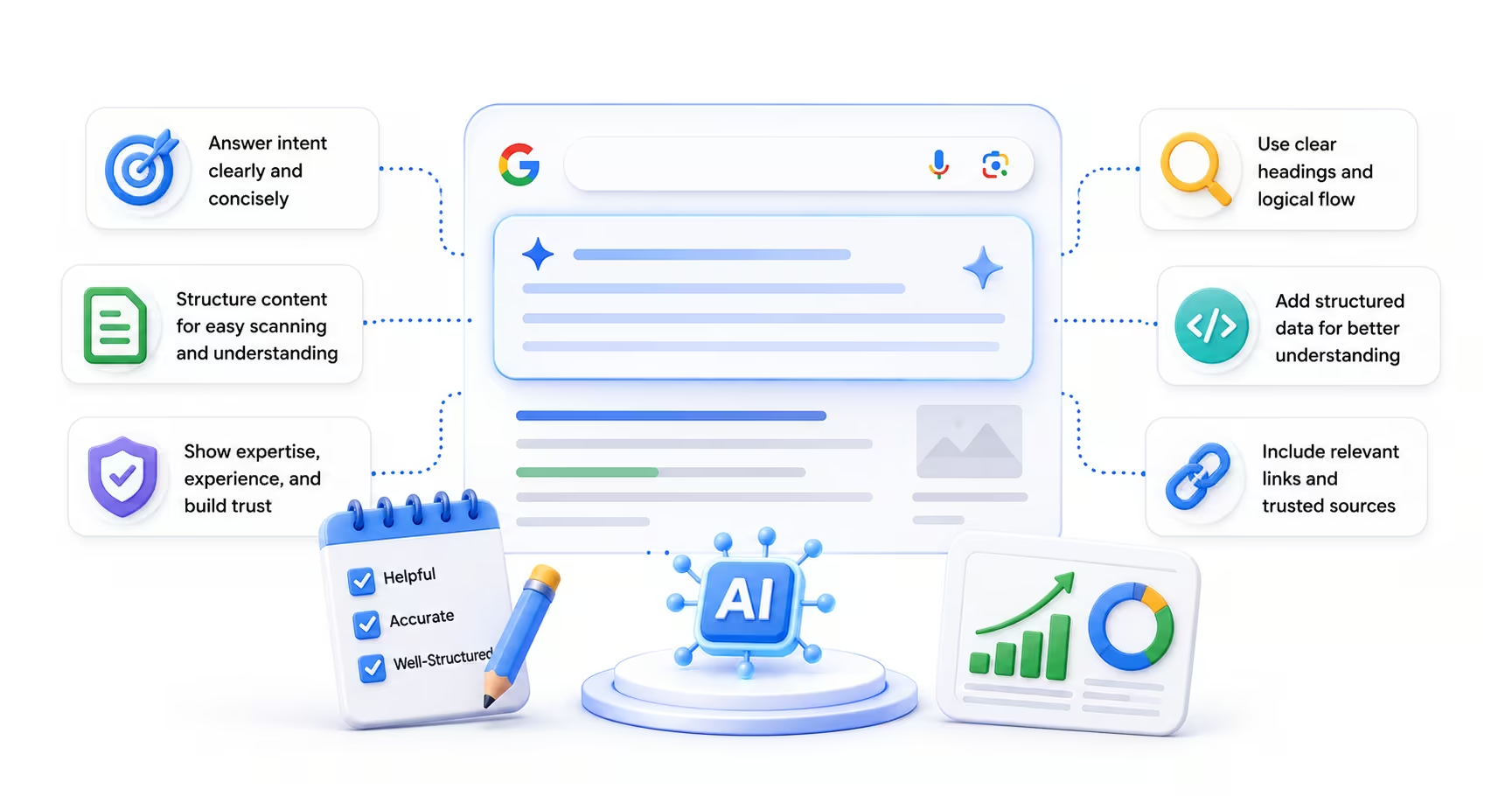
Google AI Overviews now appear at the top of results for hundreds of millions of queries. They synthesize answers from multiple sources, display a summary directly in the search results page, and cite a small number of pages that earned the right to be there. For marketers and SEO practitioners, this creates both a challenge and an opportunity. Seer Interactive's study of 25 million impressions found that brands cited in AI Overviews earn roughly 35 percent more organic clicks than non-cited brands in the same results. Pages that are ignored by the AI are effectively invisible to the fastest-growing segment of search behavior.
AI Overview optimization is not a separate discipline from good SEO. The same signals that help content rank well in traditional results also help it get cited: clear structure, genuine expertise, credible sourcing, and strong technical foundations. The difference is in the execution details. AI systems process content differently than human readers, and small adjustments in how you write, structure, and mark up your pages can make a meaningful difference in citation frequency.
Why AI Overviews Change the Content Game
Google's AI Overviews represent a fundamental shift in how search results are assembled and presented. Rather than surfacing ten links and letting users decide which to click, AI Overviews generate a synthesized paragraph or structured answer and attribute it to a small pool of sources. The implication for content creators is significant: you are no longer just competing for a ranked position. You are competing to be selected as a trusted source by a machine that evaluates your content for accuracy, clarity, and authority.
The queries most likely to trigger AI Overviews are informational in nature, covering definitions, explanations, how-tos, and comparisons. These are precisely the queries that populate the top of the marketing funnel, where potential customers first encounter your brand. If your content is absent from AI Overviews for relevant informational queries, you are missing the first moment of discovery for a large and growing share of your target audience.
Start With Technical and Ranking Foundations
Before diving into content tactics, it is worth stating the baseline clearly: pages that do not rank in traditional organic search results are almost never cited in AI Overviews. AI systems pull from indexed, crawlable content that has already demonstrated some degree of authority. If your technical SEO is broken, your page speed is poor, or your content is thin, no amount of AI-specific optimization will overcome those deficits.
That means the first step in AI Overview optimization is ensuring your technical foundations are sound. Pages should be fully indexable, free of crawl errors, and fast enough to pass Core Web Vitals thresholds. Your site architecture should make key content accessible within a few clicks of the homepage. And your overall domain authority should be growing through legitimate backlink acquisition and a consistent content publishing cadence.
Write With an Answer-First Structure
The single most impactful content change you can make for AI visibility is adopting an answer-first structure. Each section of your content should open with a direct, clear answer to the implied question of that section before adding supporting detail, examples, or nuance. AI systems scan for the most concise, accurate answer available; burying the answer after three paragraphs of setup means the AI will likely cite a competitor who leads with the answer instead.
A practical target is to deliver the core answer or definition within the first 50 to 70 words of each section. Use your heading to state the question or topic, then open the body with the answer. Additional explanation and context can follow in subsequent paragraphs. This structure works equally well for human readers, who also tend to prefer clarity over preamble.
Scannable formatting supports the same goal. H2 and H3 headings, short paragraphs, and occasional tables or numbered steps give AI systems clear parsing signals and make it easier for them to extract citable chunks. Pages that are difficult to parse, whether because of long unbroken blocks of text or inconsistent heading use, are systematically underrepresented in AI citations.
Demonstrate E-E-A-T at Every Level
Experience, Expertise, Authoritativeness, and Trustworthiness are the four criteria Google uses to evaluate content quality, and AI Overviews apply them at least as stringently as traditional ranking systems. See our guide on why E-E-A-T matters more in AI search for a deeper look at those signals.
Experience signals are particularly important after recent algorithm updates. Content that reflects direct experience with a topic, whether through first-person case studies, original data, or practitioner-level depth, is weighted more heavily than content that simply synthesizes what other sources already say. If your team has genuine expertise in a subject area, make that expertise visible in the content itself rather than relying on organizational credentials alone.
Implement Schema Markup on Key Pages
Structured data gives AI systems an explicit map of your content's meaning, structure, and relationships. Pages with proper schema markup are cited in AI-generated answers significantly more often than pages without it. For implementation priorities, read why structured data matters for AI search and use our AI Visibility Strategy Guide to plan broader AI discovery work.
Implementing schema does not require advanced technical skills. Most CMS platforms support schema through plugins or built-in fields. The key is accuracy: schema that contradicts the visible page content can actually hurt your credibility with AI systems. Use schema to confirm and amplify what is already on the page, not to claim attributes you have not earned.
Build Topic Clusters Around Key Questions
AI systems favor sources that demonstrate depth and breadth on a topic, not just a single strong page. A topic cluster strategy, where a central pillar page addresses a broad topic and a series of supporting pages cover subtopics, signals topical authority at the domain level. AI systems interpret this architecture as evidence that your site is a comprehensive, trustworthy resource rather than a one-off contributor.
When building clusters for AI visibility, prioritize the questions your target audience is most likely to ask in an AI-powered search. Use your existing search data, customer conversations, and competitive research to map the question landscape, then build content that addresses those questions with the depth and clarity that earns citation. Update that content on a regular cadence, at minimum every 90 days for your highest-traffic pages, to maintain freshness signals that AI systems use to assess relevance.
Frequently Asked Questions
Common questions about GEO, SEO, and AI-driven search visibility.
Google Search Console now includes AI Overviews data in its Performance report, folded into the main "Web" search type rather than broken out as a separate surface, so impressions from AI Overviews are already inside the numbers you look at every week. The tell is in the query patterns: unusually long, conversational queries and question fragments often indicate AI surface activity, since those are the query shapes that trigger AI answers most often. Beyond Search Console, manually search your priority queries in a logged-out browser and note whether your pages are cited in the Overview panel, then record the results so you can track movement over time. Third-party tools that track AI citations at scale are maturing quickly for enterprise use, but a disciplined manual sample of your top twenty queries once a month costs nothing and catches most meaningful changes.
Volume alone does not help, and past a point it actively works against you. AI systems reward clarity, accuracy, and authority, not quantity, and Google's scaled content abuse policy explicitly targets sites that multiply thin pages faster than they can maintain quality. A smaller number of well-structured, deeply researched, regularly updated pages will consistently outperform a high volume of quickly published content, because each strong page builds the topical authority that citation selection depends on, while each weak page dilutes it. The practical test before publishing anything new is whether the page answers a question your existing content does not already cover, and whether you would be comfortable having it quoted verbatim as your brand's answer. If the honest answer is no, improving an existing page is usually the better investment.
Yes, but new websites face a higher bar because they lack the established domain authority and ranking history that citation selection leans on. AI Overviews draw heavily from pages that already rank well, so a new site's path runs through the same foundational work as classic SEO, just with more patience. The most practical strategy is concentration: pick a tightly defined topic area, cover it more thoroughly than anyone else, and interlink that cluster so the site demonstrates depth in one place rather than thin coverage everywhere. Pair that with off-site trust building through PR mentions, industry publications, podcasts, and community participation, because third-party references accelerate how quickly both search engines and language models learn to associate your brand with your subject. New sites that focus narrowly often earn their first citations on specific, lower-competition questions within a few months.
AI Overviews primarily cite text-based web content, and written pages remain where the overwhelming share of citations point today. Google is steadily expanding multimedia inside AI surfaces, including video references for how-to queries and, more recently, AI-generated imagery appearing within Overview panels, so the direction of travel is clear even if the citation economics have not caught up. For now, the highest-leverage optimization work is still written content with proper structure and schema, because that is what gets extracted, quoted, and linked. Where video and images earn their keep is in supporting roles: a transcript makes video content citable as text, descriptive alt text and captions make images legible to AI systems, and VideoObject or ImageObject schema connects the media to the entities and topics your pages cover.
Length is less important than clarity and structure, and this is one of the places where old SEO instincts mislead. AI systems extract passages, not pages, so what matters is whether the section under each heading is a complete, self-contained answer that survives being lifted out of context. Passages in the range of roughly one hundred thirty to one hundred seventy words tend to get quoted whole, while very short fragments get paraphrased and very long sections get truncated or summarized. Comprehensive coverage of a topic still helps establish topical authority at the page level, but padding content for length without adding substance actively hurts citation rates because it dilutes the extractable answer. The working target is thorough and concise at the same time: every section should say one thing completely, with the evidence, and then stop.
Yes, meaningfully. Freshness is a real signal for AI systems, which prefer to cite sources that reflect current information, and refreshing is usually the highest-return content work available because the pages already have accumulated authority, indexed history, and internal links that new pages start without. An effective refresh goes beyond changing the date: update statistics and examples to current data, rewrite sections into answer-first structure with clear headings, add or update schema markup, tighten anything that has drifted from accuracy, and record a real dateModified so the change is visible to crawlers. Start with the pages that already rank on page one or earn occasional citations, because those are closest to the threshold where a quality improvement changes outcomes. A quarterly refresh cycle across your priority pages compounds far faster than the same effort spent on net new publishing.
Paid search does not directly influence AI Overview citations, which are selected from organic content based on quality and authority signals, and no ad spend changes that selection. Where paid search earns its place in an AI visibility strategy is as an intelligence source and a hedge. Search term reports show you the actual language prospects use, including the long, specific, question-shaped queries that increasingly trigger AI answers, and that data should feed directly into which questions your organic content answers. Paid placements also keep your brand visible on high-intent queries where an AI Overview has compressed organic clicks, which matters while the citation landscape settles. Treat the two channels as complementary instruments: organic and content work earns the citations, while paid buys the data and defends the queries you cannot yet win organically.
Sources
- Google Search Central: AI features and your website (opens in a new tab)
- Google Search Console: Performance report (opens in a new tab)
- Google Search Central: Creating helpful, reliable, people-first content (opens in a new tab)
- Schema.org: FAQPage (opens in a new tab)
- Schema.org: Article (opens in a new tab)
- Schema.org: HowTo (opens in a new tab)
- Seer Interactive: AI Overviews impact on Google CTR (opens in a new tab)