0%
Zero-click searches
Searches that end without a click to any website
Growing year over year
Source: SparkToro, 2024


SEO, GEO and AI visibility: get found on Google and cited in AI answers.
Paid search and social, run on conversion data your CRM confirms.
Fast websites, landing pages and CRO, with tracking built in from launch.
Use AI and automation to streamline marketing workflows, improve consistency, and move faster.
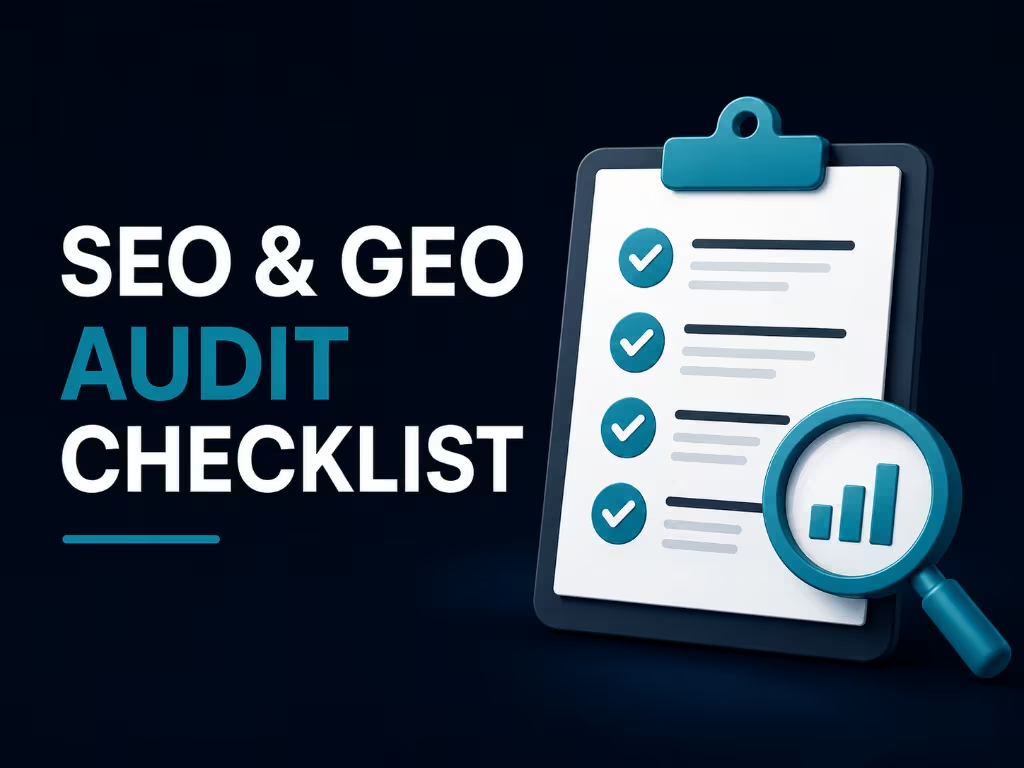
See how your site performs in search and AI visibility.
View Now →Programs built around one goal at a time: pipeline, demand, or AI visibility.

Talk to a strategist to find the best path for your goals.
Book a Discovery Call →Actionable insights, guides, and tools to help you grow.
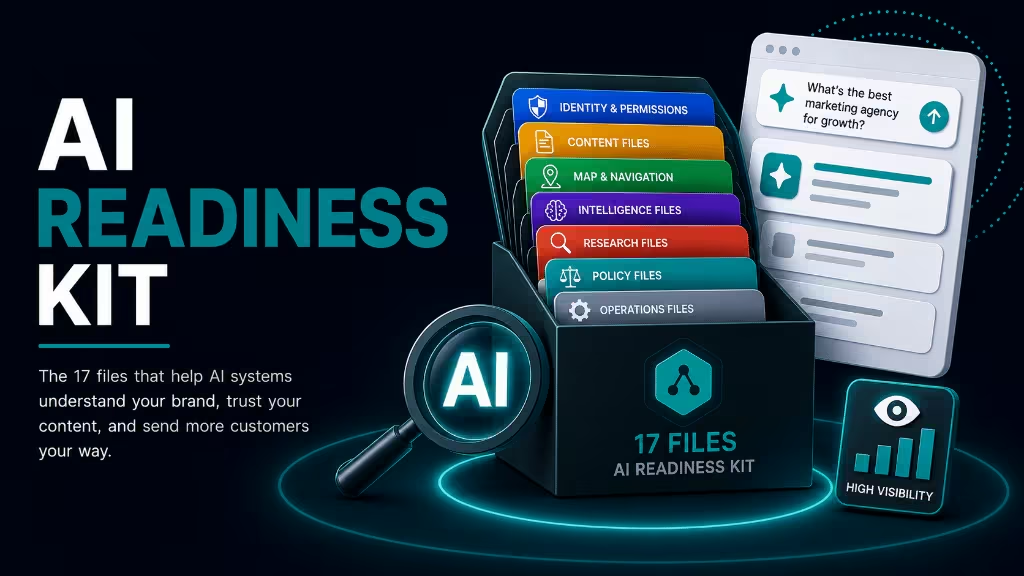
Learn how to increase your brand's visibility in AI search.
Download Kit →Learn about Silverback Marketing and what makes us different.
Let's start a conversation. We're here to help you grow.
Tell us about your goals and we'll build a plan that delivers results.
Get StartedHow to get found by AI, not just Google. ChatGPT, Perplexity, Google AI Overviews, and Gemini now answer questions directly. This guide shows you exactly how to get your brand cited, recommended, and trusted by every major AI system.
For two decades, SEO meant one thing: rank on Google's first page. Build backlinks, target keywords, earn clicks. That playbook still has value, but it's no longer sufficient. A seismic shift is underway.
AI-powered search engines now answer questions directly. When someone asks what is the best CRM for a small marketing agency, ChatGPT, Perplexity, Google's AI Overviews, and Microsoft Copilot synthesize an answer from dozens of sources and present it as a single confident response. No list of blue links. No need to click through.
The AI decides who gets mentioned, and who gets ignored.
Traditional SEO focused on rankings: position 1, 2, 3 in a list. AI visibility works differently. There is no position 1. You either get cited or you don't. The AI either treats your brand as an authoritative source, or it skips you entirely.
The core truthAI systems are citation machines. They read the web, form judgments about which sources hold up under scrutiny, and quote those sources in their answers. Your job is to become a source the AI trusts enough to quote.
This is not a future trend. It is happening right now. Brands that appear in AI answers are generating leads, building authority, and winning clients without their prospects ever opening a search results page. The businesses that act now will build a compounding advantage that gets harder to close every year.
Before you can optimize for AI visibility, you need to understand what these systems actually do when they decide what to say. Each major AI engine uses a different retrieval architecture, but they share the same objective: produce accurate, useful answers drawn from sources that have earned trust.
Most AI search engines run on a process called Retrieval-Augmented Generation. When a user submits a question, the system:
Searches a massive index of web content, identifying pages and passages relevant to the query
Scores retrieved content by relevance, authority, recency, and trustworthiness
Feeds the top-ranked passages to a large language model as context
The LLM writes a coherent answer, drawing on the provided passages
Attributes statements to their sources, creating the citations you see in responses
Each major AI platform retrieves and ranks content differently:
Uses Bing index + web browsing. Prioritizes high-authority domains, Wikipedia, news sources, and sites with strong structured data.
Real-time web retrieval on every query. Heavily rewards clear, factual, well-structured content. Best citations go to specific, answerable pages.
Draws from Google's own index. Favors pages already ranking well, rich with E-E-A-T signals, schema markup, and featured snippet patterns.
Bing-powered. Strongly weights .gov, .edu, news publishers, and brands with Wikipedia presence. Schema markup significantly boosts inclusion.
Deep integration with Google's Knowledge Graph. Entity authority, structured data, and brand mentions across the web drive citation decisions.
Training-data weighted. Favors brands with extensive authoritative web presence, press coverage, and consistent entity mentions.
Key insightNo single optimization wins across all platforms. A real AI visibility strategy requires a multi-platform approach. Each engine has different strengths and weighs different content signals.
After auditing hundreds of websites against AI citation patterns, we identified five factors that consistently determine whether AI systems cite a brand. Get all five right, and you become the source AI engines reach for, again and again.
“AI visibility isn't one tactic. It's a system. Build all five pillars and you become impossible to ignore.”
Domain authority, backlinks, brand mentions, Wikipedia presence, and third-party validation. AI systems pay close attention to how the broader web talks about you, not just what you say about yourself.
Clear, factual, well-structured content that answers questions directly. AI prefers content that mirrors how it wants to respond: specific, evidence-based, with nothing buried.
Schema markup, structured data, clean HTML, fast load times, and proper crawlability. The technical layer determines whether AI can actually read and parse your content, or just see noise.
Your brand as a recognized entity in AI knowledge bases: name, category, location, description, and relationships, all consistently represented across the web.
Direct answers, statistics, definitions, and quotable passages. AI systems cite content that makes their answers sharper. Format yours to be the passage they pull.
Google introduced E-E-A-T (Experience, Expertise, Authoritativeness, Trustworthiness) as a quality framework for human raters, but AI systems have internalized the same logic. When an AI decides whether to cite your content, it runs an implicit E-E-A-T check, whether you've optimized for it or not.
First-hand experience with the topic. Case studies, real data, client results, and personal accounts. AI systems can detect the difference between lived experience and surface-level content.
Demonstrated depth of knowledge. Technical accuracy, nuanced explanations, proprietary frameworks, and credentials. Thin, generic content fails this test on the first read.
Recognition from others in the field. Backlinks from authoritative sites, mentions in industry publications, speaking engagements, awards, and third-party citations of your work.
Accuracy, transparency, and consistency. Verified facts, clear author attribution, current content, HTTPS security, and a straightforward about/contact page.
AI systems don't just read your website. They read the entire web's opinion of you. Off-site signals carry serious weight:
A Wikipedia article about your brand is one of the strongest authority signals available. It tells AI models that an independent third party considered your brand notable enough to document.
Coverage in recognized news publications trains AI models to associate your brand with credible authority. Earned media in industry trades carries particular weight.
G2, Trustpilot, Clutch, and Google Reviews build a consistent entity footprint. Volume and recency of reviews correlate directly with AI citation frequency.
LinkedIn company page, YouTube channel, X presence, and podcast appearances all contribute to entity recognition across AI knowledge graphs.
Crunchbase, Inc., Forbes, and industry-specific databases confirm your existence and category to AI systems that retrieve from structured sources.
Technical optimization for AI visibility goes deeper than traditional SEO. AI crawlers need to extract meaning, not just index text. Schema markup, semantic HTML, and deliberate AI crawler configuration can measurably increase how often, and how accurately, AI systems represent your brand.
| Schema type | Priority | What it tells AI |
|---|---|---|
| Organization | Critical | Your brand identity, location, contacts, and social profiles |
| Article / BlogPosting | Critical | Author, date, topic, and content structure for every piece |
| FAQPage | High | Direct Q&A pairs that are exactly what AI systems want to cite |
| HowTo | High | Step-by-step process content optimized for procedural queries |
| Product / Service | High | Pricing, features, and specifications for commercial queries |
| Person / Author | Medium | Expert credentials and authorship signals for E-E-A-T |
| LocalBusiness | Medium | Physical location, hours, and service area for local queries |
| BreadcrumbList | Medium | Site structure and content hierarchy for navigation context |
Major AI systems send dedicated crawlers to index content. You control which crawlers access your site via robots.txt. The tradeoff is straightforward: block AI crawlers and you stop content extraction, but you also forfeit any chance of citation.
| Crawler | Platform | Recommendation |
|---|---|---|
| GPTBot | OpenAI / ChatGPT | Allow for citation eligibility |
| PerplexityBot | Perplexity AI | Allow for the highest citation rate for quality content |
| Google-Extended | Google AI / Gemini | Allow to maintain AI Overviews presence |
| CCBot | Common Crawl | Allow for broad AI training data coverage |
| anthropic-ai | Claude / Anthropic | Allow for entity recognition training |
| Applebot-Extended | Apple Intelligence | Allow for emerging Apple AI features |
llms.txt: the new standardA new protocol (llms.txt) is emerging as the AI equivalent of robots.txt. Place a /llms.txt file in your web root to give AI systems a structured overview of your site's content, purpose, and key pages. Done right, it sharply improves how AI systems understand and represent your brand.
The best AI-optimized content doesn't feel optimized. It's simply the clearest, most authoritative answer to a question on the web. AI systems cite content that makes their answers better. Your job is to write that content.
Cover the topic fully. AI systems synthesize answers from multiple sources. Be the source that covers the most ground with the highest accuracy, and you get cited most often.
Answer questions directly. Don't bury the point in a 500-word intro. State your answer in the first paragraph, then expand on it.
Back every claim with data, studies, or first-hand experience. AI systems are trained to favor verifiable information over bare assertions.
Show expertise in every paragraph. Specific details, accurate terminology, and genuine insight tell AI models they're reading a practitioner, not a generalist.
Link out to authoritative sources, and build the kind of content others link back to. Citation networks are an active trust signal for AI systems.
Long-form guides on the core topics in your niche. AI systems gravitate toward sources that appear exhaustive, and quote from them repeatedly.
Original research with proprietary data. When you conducted the study, you are the primary source, and primary sources get cited far more than secondary ones.
Structured Q&A content mirrors exactly how AI answers questions. Well-formatted FAQ pages with FAQPage schema consistently rank among the most-cited content types.
Direct comparisons of products, services, or approaches. These pages get pulled constantly because users ask comparative questions constantly.
Step-by-step instructional content with HowTo schema. Procedural queries are where AI search dominates. Be the answer it pulls.
Curated collections of industry statistics. These pages become permanent citation targets as AI systems return to the same data points repeatedly.
Real-time retrieval rewards scannable, data-rich pages with clear answers.
Bing-backed retrieval favors authority domains, structured data, and entity clarity.
Google index + E-E-A-T + schema drive inclusion in AI-generated answers.
Bing signals, news coverage, and structured business profiles matter most.
Generative Engine Optimization (GEO) is the practice of optimizing content for AI-generated answers, the direct counterpart to traditional SEO for AI search. A structured scoring framework tells you exactly where you stand today and gives you a clear target to move toward.
| Category | Weight | What's measured |
|---|---|---|
| AI Citability | 30% | How likely AI systems are to quote your content |
| Technical Structure | 25% | Schema markup, crawlability, and structured data |
| Content Quality | 20% | E-E-A-T signals, depth, and accuracy |
| Authority & Trust | 15% | Off-site signals, backlinks, and entity recognition |
| Platform Presence | 10% | Coverage across AI platforms and knowledge graphs |
Consistently cited across all major AI platforms. The brand is recognized as a go-to authoritative source.
Regularly cited by most AI systems. Some platform gaps remain. Double down on authority building.
Cited occasionally. The technical and content foundations exist but need strengthening before they stick.
Rarely cited. Significant gaps in technical structure, content quality, or authority signals, likely all three.
Invisible to AI systems. Foundational issues need to be addressed before anything else will matter.
AI visibility isn't built overnight, but the right first 30 days can show up in AI citations within 90. This plan is sequenced for maximum impact: fix the technical layer first, then content, then authority.
The right tools are the difference between guessing and knowing. These are the tools we use at Silverback Marketing to audit, optimize, and track AI visibility for our clients, and the ones we recommend first.
| Tool | Use case | URL |
|---|---|---|
| Google Rich Results Test | Test schema markup and preview rich results | search.google.com/test/rich-results (opens in a new tab) |
| Schema Markup Validator | Official schema.org validation tool | validator.schema.org (opens in a new tab) |
| Merkle Schema Markup Generator | Visual JSON-LD generator for all schema types | technicalseo.com/tools/schema-markup-generator (opens in a new tab) |
| JSON-LD Playground | Live JSON-LD editing and validation | json-ld.org/playground (opens in a new tab) |
| Tool | Use case | URL |
|---|---|---|
| Screaming Frog | Comprehensive site crawl with schema and meta analysis | screamingfrog.co.uk (opens in a new tab) |
| Semrush Site Audit | Full technical audit with Core Web Vitals monitoring | semrush.com (opens in a new tab) |
| Google Search Console | Official index coverage, rich results, and Core Web Vitals | search.google.com/search-console (opens in a new tab) |
| Bing Webmaster Tools | Bing indexation, critical for for ChatGPT/Copilot visibility | bing.com/webmasters (opens in a new tab) |
| Tool | Use case | URL |
|---|---|---|
| Brandwatch | Monitor brand mentions across AI-indexed content | brandwatch.com (opens in a new tab) |
| Mention | Real-time alerts for brand citations across the web | mention.com (opens in a new tab) |
| Perplexity.ai | Test your brand's AI visibility directly by querying | perplexity.ai (opens in a new tab) |
| Tool | Use case | URL |
|---|---|---|
| Clearscope | AI-powered content optimization against top-ranking content | clearscope.io (opens in a new tab) |
| Surfer SEO | Content grading for comprehensiveness and topical authority | surferseo.com (opens in a new tab) |
| Grammarly Business | Clarity and expertise scoring for AI readability | grammarly.com/business (opens in a new tab) |
| Answer The Public | Question-based content research for AI query optimization | answerthepublic.com (opens in a new tab) |
Complete AI visibility audit with GEO score, gap analysis, and prioritized action plan.
Request an auditFull schema markup implementation for your entire site, validated and deployed.
Explore technical SEOContent roadmap built for AI citability: formats, topics, and optimization guidelines.
Explore content strategyOngoing AI visibility tracking with monthly score updates and progress reports.
Explore AI visibility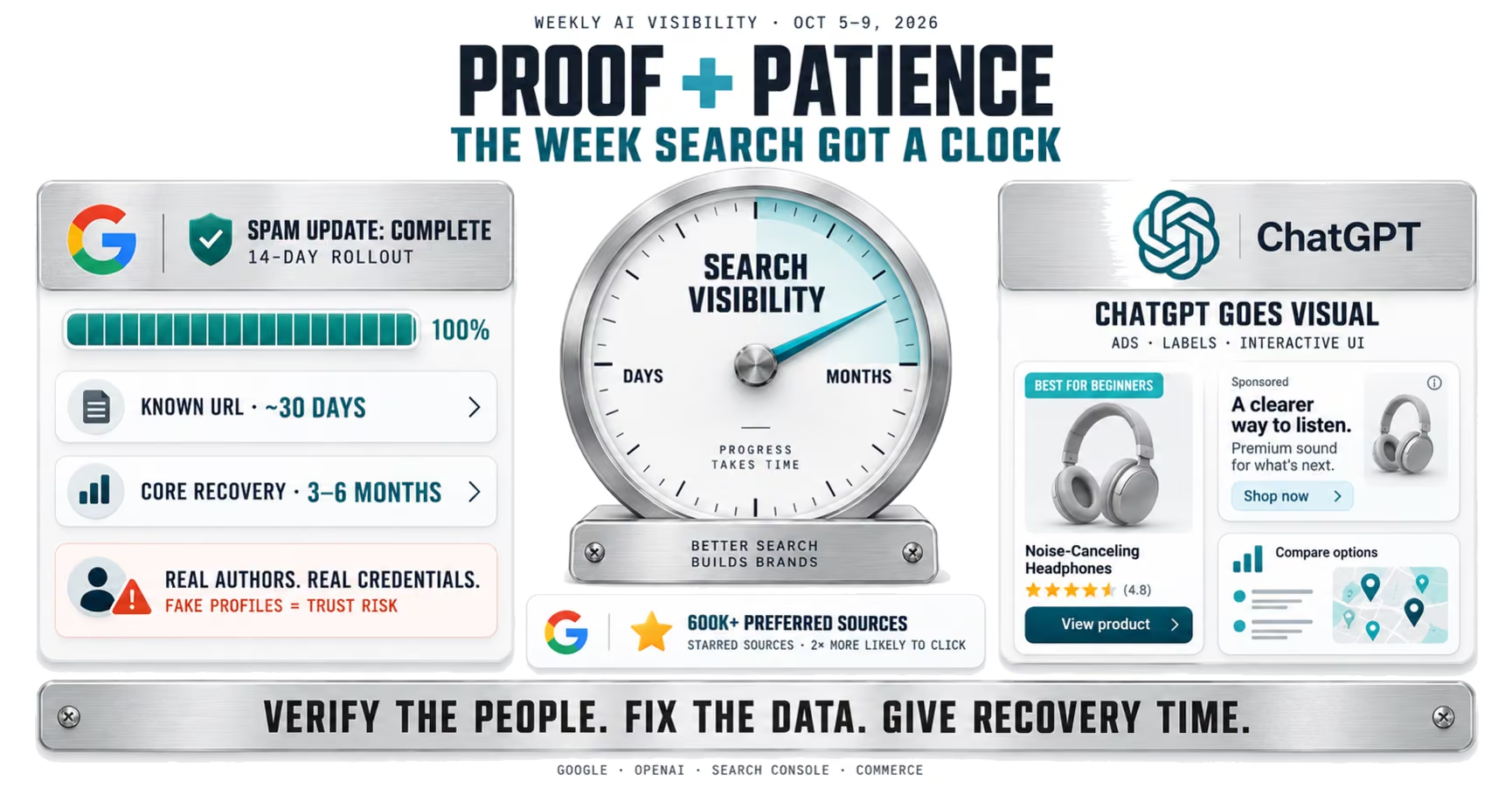

Google's spam update finished after 14 days, Google published crawl and recovery timelines, and ChatGPT added visual ads, labels and a new interface.
Read now →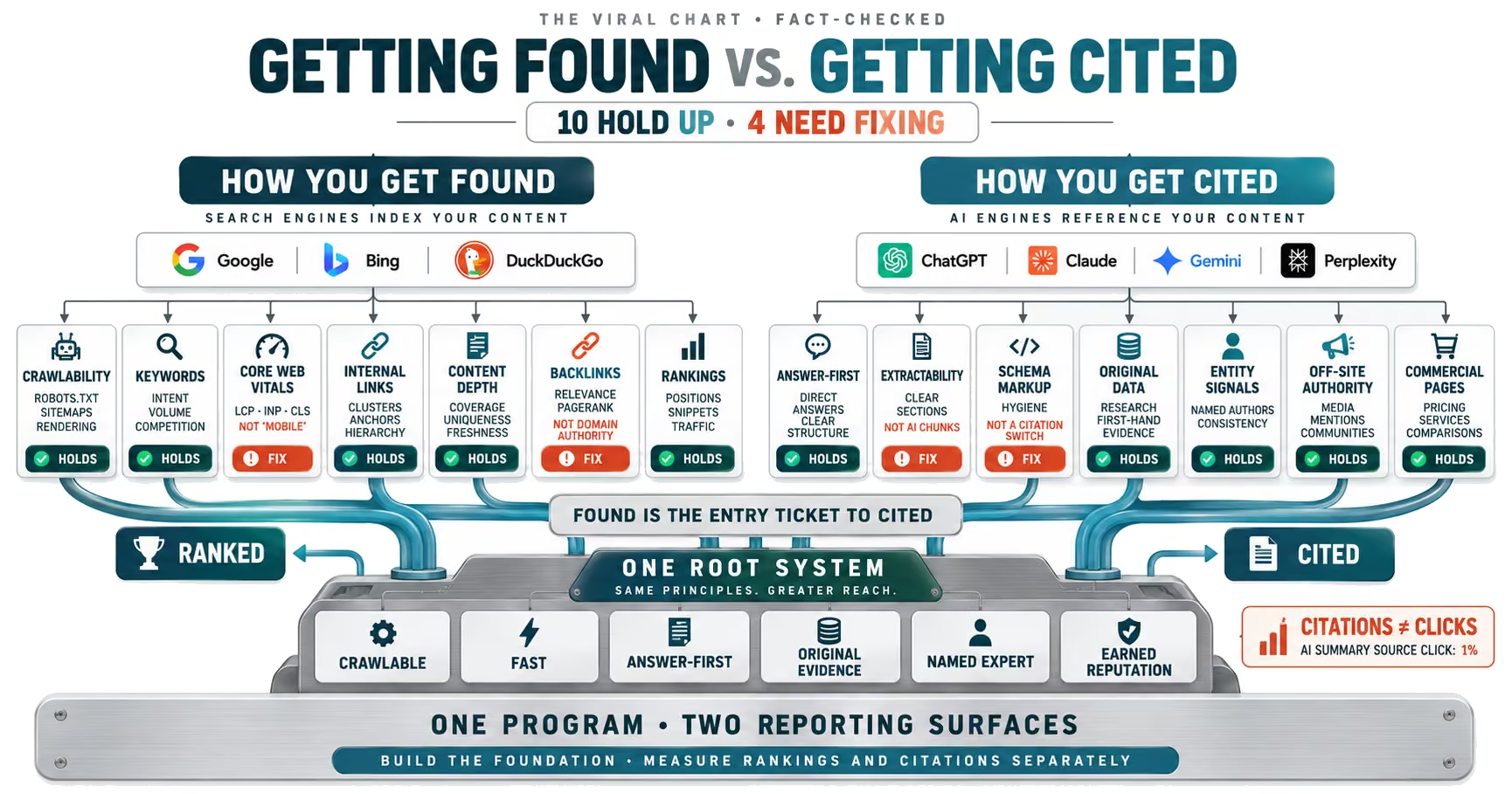
A viral chart splits SEO and AI citations into 14 boxes. We checked each one against Google, OpenAI and the research. Ten hold up. Four need fixing.
Read now →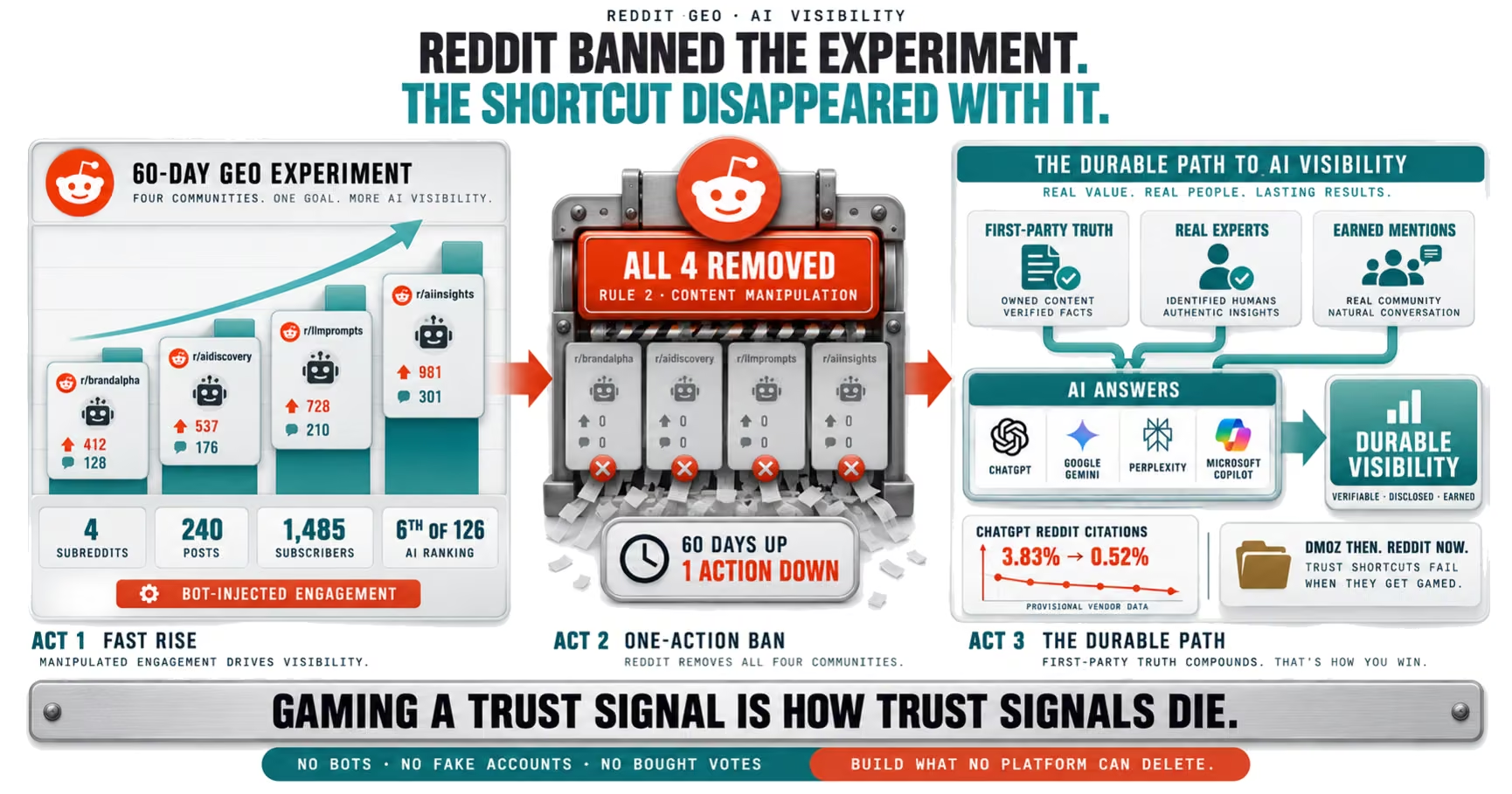
A Reddit GEO test built on injected engagement was banned in 60 days. Here is why gaming AI citations fails, and what durable AI visibility takes.
Read now →An audit takes 15 minutes of your time and gives you a prioritized 30‑60‑90 plan, whether or not we ever work together.