





SEO Has Died Nine Times Since 1997. Someone Should Tell the Money.
 Preferred source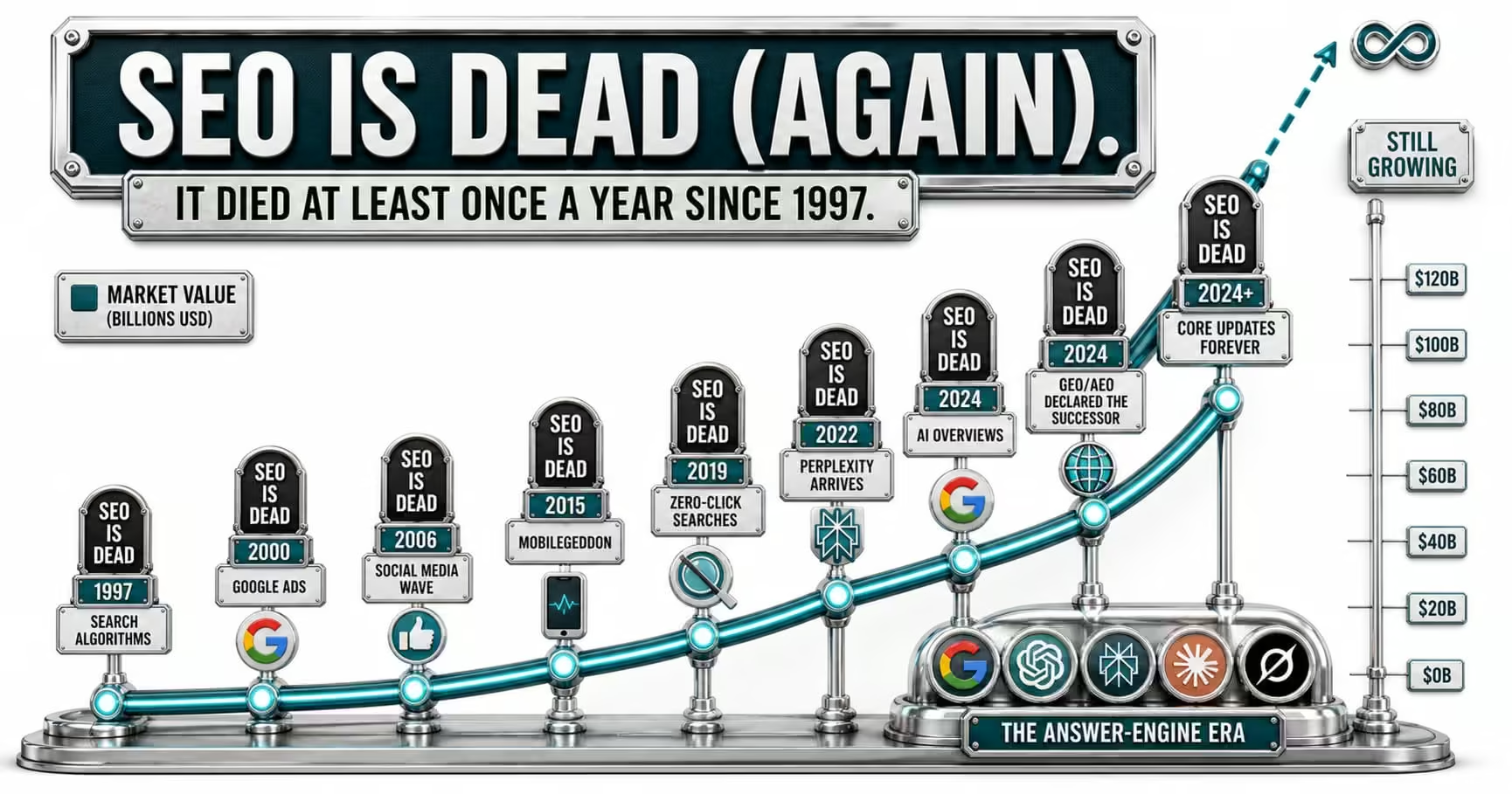
In November 1997, a marketer named Richard Hoy posted a message to the Online Advertising Discussion List, which was how the industry argued with itself before forums existed. His conclusion was unambiguous.
I submit that search engines are dying. In fact, I would say they are dead already and just don't know it yet.
That was written the same year the term "search engine optimization" was coined. SEO was, at most, a few months old. It had already been pronounced dead. In the twenty-nine years since, it has been buried roughly once a year, by increasingly confident people, for increasingly plausible reasons.
Here is the awkward detail. Hoy's original post is now a dead link. So is Robert Scoble's 2009 declaration that SEO was becoming unimportant. Danny Sullivan's write-up of both on Search Engine Land is still online, still indexed, and still ranking. Make of that what you will.
Below is every funeral on the chart, checked against what actually happened. One of them turns out to be substantially correct, which is the part worth your attention.
Nine funerals, one pattern
| Year | The obituary | What the data showed |
|---|---|---|
| 1997 | Search engines are dying | The diversify advice from that thread still ranks; both obituaries are dead links |
| 2000 | Google Ads will kill organic | Paid and organic became a portfolio decision, not a rivalry |
| 2006 | Social media replaces search | Discovery fragmented; search stayed |
| 2015 | Mobilegeddon | Not statistically significant a month later (P = 0.7889) |
| 2019 | Zero-click takes all the clicks | Directionally right, years ahead of schedule |
| 2022 | Perplexity is the new Google | Google at roughly 90% share in 2026 |
| 2024 | AI Overviews end the click | The real one: 8% vs 15% click rate, 1% on cited sources |
| 2024 | GEO and AEO replace SEO | About 90% shared work; a 10% extension, not a successor |
| 2026 | The next core update | Obituary pending |
1997: search engines are a dead-end technology
Hoy's reasoning was not stupid. He noticed that on sites where he invested in PR and partnerships, search accounted for 6% of traffic, while on sites with no other promotion, search was almost everything. He concluded search was an unstable system nobody could rely on.
He was right about the mechanics and wrong about the conclusion, which is the most common way to be wrong in this industry.
Sullivan's reply at the time is the part that has aged frighteningly well: people "should have never been what people depending on for 100% of their traffic," but investing a little to capture that free traffic was obviously worthwhile, and search had to be "part of a comprehensive publicity program." That advice, written in 1997, is exactly what we tell clients about AI search in 2026. Diversify, do not obsess, do not abandon.
2000: Google Ads means nobody clicks the free stuff
AdWords launched in October 2000, and the reasoning was that if Google sells the top of the page, organic becomes worthless.
Twenty-six years later Google sells rather a lot of the page and organic is still an industry. What actually happened is that paid and organic became a portfolio decision rather than a rivalry. The obituary confused "less real estate" with "no value," which is a mistake this list repeats roughly every eight years.
2006: social media replaces search
The argument was that people would stop searching for things and start asking their networks instead. Facebook and Twitter were ascendant, and discovery was going social.
Some of this came true. Discovery did fragment, and social is now a serious channel. What did not happen is people abandoning search. It turns out that asking 400 acquaintances for a plumber is a worse experience than typing "plumber near me," and the platforms that promised to replace search mostly ended up buying ads on it.
2015: Mobilegeddon
Google's mobile-friendly update landed on 21 April 2015 with a nickname coined by Search Engine Land itself, which then had to spend a month explaining that nothing much had happened.
The best evidence is a study published there a month later, which examined 69 law firm websites across 16 days against an eight-week benchmark, splitting them into mobile-friendly and non-mobile-friendly groups. The difference between the two was not statistically significant, with a two-tailed P value of 0.7889. When the author aggregated traffic across both groups, the non-mobile-friendly sites had very slightly outperformed. He closed by apologizing to a client he had aggressively pushed to rebuild, and offering to send him a bottle of scotch.
Mobile mattered enormously, of course. It just mattered gradually, which does not make a good headline. Most algorithm panics are like this: the direction is right and the timeline is fiction.
2019: zero-click searches take all the clicks
This one deserves more credit than it usually gets, because it was directionally correct years before AI Overviews existed.
Here is the underappreciated part, from Pew's 2025 browsing study: roughly two thirds of all Google searches ended with the user either searching again on Google or leaving without clicking a result, regardless of whether an AI summary appeared. Zero-click was already the majority behavior. AI Overviews did not create that pattern. They intensified an existing one.
Which is why the people who adapted in 2019, by optimizing for visibility in the SERP rather than purely for the click, were better prepared for 2024 than the people who spent five years insisting it was overblown.
2022: Perplexity is the new Google
Perplexity launched in December 2022 and was immediately described as a Google killer.
As of 2026, StatCounter puts Google at roughly 90% of the global search engine market. Perplexity is a good product with a real and growing audience, and it is not close to being Google. This is the recurring error of the "new Google" genre: a product can be better on a specific dimension while being nowhere near replacing an incumbent with default placement on billions of devices.
2024: AI Overviews sit on top of every result
Now the one that is substantially correct, and we are not going to soften it, because pretending otherwise is how agencies lose credibility.
Pew Research Center analyzed the browsing data of 900 US adults covering 68,879 Google searches in March 2025. Users who encountered an AI summary clicked a traditional search result in 8% of visits. Users who did not encounter one clicked in 15% of visits, nearly twice as often. Clicks on the sources cited inside the summary happened in just 1% of visits. Users were also markedly more likely to abandon browsing entirely after a page with an AI summary, 26% against 16%.
The publisher picture is worse. Chartbeat data cited in the Reuters Institute's Digital News Report 2026 shows Google organic traffic to more than 2,500 sites fell 33% globally between November 2024 and November 2025, and 38% in the US.
So: clicks per search are down, and for some sectors the decline is severe. This is not 2015 again. Anyone telling you it is has not read the data.
What it is not is the death of SEO, and here the numbers are equally stubborn. Alphabet reported Search and other revenue growth of 19% in Q1 2026 and 17% in Q2 2026, with Pichai noting query volumes at an all-time high. Search is growing. Individual clicks are worth less. Both things are true, and holding both in your head at once is the entire job right now.
2024, again: GEO and AEO are the official successors
Barely had AI Overviews arrived before the industry produced a successor acronym, or three.
Google's own position is blunt. Its guidance on optimizing for generative AI search states that from Google Search's perspective, optimizing for generative AI search is optimizing for the search experience, "and thus still SEO."
We think that is right for Google and incomplete everywhere else, which is an argument we made at length in our piece on why Google's AI advice does not travel. The short version: about ninety percent of the work is shared with traditional SEO, and the remaining ten percent, mostly per-agent crawler access and measurement outside Search Console, is what decides whether ChatGPT can cite you at all. GEO is not the successor to SEO. It is a small, important extension of it, being sold by some people as a replacement because replacements command higher retainers.
2026 and every core update until the end of time
Which brings us to the ninth entry on the chart, and the honest one. There will be another core update. Someone will write the obituary. It will get more engagement than any careful analysis of what actually changed.
About that chart, since we are being rigorous
We should hold our own graphic to the standard we are applying to everyone else.
The market value line ends around 120 billion dollars, and that is on the optimistic side. Independent estimates for the global SEO services market in 2026 range from roughly 84 billion dollars from Mordor Intelligence to about 108 billion from The Business Research Company, with the gap coming down to whether you count internal tooling and consulting revenue. The shape of the curve is right. The final number is a stretch.
We are pointing this out about our own illustration because the entire argument of this article is that you should check the numbers before repeating them. It would be quite something to make that case on top of an unverified chart.
What has actually stayed true since 1997
Nine funerals, one pattern. Every time, the mechanism was real and the conclusion was wrong. Paid ads did take space. Social did fragment discovery. Mobile did become dominant. Zero-click did rise. AI Overviews are taking clicks. In every case the correct response was to adapt the tactics and keep the fundamentals, and in every case the people who declared the whole discipline finished were replaced by people who had adjusted.
The fundamentals have not moved in twenty-nine years. Sullivan said as much in 1997 to a man who thought search engines were finished, and it is still the correct answer to whoever writes the 2027 obituary.
- Be findable. Crawlable and indexable for every engine you care about, which now includes the AI crawlers and their separate access switches.
- Be useful. Content a model has a reason to cite is the same content a person has a reason to read. Commodity content was never the asset.
- Be trustworthy enough to cite. Real authorship, checked numbers, consistent facts. AI systems repeat what they find, so what they find has to be right.
- Never depend on one traffic source. The advice from the original 1997 thread, unchanged: search is part of a comprehensive program, not the whole of it.
What has changed is the scoreboard. Rankings alone no longer tell you whether you are visible, clicks per search are falling, and Search Console only reports on one of the engines that now matter. If your measurement still looks like 2019, that is the actual risk to your traffic, not the death of SEO.
If you would like to know which of this year's panics applies to your site and which is noise, that is precisely the question our SEO and GEO work is built to answer. We will also tell you when the answer is "nothing is wrong, keep going," which happens more often than the headlines suggest.
Frequently Asked Questions
Common questions about GEO, SEO, and AI-driven search visibility.
No, and the financial evidence is not subtle. Alphabet reported Search and other revenue growth of 19% in Q1 2026 and 17% in Q2 2026, with Sundar Pichai stating that query volumes reached an all-time high. Google still holds roughly 90% of the global search engine market according to StatCounter. Independent market research puts the global SEO services market somewhere between 84 and 108 billion dollars in 2026 depending on how the category is defined. What has changed is not whether search matters but how much traffic a given ranking returns.
The earliest widely cited declaration came from Richard Hoy in November 1997, posted to the Online Advertising Discussion List in the same year the term SEO was coined. He wrote that he submitted search engines were dying, and that in fact he would say they are dead already and just do not know it yet. Danny Sullivan documented the exchange on Search Engine Land in 2009, comparing it to Robert Scoble's post that year arguing SEO was becoming unimportant. Both original posts are now offline. Search, notably, is not.
Yes, and this is the one panic on the list with hard supporting evidence. Pew Research Center analyzed the browsing data of 900 US adults covering 68,879 Google searches in March 2025. Users who saw an AI summary clicked a traditional search result in 8% of visits, compared with 15% for users who did not see one. Only 1% of visits to pages with an AI summary produced a click on a source cited inside the summary. Users were also more likely to end their browsing session entirely, 26% versus 16%.
No. Google's mobile-friendly update rolled out on 21 April 2015 to widespread predictions of catastrophe. A study published by Search Engine Land a month later examined 69 law firm websites, comparing mobile-friendly and non-mobile-friendly sites across 16 days against an eight-week benchmark. The difference between the two groups was not statistically significant, with a two-tailed P value of 0.7889, and in aggregate the non-mobile-friendly group very slightly outperformed. Mobile still mattered enormously. The apocalypse did not arrive on schedule.
Google's official position is that they are the same discipline. Its guidance on optimizing for generative AI search states that from Google Search's perspective, optimizing for generative AI search is optimizing for the search experience, and thus still SEO. That is correct for Google's own surfaces, which are grounded in the Search index. It is incomplete elsewhere, because ChatGPT, Perplexity and Copilot retrieve through different pipelines with their own crawler controls. The honest answer is that GEO is not a replacement for SEO, it is roughly ten percent of additional work layered on top of it.
Meaningful amounts, and it varies enormously by sector. Data from Chartbeat cited in the Reuters Institute's Digital News Report 2026 shows Google organic search traffic to more than 2,500 sites fell by 33% globally between November 2024 and November 2025, and by 38% in the United States. Publishers surveyed expect search traffic to fall by a further 43% over the following three years. Those figures describe news publishers specifically, who are unusually exposed, so treat them as a warning rather than a universal benchmark.
Stop measuring rankings as though they were revenue, and start measuring citation and crawler access alongside them. Confirm that Googlebot and the AI crawlers you want are not being blocked by bot management rules. Fix contradictions and stale facts across your site, because AI systems repeat what they find without checking it. Then keep doing the fundamentals, which have survived all nine funerals: useful content, sound technical foundations and real authority. The tactics change every few years. The underlying job has not changed since 1997.
Sources
- Search Engine Land: Is SEO Dead? 1997 Prediction, Meet 2009 Reality (opens in a new tab)
- Search Engine Land: Mobilegeddon a month later, small business study shows nothing happened (opens in a new tab)
- Pew Research Center: Google users are less likely to click on links when an AI summary appears (opens in a new tab)
- Google: Alphabet earnings call Q2 2026, Sundar Pichai remarks (opens in a new tab)
- Google: Alphabet earnings call Q1 2026, Sundar Pichai remarks (opens in a new tab)
- StatCounter Global Stats: Search engine market share (opens in a new tab)
- Reuters Institute: Digital News Report 2026 executive summary (opens in a new tab)
- Google Search Central: Optimizing for generative AI search (opens in a new tab)
- Mordor Intelligence: SEO services market size and share (opens in a new tab)
- The Business Research Company: Search engine optimization services global market report (opens in a new tab)