





Great Advice. For Google. The Other Engines Didn't Get the Memo.
 Preferred source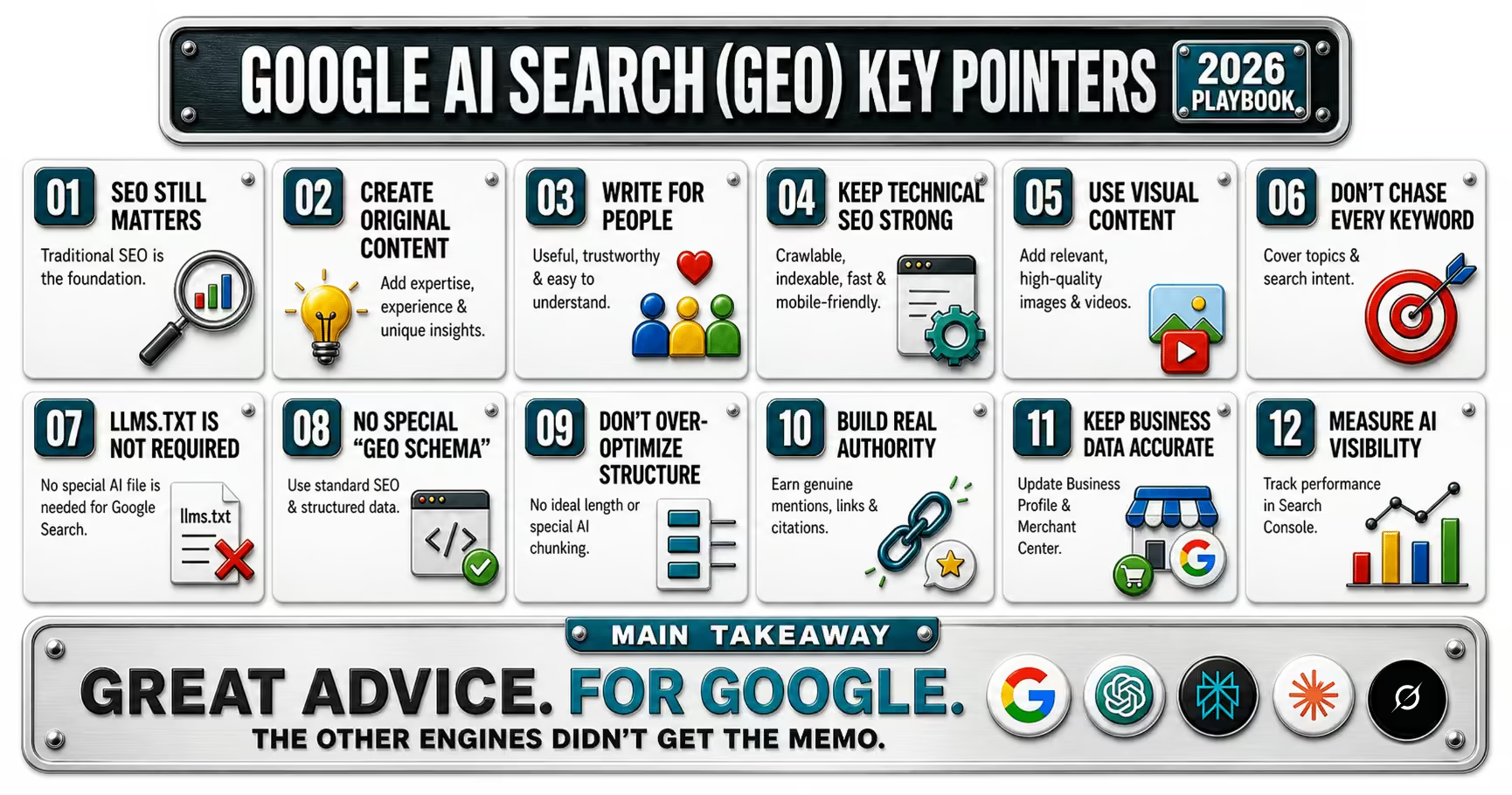
There is a tidy little infographic doing the rounds called the 2026 GEO playbook. Twelve numbered pointers, hand-drawn icons, a big underlined takeaway at the bottom: don't optimize for AI, create content AI has a reason to recommend. It is well made and, as far as it goes, almost entirely correct.
The problem is the "as far as it goes" part. Every one of those twelve pointers traces back to Google's official guidance on optimizing for generative AI search, published in May 2026 and updated in July. Google wrote a document about Google. Someone turned it into a poster about AI. Those are not the same thing, and the gap between them is where a lot of budget is about to get wasted in both directions: some of it on files nobody reads, and some of it on nothing at all, because a poster said nothing was required.
We treat SEO and GEO as one discipline at Silverback. Not because Google told us to, but because the evidence says roughly nine tenths of the work is shared. What follows is an honest scoring of that playbook: what is right and should never be overlooked, and the specific places where advice written for Google quietly stops being true the moment a user opens ChatGPT instead.
What Google actually said, and why most of it is right
Google's position is not marketing spin, and it is worth understanding the mechanism before arguing with it. Google's generative AI features are grounded in the core Search index using retrieval-augmented generation. The model does not roam the open web at query time; it retrieves from Google's index, then generates. Google also runs query fan-out, splitting one question into several related sub-queries and pulling results for each.
That architecture has a hard consequence, stated plainly in Google's technical requirements: to appear in generative AI features on Google Search, a page must be indexed and eligible to be shown with a snippet. There is no side door. No file you can upload, no schema you can bolt on, no formatting trick gets a page into an AI Overview if the page is not already eligible for Search.
So when Google says SEO is the foundation, that is not a platitude. It is a description of the plumbing. Which means the following pointers from that playbook are correct, load-bearing, and should never be overlooked by anyone:
Technical SEO is the whole ballgame, and it matters more for AI, not less. Crawlable, indexable, fast, mobile-friendly. Every AI system that can cite you has to fetch you first. Google is the only one of them that will tell you when it cannot.
Original, experience-led content beats commodity content. Google's framing in its people-first content guidance is sharp here, and the AI guide sharpens it further by contrasting a generic "7 Tips for First-Time Homebuyers" against something like "Why We Waived the Inspection and Saved Money." The first is reproducible by any model without your site. The second is not. That distinction holds on every engine, because a model with nothing unique to quote has no reason to cite you.
Don't chase every keyword variation. Google explicitly warns that spinning up a page for every fan-out permutation runs into its scaled content abuse policy. It is also just bad strategy. Topical coverage beats keyword coverage now that fan-out evaluates you against sub-queries you never tracked.
Don't over-optimize structure, and don't chunk your content for robots. There is no ideal page length and no magic chunk size. Anyone selling you one is guessing.
Build real authority, and keep your business data accurate. Google Business Profile and Merchant Center feeds do surface in AI responses. This is unglamorous and it works.
Visual content earns its place. The effect is large: in Ahrefs data reported by Search Engine Journal, YouTube accounted for 5.6 percent of all AI Overview citations, and 18.2 percent of the citations that did not rank in Google's top 100 for the same keyword were YouTube URLs. The text around those videos is doing most of that work.
If you did nothing but the above, you would be ahead of most of your competitors. That is the honest case for Google's position, and it is a strong one.
Where the advice quietly stops being true
Now the memo problem. Google wrote scoped advice. The poster dropped the scope. Here is what falls off.
On other engines, robots.txt is a visibility switch, not just a crawl control
This is the single biggest omission, and it is not a matter of opinion. It is in OpenAI's own crawler documentation.
OpenAI runs separate agents for separate jobs. OAI-SearchBot handles search. GPTBot handles model training. ChatGPT-User handles live, user-initiated fetches. OAI-AdsBot validates ad landing pages. The controls are independent, so you can allow search inclusion while refusing training, which is a useful lever.
But read the consequence OpenAI states directly: sites opted out of OAI-SearchBot will not be shown in ChatGPT search answers. Not demoted. Not shown. OpenAI adds that it can take roughly 24 hours for a robots.txt change to propagate through its systems, and that because ChatGPT-User actions are user-initiated, robots.txt rules may not apply to them.
Now hold that against pointer seven on the poster: no special AI file is needed. True for Google. On ChatGPT, one line in a plain text file decides whether you are eligible to be cited at all. That is not a special AI file. It is the oldest file on the web, doing a new job, and Google's guidance had no reason to mention it because it is not Google's crawler.
The practical risk is rarely a deliberate block. It is a security team tightening bot rules against AI scraping, a WAF rule matching a user-agent pattern too broadly, or a copied robots.txt with a blanket disallow. Google will eventually surface a Googlebot problem in Search Console. Nothing anywhere will tell you that OAI-SearchBot has been getting a 403 for five months.
Ranking is a weaker proxy for citation than it used to be
Pointer one says traditional SEO is the foundation. Broadly true. But if you read that as "rank well and the citations follow," the data has moved under you.
Ahrefs analyzed 863,000 keywords and 4 million AI Overview URLs and found that 38 percent of cited pages also ranked in Google's top 10 for the same query. In its July 2025 version of the study, that figure was 76 percent. The remaining citations split almost evenly between positions 11 to 100 and beyond position 100.
Two caveats worth stating, because the honest version of this argument is more useful than the dramatic one. First, Ahrefs says its parsing method improved between the two studies, so the numbers are not strictly comparable and some of the drop reflects better detection rather than changed behavior. Second, a separate BrightEdge analysis published in February 2026 put top-10 overlap at around 17 percent using different methodology. The precise figure is contested. The direction is not.
Cross-engine, the divergence is wider still. Ahrefs also compared AI assistant citations against Google and Bing top-10 results across 15,000 queries and found overlap in the region of 11 to 12 percent. Different engines, different retrieval, different sources.
This does not mean rankings stopped mattering. On Google it is still a prerequisite. It means rankings are no longer a sufficient measurement of whether AI systems can find and use you.
Microsoft, which also runs a search engine, flatly disagrees
Google's guide dismisses AEO and GEO as terms describing work that is really just SEO. Microsoft did not get that memo either. Bing added GEO to its official webmaster guidelines and expanded its definitions of AI-related abuse, and Microsoft Advertising has published its own AEO and GEO framework for advertisers, treating them as distinct disciplines and folding in agentic commerce.
You do not have to decide who is right. You do have to notice that the second-largest Western search engine, which also powers a large share of Copilot, publishes guidance that contradicts the poster. "There is no such thing as GEO" is a defensible position for Google to hold about Google. It is not a description of the market.
Your measurement stack has a hole in it, and the poster points at the hole
Pointer twelve says to track AI performance in Search Console. Good advice. Google's Generative AI performance report is the only first-party view of AI Overviews and AI Mode impressions that exists, and you should be using it.
It also reports precisely nothing about ChatGPT, Perplexity, Claude, or Copilot. It cannot. Google has no visibility into them.
Google's guide follows this with a warning to be wary of third-party tools claiming access to internal ranking metrics. That warning is fair on its own terms, and plenty of AI visibility tools do oversell. But stack the two together and you get a playbook that tells you to measure AI visibility in a Google product and to distrust the tools measuring anything else. That is a complete answer only if Google is the only engine that matters to your customers.
The most reliable thing you own is your own server logs. They show exactly which AI agents requested which URLs and what status code came back. No vendor required.
The economics nobody puts on a playbook
There is a reason "just make good content and let the AI find it" feels incomplete, and Cloudflare has quantified it.
Cloudflare Radar publishes a crawl-to-refer ratio for AI and search platforms, introduced in July 2026: how many HTML pages a platform crawls for every visitor it sends back. Google sits at roughly 5 pages crawled per referral. The AI platforms are orders of magnitude further out, with Anthropic's ClaudeBot in the low thousands to one and OpenAI's GPTBot in the low hundreds to one on mid-2026 figures. These are live dashboards, so the exact numbers move, but the shape does not.
That gap is the actual strategic problem. It is not that AI engines will not find your content. It is that being found is worth dramatically less traffic than it used to be, which changes what you should optimize for. Citations start to function more like brand placement than like a traffic channel: the value is in being the source named in the answer, not in the click that may never arrive.
It also explains why the regulatory picture is moving. In January 2026 the UK's Competition and Markets Authority proposed that publishers should be able to opt out of AI Overviews without losing their normal search visibility, noting that publishers currently have "no realistic option but to allow their content to be crawled." The CMA also pointed out that Google-Extended, the control most people assume covers this, governs Gemini and Vertex training and does not stop content being used to ground AI Overviews. Google said it was "exploring updates" to let sites opt out of Search generative AI features specifically.
Keep that in view. The controls in this area are actively being rewritten by regulators, which is a strong argument for owning a deliberate crawler access policy rather than inheriting whatever your CDN defaults to.
The honest verdict on llms.txt
We ship llms.txt as part of our AI readiness work, so let me be straight about the evidence rather than sell you something.
Google is right that it does nothing for Google Search. Google states outright that Search ignores the file, and Search Central has declined to endorse it, with John Mueller comparing it to the old keywords meta tag: self-declared, therefore easy to game, therefore ignored.
The wider evidence is not much kinder. Ahrefs examined 137,210 domains that received traffic in May 2026 and found that among the roughly 38,000 carrying a valid llms.txt file, 97 percent received no requests for it at all that month. Of the small remainder that saw any traffic, a meaningful share came from GEO tooling and researchers studying the format rather than from AI systems using it. Crawlers do not go looking for the file on sites that lack one.
So: llms.txt is not a citation mechanism, and anyone telling you it is has not read the data. What it is, is a near-zero-cost file that a minority of AI tools do fetch, with GPTBot the most frequent requester among those that saw any traffic at all. We include it because it costs nothing and the downside is zero. We would never put it at the center of a proposal, and if an agency is selling you llms.txt as an AI visibility strategy, ask them for the request logs.
That is the correct way to read pointer seven on the poster. Google is right. Just notice that "this file does nothing" and "there is nothing to do" are different claims, and the poster blurs them.
How we handle this at Silverback
Our AI Readiness Kit exists to close the specific gap this article describes, and it is worth being precise about which parts do the heavy lifting.
The part that changes results is access control. A per-agent robots.txt that makes deliberate decisions about OAI-SearchBot, GPTBot, ClaudeBot, PerplexityBot, Google-Extended and the rest, rather than one blanket rule written before any of them existed. Paired with a log review that shows which agents actually reached you and which got blocked. This is the work with documented mechanical effect, because OpenAI's own documentation ties search inclusion to a robots.txt directive.
The second tier is machine-readable clarity: entity and schema files, a clean sitemap, structured business facts, and a RAG-friendly index of your key content. Google is right that no special schema is required for its AI features, and we do not claim otherwise. Standard structured data still earns rich results, still disambiguates your entity, and is increasingly what browser agents parse when they interact with your site. Google's own guide now points to agent-friendly site practices for exactly this reason.
The third tier, including llms.txt, is cheap insurance with honest expectations attached.
We deliver it two ways: a full set for teams who can deploy in one pass, and the same files split into three phases for clients who roll changes out gradually. The deliverable is files your developers can ship, not a PDF of recommendations.
What to actually do this quarter
Start by finding out what the engines can currently see. Pull your server logs, filter for Googlebot, OAI-SearchBot, GPTBot, ChatGPT-User, ClaudeBot and PerplexityBot, and look at the status codes. If any of them are collecting 403s, you have found something more valuable than any content project on your roadmap. Test from outside your own network, because internal requests often bypass the rules that matter.
Then write a deliberate crawler policy instead of inheriting one. Decide, per agent, whether you want to be in the index, in the answers, or in the training data. Those are three different questions and they now have three different switches. Most organizations have never made the decision consciously.
Keep doing the SEO. The infographic's main takeaway, that you should create content AI has a reason to recommend rather than optimising for AI, is the right instinct and we would not argue with it. Unique, experience-led content is the only durable asset in this whole picture, on every engine.
Just add the ten percent the poster left out, because it was written by a company that only had to describe its own front door.
- Read your server logs before your rankings. Filter for Googlebot, OAI-SearchBot, GPTBot, ChatGPT-User, ClaudeBot, and PerplexityBot, and look at the status codes. A 403 there outranks any content project on your roadmap.
- Write a per-agent crawler policy. Index, answers, and training data are three different questions with three different switches. Decide each one deliberately instead of inheriting a default.
- Keep doing the SEO. Unique, experience-led content is the only durable asset on every engine, and Google's index is still the front door to its AI surfaces.
- Measure beyond Search Console. Use the Generative AI report for Google's surfaces, and your own logs plus a monthly prompt baseline for everything Google cannot see.
If you want to know what that ten percent looks like on your site specifically, that is exactly what our AI readiness audit covers.
Frequently Asked Questions
Common questions about GEO, SEO, and AI-driven search visibility.
Yes, and Google explains why in its own documentation. Google's generative AI features are grounded in the core Search index through retrieval-augmented generation, so a page must be indexed and eligible to appear with a snippet before it can be cited in AI Overviews or AI Mode. The same fundamentals of crawlability, useful content, and real authority also drive visibility on ChatGPT, Perplexity, and Copilot. The difference is that those engines add access and retrieval mechanics that Google's guidance does not cover, because they are not Google's to cover.
Very little, based on the best available evidence. Ahrefs examined 137,210 domains that received traffic in May 2026 and found that of the roughly 38,000 with a valid llms.txt file, 97 percent received no requests for it at all that month. Google states plainly that Google Search ignores the file. It costs almost nothing to publish and a minority of AI tools do fetch it, with GPTBot the most frequent requester among the 3 percent that saw any traffic, but it is not a citation mechanism and should never be the centerpiece of an AI visibility plan.
For Google's own surfaces, SEO is the strategy, and Google says so directly: optimizing for generative AI search is optimizing for the search experience. For everything else, you need a small amount of additional work that traditional SEO never covered, principally per-agent crawler access in robots.txt and measurement outside Search Console. At Silverback we treat SEO and GEO as one discipline for this reason. Roughly 90 percent of the work is shared, and the remaining 10 percent is what decides whether ChatGPT can cite you at all.
Yes. OpenAI's crawler documentation states that sites opted out of OAI-SearchBot will not be shown in ChatGPT search answers. OAI-SearchBot governs search inclusion, GPTBot governs model training, and the two are independent, so you can allow one and disallow the other. OpenAI also notes it can take around 24 hours for a robots.txt change to take effect in its systems. A single overly broad disallow line, or an aggressive bot management rule, can remove you from ChatGPT search results without affecting your Google rankings at all.
Less well than it used to, though the measurements vary. Ahrefs analyzed 863,000 keywords and 4 million AI Overview URLs and found 38 percent of cited pages also ranked in Google's top 10 for the same query, down from 76 percent in its July 2025 study. Ahrefs cautions that its parsing method improved between the two studies, so the figures are not directly comparable. A separate BrightEdge analysis published in February 2026 put top-10 overlap at roughly 17 percent. Both point the same direction: page-one position is a weaker proxy for citation than it was.
Search Console's Generative AI performance report covers Google's own AI Overviews and AI Mode only. It reports nothing about ChatGPT, Perplexity, Claude, or Copilot, because Google has no visibility into them. Google's guidance also advises caution about third-party tools that claim access to internal metrics, which is fair, but it leaves a genuine measurement gap. Server log analysis of AI user agents is currently the most reliable first-party method, since it shows which AI crawlers reached your site and which received errors.
It is a review of whether AI systems can reach, parse, and correctly identify your site, covering per-agent robots.txt rules, bot management and WAF rules that may be blocking AI crawlers, structured data and entity clarity, and server log evidence of which AI agents actually fetched your pages. You need one if your security team has tightened bot rules in the past year, which most have, or if you have never checked what a 403 to GPTBot or ClaudeBot would cost you. Unlike Googlebot problems, nothing in Search Console will warn you.
Sources
- Google Search Central: Optimizing your website for generative AI features on Google Search (opens in a new tab)
- Google Search Central: AI features and your website (opens in a new tab)
- Google Search Central: Search technical requirements (opens in a new tab)
- Google Search Central: Creating helpful, reliable, people-first content (opens in a new tab)
- Google Search Central: Spam policies, scaled content abuse (opens in a new tab)
- OpenAI: Overview of OpenAI Crawlers (opens in a new tab)
- Search Engine Journal: Google AI Overview citations from top-ranking pages drop sharply (opens in a new tab)
- Search Engine Journal: 97% of llms.txt files got no requests, Ahrefs data shows (opens in a new tab)
- Search Engine Journal: Bing adds GEO to official guidelines (opens in a new tab)
- Search Engine Roundtable: Google Search team does not endorse llms.txt files (opens in a new tab)
- Press Gazette: Google exploring updates to let publishers opt out of AI Overviews (opens in a new tab)
- Cloudflare Radar: AI Insights (opens in a new tab)
- Cloudflare Blog: The crawl before the fall of referrals (opens in a new tab)