




YouTube Is Already the Most-Cited Domain in Google's AI Answers. Your Video Descriptions Are the Reason You Are Not In Them.
 Preferred source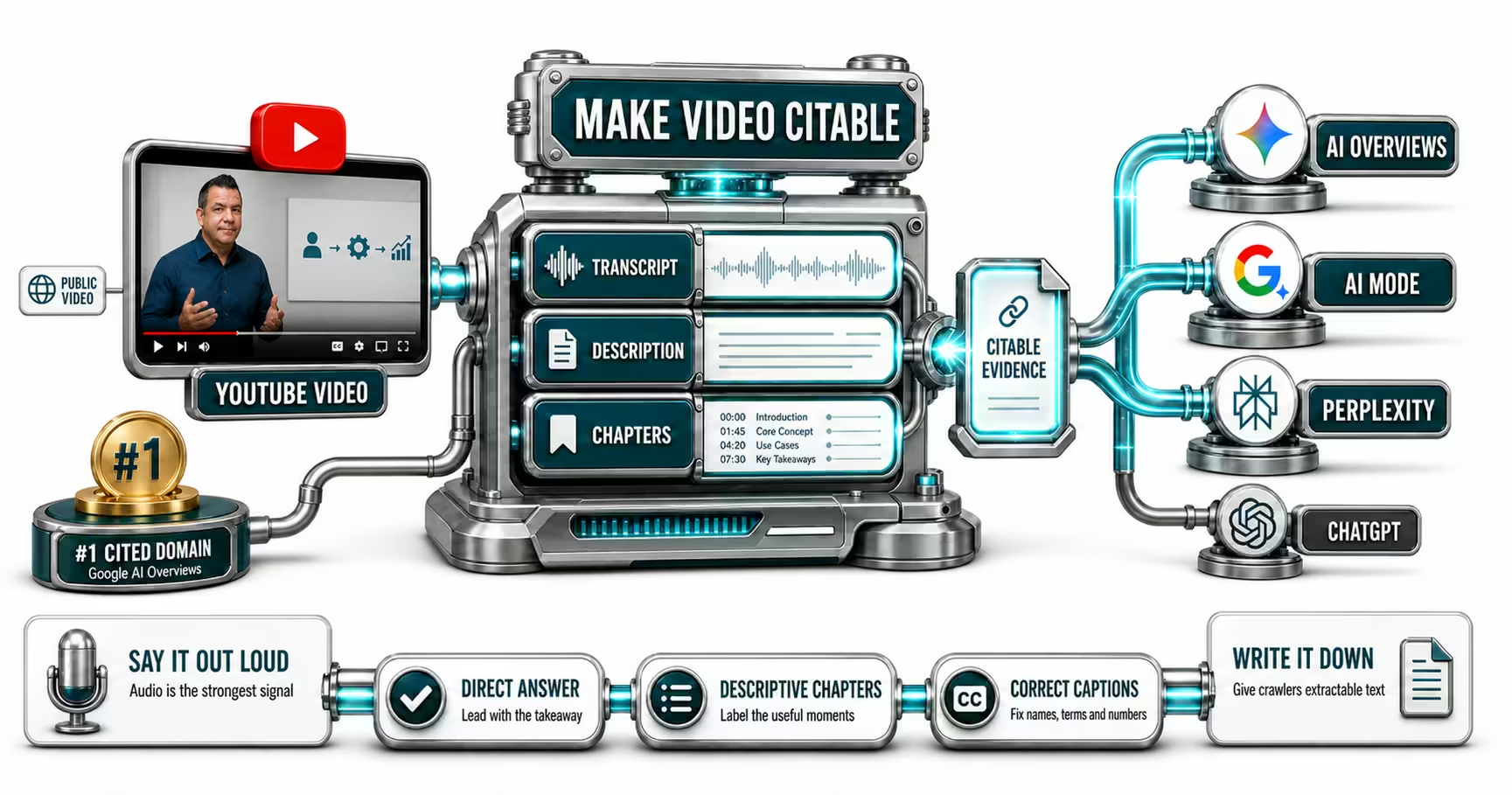
There is a question going around that gets the tense wrong. People keep asking whether YouTube will become a major citation source for AI answers.
It already is one. In Google's AI Overviews it is the single most-cited domain on the internet, ahead of Mayo Clinic and Investopedia. Not the most-cited video site. The most-cited site.
But the more useful finding sits underneath that headline, and it is the reason most brands with active YouTube channels are still invisible in AI answers. When an AI system decides whether to cite your video, the thing it evaluates is almost never the video. It is the text wrapped around the video. And for most business channels, that text is a link to a homepage, a tagline, and three hashtags.
Here is what the data actually shows, how these systems really process video, and what a description has to contain to earn a citation.
The short answer, with the caveat included
YouTube's citation dominance is real but uneven, and anyone telling you it is uniformly dominant across every AI engine has not read the numbers.
BrightEdge analyzed citation patterns across Google AI Overviews, Google AI Mode, ChatGPT, and Perplexity from May 2024 through September 2025. YouTube was cited 200 times more often than any other video platform. Its nearest competitor, Vimeo, sat at 0.1%. TikTok also 0.1%. Dailymotion and Twitch rounded to zero.
Broken out by engine, the picture varies enormously:
| Engine | YouTube citation share | Rank among all domains |
|---|---|---|
| Google AI Overviews | 29.5% | #1 |
| Google AI Mode | 16.6% | #1 |
| Perplexity | 9.7% | #5 |
| ChatGPT | 0.2% | Low, but growing fast |
Average across platforms: roughly 20%.
So if your question is "should we treat YouTube as an AI visibility channel," the answer for Google's AI surfaces and Perplexity is emphatically yes, today. For ChatGPT specifically, the honest answer is not yet. BrightEdge recorded 100% week-over-week growth for ChatGPT, but off a base so small that the percentage is nearly meaningless on its own. Anyone quoting that growth figure without the base is selling something.
A separate analysis by Peec AI covering 30 million cited sources, reported in March 2026, found Reddit the most-cited domain across ChatGPT, Google AI Mode, Gemini, Perplexity, and AI Overviews, with YouTube second and LinkedIn third. That study's explanation of the mechanism is the sentence this entire article exists to explain: YouTube dominates video citations via transcripts and descriptions.
For a sense of the trajectory, Pew Research Center's analysis of 68,879 Google searches from March 2025 found Wikipedia, YouTube, and Reddit were already the most frequently cited sources in AI summaries, though at that point YouTube links appeared somewhat more often in standard search results than in AI summaries. Eighteen months later YouTube is the number one cited domain in AI Overviews. The direction of travel is not subtle.
Why YouTube and not any other video platform
The 200x gap is worth pausing on, because it tells you something about how these systems work.
It is not simply that Google owns YouTube. Perplexity and ChatGPT have no incentive whatsoever to favor a Google property, and Perplexity still puts YouTube in its top five domains. Something structural is going on.
Three things, mostly.
YouTube pages are text pages. A YouTube watch page is server-rendered HTML containing a title, a description of up to 5,000 characters, chapter markers, channel information, and machine-accessible captions. It is, from a crawler's point of view, an article that happens to have a video embedded in it. Most competing platforms surface far less text and lean harder on client-side rendering.
Captions exist at scale. YouTube auto-generates transcripts for effectively everything. That means even a video whose owner never wrote a word of description still has a text representation. That is not true across the rest of the video web.
Persistent, stable, public URLs. Citations require something linkable that will still resolve later. YouTube URLs are stable and public in a way that ephemeral short-form content generally is not.
None of that is about video quality. It is about text availability. Which brings us to the mechanism.
How AI systems actually process a video
This is where most advice goes wrong, because there are two completely different paths and they have different requirements.
Path one: models that watch the video
Google's Gemini can process video natively, and its API documentation is specific about how. Gemini extracts information from both the audio and visual streams. For the visual side, the model samples video at one frame per second. Audio is processed at 1Kbps, single channel. Timestamps are inserted every second, so you can ask questions like "what is shown at 04:32" and get a coherent answer.
The cost profile tells you how much attention each second receives: roughly 300 tokens per second of video at default media resolution, or 100 tokens per second at low resolution. A one-hour video consumes a substantial fraction of even a one-million-token context window.
Two limits in that documentation matter enormously for businesses:
- "You can only upload public videos (not private or unlisted)." Unlisted videos are invisible to this path entirely. If your best explainer is unlisted because it lives on a landing page, no Gemini-based system can watch it.
- Google's docs warn that "fast action sequences might lose detail due to the 1 FPS sampling rate." At one frame per second, a slide you displayed for two seconds may be seen once, or not at all.
Read that carefully and the implication is clear. Even the model that can watch your video is getting a coarse visual sample and a compressed audio stream. What survives that process best is the spoken word, because audio is continuous while video is sampled. Whatever you say out loud is the highest-fidelity signal in your video.
Path two: systems that never watch anything
Every other major AI system reaches your video the way it reaches any web page, and none of the major non-Google AI crawlers execute JavaScript. Joint research from Vercel and MERJ found that GPTBot, ClaudeBot, PerplexityBot, Meta's crawler, and ByteDance's Bytespider all fail to render JavaScript, reading only raw HTML.
For those systems, your video is not a video. It is a title, a description, chapter labels, a channel name, and whatever caption text is exposed. That is the entire input. The model is not being persuaded by your production values, your host's charisma, or your editing. It is reading text and deciding whether that text answers a user's question well enough to quote and attribute.
So the practical rule across both paths:
Say it out loud, and write it down. Audio survives the models that watch. Text is the only thing that reaches the models that do not.
Which is why the description is the actual asset
Most business YouTube descriptions are written for a viewer who has already clicked. That is precisely backwards for AI visibility, where the description is often the only thing that gets read at all.
YouTube's own documentation is blunt about the description's function: "Descriptions tell the YouTube algorithm and your viewers what the video is about." YouTube's search ranking system weighs relevance, engagement, and quality, and it estimates relevance by looking at "how well the title, tags, description, and video content match your search query."
What YouTube says about tags matters, since a lot of channels still over-invest there: tags "play a minimal role in your video's discovery" and are mainly useful when your subject matter is commonly misspelled. The description is where the weight sits.
You get 5,000 characters. The median business channel uses perhaps 200 of them. That is roughly 4% of the available surface area for telling every AI system on the internet what you know.
What a citation-worthy description contains
Think of it as an abstract for a paper, not a caption for a post. Structure it in three zones.
Zone one, the first two or three lines. This is what viewers see before clicking "Show more," and it is the passage most likely to be extracted whole. Write a direct, self-contained summary of what the video answers. No greeting, no channel branding, no "In this video we're going to." State the question and the answer.
Zone two, the substantive body. This is where the real work happens and where almost nobody bothers. Include:
- A short summary paragraph expanding on the answer, written so it stands alone if lifted out of context
- Timestamped chapters with descriptive labels, not generic ones. "07:15 Why HVAC static pressure readings are misleading above 0.8 inches" earns citations. "07:15 Part 3" earns nothing
- The specific figures, prices, model numbers, dosages, specifications, or steps mentioned in the video, written as text. Numbers spoken aloud survive Gemini's audio processing but are lost entirely to text-only crawlers unless you write them down
- Names and credentials of who is speaking, which feeds YouTube's stated quality criterion around channels that "demonstrate expertise, authoritativeness, and trustworthiness on a given topic"
- Definitions of any jargon used
- Two or three genuine questions the video answers, phrased the way a person would actually ask them
Zone three, the standard block. Links, related playlists, contact details, disclaimers. YouTube supports a default description that auto-fills across uploads, which is the right home for this material. Keep it below the substance, not above it.
A worked example
Here is a typical business description:
New video! 🔥 Check out our latest on water heaters. Subscribe for more tips!
www.example.com | #plumbing #waterheater #DIY
Here is the same video, described for machines and humans at once:
Tankless water heaters cost between $1,800 and $4,500 installed in most US homes, and they only save money over a tank system if your household uses more than about 41 gallons of hot water per day. This video walks through the break-even math and the three situations where a tank heater is still the better choice.
Licensed master plumber Dana Ruiz (Arizona ROC #123456) compares installation cost, energy use, lifespan, and maintenance for tankless versus tank water heaters, using 2026 pricing from three Phoenix-area suppliers.
Chapters
00:00 Why the payback period is usually quoted wrong
02:14 Real installed cost of tankless in a retrofit, including gas line upsizing
06:40 Energy factor explained, and why a 0.95 EF does not mean 95% savings
11:05 The 41-gallon-per-day break-even threshold
15:22 Three cases where a tank heater wins: low usage, cold inlet water, tight budgets
19:48 Maintenance reality, including annual descaling in hard waterQuestions this video answers
How much does a tankless water heater cost to install in 2026?
Is a tankless water heater worth it for a two-person household?
How long do tankless water heaters last compared with tank models?Key figures: installed cost $1,800 to $4,500. Tankless lifespan 20 years versus 10 to 13 for tank. Break-even usage roughly 41 gallons per day. Annual descaling recommended above 7 grains per gallon water hardness.
The second version is still under 2,000 characters. It contains extractable claims, attributed expertise, specific numbers, and question phrasing that matches how people prompt. It is the version an AI system can quote.
Channel-level signals matter too
YouTube states that for quality, its system "is designed to identify signals that can help determine which channels demonstrate expertise, authoritativeness, and trustworthiness on a given topic." That is channel-level, not video-level, and it rewards focus.
Practical implications: fill out your channel description with what your organization actually does and who it serves. Name your presenters and state their credentials. Organize videos into coherent playlists by topic rather than by upload date. Publish consistently in a defined subject area rather than scattering across unrelated topics.
A channel that is unmistakably about one domain is easier for any retrieval system to trust on that domain.
Where this strategy does not work
Being honest about limits is what makes the rest of this credible.
Query type matters more than effort. BrightEdge found YouTube citations concentrated in tutorials, how-to content across finance, software, and medical topics, plus pricing, deal hunting, product demos, and reviews. YouTube was less likely to be cited for career advice, strategy, abstract concepts, and pure informational queries. If your category is conceptual rather than demonstrable, video will underperform for you regardless of how good your descriptions are.
ChatGPT is not the win here. At 0.2% citation share, building a YouTube strategy specifically to appear in ChatGPT would be premature. Build it for Google's AI surfaces and Perplexity, and treat ChatGPT as a call option.
You are building on rented land. In August 2026, Reddit's share of ChatGPT Search citations fell roughly 86% in four days following a retrieval change, according to Promptwatch data reported by Search Engine Land. Platform citation share can evaporate without notice. YouTube should be a channel in your mix, not the foundation of your visibility.
Unlisted means invisible. Worth repeating because it is a silent failure. Gemini's documentation states it can only process public videos. Marketing teams routinely make videos unlisted to control where they appear, and in doing so remove them from AI systems entirely.
Putting the mechanism to work
Start with an inventory rather than new production. Pull every video on your channel into a spreadsheet with its description character count. Sort ascending. The videos at the top of that list are your cheapest wins, because they are already published, already indexed, and already carry whatever watch history they have earned. You are not making content. You are making existing content legible.
Then rewrite descriptions in priority order: highest-view videos first, then videos covering topics you most want to be cited on. Follow the three-zone structure, and hold yourself to a floor of roughly 1,000 characters of genuine substance before the standard link block. Add descriptive chapters to anything over about four minutes.
Fix the transcripts while you are in there. Auto-captions handle conversational speech well and mangle product names, technical terms, and proper nouns, which are exactly the words you most need transcribed correctly. Uploading a corrected caption file is a small task with outsized returns, because that transcript is what text-only systems read.
Change how you script, going forward. Since audio is the highest-fidelity signal for models that watch, say the important things out loud rather than only displaying them on screen. Read numbers aloud. State your name and credentials verbally. Name the product or concept explicitly instead of saying "this one." A slide shown for two seconds may be sampled once at 1 FPS. A sentence spoken is captured continuously.
Audit your unlisted videos and make public anything that has no genuine reason to be hidden.
Finally, measure it. Log which prompts currently surface competitor videos in Google AI Mode, AI Overviews, and Perplexity, run them monthly, and record whether your videos start appearing. Without that baseline, you are guessing.
- Inventory by description length. Every video in a spreadsheet, sorted by character count ascending. The shortest descriptions on your best videos are the cheapest wins on the list.
- Rewrite in three zones. Direct answer up top, substance in the middle with descriptive chapters and real figures, standard links at the bottom. Floor of 1,000 characters of substance.
- Fix captions and say it aloud. Upload corrected transcripts, and script so numbers, names, and credentials are spoken, not just shown. Audio survives sampling; slides may not.
- Go public and measure monthly. Unlisted videos are invisible to Gemini. Log the prompts that surface competitor videos and track when yours start appearing.
If you want help scoping this, Silverback's AI visibility work covers video alongside the rest of the citation surface, because a great video with a two-line description is one of the most common and most fixable gaps we find.
Frequently Asked Questions
Common questions about GEO, SEO, and AI-driven search visibility.
In Google's AI surfaces, yes. BrightEdge analysis covering May 2024 through September 2025 found YouTube held a 29.5% citation share in Google AI Overviews, making it the top domain overall ahead of Mayo Clinic at 12.5%, and a 16.6% share in Google AI Mode, also ranking first. Across AI platforms generally its average citation share was approximately 20%. However, this varies sharply by engine: Perplexity cited YouTube in 9.7% of cases, ranking it fifth, while ChatGPT showed only 0.2% citation share. A separate Peec AI analysis of 30 million cited sources reported in March 2026 ranked YouTube second overall behind Reddit across ChatGPT, Google AI Mode, Gemini, Perplexity, and AI Overviews.
Both, depending on the system. Google's Gemini processes video natively from both audio and visual streams, sampling visuals at one frame per second, processing audio at 1Kbps, and consuming roughly 300 tokens per second of video at default media resolution. It can only process public videos, not private or unlisted ones. Other major AI crawlers including OpenAI's GPTBot, Anthropic's ClaudeBot, and PerplexityBot do not execute JavaScript and cannot process video at all, according to Vercel and MERJ research. For those systems the video's title, description, chapter labels, and caption text are the entire available input, which is why written metadata determines citation eligibility on most platforms.
YouTube allows a maximum of 5,000 characters, and most business channels use a small fraction of that. A practical target is at least 1,000 characters of genuine substance before any standard link block, structured in three zones: a direct self-contained answer in the first two or three lines that appear before the "Show more" cutoff, a substantive body containing timestamped descriptive chapters, specific figures and specifications, presenter credentials, and questions the video answers, and finally the standard links and channel information. YouTube's documentation advises that every video have a unique description and that one or two main descriptive terms feature prominently in both the description and the title.
Not meaningfully. YouTube's own documentation states that tags "play a minimal role in your video's discovery" and are primarily useful when a video's subject matter is commonly misspelled. YouTube's search ranking system estimates relevance from how well the title, tags, description, and video content match a query, but the description carries substantially more weight and offers 5,000 characters versus a tag field's limited utility. Time spent expanding tags is better spent writing descriptions and correcting transcripts.
BrightEdge found YouTube cited approximately 200 times more often than any other video platform, with Vimeo and TikTok each at roughly 0.1% and Dailymotion and Twitch rounding to zero. The gap is structural rather than a matter of Google ownership, since Perplexity and ChatGPT have no incentive to favor Google properties yet still cite YouTube heavily. YouTube watch pages are server-rendered HTML containing up to 5,000 characters of description text, chapter markers, and machine-accessible auto-generated captions, which makes them readable to crawlers that cannot process video. YouTube URLs are also stable, public, and persistently linkable, which citation requires.
BrightEdge found YouTube citations concentrated in tutorial and how-to content across finance, software, and medical topics, along with pricing research, deal hunting, product demonstrations, and reviews. YouTube was notably less likely to be cited for career advice, strategy discussions, abstract concepts, and purely informational queries. This means video investment for AI visibility pays off most for demonstrable, procedural, and product-specific subject matter, and underperforms for conceptual topics regardless of description quality.
Sources
- Search Engine Land: YouTube dominates AI search with 200x citation advantage (reporting BrightEdge analysis) (opens in a new tab)
- Search Engine Land: AI search engines cite Reddit, YouTube, and LinkedIn most (reporting Peec AI analysis) (opens in a new tab)
- Pew Research Center: Google users are less likely to click on links when an AI summary appears in the results (opens in a new tab)
- Google AI for Developers: Video understanding, Gemini API (opens in a new tab)
- Vercel and MERJ: The rise of the AI crawler (opens in a new tab)
- YouTube Help: Tips for video descriptions (opens in a new tab)
- YouTube Help: How YouTube search works (opens in a new tab)
- YouTube Help: Add tags to your YouTube videos (opens in a new tab)
- Google Search Central: Video SEO best practices (opens in a new tab)
- Google Search Central: Video (VideoObject, Clip, BroadcastEvent) structured data (opens in a new tab)
- Search Engine Land: Reddit's ChatGPT Search citations fell 86% in four days (opens in a new tab)
- Silverback Marketing: AI Visibility Services (opens in a new tab)