





Reddit Nearly Vanished From ChatGPT and Google Shipped a Spam Update: The Week in SEO, GEO, and AI Visibility August 17 to 21, 2026
 Preferred source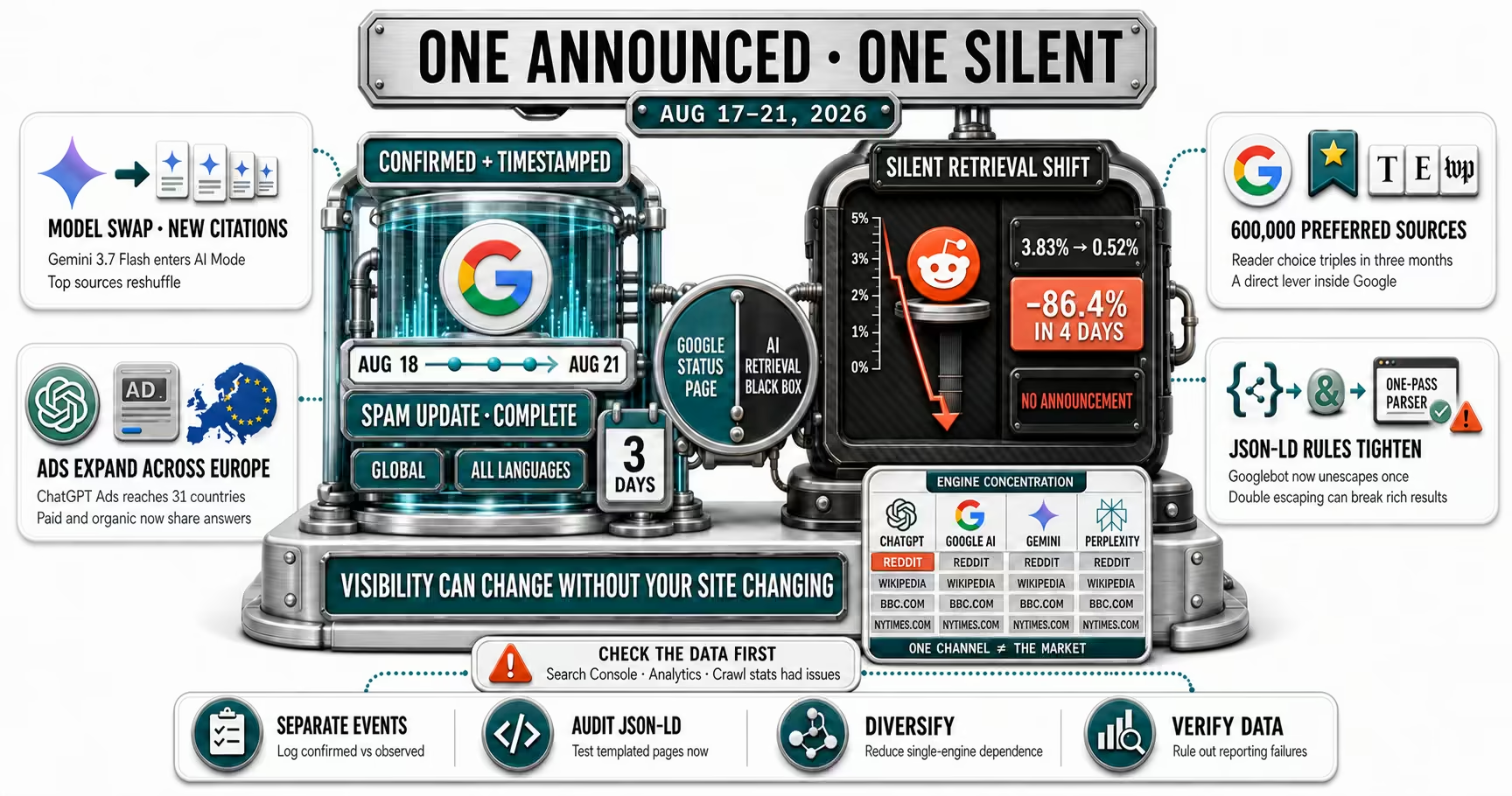
Two things happened this week that tell you almost everything about where visibility work is heading. Google rolled out a routine spam update and finished it in three days, while the search community argued about whether it had started early. Meanwhile, one of the most-cited domains on the open web fell off a cliff inside ChatGPT Search in four days, for reasons nobody has fully explained.
One of those events had a status page. The other did not. That asymmetry is the story.
Google's August 2026 spam update came and went in three days
Google announced the August 2026 spam update on the Search Status Dashboard on Tuesday, August 18, describing it as a normal spam update applying globally and to all languages (Search Engine Roundtable). The rollout finished on Friday, August 21 at roughly 4:50 am ET. For comparison, the August 2025 spam update took 27 days.
Google's public framing was deliberately boring. It targets sites violating the search spam policies. It does not target link spam, and it does not target the site reputation abuse policy. Google declined to quantify the impact. Recovery, per the documentation, may take months.
The community framing was less boring. Discussion threads filled with reports of niche specialist sites being displaced by large general retailers, and of Discover and Google News traffic disappearing. One publisher reported the opposite: a false positive that had suppressed their site finally lifted, with a recovery spike dated August 18. Both can be true at once, which is why spam updates are so hard to read from outside.
The most useful exchange of the week was procedural. Several site owners noticed heavy volatility on August 12 and 13, days before the announcement, and concluded Google had shipped early. Mueller pushed back on LinkedIn: "We don't roll them out beforehand. We try to get the announcement as close as possible to the actual 'button-pushing' (which is sometimes challenging due to time-zones)." He added that most Google systems update continuously and only the bigger, broader changes get announced, while acknowledging it is "sometimes hard to find a good balance between giving some transparency and causing unnecessary worries."
Why it matters: if you saw a ranking change on August 12 or 13, the announced spam update is not your explanation, and building a recovery plan around it will waste weeks. The announced updates are a small, self-selected sample of what Google ships. Your incident log needs two columns: what Google confirmed, and what you observed. Stop assuming every volatility spike has a name.
Reddit's ChatGPT citation share collapsed 86 percent in four days
This is the week's most consequential story, and it did not come from Google at all.
According to Promptwatch data reported by Search Engine Land on August 20, Reddit accounted for an average of 3.83 percent of ChatGPT Search citations between July 18 and August 7. That share fell below 1 percent on August 14 and averaged about 0.52 percent through August 17. That is a decline of roughly 86.4 percent in four days, for a domain treated for two years as the single biggest winner of the AI answer era.
Promptwatch also flagged an earlier, smaller slide beginning August 8, the same day it says ChatGPT Search changed its query fan-out behavior. The working hypothesis is that OpenAI's retrieval layer started leaning harder on site-targeted queries rather than broad web searches, stripping the advantage from domains winning through wide fan-out. Promptwatch was careful to say the data shows when the shift happened, not why, and called the findings provisional. Search Engine Journal made the same point. Forbes and Axios both covered it on August 20.
Google's AI products showed nothing like it. Reddit's share in AI Overviews drifted down gently from roughly 2.5 percent in early July to about 2.1 percent in August. That is drift. What happened in ChatGPT was a step change.
Why it matters: every brand that has been told to "go build a Reddit presence" for AI visibility just watched that channel lose most of its citation value inside one retrieval system, in four days, with no announcement and no appeal. The lesson is not that Reddit is worthless. It is that citation share inside any single AI system is a function of that system's retrieval configuration, and those configurations change silently and without versioning. We made the same argument from history in our piece on Reddit, DMOZ, and borrowed authority: if a meaningful slice of your AI visibility sits on a platform you do not control, you are exposed to a change you will never be notified about.
Gemini 3.7 Flash is now behind AI Mode, and practitioners are seeing different citations
Google's Robby Stein and Rajan Patel confirmed late on Friday, August 14 that Google Search is now using Gemini 3.7 Flash in AI Mode, rolling out globally for Google AI Pro and Ultra subscribers in English. The model was announced on Thursday, August 13 with no mention of Search, billed only as Google's "most intelligent workhorse model yet for coding and agents." Stein said it is "better at following instructions and understanding your intent."
Independent testing was mixed. Glenn Gabe reported no dramatic difference at first, though he later found a clear case where 3.7 correctly read a question about how Google review updates roll out while the older default misread it entirely. Gagan Ghotra tested local queries and found the entities named in answers largely unchanged, but the top three citations were frequently different URLs.
That last observation deserves more attention than it got. Google positions this as an accuracy upgrade. What practitioners are measuring is a reshuffle of which sources get credited.
Why it matters: this is subscriber-only and English-only for now, which limits blast radius, but it previews what happens when Google removes the subscription gate. A model swap in AI Mode can change your citation status without changing your rankings, your content, or your technical setup. Log which model produced the answer wherever you can, and expect your baselines to reset each time Google promotes a new model into the default slot.
OpenAI took ChatGPT Ads into 31 European countries
OpenAI announced on August 18 that ChatGPT Ads is expanding to 31 European countries, including Germany, France, Spain, Italy, Sweden, Norway, Denmark, the Netherlands, and Austria. Access initially runs through the OpenAI Ads Solutions team, agency partners, and technology partners, with self-service through Ads Manager to follow later this summer (Search Engine Land). Ads will be shown only to Free and Go plan users; Plus, Pro, and Enterprise stay ad-free. OpenAI said "tens of thousands of marketers have now advertised on ChatGPT" and that it has "made significant progress in six months, but we are still early." The US self-service ads manager only launched in May 2026.
Why it matters: the commercial layer of AI answers is being built faster than the organic visibility layer is being understood. Six months from launch to a 31-country expansion is aggressive. For European brands, this is the moment to run small controlled tests rather than wait for best practices to settle, because ad inventory in a conversational surface behaves differently from a SERP and the learning does not transfer cleanly from Google Ads. It also raises a question worth discussing now: when one system serves both organic citations and paid placements inside the same answer, how do you attribute a conversion to either?
Google says Preferred Sources has passed 600,000 unique sources
On August 21, Google updated the Preferred Sources button that publishers embed on their own sites. The new embed code returns the user to the page they were on after they add a source. Google framed the benefit as readers finding their favorite publications "in Top Stories, AI Overviews, and AI Mode, while publishers gain a more seamless way to connect with readers across Google" (documentation).
The number buried in that announcement is the interesting part. Google said users have selected more than 600,000 unique Preferred Sources. In May 2026 that figure was 200,000. It tripled in roughly three months.
Why it matters: Preferred Sources is one of the few levers a publisher has that directly influences what Google shows a specific reader, including inside AI surfaces. It is opt-in, per-user, and it compounds. The growth rate suggests Google is investing in it rather than quietly shelving it. If you publish anything news-adjacent and have not shipped the embed, that is a cheap win available this week.
The quiet JSON-LD escaping change most people will miss
Also on August 21, Google announced that Googlebot's JSON-LD extraction now applies only a single pass of HTML unescaping. Google's wording: "To bring our parser up to JSON and other standards, we changed our JSON-LD extraction and are now only applying a single pass of HTML unescaping." Gary Illyes pointed people to RFC 8259, section 7, for what proper JSON escaping actually means.
In plain terms, Google used to quietly fix double-escaped entities in your structured data. It no longer does. Google's guidance is to move to standard JSON escapes or Unicode hexadecimal escapes.
Why it matters: this is the kind of change that silently kills rich results on CMS-generated markup, especially anywhere a template escapes output twice on its way into a JSON-LD block. Product names with ampersands, review snippets with special characters, and FAQ blocks are the usual suspects. It will not throw an error. It will just stop producing rich results, on a delay, as pages are recrawled. Run the Rich Results Test against a sample of templated pages and check any field where content flows from a database through an escaping layer, the same discipline we describe in our structured data guide.
Measurement had a rough week
Search Console's Generative AI performance report had a data logging issue around August 13, with widespread reports of impression and click declines starting around August 12 and 13. Crawl stats were missing two days of data as of August 21. Google Analytics real time had an outage starting around 4 am ET on August 19. And the video carousel is showing far less often; Semrush data cited by Search Engine Roundtable had it on just over 30 percent of queries previously and under 20 percent now.
Why it matters: four reporting anomalies inside one week, in the same week as a confirmed algorithm update, is a recipe for bad decisions. Anyone who pulled a week-over-week report on Friday and concluded the spam update tanked their impressions may be looking at a logging bug. Check whether the metric itself was broken before you write the incident report.
Also worth knowing
Apple added 4,656 new IP addresses for Applebot, its Siri and Apple Intelligence crawler, spotted by Ryan Siddle and reported on August 17. Apple had not updated those ranges in years, and warming crawler capacity at that scale usually precedes a launch. If you have been aggressively blocking AI crawlers, check whether Applebot is on the list.
Elsewhere: Google's Content API for Shopping was sunset on August 18, so anyone still on it has broken feeds. Microsoft Advertising rolled out AI Max globally and confirmed Max CPC will not be available for new campaigns starting October 1. Pew Research published data on August 18 showing young US adults are increasingly wary of AI and concerned about job displacement.
How to act on this
- Separate your incident logs. If you saw movement on August 12 or 13, stop attributing it to the spam update, because Google has said plainly the update began at 12:30 pm ET on August 18. If you did move on or after the 18th and you sell in a competitive commercial niche, check whether you were displaced by larger general retailers rather than by better specialist content, because that is the pattern showing up repeatedly and it changes what a sensible response looks like.
- Audit your JSON-LD. This is the highest-certainty task on the list because Google told you exactly what changed and what to do. Pull a sample of templated pages, run the Rich Results Test, and check every field that passes through an escaping layer. Fix double escaping now rather than discovering the loss in three weeks.
- Rethink your AI visibility concentration. The Reddit story is a warning about single-platform dependency, not about Reddit specifically. Map where your citations actually come from across ChatGPT, AI Overviews, AI Mode, and Perplexity, and be honest about how much sits on domains you do not control.
- Ship the small things. Add the updated Preferred Sources embed if you publish news-adjacent content. Verify Applebot can reach your site. And before you report on any of this week's numbers, confirm the underlying data was not broken, because this week there is a real chance it was.
Frequently Asked Questions
Common questions about GEO, SEO, and AI-driven search visibility.
Google launched the August 2026 spam update on Tuesday, August 18, 2026 at approximately 12:30 pm ET and confirmed the rollout was complete on Friday, August 21, 2026 at around 4:50 am ET, roughly three days. Google described it as a normal spam update applying globally and to all languages. It targeted sites violating Google's search spam policies but did not target link spam or the site reputation abuse policy, and Google declined to say what share of queries were affected. By comparison, the August 2025 spam update took 27 days.
No. Google's John Mueller addressed this on LinkedIn after site owners reported heavy ranking volatility on August 12 and 13, days before the August 18 announcement. Mueller said, "We don't roll them out beforehand. We try to get the announcement as close as possible to the actual 'button-pushing' (which is sometimes challenging due to time-zones)." Google runs unannounced ranking changes continuously and announces only the larger ones, so volatility outside an announced window is common and should not be attributed to a named update.
Reddit's share of ChatGPT Search citations fell approximately 86.4 percent in four days, from an average of 3.83 percent between July 18 and August 7, 2026 to roughly 0.52 percent by August 17, according to Promptwatch data reported by Search Engine Land on August 20, 2026. The decline accelerated on August 14, following an earlier slide that began August 8 when Promptwatch says ChatGPT Search shifted its query fan-out behavior toward more site-targeted searches. Promptwatch stated the data shows when the shift occurred but not why, and described the findings as provisional. Google's AI Overviews showed no comparable drop, with Reddit's share there declining gradually from about 2.5 percent in early July to roughly 2.1 percent in August.
Google Search AI Mode began using Gemini 3.7 Flash on Friday, August 14, 2026, confirmed by Google's Robby Stein and Rajan Patel on X. The rollout is global but limited to Google AI Pro and Ultra subscribers searching in English, accessed by clicking the plus icon and selecting the model. Gemini 3.7 Flash was announced on August 13, 2026 as Google's "most intelligent workhorse model yet for coding and agents," with no mention of Search. Google says it is better at following instructions and understanding intent. Independent testing by Glenn Gabe and Gagan Ghotra found modest differences in answer quality but noticeable changes in which URLs were cited.
On August 21, 2026, Google announced that Googlebot now applies only a single pass of HTML unescaping when extracting JSON-LD structured data. Google's statement read, "To bring our parser up to JSON and other standards, we changed our JSON-LD extraction and are now only applying a single pass of HTML unescaping." Double-escaped entities will no longer be unrolled, so publishers must update to standard JSON escapes or Unicode hexadecimal escapes. Gary Illyes pointed to RFC 8259, section 7, as the definitive specification. Sites with double-escaped markup risk losing rich results with no error surfaced anywhere.
OpenAI announced on August 18, 2026 that ChatGPT Ads is expanding to 31 European countries, including Germany, France, Spain, Italy, Sweden, Norway, Denmark, the Netherlands, and Austria. Initial access runs through the OpenAI Ads Solutions team, agency partners, and technology partners, with self-service access through Ads Manager to follow later in the summer. Ads appear only to users on the Free and Go plans; Plus, Pro, and Enterprise subscriptions remain ad-free. OpenAI's US self-service ads manager launched in May 2026, and OpenAI says tens of thousands of marketers have now advertised on the platform.
Sources
- Search Engine Roundtable: Google August 2026 spam update has been unleashed (opens in a new tab)
- Search Engine Roundtable: Google August 2026 spam update has finished rolling out (opens in a new tab)
- Search Engine Roundtable: Google: we do not roll out updates prior to the announcement (opens in a new tab)
- Search Engine Roundtable: Why Google announces some search updates but not all (opens in a new tab)
- Google Search Status Dashboard: August 2026 spam update (opens in a new tab)
- Google Search Central: Google Search ranking updates and spam updates (opens in a new tab)
- Google Search Central: Spam policies for Google web search (opens in a new tab)
- Search Engine Land: Reddit's ChatGPT Search citations fell 86% in four days: report (opens in a new tab)
- Search Engine Journal: Why Reddit's ChatGPT citation drop isn't fully explained (opens in a new tab)
- Axios: Reddit fades from ChatGPT citations (opens in a new tab)
- Forbes: Reddit nearly vanishes from ChatGPT citations after OpenAI search change, report suggests (opens in a new tab)
- Search Engine Roundtable: Google Search using Gemini 3.7 Flash in AI Mode (opens in a new tab)
- The Keyword (Google): Introducing Gemini 3.7 Flash (opens in a new tab)
- OpenAI: ChatGPT Ads expands across Europe (opens in a new tab)
- Search Engine Roundtable: ChatGPT Ads expanding to 31 European countries (opens in a new tab)
- Search Engine Land: ChatGPT Ads are expanding to 31 European countries (opens in a new tab)
- Search Engine Roundtable: Google Preferred Source button improved for publishers (opens in a new tab)
- Google Search Central: Preferred Sources (opens in a new tab)
- Search Engine Roundtable: JSON-LD extraction for Googlebot now does one pass of HTML unescaping (opens in a new tab)
- IETF: RFC 8259: The JavaScript Object Notation (JSON) Data Interchange Format (opens in a new tab)
- Search Engine Land: Google Search Console Generative AI performance report data bug (opens in a new tab)
- Search Engine Roundtable: Google Search Console crawl stats missing two days of data (opens in a new tab)
- Search Engine Roundtable: Google Analytics real time outage seems to be resolving (opens in a new tab)
- Search Engine Roundtable: Google Search video carousel showing less often (opens in a new tab)
- Search Engine Roundtable: Apple adds thousands of new IP addresses for Applebot to crawl from (opens in a new tab)
- Search Engine Land: Microsoft Advertising rolls out AI Max globally for Search campaigns (opens in a new tab)
- Pew Research Center: Young adults in the US are increasingly wary of AI, concerned it will take jobs (opens in a new tab)