





Why Structured Data Matters for AI Search
 Preferred source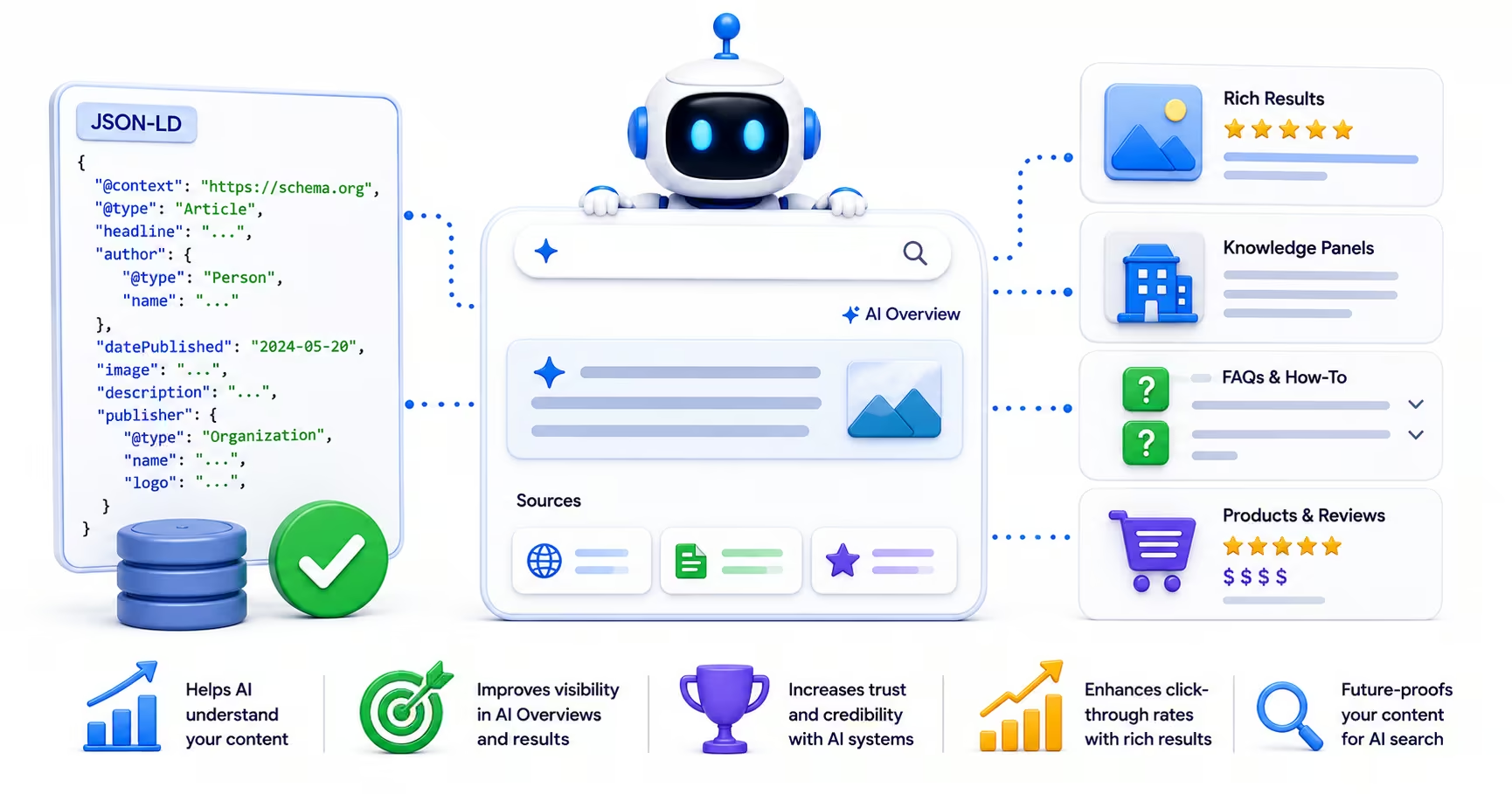
Structured data has always been described as an SEO enhancement, a way to earn rich results and help search engines better understand page content. That framing undersells it significantly now that AI-powered search has become mainstream. Google and Microsoft have both publicly confirmed that they use schema markup to power their generative AI features. Structured data has crossed the line from optional enhancement to essential infrastructure.
The practical implication is that websites without proper schema markup are systematically disadvantaged in AI-generated answers. Sites with complete, accurate structured data implementations are cited in AI responses up to 3.2 times more often than those without. For marketers building visibility strategies for the next several years, structured data is not a technical nicety. It is a prerequisite for competing in AI search, and a core part of technical SEO work at Silverback.
From SEO Tactic to AI Infrastructure
When schema markup was introduced in 2011 through Schema.org, the primary use case was helping search engines interpret page content more accurately to serve richer results. Breadcrumbs, star ratings, event dates, product prices: these are the kinds of facts that structured data communicated early on. The benefits were real but incremental, and many sites deprioritized implementation because the ranking impact was indirect.
AI search changes the calculus entirely. When a generative AI system assembles an answer to a user query, it is not just reading your content the way a human would. It is parsing the relationships between entities, facts, and sources at machine speed, drawing on signals from across the web to determine which content is authoritative enough to cite. Structured data gives that machine a precise, unambiguous map of what your content contains and what it claims to be true. Without it, the AI is guessing from context. With it, you are telling the machine exactly what you want it to understand.
This is why schema markup has become what one industry analysis called "the connective tissue between websites and emerging agentic experiences." As AI systems evolve from answering questions to taking actions, the sites that have built rich, accurate structured data vocabularies will be positioned to participate in those experiences. The sites that have not will be invisible by default.
Which Schema Types Matter Most for AI Visibility
Not all schema types carry equal weight for AI search visibility. The types that matter most are those that communicate entity identity, content authority, and answer-format content. Priority implementation should focus on the following. Our Technical SEO Priority Matrix can help you rank which fixes come first.
Organization and LocalBusiness schema establish your brand's identity at the entity level: who you are, what you do, where you are located, and how you can be contacted. This is foundational data that AI systems use to build a reliable profile of your brand, and without it, your entity recognition in AI answers will be weaker and less consistent.
Article and NewsArticle schema communicate the authorship, publication date, and update history of your content. These signals map directly to the experience and trustworthiness dimensions of E-E-A-T, and AI systems use them to evaluate how current and authoritative a piece of content is. Every substantive article on your site should carry Article schema with accurate author and date metadata.
FAQPage schema is among the highest-leverage implementations for AI visibility because it formats your content as explicit question-and-answer pairs, exactly the structure that generative AI uses to construct synthesized answers. Pages with FAQPage schema provide AI systems with pre-parsed, citation-ready content.
HowTo schema serves a similar function for instructional content. BreadcrumbList schema communicates site hierarchy to AI systems, helping them understand how individual pages relate to the broader content architecture of your site. Product and Service schemas are essential for commercial pages, communicating pricing, availability, and feature data that AI systems increasingly surface in shopping and comparison answers.
JSON-LD is the right implementation choice
Schema markup can be implemented in three formats: JSON-LD, Microdata, and RDFa. Google strongly recommends JSON-LD, and for good reason. JSON-LD lives in the page head as a separate script block rather than being embedded within the visible HTML. This makes it significantly easier to implement, update, and audit than inline formats, particularly at scale when multiple page types require consistent schema across hundreds or thousands of URLs.
The most common implementation errors are schema that contradicts visible page content, schema applied to pages where the declared type does not match the content, and outdated schema that references properties no longer recognized by Schema.org. All three errors can undermine your credibility with AI systems rather than enhancing it. Treat your structured data implementation with the same rigor you apply to your content accuracy, and run those checks as part of a broader SEO and GEO audit.
Measuring the Impact of Structured Data
Tracking the ROI of structured data requires looking in multiple places. In Google Search Console, the Enhancements section reports on which rich result types are detected, valid, and eligible on your site. Errors here indicate implementation problems that need immediate attention. Impressions and clicks for rich result types, visible in the Performance report when filtered by search appearance, show whether your schema is actually earning enhanced visibility.
For AI-specific measurement, monitor your citation frequency across Google AI Overviews and other AI platforms for your target queries before and after major schema implementations. This is still a developing measurement area, but the directional signal from these comparisons is meaningful enough to guide investment decisions. Schema implementation is one of the higher-ROI technical changes available to most sites because the effort is moderate and the compounding visibility benefit across both traditional and AI search is significant.
Frequently Asked Questions
Common questions about GEO, SEO, and AI-driven search visibility.
Schema markup does not directly increase rankings for organic blue-link results, and Google has been consistent on that point for years. What it does is arguably more valuable in the current landscape. First, it enables rich results such as review stars, FAQ dropdowns, and product details that make your listing larger and more clickable, and the click-through improvements from rich results are well documented. Second, it has become a significant factor in AI visibility, because structured data gives AI systems unambiguous, machine-readable facts about your content, your products, and your organization, which supports both AI Overview citation selection and how assistants describe your brand. The indirect ranking effects flow from there: better CTR, clearer entity understanding, and stronger authority signals all feed systems that do influence rankings. Treat schema as infrastructure for being understood rather than a ranking lever, and the investment logic becomes obvious.
Use a layered validation approach, because each tool catches different problems. Google's Rich Results Test validates specific URLs against the types Google actually supports for rich results and shows you how Google parses the page, making it the right first check for any template. The Schema Markup Validator at validator.schema.org checks against the full Schema.org vocabulary and catches structural errors the Rich Results Test ignores because they fall outside rich result eligibility. Then use the Enhancements section of Google Search Console for the ongoing view: it reports valid and invalid structured data across your whole site and alerts you when a template change introduces errors at scale. That last layer matters most in practice, since schema breaks silently; a CMS update can invalidate markup on thousands of pages without any visible change. Validate new templates before launch, and let Search Console watch everything afterward.
Volume alone is not the risk; accuracy is. Inaccurate or spammy schema can hurt your site, because structured data is a claim about your content, and false claims carry consequences. Applying Product schema to a blog post, claiming star ratings that appear nowhere on the visible page, or marking up content the user cannot see all violate Google's structured data guidelines and can result in manual actions or loss of rich result eligibility across the site, not just the offending page. The governing rule is simple: schema must accurately describe visible page content, and every property you declare should be verifiable by a human looking at the page. Within that constraint, comprehensive markup is an advantage rather than a risk, and a page can legitimately carry several connected types. When in doubt, describe less and describe it truthfully; a small accurate graph outperforms an ambitious inaccurate one.
Yes, and largely through the same mechanism. Voice assistants have to select a single answer to read aloud, and those responses are heavily sourced from featured snippets and AI-generated answers, both of which favor content that machines can parse confidently. Schema markup contributes exactly that confidence: it tells the system what your content is, who published it, and how its facts relate, which reduces the risk of the assistant misreading your page and makes it a safer choice as the spoken answer. The formats that matter most for voice are FAQPage and Speakable where appropriate, plus clean Organization and Article markup that establishes the source identity an assistant can attribute out loud. Voice queries also skew conversational and question-shaped, which rewards the same answer-first content structure that AI search rewards. Work done for AI citability is work done for voice, with no separate project required.
Two triggers should drive audits: change and calendar. Audit immediately whenever you make significant changes to page templates, CMS configurations, or site architecture, because schema is template-driven and a single template error propagates to every page built from it, which is how sites lose rich results on thousands of URLs overnight without noticing. Between changes, a quarterly structured data audit is a reasonable baseline for most sites: verify your priority templates still validate, check Search Console's Enhancements reports for accumulating errors, and confirm the marked -up facts still match what pages visibly say, since prices, people, and offerings drift over time. Sites that deploy weekly should fold a schema check into their release process rather than relying on the quarterly pass, because the interval between audits is exactly the window in which silent breakage costs you rich results and AI citation eligibility.
Schema.org is the open vocabulary itself: a collaborative standard founded by Google, Microsoft, Yahoo, and Yandex that defines hundreds of types and thousands of properties for describing things on the web. Google's structured data guidelines are one consumer's rulebook for that vocabulary: they specify which Schema.org types and properties Google supports for rich results and AI features, which fields it requires or recommends for each, and the quality policies attached to using them. The practical consequence is that the two diverge in both directions. Some valid Schema.org markup earns no rich result because Google does not support the type, and that markup can still be worthwhile because other systems, including AI engines, read the vocabulary too. Meanwhile, passing Google's requirements is about eligibility, not guarantees. Validate against Schema.org for correctness, follow Google's guidelines for its features, and remember Google is not the only reader anymore.
Both benefit significantly, but the priority types and the payoff mechanics differ. E-commerce sites should prioritize Product, Offer, and Review schema, because those power the price, availability, and rating displays that shopping surfaces and AI assistants pull from, and clean product structured data is increasingly what AI shopping agents match against buyer constraints. Content sites should prioritize Article, FAQPage, and author-focused Person markup, which support citation, attribution, and the E-E-A-T signals AI systems weigh when choosing sources. For either kind of site, the foundation comes first: accurate Organization schema and breadcrumb markup establish who you are and how your site is structured, and every other type builds on that identity. If forced to rank urgency, e-commerce sites feel the gap sooner because product data quality has immediate transactional consequences, but content sites competing for AI citations are discovering the gap costs them visibility just as surely.
Sources
- Google Search Central: Intro to structured data (opens in a new tab)
- Google Rich Results Test (opens in a new tab)
- Schema.org: Organization (opens in a new tab)
- Schema.org: FAQPage (opens in a new tab)
- Schema.org: BreadcrumbList (opens in a new tab)
- Google Search Central: AI features and your website (opens in a new tab)