





Google Says GEO and AEO Are Just SEO. Here Are the Four Places That Stops Being True.
You have seen the chart. Two columns, old versus new. Old SEO was keywords, content built around keywords, backlinks, rankings, and traffic. The 2026 version runs ten items deep: business first, then search demand, intent, experience, content, authority, entity, AI visibility, conversion, and revenue.
It is a good chart. It is doing something useful, which is dragging the conversation away from tactics and toward outcomes. It has also been shared tens of thousands of times without anyone checking whether the two columns describe reality.
So we checked. Some of it holds up beautifully. Some of it is a strawman. And the question underneath it, the one everybody actually argues about, now has an official answer from Google that most of the industry has not read.
Google answered the SEO versus GEO versus AEO question directly
In July 2026 Google published a dedicated guide to optimizing for generative AI features. Buried in it is a section that resolves a debate the industry has been having for two years.
What about "AEO" and "GEO"? "AEO" stands for "answer engine optimization" and "GEO" for "generative engine optimization". These are both terms you may see used to describe work specifically focused on improving visibility in AI search experiences. From Google Search's perspective, optimizing for generative AI search is optimizing for the search experience, and thus still SEO.
The reasoning is architectural, not rhetorical. Google's AI features are grounded in the same index and the same ranking systems as classic Search. The guide names the two mechanisms: retrieval-augmented generation, which pulls relevant pages from the Search index to ground responses, and query fan-out, which issues concurrent related queries to gather more sources.
If AI Overviews are reading from the Search index, then improving your position in the Search index improves your odds in AI Overviews. There is no separate door.
Google's John Mueller made the same point more bluntly when a Reddit user asked whether SEO is still enough or whether they need GEO too: "What you call it doesn't matter, but 'AI' is not going away." His actual advice was to look at your own numbers. "Be realistic and look at actual usage metrics and understand your audience (what % is using 'AI'? what % is using Facebook? what does it mean for where you spend your time?)."
The mythbusting section is the part worth printing out
Google's guide includes a heading called "Mythbusting generative AI search: what you don't need to do." It is unusually direct for Google, and it contradicts a large amount of paid advice:
| Tactic | What Google says |
|---|---|
| llms.txt and AI files | "Google Search itself doesn't use them" and "will neither harm nor help" |
| Chunking content | "No requirement to break your content into tiny pieces" and "no ideal page length" |
| Rewriting for AI | "You don't need to write in a specific way just for generative AI search" |
| Chasing mentions | Seeking inauthentic mentions "isn't as helpful as it might seem" |
| Special schema | "No special schema.org markup you need to add" |
Google also takes a swing at the tooling market: "Be wary of third-party tools that promise ranking success or claim to use 'internal' Google metrics. No third-party tool has access to our internal ranking or AI systems."
And on services, it points readers who are "considering third-party 'AEO' or 'GEO' advice or services" to its guidance on evaluating third-party SEO advice. That is a polite way of saying check whether you are buying capability or vocabulary.
Where the chart is right
Three of its claims are strongly supported.
Rankings are no longer a proxy for traffic. Pew Research Center tracked 900 US adults across 68,879 Google searches in March 2025. Users who saw an AI summary clicked a traditional result in 8% of visits, against 15% for users who did not. Clicks on links inside the summary happened in 1% of visits. Session abandonment rose from 16% to 26%. Ranking first on a query that produces an AI answer is worth materially less than it was, which is exactly the chart's point about traffic being a weak success metric.
Content structure demonstrably affects AI visibility. This is not vendor folklore. "GEO: Generative Engine Optimization," by Aggarwal, Murahari, Rajpurohit, Kalyan, Narasimhan and Deshpande from Princeton, Georgia Tech and the Allen Institute for AI, was accepted to KDD 2024 and found optimization methods could lift visibility in generative engine responses by up to 40%, with effectiveness varying by domain. So the chart is right that how you construct content matters more than it used to.
Search visibility does not guarantee AI visibility. The surfaces diverge. BrightEdge analysis found YouTube held a 29.5% citation share in Google AI Overviews, the top domain overall, while holding 0.2% in ChatGPT. In August 2026, Reddit's ChatGPT Search citation share fell roughly 86% in four days according to Promptwatch data reported by Search Engine Land, with no comparable movement in AI Overviews. Same web, wildly different outcomes.
Where the chart is a strawman
The left column is not "old SEO." It is bad SEO, and it has been bad for at least a decade.
Take backlinks as "the main strategy." Google has been publicly deflating that since 2014, when Matt Cutts said "over time, backlinks will become a little less important." By September 2023 Gary Illyes was saying it outright at Pubcon: links are "important, but I think people overestimate the importance of links. I don't agree it's in the top three. It hasn't been for some time." Illyes went further, saying it is possible to rank without links, and cited a site with zero internal or external links that ranked first consistently on content quality alone, discovered only through its sitemap. Google's Duy Nguyen has said backlinks carry "a lot less significant impact compared to when Google Search first started out."
So "backlinks were the main strategy" describes practitioners who were not listening, not an era that ended.
The same applies to "traffic was the success metric" and "keywords were the focus." Competent operators have tied search to pipeline for as long as analytics has existed. Presenting business alignment, intent, and revenue as 2026 innovations flatters the present and libels the past.
There is a second problem. Several items in the right column are not optimization disciplines at all. "Business comes first," "conversion turns visibility into customers," and "revenue is the real outcome" are true, and they are marketing, not SEO. Folding them into a search framework makes the framework feel bigger while making it harder to act on. If everything is SEO, nobody owns anything.
The four places "it's all just SEO" stops being true
Here is the part Google's guide cannot tell you, because Google only speaks for Google. Every divergence below is technical. None of them is strategic.
1. JavaScript rendering
Googlebot renders JavaScript. The AI crawlers do not.
A joint analysis by Vercel and MERJ found that none of the major AI crawlers execute JavaScript, including OpenAI's GPTBot, Anthropic's ClaudeBot, PerplexityBot, Meta's crawler and ByteDance's Bytespider. They fetch JavaScript files, with GPTBot doing so in 11.50% of requests and ClaudeBot in 23.84%, but never run them.
The consequence is a site that ranks in Google and reads as a blank shell to ChatGPT. Google's own guide says JavaScript is fine, and for Google it is. That advice does not transfer.
2. Crawler permissions are per-bot, not per-category
Every AI company runs several crawlers with different jobs and independent controls. OpenAI separates OAI-SearchBot for ChatGPT search from GPTBot for training, and states the settings are independent. Anthropic splits Claude-SearchBot, ClaudeBot and Claude-User, warning that disabling the search crawlers "may reduce your site's visibility" in Claude results. Perplexity states PerplexityBot "is not used to crawl content for AI foundation models" at all.
Two failure modes follow. Blocking GPTBot to stay out of training does not remove you from ChatGPT search. Blocking "AI bots" wholesale at your CDN removes you from all of it at once. Neither of those decisions exists in a Google-only worldview.
3. Machine-readable files that Google ignores and others publish
Google says it ignores llms.txt. That is a fact about Google.
Meanwhile, OpenAI's crawler documentation page opens by pointing machines to developers.openai.com/llms.txt, and Perplexity's crawler page instructs readers to "fetch the complete documentation index" at docs.perplexity.ai/llms.txt. Both also serve markdown versions of docs pages via a .md suffix.
That does not prove either company's retrieval consumes your llms.txt, and we are not claiming it does. It does establish that the format is live infrastructure at two major AI companies, which is a different situation from Google shrugging at it. Treat it as a cheap experiment for non-Google surfaces, never as a substitute for readable HTML.
4. Measurement has no unified view
Google gives you the Generative AI performance report in Search Console for AI Overviews and AI Mode. There is no equivalent for ChatGPT, Claude, or Perplexity. No console, no impressions, no query data.
The only working method is manual: build a list of prompts a real buyer would use, run them across each assistant on a schedule, and log which sources get cited and whether the claims about you are accurate. That is a new operational practice, and it is the strongest argument that something beyond classic SEO now exists.
So what should you actually call it, and who should own it?
Call it whatever your organization will fund. Mueller is right that the label is noise.
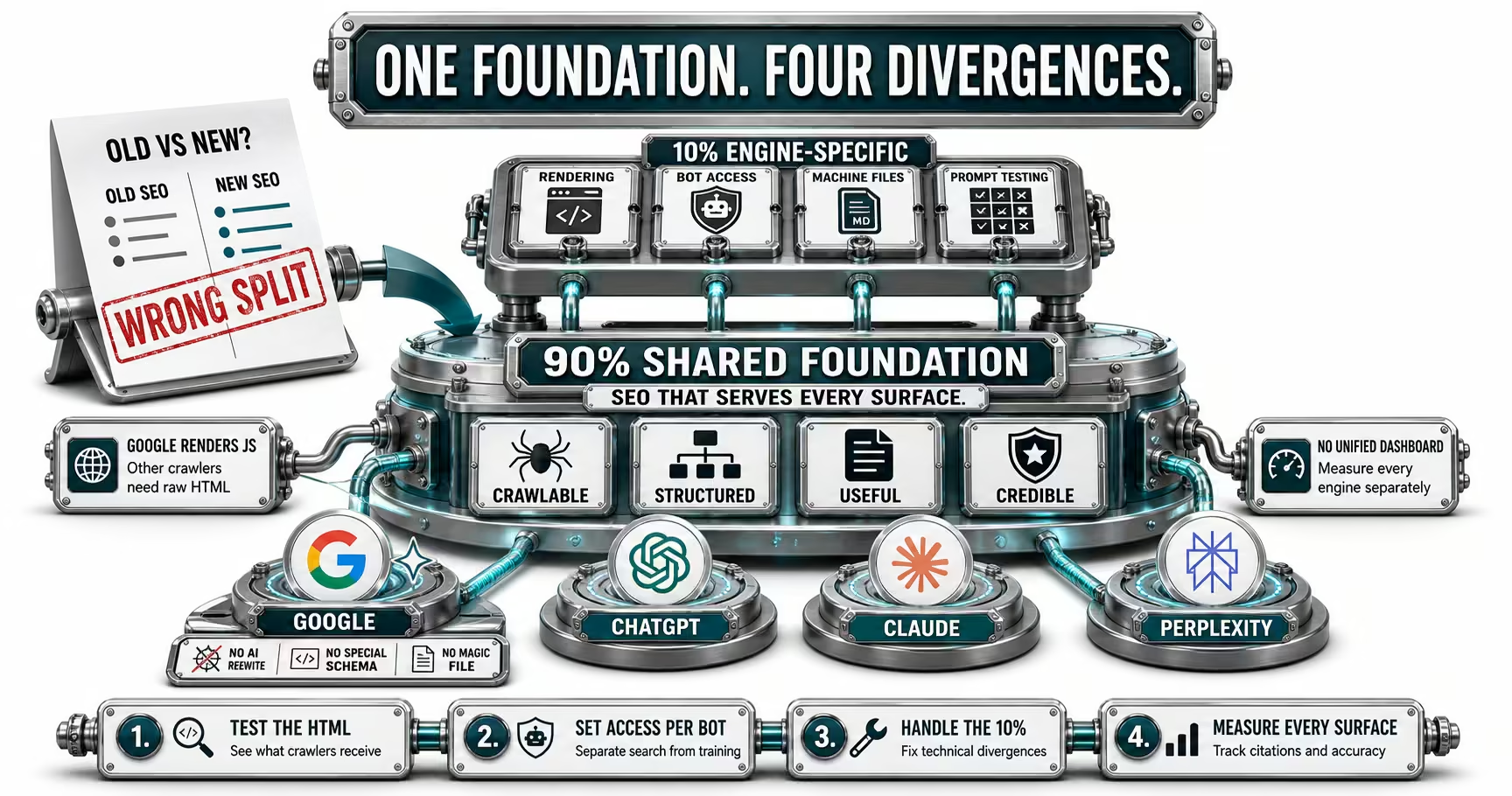
What matters is the split. Roughly 90% of the work is one discipline: crawlable, well-structured, useful content from a credible source. Doing that well serves Google, ChatGPT, Claude, and Perplexity simultaneously, which is why Google can honestly say it is all SEO.
The remaining 10% is real, and it is not strategy. It is server-side rendering so non-Google crawlers can read you, deliberate per-bot access decisions across robots.txt and your CDN, an optional machine-readable layer for engines that use it, and a prompt-testing habit because no dashboard exists.
If a provider is selling you a separate GEO strategy, ask which of those four things they are doing. If the answer is a new report and a new acronym, you are buying vocabulary. If the answer is rendering, access, and measurement, you are buying capability.
- Test what crawlers actually see. Pull the raw HTML for your top pages and confirm the substance is present without JavaScript, since AI crawlers will not run it.
- Set crawler permissions per bot. Allow the search crawlers explicitly, then make a separate, deliberate call on the training crawlers across robots.txt and your CDN.
- Skip the tactics Google names. Ignore chunking, AI-specific rewriting, and manufactured mentions, and treat llms.txt as a cheap experiment rather than a requirement.
- Build a prompt baseline. Run twenty to fifty buyer prompts monthly across ChatGPT, AI Mode, Claude and Perplexity, logging citations and accuracy, because no console reports this.
The viral chart is directionally right about where attention should go and historically unfair about where it has been. The more useful framing is not old versus new. It is universal versus engine-specific: get the 90% right for everyone, then handle the four technical divergences deliberately instead of buying an acronym to cover them.
If you want a read on which of those four is actually costing you visibility, that is the first thing we scope in SEO and GEO work, and it is usually the rendering layer nobody has checked. Our AI visibility service covers the prompt-baseline side, and if you want to run the machine-readable experiment yourself, our AI Readiness Kit generates those files free.
Frequently Asked Questions
Common questions about GEO, SEO, and AI-driven search visibility.
For Google Search, yes. Google's official guide to optimizing for generative AI features, last updated July 10, 2026, states directly: 'From Google Search's perspective, optimizing for generative AI search is optimizing for the search experience, and thus still SEO.' Google's AI Overviews and AI Mode are grounded in the same core Search ranking and index, so the same work drives both. Outside Google the picture changes, because ChatGPT, Claude, and Perplexity each run separate crawlers with separate permission controls, and most of them cannot execute JavaScript. The strategy is one discipline. The technical requirements diverge in four specific, measurable ways.
No. Google's generative AI optimization guide is explicit: 'You don't need to create new machine readable files, AI text files, markup, or Markdown to appear in Google Search (including its generative AI capabilities), as Google Search itself doesn't use them.' Google adds that maintaining such files 'will neither harm nor help your site's visibility or rankings in Google Search, as Google Search ignores them.' That statement covers Google only. OpenAI and Perplexity both publish llms.txt files for their own developer documentation and point machines to them, so the format is in active use elsewhere even though Google ignores it.
Yes, but far less than the traditional framing suggests, and Google has been saying so for over a decade. Google's Gary Illyes said in September 2023 that links are 'important, but I think people overestimate the importance of links. I don't agree it's in the top three. It hasn't been for some time.' He also noted it is possible to rank without links, citing a site with zero internal or external links that ranked first on content quality alone. Google's Duy Nguyen said backlinks have 'a lot less significant impact compared to when Google Search first started out.' Matt Cutts predicted the decline back in 2014.
Google's guide includes a section titled 'Mythbusting generative AI search: what you don't need to do.' It lists five things to ignore for Google Search: creating llms.txt files or other special markup, 'chunking' content into tiny pieces, rewriting content specifically for AI systems, seeking inauthentic mentions across the web, and overfocusing on structured data. Google states there is 'no ideal page length' and 'no special schema.org markup you need to add,' while noting structured data remains worthwhile for rich results eligibility. Google also warns to 'be wary of third-party tools that promise ranking success or claim to use internal Google metrics.'
In four technical areas, none of which are strategic. First, JavaScript rendering: Googlebot renders JavaScript, but research from Vercel and MERJ found GPTBot, ClaudeBot, PerplexityBot, Meta's crawler and Bytespider do not. Second, crawler permissions: each AI company runs multiple crawlers with independent robots.txt controls, so blocking a training bot is not the same as blocking a search bot. Third, machine-readable files: Google ignores llms.txt while OpenAI and Perplexity publish their own. Fourth, measurement: Search Console reports AI Overviews and AI Mode but has no equivalent for ChatGPT, Claude, or Perplexity, which requires manual prompt testing.
Google's guidance is notably cautious. Its generative AI guide advises that if you are 'considering third-party AEO or GEO advice or services,' you should review Google's guidance on evaluating third-party SEO advice, and separately warns to be wary of tools claiming access to internal Google metrics, stating plainly that 'no third-party tool has access to our internal ranking or AI systems.' The practical test is whether a provider is selling vocabulary or capability. Work that improves crawlability, content quality, and extractability helps everywhere. Work that exists only to satisfy a format Google says it ignores is harder to justify.
Not reliably. The surfaces diverge sharply in practice. BrightEdge analysis covering May 2024 to September 2025 found YouTube held a 29.5% citation share in Google AI Overviews, making it the top domain, while holding just 0.2% share in ChatGPT. In August 2026, Promptwatch data reported by Search Engine Land showed Reddit's ChatGPT Search citation share falling roughly 86% in four days, with no comparable drop in Google's AI Overviews. Search Engine Land's own summary of Google's position notes you should not assume search visibility automatically translates into AI visibility, because it does not always.
Query fan-out is a technique Google confirms it uses in AI Overviews and AI Mode, defined in its documentation as 'a set of concurrent, related queries generated by the model to request more information and fetch additional relevant search results.' Google's own example: for 'how to fix a lawn that's full of weeds,' fan-out queries might include 'best herbicides for lawns,' 'remove weeds without chemicals,' and 'how to prevent weeds in lawn.' Importantly, Google warns against creating separate pages for every fan-out variation, stating that doing so primarily to manipulate rankings violates its scaled content abuse spam policy.
Sources
- Google Search Central: Optimizing your website for generative AI features on Google Search (opens in a new tab)
- Google Search Central: AI features and your website (opens in a new tab)
- Google Search Central: Guidance on third-party SEO tools and advice (opens in a new tab)
- Search Engine Land: Google's John Mueller on SEO vs. GEO: Focus on audience behavior (opens in a new tab)
- Search Engine Land: Links are not a top 3 Google Search ranking factor, says Gary Illyes (opens in a new tab)
- Vercel and MERJ: The rise of the AI crawler (opens in a new tab)
- OpenAI: Overview of OpenAI Crawlers (opens in a new tab)
- Anthropic: Does Anthropic crawl data from the web, and how can site owners block the crawler? (opens in a new tab)
- Perplexity: Perplexity Crawlers (opens in a new tab)
- Aggarwal et al.: GEO: Generative Engine Optimization (KDD 2024) (opens in a new tab)
- Pew Research Center: Google users are less likely to click on links when an AI summary appears (opens in a new tab)
- Search Engine Land: YouTube dominates AI search with 200x citation advantage (reporting BrightEdge analysis) (opens in a new tab)
- Search Engine Land: Reddit's ChatGPT Search citations fell 86% in four days (reporting Promptwatch data) (opens in a new tab)