



A Billion Users, a 38% Traffic Drop, and a Hidden Sources Button: The Week in SEO, GEO, and AI Visibility August 10 to 14, 2026
 Preferred source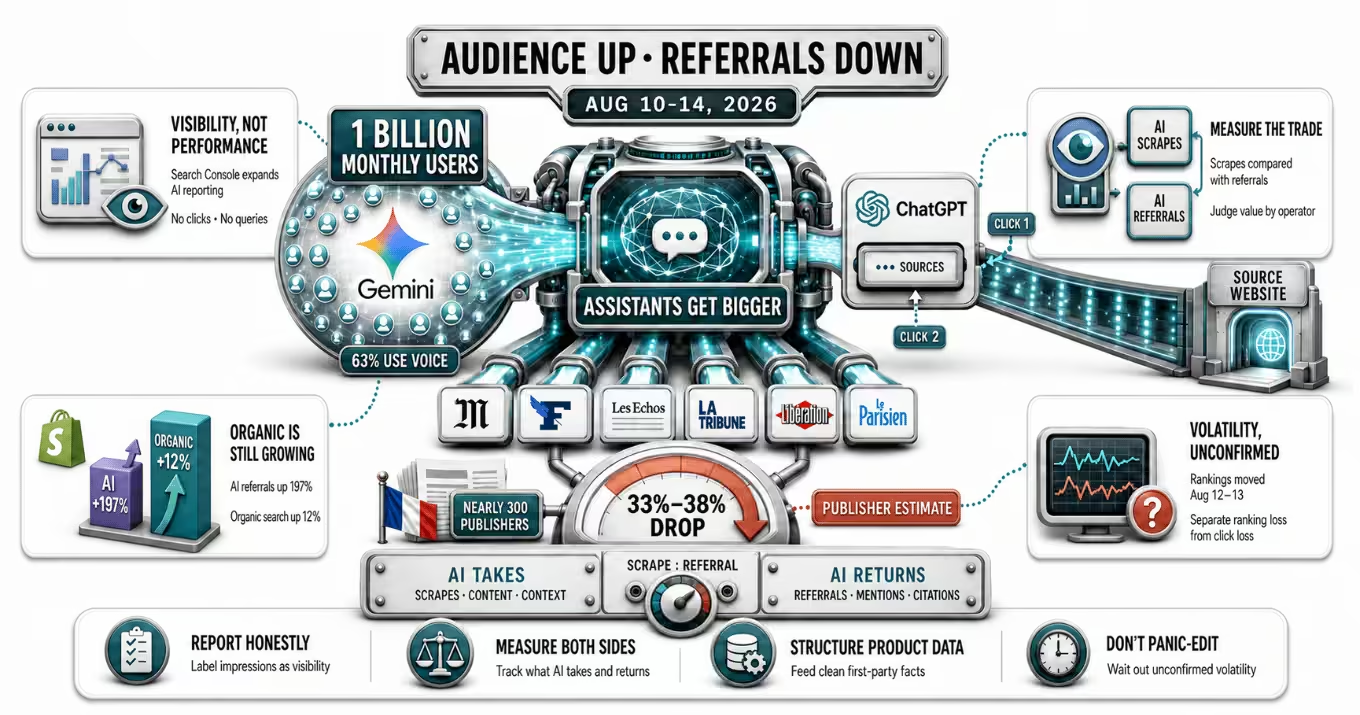
Three things happened this week that, read together, tell you almost everything about where search is heading. Google announced that its Gemini app crossed a billion monthly users. Nearly 300 French newspapers filed a competition complaint saying AI Overviews have cut their referral traffic by up to 38%. And OpenAI quietly moved the "Sources" button in ChatGPT into a three-dot overflow menu, where almost nobody will find it.
Assistants are getting bigger. The road back to the websites that feed them is getting narrower. That is the story of the week, and it is not subtle.
Nearly 300 French newspapers take AI Overviews to the competition regulator
On August 11, APIG, the trade body representing France's general news publishers, filed a complaint with the French competition authority accusing Google of breaching a 2022 compensation agreement by launching AI-generated search summaries without publisher consent, as reported by Search Engine Land and France 24 with AFP. Google launched AI Overviews and AI Mode in France on July 22. APIG says publishers were offered an update to their existing licence, with the only alternative being an opt-out that would cost them search visibility.
APIG president Marc Feuillee framed it plainly: "The editors are not seeking to halt innovation. They are asking for this value to be shared, and for compensation of the use of their content." Google's response is the one it uses everywhere: AI Overviews help people ask more complex questions and come with tools for publishers to manage how their content appears. This is not a first offence. France's competition authority fined Google 250 million euros in 2024 over parts of that same 2022 agreement, and the EU opened an investigation in December into whether Google used publisher content to train and serve AI features without appropriate compensation.
Why it matters: the 33% to 38% figure is a publisher estimate, not an audited number, and you should treat it that way. The regulatory pattern is what matters for planning. Europe is steadily converting "AI summarises your content" from a product decision into a licensing obligation. If that lands, paid content partnerships become a visibility channel and brands with no licensing leverage compete on structure and citability instead.
Gemini crosses a billion monthly users
Google announced on August 11 that more than a billion people now use the Gemini app every month, making it the fastest-growing product in the company's history. The usage detail is more interesting than the headline: 63% of users now talk directly to Gemini rather than typing, one in five Gemini Live interactions involve a camera feed or screen share, the app generates more than 150 million images a day, and there are over 100 million active users on iOS. TechCrunch covered the milestone the same day.
Why it matters: nearly two thirds of that usage is voice, and voice answers do not have ten blue links. They have one answer. When you model where your brand can appear in a Gemini interaction, a link in a citation panel is the optimistic case and a spoken mention with no link is the realistic one. That pushes up the value of unlinked brand mentions, consistent entity data, and simply being the name a model reaches for, and it makes last-click attribution even less honest than it already was. The image figure matters too: a product generating 150 million images a day is being used to make marketing collateral at enormous scale.
OpenAI buries the ChatGPT sources button
Glenn Gabe spotted that ChatGPT has started hiding the "Sources" control. It used to sit in the footer of a response. Now it sometimes appears only inside the three-dot "More actions" menu, so a user has to click twice to see which sites the answer came from. Barry Schwartz replicated it and covered it on August 13. Gabe's read: "That can definitely decrease visibility and clicks for citations that show up in the right-side panel." OpenAI has not announced this, and it may be a test. Gabe wondered aloud whether the goal is to keep attention on the ads that now appear in ChatGPT responses.
Why it matters: this is the most consequential item of the week for anyone whose GEO programme is justified on referral clicks. Every extra click between a user and your citation cuts click-through, and a two-click path to a source panel is close to a dead channel for most users. Citations do not stop mattering, but their job changes: they become a trust and consideration signal inside the answer, not a traffic source. Plan measurement accordingly, and stop promising clients that AI citations convert like organic listings.
Search Console's generative AI report expands, and still will not show you clicks
On August 11, the generative AI performance report in Google Search Console appeared on many more properties. Barry Schwartz checked around 25 properties and found it on all of them. Google's John Mueller then confirmed on Reddit that it is still not universal: "Correct, it's not yet every domain. (Also, like the discover and news reports, these are only shown if there's sufficient data to display.)" Google's own Search Console documentation notes the report will not appear if a site has not received enough impressions in generative AI features.
The report gives you impressions, pages, countries, devices, and dates. It does not give you clicks or queries, and it does not separate AI Overviews impressions from AI Mode or other generative surfaces.
Why it matters: here is where Google's framing and practitioner reality part company. Google presents this as visibility into generative AI performance. What you get is an impression counter with no query context and no click data, so you can see that a page is being surfaced but not what for, or whether anyone came. Wire it into reporting anyway, because impression trend by page is a genuine leading indicator. Just label it honestly: it is visibility data, not performance data.
Shopify's numbers push back on the death-of-organic story
Shopify released second-quarter commerce data showing AI-referred sessions to merchant storefronts up 197% year over year, covered by Search Engine Land on August 13. The part most people skipped: organic search traffic also grew 12%, and organic still sent more traffic to Shopify merchants than all tracked AI platforms combined.
The behavioural detail is where the value is. In research-heavy categories, where buyers compare specifications, compatibility, and reviews, AI-referred shoppers converted at roughly twice the rate of organic visitors. In broader taste-driven categories organic stayed the bigger discovery channel, though AI brought in about 1.3 times more first-time customers. And AI-referred shoppers converted at twice the rate when the system used structured Shopify Catalog data rather than scraped or third-party feeds.
Shopify CTO Mikhail Parakhin put it bluntly on X: "Everyone (myself included) assumes AI is swallowing Search and killing organic discovery. Surprisingly, Shopify's numbers say otherwise: AI-referred sessions are up 3x YoY, but organic still grew 12% on a much bigger base. The pie itself got bigger." Worth stating the limits: this is first-party data from a company selling commerce infrastructure, and Shopify did not disclose sample size.
Why it matters: the structured-data finding is the actionable one. Doubling conversion by feeding AI systems clean first-party product data rather than letting them scrape is the clearest return on structured data anyone has published this year. If you sell products, feed quality is now an AI visibility lever, not just a Merchant Center chore. And the broader point stands: a channel growing 197% off a small base is not yet a replacement for one growing 12% off a large one.
Microsoft puts a number on what AI crawlers give back
Microsoft Clarity added an AI Scrape-to-Referral Ratio to its Bot Analytics report on August 13. It compares AI scrape activity against referral traffic in a single metric, breaks it down by operator so you can see which AI sources actually send visitors back, and links straight into filtered session recordings so you can judge whether those visitors are worth anything. Microsoft's framing: "you can evaluate the tradeoff between content extraction and traffic return, then investigate how AI-referred visitors behave once they arrive." In the example screenshot Microsoft published, one operator had sent 41 referrals against a crawl volume implying roughly 6,000 scrapes per referral. That is an illustration, not a benchmark, but a vivid one.
Why it matters: until now the "should I block this AI crawler" argument has been almost entirely vibes. Now there is an operator-level ratio you can put in front of a client, alongside recordings showing whether AI-referred visitors scroll, convert, or bounce. Run it before you touch robots.txt. Some operators will look like a bad trade and some will be quietly sending your highest-intent traffic, and you cannot tell which is which without the data.
Rankings moved on August 12 and 13, and nobody confirmed anything
Third-party volatility trackers lit up on August 12 and into August 13 with movement outside the day-to-day norm. Google confirmed nothing. This continues a run of unconfirmed activity, with similar spikes around August 5, August 1 to 3, July 24, and July 18 to 19. The last confirmed update was the June 2026 spam update, June 14 to June 26. Webmaster forum chatter was severe, including Discover drops reported above 70% in Brazil and one operator writing "traffic today is the worst I have ever seen." Forum sentiment always skews toward the wounded, so weight it accordingly.
Why it matters: do not rebuild anything on an unconfirmed spike, and check whether movement is ranking loss or click loss, because those need different responses. Schwartz made the sharper point himself, that these movements matter less each cycle because Google sends less traffic regardless of where you rank. That is the real story behind every volatility post now.
Also worth knowing
After a judge dismissed Google's suit against the scraping service SerpApi last month, Google filed an amended complaint on August 10 built on a different argument: protecting licensed content inside its results. Google alleges Reddit, which licenses content to it, directed Google not to let third parties extract and commercialise that content. If you rely on SERP scraping APIs for rank tracking or GEO monitoring, that is a live supply-chain risk.
AI Overviews in the local pack are citing self-promotional listicles rather than the businesses themselves. Joy Hawkins documented Google quoting a single lawyer's own listicle as the primary source for every firm in a local result. If you do local SEO, getting into the listicles that AI systems trust is now part of the job, uncomfortable as that is.
Google confirmed on August 10 that it is testing "Create images," "Ask about files," and "Brainstorm" buttons in place of the classic Search and I'm Feeling Lucky buttons. Anthropic began watermarking Claude output worldwide on August 11 under the EU AI Act transparency code, something we covered in depth in our piece on the AI content penalty myth. Meta appears to be crawling the web at scale and may be building a search engine. Google cut the Search Profiles subscriber threshold from 100,000 to 35,000 on August 13. And AI-generated images started appearing inside AI Overviews on August 14.
The practical follow-through
- Rewrite how you report AI visibility. Turn on the Search Console generative AI report wherever it is available and start banking impression history by page, but caption it as visibility rather than performance in every deck. Pair it with the Microsoft Clarity Scrape-to-Referral view so you have both sides of the ledger: what AI systems take, and what they return, by operator.
- Stop building GEO business cases on referral clicks. The ChatGPT sources change is a warning shot and it will not be the last. Build the case on citation share, brand mention frequency, and assisted conversion, and get clients used to those metrics now while you can still frame the shift proactively rather than defensively.
- If you sell products, treat structured data as an AI visibility asset. Shopify's finding that AI-referred shoppers convert at double the rate when systems use clean first-party catalogue data instead of scraped feeds is the most concrete conversion lever published this month. Audit feed completeness and schema before you spend another hour on prompt-level tactics.
- Resist reacting to the August 12 and 13 volatility. Nothing was confirmed, this is the fifth unconfirmed spike in five weeks, and the useful question is whether you lost rankings or lost clicks at stable rankings. Those are different problems. And if you have European clients or news-adjacent content, put the French complaint on your risk register.
Frequently Asked Questions
Common questions about GEO, SEO, and AI-driven search visibility.
On August 11, 2026, APIG, the Alliance de la Presse d'Information Générale, filed a complaint with France's competition authority on behalf of nearly 300 French newspapers. The publishers allege Google breached a 2022 agreement on compensation for news content by launching AI Overviews and AI Mode in France on July 22, 2026 without negotiating payment for the press content those summaries use. Publishers estimate AI Overviews cut their referral traffic by 33% to 38%. APIG president Marc Feuillee said editors are "not seeking to halt innovation" but want the value shared. France's competition authority fined Google 250 million euros in 2024 over parts of the same agreement.
Google announced on August 11, 2026 that the Gemini app surpassed one billion monthly active users, making it the fastest-growing product in the company's history. Google reported that 63% of users now speak to Gemini rather than typing, one in five Gemini Live interactions involve a live camera feed or screen share, the app generates more than 150 million images per day, and there are over 100 million active users on iOS.
Yes. On August 13, 2026, Search Engine Roundtable reported that OpenAI is testing or rolling out a change that moves the "Sources" control in ChatGPT from the footer of a response into the three-dot "More actions" overflow menu, requiring two clicks to see cited sources. It was first spotted by Glenn Gabe, who noted it "can definitely decrease visibility and clicks for citations that show up in the right-side panel." OpenAI has not publicly announced the change. For marketers, it means AI citations are better valued as brand exposure and trust signals than as a reliable source of referral clicks.
No. As of August 2026, the generative AI performance report in Google Search Console shows impressions, pages, countries, devices, and dates with hourly to monthly granularity, but it does not show click data or query data, and it does not separate AI Overviews impressions from AI Mode or other generative surfaces. The report expanded to many more properties on August 11, 2026, though Google's John Mueller confirmed on Reddit that it is "not yet every domain" and that it only appears for sites with sufficient impressions in generative AI features.
Not yet, according to Shopify data published on August 13, 2026. Shopify reported AI-referred sessions to merchant storefronts grew 197% year over year in the second quarter of 2026 while organic search traffic grew 12%, and organic still sent more traffic than all tracked AI platforms combined. Shopify CTO Mikhail Parakhin said the numbers show "the pie itself got bigger." AI referrals did convert at roughly twice the rate of organic visitors in research-heavy categories and brought in about 1.3 times more first-time customers. Shopify did not disclose how many merchants or transactions were included.
Microsoft Clarity added the AI Scrape-to-Referral Ratio to its Bot Analytics report on August 13, 2026. It compares how much an AI operator scrapes from your site against how much referral traffic that operator sends back, expressed as a single metric and broken down by operator, and links into session recordings filtered to AI-referred traffic so you can assess visit quality. It is designed to help site owners decide which AI crawlers are worth allowing. In Microsoft's published example, one operator had sent 41 referrals against crawl activity implying roughly 6,000 scrapes per referral.
Sources
- Search Engine Land: 300 French newspapers file complaint over Google AI Overviews (opens in a new tab)
- France 24: French newspapers appeal to antitrust regulator over Google's AI summaries (opens in a new tab)
- Google: More than 1 billion people are using the Gemini app every month (opens in a new tab)
- TechCrunch: Google's Gemini app surges to 1 billion users (opens in a new tab)
- Search Engine Roundtable: OpenAI makes the ChatGPT sources less visible (opens in a new tab)
- Search Engine Roundtable: Google Search Console generative AI performance report expands to more (opens in a new tab)
- Google Search Console Help: Generative AI performance report (Search) (opens in a new tab)
- Search Engine Land: Shopify: AI referrals up 197%, but organic search still leads traffic (opens in a new tab)
- Shopify: AI and organic search are doing different jobs, what Shopify's data shows (opens in a new tab)
- Search Engine Land: Microsoft Clarity AI Scrape-to-Referral insights report (opens in a new tab)
- Search Engine Roundtable: Google search ranking volatility spikes on August 12-13 (opens in a new tab)
- Search Engine Roundtable: Google amends lawsuit against SerpApi over licensed content (opens in a new tab)
- Search Engine Land: Google confirms testing new buttons on home page to drive users to AI-powered search features (opens in a new tab)
- Search Engine Roundtable: Google AI Overview local results pulling from low-quality listicles (opens in a new tab)
- Search Engine Land: Anthropic adds AI text watermarking to Claude models worldwide (opens in a new tab)
- Anthropic: How Claude marks AI-generated content (opens in a new tab)
- Search Engine Roundtable: Meta/Facebook crawling web and may be building search engine (opens in a new tab)
- Search Engine Roundtable: Google lowers subscriber requirements for Search Profiles (opens in a new tab)
- Search Engine Roundtable: Google AI Overviews with AI-generated images in the wild (opens in a new tab)
- Search Engine Roundtable: Daily search forum recap, August 10, 2026 (opens in a new tab)
- Search Engine Roundtable: Daily search forum recap, August 13, 2026 (opens in a new tab)