





A quality week with a clock attached
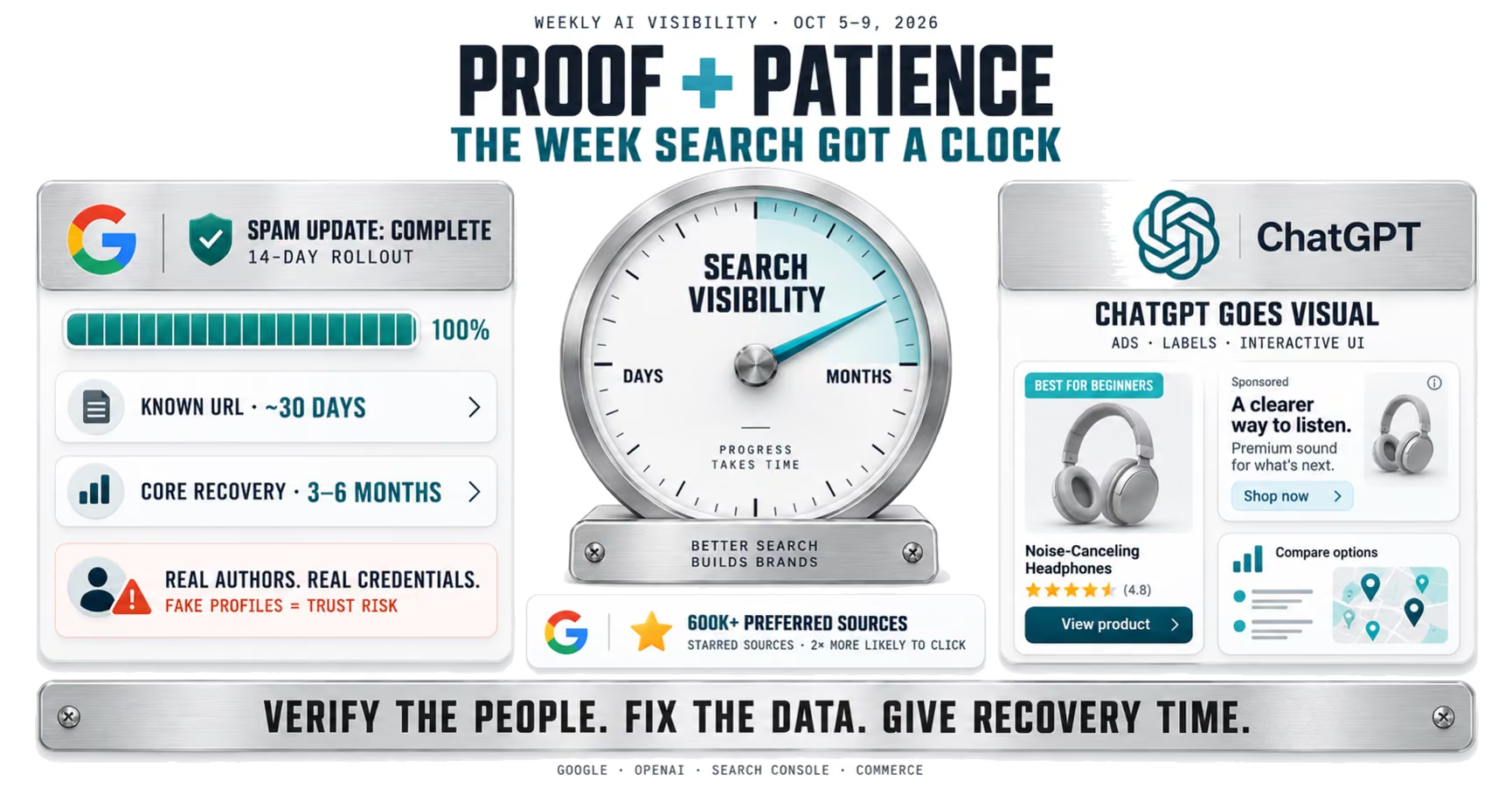
Most of this week's news was about trust and time. Google finished a long spam update, told site owners how slowly some of its systems move, and tightened its language on fake authors. OpenAI, meanwhile, spent the week building out the commercial side of ChatGPT: ads, measurement partners and product labels.
The window here is Monday, October 5 through Friday, October 9, 2026. Where a story started earlier, we give the real date. If you missed last week, our September 28 to October 2 roundup covers the first half of the spam update and the helpful content rewrite that set up this week.
The September spam update took two weeks to finish
Google confirmed on October 8 that the September 2026 spam update is complete. Search Engine Land reported the launch on September 24, and Search Engine Roundtable reported the finish at 4:37 am ET on October 8. Google's status dashboard entry is the primary record.
At launch Google said the update "applies globally and to all languages" and that "the rollout may take up to two weeks to complete." Google later described it as a normal spam update. It would not say what share of queries it affected, did not target link spam, and did not announce any policy changes. Barry Schwartz points out that recent spam updates finished in about two days, so this one ran roughly seven times longer. He also tracked the likely impact windows across ranking tools as September 25 to 27, September 30, and October 4 to 6, which are his observations and not Google's.
| Date | Event |
|---|---|
| Sept 24 | Rollout begins |
| Sept 25 to 27 | First volatility window |
| Sept 30 | Second spike |
| Oct 4 to 6 | Final phase |
| Oct 8 | Google confirms complete |
Why it matters. A two-week rollout means you should not judge the damage until the update is confirmed finished, and that moment was Thursday. Google also said recovery can take many months and that periodic refreshes will continue. If your traffic fell during the window, audit against Google's spam policies now, and do not expect a quick rebound.
Google put real numbers on how slowly its systems move
At Search Central Live in Barcelona, Gary Illyes shared internal figures on crawling, indexing and serving. Search Engine Roundtable published the tables on October 5, and Search Engine Land noted it is the first time Google has presented this kind of information at an event. Illyes framed it as an exercise to see whether the audience could relate to the numbers Google pulled internally.
| Process | Typical | Slowest |
|---|---|---|
| New URL discovery | About 20 hours | Weeks to never |
| Known URL refresh | About 30 days | Weeks to never |
| End-to-end indexing | About 1.5 hours | Months, or never |
| Title or snippet update | 1 to 2 days | Weeks to months |
| Manual action removal | 1 to 2 weeks | 4 to 6 weeks |
| Site move | 1 to 3 months | 6 months to 1 year or more |
| Core update recovery | 3 to 6 months | 6 months to 1 year |
Illyes cautioned that many of these processes are linked, so a delay in one can compound in the next.
- The slides were screenshots. Search Engine Land's text could not reproduce every figure, so we used the table Search Engine Roundtable built from the presentation. Check it against Google's own slides before quoting a number to a client.
- Some rows are unclear. Schwartz says he is not sure what a few serving entries mean, and Search Engine Land's reading of the spam update row differs from the table, so we left that row out.
- Typical is not guaranteed. Almost every row has a slowest case of months or never.
Why it matters. Most agencies, ours included, have been estimating these timelines from experience. Now there is a Google-sourced range to point to. A 30-day refresh cycle for known URLs and a 3 to 6 month recovery window for core updates are the numbers to put in your next forecast, and they argue against measuring a fix in the first two weeks.
Google warned against fake authors in plain language
Google updated its helpful, reliable, people-first content guidance with a new paragraph under the "who, how and why" section. Search Engine Land reported the change on October 6. The guidance now says to "avoid using deceptive authorship information."
It names the tactic: fabricating creator profiles, such as with "AI-generated headshots, made-up names, or false credentials," is a form of deception. Google adds that "any form of deception makes a page untrustworthy to both users and our automated quality systems."
Any form of deception makes a page untrustworthy to both users and our automated quality systems.
Schwartz notes how many news-style sites publish under invented bylines, and reads the wording as a warning that fake authorship could lower Google's view of a whole site. That is his interpretation. Google did not describe a specific penalty or tie this to the spam update.
Why it matters. Author pages are one of the cheapest things to fix and one of the easiest for a reviewer to verify. If your site credits articles to people who do not exist, replace the profile with a real person who can be found elsewhere, or publish under the company name.
ChatGPT gets a new interface, labeled shopping results and visual ads
OpenAI had three announcements that affect where brands appear. The first is the interface. TechCrunch reported that OpenAI launched Intelligent UI on October 7 alongside GPT-6, adding interactive visuals such as charts, calculators and maps to conversations. It rolled out to Pro, Plus, Business and Enterprise users first, with free and Go users following on Thursday.
The second is labeling. Search Engine Roundtable reported on October 6 that OpenAI is testing descriptive labels on product results, with examples like "best all-rounder," "best for beginners" and "best cushioning." Brodie Clark spotted the test, and OpenAI has not made a statement.
The third is advertising. OpenAI announced on October 5 a new visual ad format that will first appear during image generation, starting later in October with a group of U.S. advertisers. Search Engine Land's coverage lists a long set of attribution and incrementality partners. OpenAI also published early results: according to measurement firm DV Rockerbox, WeightWatchers' attributed cost per acquisition was 15.3% below its blended paid search benchmark, and Triple Whale reported that 93% of Portland Leather's visitors from ChatGPT Ads were new. OpenAI states that ChatGPT reaches 1.2 billion people each week.
- The results are partner-reported. DV Rockerbox and Triple Whale sell measurement and attribution, so they have a stake in ads looking measurable, and OpenAI gave no methodology.
- The audience figure is OpenAI's own. It gave no source for the 1.2 billion weekly number.
- Availability is narrow. Visual ads start later this month with select U.S. advertisers, so there is no broad benchmark yet.
Why it matters. Labels like "best for beginners" turn a product mention into a short editorial verdict, which means the attributes in your feed and on your pages now decide how you are described. Ads and organic results are also converging inside the same interface. Treat ChatGPT as a measured channel and test your product data there, but keep spend small until independent benchmarks exist.
Preferred Sources passed 600,000
Google began emailing some site owners their Preferred Sources count. Search Engine Land reported on October 6 that each email opens with the site's latest subscriber figure, as of October 5. Google says people have selected more than 600,000 unique sources, up from 200,000 in May 2026, and that users who pick a source are twice as likely to click it.
Preferred Sources lets searchers star publications so Google shows more of their stories in Top Stories. Google also included a survey asking whether site owners want this data more often, which suggests a Search Console report could follow. That is our inference, not something Google said.
Why it matters. This is a loyalty signal you can ask for. If you publish news or timely analysis, put the Preferred Source button on your site and mention it in your newsletter, because a starred source is a measurable audience advantage.
Merchant Center opens its UCP integration hub in the U.S.
Google began rolling out a Universal Commerce Protocol integration hub in Merchant Center to U.S. merchants. Search Engine Land reported on October 6 that merchants can choose which capabilities to support: cart transfer to their own site, native checkout on Google, and identity linking. Google has pushed other markets back, with Australia and Canada now expected next year.
Why it matters. Agentic shopping needs a clean handoff between discovery and purchase, and this hub is where merchants choose how much of that to hand to Google. Decide your position on native checkout before the rollout reaches your account.
Healthcare review snippets may have been switched off
Review rich results appear to have stopped showing for healthcare pages that use review markup. Search Engine Roundtable reported the observation on October 7, based on analysis from Schema App, a structured data vendor that has an interest in rich results working. Schema App says visibility dropped in late May, with a further drop in early August for some organizations, and that none of its markup changes restored the snippets. Google's review snippet documentation is the reference, and Google has made no statement.
Why it matters. If your healthcare clients lost star ratings in search, the cause may be on Google's side. Keep the markup accurate, but stop spending hours on fixes while Google stays silent.
Also this week
Google's crawl rate documentation now covers the Retry-After header for 503 and 429 responses in its emergency section, which Search Engine Roundtable explained on October 6. The header accepts a delay in seconds or an absolute UTC time.
The Search generative AI control page in Search Console now tells owners of a top-level domain property when a child property overrides their setting, according to Search Engine Roundtable and the updated Search Console help page.
Three moves for the week ahead
- Reset your recovery forecasts. Use Google's own ranges of 30 days for known URL refreshes and 3 to 6 months for core update recovery, and tell stakeholders not to judge a fix after two weeks.
- Audit every author page. Replace invented names, stock headshots and unverifiable credentials with real people, or publish under the company name.
- Compare your traffic to the spam window. Look at September 24 through October 8 in Search Console and note any pages that moved, before the next refresh.
- Check your product attributes for ChatGPT. Review the words in your feed and on your pages that could become a label like "best for beginners," and make sure each is accurate.
- Add the Preferred Source button if you publish timely content. It is free and Google says starred sources are twice as likely to be clicked.
The week's theme was proof and patience. Google wants authors to be real and tells you recovery takes months, while OpenAI is building a commercial layer that rewards clear product facts. If you want help turning this into a plan, our SEO and GEO service is built for exactly that. The sites that do well will be the ones with verifiable people, accurate data and the discipline to wait for results.
Frequently Asked Questions
Common questions about GEO, SEO, and AI-driven search visibility.
Search Engine Land reported the rollout began on September 24, 2026, and Search Engine Roundtable reported Google confirmed it complete on October 8, 2026. That is about two weeks, which matches the up to two weeks Google said it might take. Google said it applies globally and to all languages.
Gary Illyes presented internal Google figures at Search Central Live in Barcelona, reported by Search Engine Roundtable. Typical new URL discovery is about 20 hours, a known URL refresh is about 30 days, and end-to-end indexing is about 1.5 hours. The slowest cases run to months or never, so treat the typical numbers as a floor, not a promise.
Google updated its helpful content guidance to say that deceptive authorship information, including AI-generated headshots, made-up names and false credentials, makes a page untrustworthy to users and to its automated quality systems. Search Engine Land reported the change on October 6, 2026. Google did not name a specific ranking penalty, so the safest move is to show real people with real credentials.
OpenAI announced on October 5, 2026 a visual ad format that starts testing later in October with a group of U.S. advertisers, plus new measurement and attribution partners. OpenAI says ChatGPT reaches 1.2 billion people each week, which is the company's own figure. The early results it cited came from partners and OpenAI gave no methodology.
Preferred Sources lets searchers star publications so Google shows more stories from them in Top Stories. Search Engine Land reported on October 6, 2026 that Google says people have selected more than 600,000 unique sources, up from 200,000 in May 2026. Google also says users who pick a source are twice as likely to click it.
Google's crawl rate documentation now covers the Retry-After header for 503 and 429 responses in its emergency section, as reported by Search Engine Roundtable on October 6, 2026. Separately, the Search generative AI control page now tells top-level domain owners when a child property overrides their setting. Check both if you run multiple properties or have ever throttled Googlebot.
Sources
- Search Engine Roundtable: Google September 2026 Spam Update Has Finished Rolling Out (opens in a new tab)
- Search Engine Land: Google releases September 2026 spam update (opens in a new tab)
- Google Search Status Dashboard: September 2026 spam update (opens in a new tab)
- Search Engine Roundtable: Google crawling, indexing and serving timing data (opens in a new tab)
- Search Engine Land: Google Search shares data on how long crawling, indexing and serving takes (opens in a new tab)
- Search Engine Land: Google warns against using fake author information on your content (opens in a new tab)
- Google Search Central: Creating helpful, reliable, people-first content (opens in a new tab)
- OpenAI: New ChatGPT ads format and measurement (opens in a new tab)
- Search Engine Land: OpenAI brings visual ads and expanded measurement to ChatGPT (opens in a new tab)
- TechCrunch: ChatGPT is getting a lot more visual, with the launch of a new interface (opens in a new tab)
- Search Engine Roundtable: OpenAI Tests New Product Labels On ChatGPT Results (opens in a new tab)
- Search Engine Land: Google shares preferred source follower data via email (opens in a new tab)
- Search Engine Land: Google rolls out Merchant Center UCP integration hub in the U.S. (opens in a new tab)
- Search Engine Roundtable: Google Drops Review Snippets For Healthcare Web Pages (opens in a new tab)
- Google Search Central: Review snippet structured data (opens in a new tab)
- Search Engine Roundtable: Google Search Crawl Rate Doc Adds Retry-After HTTP & More (opens in a new tab)
- Google Search Central: Reduce the Google crawl rate (opens in a new tab)
- Search Engine Roundtable: Google Search Generative AI Control Page Adds Top-Level Domain Details (opens in a new tab)
- Search Console Help: Search generative AI control (opens in a new tab)