





Spam Update Wave Two and AI Pay Pilot: Sept 28 to Oct 2, 2026
 Preferred source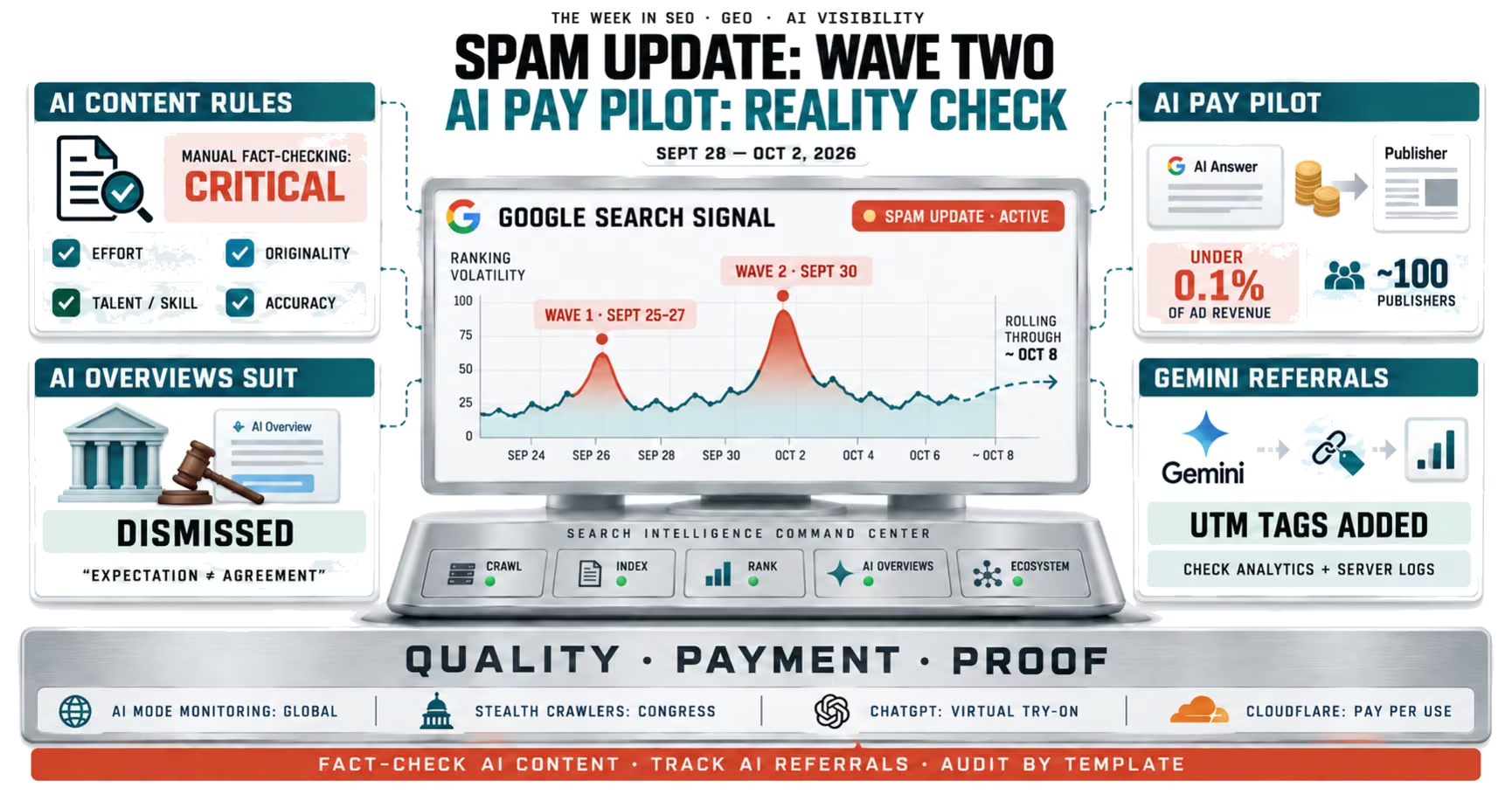
Quality, payment and proof were the themes of the week
Most weeks pull in several directions. This one kept circling three questions. What does Google count as quality content when AI can produce pages at almost no cost? Who pays publishers when AI answers use their work? And can anyone prove what AI surfaces send to a site?
Google answered the first question twice, once through a spam update and once through its documentation. A federal court and a pilot payment program gave unwelcome answers to the second. The third got a partial answer from Gemini, and a cautionary tale from a browser extension. If you missed last week's roundup, the spam update had only just been announced. This week it showed its teeth.
The September 2026 spam update came back for a second pass
Google's Search Status Dashboard logged the September 2026 spam update at 9:15am Pacific on September 24, said it applies globally and to all languages, and said the rollout may take up to two weeks. That is a long window for a spam update, and it is producing waves rather than a single event.
Search Engine Roundtable reported the first wave from Friday September 25 through Sunday September 27, with practitioners pointing at AI-generated content sites and highly templated programmatic pages, such as one page per area code. Then volatility heated up again on September 30, with site owners reporting sharp drops that day and swings in Discover and News traffic. The same report noted that Reddit's AI-translated pages, which lost visibility in earlier 2026 updates, resurfaced in Italy, Germany, Brazil and France.
| Date | What happened |
|---|---|
| Sept 24 | Update announced, two week rollout |
| Sept 25 to 27 | First wave of ranking movement |
| Sept 30 | Second wave, sharp drops reported |
| Oct 1 | AI content guidance updated |
| About Oct 8 | Two week window closes |
Why it matters. If you lost traffic on September 25 or September 30, do not rush to rebuild pages until the rollout ends, because a third wave can move things again. Use the time to audit which page templates lost and which held. Our guide to how Google spam updates work covers recovery timing. Spam updates target patterns, so the answer usually sits in a template, not a single URL.
Google rewrote its AI content and helpful content guidance
On October 1 Google updated its guidance on using generative AI content. The page now explains that generative models predict likely sequences of words, so outputs "may contain inaccuracies (also known as hallucinations)." Then it sets a bar:
It is critical to manually factcheck and review all AI-generated content for accuracy and trustworthiness before publishing.
Search Engine Roundtable pointed out that Google rarely uses the word "critical" in its Search help documents, and that Google framed the change as bringing the docs in sync with talks it gives at developer events. The timing, in the middle of a spam rollout aimed in part at automated content, is hard to ignore.
The second rewrite went deeper. Google's helpful content documentation, dated October 1 and reported by Search Engine Roundtable on October 2, adds a definition of main content as "any part of the webpage that directly helps the page achieve its purpose." It also adds four attributes that quality raters use, which Search Engine Roundtable abbreviates as EOT/SA.
| Attribute | Google's definition |
|---|---|
| Effort | How much human work went into the content or the systems behind it |
| Originality | Information or perspectives not already available elsewhere |
| Talent or skill | The expertise needed to satisfy visitors |
| Accuracy | Correct on the facts, and highly accurate for YMYL topics |
On accuracy, Google goes further for topics that affect people's lives or well-being: content there "must be highly accurate and consistent with established expert consensus."
Why it matters. Until now, much of this language sat in the Search Quality Rater Guidelines, a document many teams never read. Moving it into the main Search Central docs turns it into a published checklist. Effort and originality are the two attributes AI-only content struggles with, which tells you what the spam update and the docs have in common. Use the four attributes as an editorial review form for every page you ship.
A judge dismissed Penske's AI Overviews lawsuit
On October 1 US District Judge Amit Mehta dismissed Penske Media's antitrust claims against Google over AI Overviews. Penske owns Rolling Stone, Variety, Billboard and The Hollywood Reporter. Press Gazette reported the core reasoning: publishers that allowed free crawling in the hope of search traffic were acting in their own interest, not striking a bargain.
An expectation is not an agreement. It is simply how a general search engine works.
Search Engine Journal reported that the ruling also covered a similar case from Chegg, rejected five claims including reciprocal dealing and tying, and was made without prejudice, so the plaintiffs can refile or appeal. The judge was not dismissive of the harm itself. As Search Engine Roundtable quoted, he wrote that "the court does not treat Plaintiffs' alleged harms lightly," while Digital Content Next CEO Jason Kint responded that Google is "swallowing up all of the journalism of humanity to power its AI products."
Why it matters. The ruling closes the most obvious legal route for publishers who want AI Overviews to pay or link more. Courts are saying the harm may be real, but antitrust law as written does not reach it. For brands, this means AI Overviews are here as designed, and any shift in how they cite sources will come from Google's product choices, regulators or new legislation, not from this case.
Google's AI pay pilot pays some sites under 0.1% of ad revenue
Google's AI contribution pilot pays publishers when their content "contributes significantly" to answers in AI Overviews, AI Mode and the Gemini app. On September 30, Search Engine Roundtable relayed reporting from The Information that about 100 publishers are in the program, and that for several small and midsize sites the payments amount to less than one tenth of 1% of their advertising revenue.
Search Engine Journal's summary filled in the spread. Some smaller sites earned under $1,000 over several months. A publisher that joined a few months ago earned roughly $50,000 to $60,000. One early participant earns over $1 million a year. Participants told The Information that payments change month to month without explanation, and that niche topics with strong interest and thin coverage, such as anime and gaming, seem to earn more. Larger publishers have mostly stayed out.
Why it matters. A per-citation payment model tells you what Google's AI rewards: content that fills gaps nobody else covers. That lines up neatly with the originality attribute Google added to its docs the next day. For most brands, the money is irrelevant. The signal is not: if your content says what fifty other pages say, AI systems have no reason to choose it.
AI referrals got easier to measure, and easier to fake
On October 1, Search Engine Journal reported that Google Gemini has started adding UTM parameters to outbound links, first noticed on Reddit. Google's John Mueller replied, "Nice. I see it too." The tags survive the in-app webview and show up in server logs, so visits that used to land as Direct can now be credited to Gemini. Google has not documented the change, so nobody knows yet which answers carry tags.
The same week brought a warning. On October 2, Search Engine Roundtable reported what looked like Google adding a tracking parameter to links inside AI Overviews and AI Mode. An update to the story found it was a Chrome browser extension rewriting the URLs, likely to collect data. Google had nothing to do with it.
Click data also got murkier. Advanced Web Ranking, a rank tracking vendor, published Q2 2026 click-through figures that Search Engine Journal reported on September 29. According to the AWR analysis, combined CTR for desktop positions one and two fell 5.27 points from Q1, while mobile rose 6.59 points. On U.S. desktop, pages with an AI Overview had a 10.04% CTR at positions one and two, against 29.05% without one. AWR sells rank tracking software, so it has a commercial interest in showing that click behavior keeps shifting.
- The quarters are not comparable. Search Console had a logging error that misreported impressions from May 13, 2025 to April 27, 2026, so Q1 sat inside the error window and most of Q2 did not, as AWR's own report notes.
- The AI Overview gap is U.S. desktop only. The 10.04% versus 29.05% comparison does not describe mobile, where most searches happen.
- It is not independent research. The data comes from a vendor's own tooling and has not been replicated.
Why it matters. Attribution for AI search is being built in public, one undocumented change at a time. Treat any new parameter in your analytics as unverified until you confirm where it comes from, and do not judge AI Overviews' click impact on a single quarter-over-quarter swing.
Google appealed the EU's order to share search data
On September 29 Google filed appeals with the EU's General Court against two Digital Markets Act decisions, Search Engine Land reported. One requires Google to share anonymized search data with competitors by January 2027. The other requires Android changes by July 2027. Oliver Bethell, Google's senior director of competition, said the decisions "will force us to share people's private search history without sufficient anonymization."
Nick Fox, Google's SVP of Knowledge and Information, went further in a video interview the same day. Search Engine Roundtable quoted him saying "it literally makes me sad that we need to degrade our product in this way," and listing changes already made in Europe, including removing real-time product pricing and rolling back parts of spam enforcement such as the site reputation abuse policy.
Why it matters. If you market in Europe, Google Search there is already a different product, and it may keep diverging. Rivals that get Google's query data in 2027 could become stronger alternatives for EU searchers. Plan European SEO and AI visibility separately from U.S. work.
Publishers asked Congress to unmask stealth AI crawlers
More than 300 news publishing executives, including leaders from Condé Nast, Hearst Magazines, USA Today Co. and The Seattle Times, visited Washington on September 29 with the News/Media Alliance. Search Engine Land reported that they urged Congress to pass the Stealth Bot Prohibition Act, which would require AI crawlers to identify themselves and their purpose, and target bots that pose as humans or use residential proxies. The article cited TollBit, which sells AI content licensing tools to publishers and so benefits from tighter bot rules, as detecting over 22 billion AI bot scrapes in the first half of 2026.
The market side moved too. On September 30, Search Engine Journal reported that Cloudflare moved two products into closed beta for U.S. users: Monetization Gateway, which charges AI agents per request, and Pay Per Use, where AI companies set prices for content they use and publishers choose which offers to accept.
Why it matters. Robots.txt only works on bots that announce themselves. If stealth crawlers become illegal, publishers and brands get a real choice over which AI systems use their content. Decide now which AI crawlers you want to welcome, because that choice will soon carry commercial weight.
Also this week
- Google rolled out AI Mode monitoring to all users globally on September 28, letting searchers ask AI Mode to watch for new information such as price drops or local openings.
- OpenAI added bulk product feed uploads, product review status and seven new Asian markets to ChatGPT Ads, bringing it to more than 60 regions.
- ChatGPT launched virtual try-on for clothing and accessories on mobile and web on October 1.
- Google Maps now requires sign-in to read all reviews, sort them or leave one, a change Search Engine Roundtable suspects is aimed at scrapers.
- Search Engine Roundtable found AI Overviews returning for many large brand names, including Salesforce, Adobe, Amazon and Samsung, though not for Google's own brand or news publishers. Our AI Overviews updates tracker has the history.
- A publishers' summary judgment brief filed September 17 and reported by Search Engine Journal on September 28 quotes a 2023 note from an OpenAI engineer: "no matter how prominently we show the links, users won't click."
What we would do first
- Map spam update losses by template, not by URL. Export Search Console pages for September 18 to 24 and September 25 to October 2, group them by page type, and see which templates lost. Wait for the rollout to end before rewriting.
- Put a human review step on every AI-assisted page. Google now calls manual fact-checking critical. Name the reviewer, check every figure against a source, and keep a record.
- Score your top 20 pages against EOT/SA. Rate effort, originality, talent or skill, and accuracy from one to five. Anything scoring low on originality is a candidate for new data, examples or expert input.
- Add Gemini to your AI referral segment. Look for Gemini-tagged sessions in GA4 and server logs, and add them to the same channel group as ChatGPT and Perplexity referrals.
- Audit unfamiliar URL parameters before trusting them. If a new tag shows up in your reports, confirm it appears in clean browsers and not only on machines with extensions installed.
- Write down your AI crawler policy. List which AI bots you allow, block or plan to charge, so you are ready if stealth crawling rules or pay-per-use markets take hold.
The thread through this week is that Google is defining quality more precisely while giving publishers less say over how AI uses their work. You cannot sue your way back to clicks or wait for a payout to replace them. You can publish pages that pass Google's new checklist, measure every AI referral you can, and make your content the source an AI answer has a reason to choose.
Frequently Asked Questions
Common questions about GEO, SEO, and AI-driven search visibility.
Google's Search Status Dashboard shows the September 2026 spam update started on September 24, 2026 at 9:15am Pacific and says the rollout may take up to two weeks. Search Engine Roundtable reported a first wave of ranking movement from September 25 to 27 and a second wave on September 30. If it runs the full two weeks, it ends around October 8.
Google's guidance on generative AI content, updated October 1, 2026, does not ban AI content but now says it is critical to manually fact-check and review all AI-generated content for accuracy and trustworthiness before publishing. The same document warns that AI outputs may contain inaccuracies, also known as hallucinations. Mass-produced, unreviewed AI pages remain a spam risk.
EOT/SA stands for effort, originality, talent or skill, and accuracy, four attributes Google added to its helpful content documentation this week, as reported by Search Engine Roundtable. Google says pages on topics that could significantly affect people's lives must be highly accurate and consistent with established expert consensus. The attributes describe how Google's quality raters judge main content.
On October 1, 2026, Judge Amit Mehta dismissed Penske Media's antitrust claims against Google, ruling that publishers letting Google crawl their sites did not create an agreement, according to Press Gazette. He wrote that an expectation is not an agreement. Search Engine Journal reported the dismissal was without prejudice, so the claims can be refiled or appealed.
The Information reported, via Search Engine Roundtable and Search Engine Journal, that Google pays about 100 publishers in its AI contribution pilot. For several small and midsize sites the payments are under 0.1% of their ad revenue, some sites earned under $1,000 over several months, and one early participant earns over $1 million a year. Participants say payouts change month to month without explanation.
Search Engine Journal reported on October 1, 2026 that Google Gemini has started adding UTM parameters to outbound links, and Google's John Mueller replied that he sees it too. Google has not documented the behavior, so it is unclear which answers carry the tags. Check your analytics and server logs for Gemini-tagged sessions rather than assuming all of them are labeled.
Sources
- Google Search Status Dashboard: September 2026 spam update (opens in a new tab)
- Search Engine Roundtable: Google September 2026 Spam Update Has Big Weekend Impact (opens in a new tab)
- Search Engine Roundtable: Phase Two Of The Google September 2026 Spam Update Hits On 9/30 (opens in a new tab)
- Google Search Central: Guidance on using generative AI content on your website (opens in a new tab)
- Search Engine Roundtable: Google: Manually Factcheck & Review AI-Generated Content For Accuracy (opens in a new tab)
- Google Search Central: Creating helpful, reliable, people-first content (opens in a new tab)
- Search Engine Roundtable: Google Helpful Content Doc With New Main Content & EOT/SA Sections (opens in a new tab)
- Press Gazette: Penske AI Overviews lawsuit dismissed because no formal bargain struck with Google (opens in a new tab)
- Search Engine Journal: Judge Acknowledges Publisher Harm But Dismisses Google Antitrust Claims (opens in a new tab)
- Search Engine Roundtable: Google AI Overview Lawsuit Dismissed Over No Agreement With Publishers (opens in a new tab)
- Search Engine Roundtable: Google Paying ~100 Publishers 0.1% Of Ad Revenue In AI Contribution Pilot (opens in a new tab)
- Search Engine Journal: Google AI Pilot Pays Some Sites Under 0.1% Of Ad Revenue (opens in a new tab)
- Search Engine Journal: Google Gemini Adds UTM Parameters For Referral Attribution (opens in a new tab)
- Search Engine Roundtable: Google Tests URL Tracking Parameters To AI Overviews (opens in a new tab)
- Search Engine Journal: Google Desktop CTR Fell In Q2 While Mobile Rose, Data Shows (opens in a new tab)
- Search Engine Land: Google appeals the European Commission's DMA mandate to share search data (opens in a new tab)
- Search Engine Roundtable: Google's Nick Fox Feels Sad & Terrible For European Searchers After DMA (opens in a new tab)
- Search Engine Land: Publishers want Congress to stop AI crawlers from hiding (opens in a new tab)
- Search Engine Journal: Cloudflare Moves Monetization Gateway & Pay Per Use Into Beta (opens in a new tab)
- Search Engine Roundtable: Google Globally Rolls Out Monitoring Capabilities In AI Mode (opens in a new tab)
- Search Engine Roundtable: OpenAI ChatGPT Ads Gains Bulk Product Creation, Product Review Status & More (opens in a new tab)
- Search Engine Roundtable: ChatGPT Adds Virtually Try On Clothing & Accessories (opens in a new tab)
- Search Engine Roundtable: Google Maps Now Requires Sign In To Read All Reviews & More (opens in a new tab)
- Search Engine Roundtable: Google AI Overviews Return For Many Large Brand Names (opens in a new tab)
- Search Engine Journal: Court Filing Quotes OpenAI Engineer: Users Won't Click Links (opens in a new tab)