



Spam and Choice Screens: The Week in SEO, GEO, and AI Visibility September 21 to 25, 2026
 Preferred source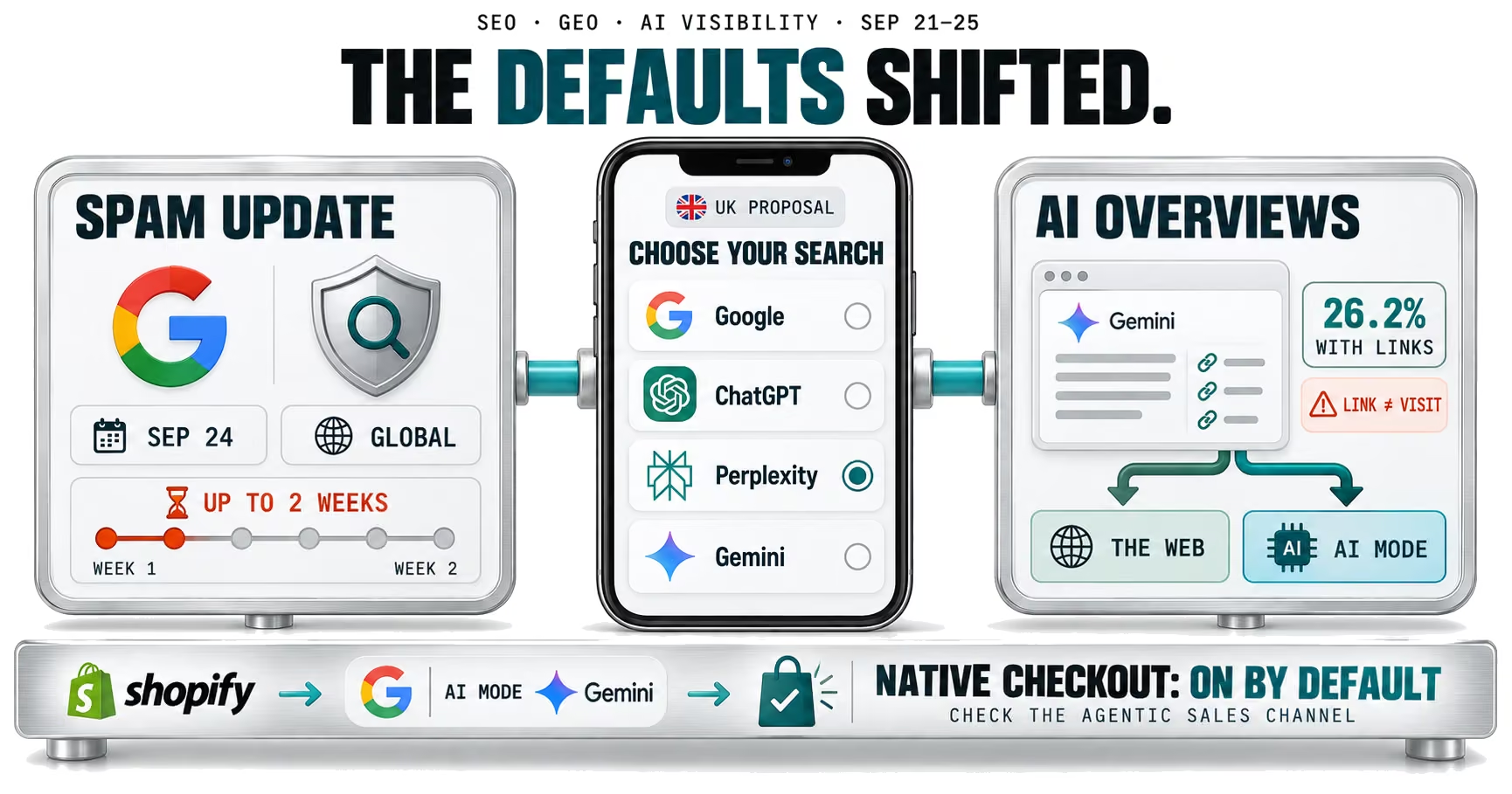
A week where the defaults shifted
Most weeks in search are about a single headline: an update, a lawsuit, a new feature. This one was about defaults. Google set native checkout to "on" for a large group of merchants. A UK regulator proposed that phones and browsers should stop defaulting to one search engine without asking. Google quietly changed how AI Overviews link out, and in some tests, where those links point.
None of that shows up as a ranking drop. It shows up as a customer who bought without visiting your site, a user who picked a different assistant on a new phone, or a citation that routes into another Google surface. The job right now is noticing these shifts before the numbers make them obvious.
| When | What happened | What it means for you |
|---|---|---|
| Mon, Sep 21 | Peec AI data shows external links in AI Overview answers rising from near zero to 26.2 percent | Track citations and clicks as separate numbers |
| Tue, Sep 22 | Google spotted testing AI Overview links that open AI Mode instead of a website | A link in an overview is not automatically a visit |
| Tue, Sep 22 | Comscore: AI Overviews on 39.4 percent of U.S. desktop searches; ChatGPT's share of assistant prompts down to 50 percent | Add Gemini and Claude to your prompt checks |
| Tue, Sep 22 | Google emails merchants that Shopify stores are enabled for native checkout in AI Mode and Gemini | Decide deliberately, and give AI Mode orders a home in reporting |
| Wed, Sep 23 | UK CMA proposes yearly choice screens on Android and Chrome that can include AI assistants | AI visibility becomes a distribution question in the UK |
| Wed, Sep 23 | News UK says a fifth of its traffic was non human; OpenAI expands ChatGPT Ads to seven more markets | Filter bots before you judge engagement; plan paid and organic AI separately |
| Thu, Sep 24 | September 2026 spam update released with a two week window; Search Console adds a multimodal search type | Annotate the date, hold off on reactive changes, and size your visual search traffic |
Here is what happened, and what we would do about it.
Google's September 2026 spam update is rolling out, and it is taking its time
Google posted the announcement on its Search Status Dashboard at 9:15 a.m. PDT on September 24:
Released the September 2026 spam update, which applies globally and to all languages. The rollout may take up to two weeks to complete.
This is the fourth confirmed spam update of 2026. Search Engine Journal noted that the three earlier ones were quick: the March update took about 19 and a half hours, June took just over two days, and August took two days and 16 hours. A two week window is a different kind of update. Google did not say which spam policies it targets.
There was ranking volatility on September 23 and 24, right before the announcement. Search Engine Roundtable reported that Google said the volatility seen prior to the announcement was not the spam update. Search Engine Roundtable also noted this update is not aimed specifically at link spam and that recovery from a spam update can take many months.
Why it matters. Two overlapping signals make diagnosis harder. If traffic dropped on September 23, that was something else, and you should not assume the spam update is to blame. If traffic drops over the next two weeks, the spam update becomes a much more likely cause. Mark September 24 as an annotation in your analytics now so you can separate the two later. Because Google has not named the target, review your site against its spam policies as a whole: scaled content made mainly to rank, expired domain plays, site reputation abuse and doorway pages are the usual suspects. Sites that rely on none of those should resist reactive changes mid rollout.
AI Overviews are linking out more, but not every link leaves Google
Two observations from the same few days point in opposite directions.
First, a win for publishers. According to Peec AI data reported by Search Engine Journal, 26.2 percent of AI Overviews contained external links within the answer text as of September 20, measured over a window from August 25 to September 20. The jump happened around September 11. Malte Landwehr of Peec AI posted on September 21 that "Google massively increased the number of external links within AI Overview answers." Search Engine Roundtable summarized it as a move from close to 0 percent to over 25 percent.
- The chart has no sample size. Search Engine Journal pointed out that Peec did not disclose the number of queries, the markets, the device types, or exactly how it distinguished inline links from citations.
- Presence is not clicks. The data measures whether links exist in the answer, not whether anyone follows them.
- The spike is unexplained. The September 11 step has not been tied to a confirmed Google change rather than a change in data collection.
- The reporter has a stake. Barry Schwartz at Search Engine Roundtable disclosed a small investment in Peec AI and wrote that the finding "doesn't 'feel' right" to him, though he shared it anyway.
Second, the other direction. On September 22, Search Engine Roundtable reported that Gagan Ghotra spotted Google testing anchor links inside AI Overviews that take users to AI Mode rather than to a webpage. Search Engine Journal tied the two together in its headline: more links, but not all of them reach the web.
Why it matters. A link in an AI Overview is not automatically a visit to your site. For the first time there is evidence of links that look identical to the user but go to very different places. That means "we got cited" and "we got traffic" are drifting further apart, and Google's own reporting will not close the gap: Search Engine Journal noted that Search Console's generative AI performance report shows impressions only, with no clicks. Track citations and track clicks as separate metrics, and be cautious about any report, including vendor dashboards, that treats a link count as a traffic forecast. That is the citation versus click split we argued for in SEO's three jobs.
Comscore puts AI Overviews on nearly four in ten U.S. desktop searches
Search Engine Land reported on September 22 on Comscore's Q2 2026 AI Intelligence Report. Google AI Overviews appeared in 39.4 percent of U.S. desktop searches in June 2026, up from 25.8 percent in July 2025. Bing's Copilot Search appeared in 17.3 percent of Bing desktop searches, up from 11.8 percent. Desktop search volume did not shrink either: Comscore counted 77 billion U.S. desktop searches in Q2 2026, up 8 percent from 71 billion in Q2 2024.
| Comscore measure | July 2025 or January 2026 | June 2026 |
|---|---|---|
| U.S. desktop searches showing a Google AI Overview | 25.8 percent | 39.4 percent |
| Bing desktop searches showing Copilot Search | 11.8 percent | 17.3 percent |
| ChatGPT share of AI assistant prompts | 70 percent | 50 percent |
| Gemini share of AI assistant prompts | 17 percent | 30 percent |
| Claude share of AI assistant prompts | 2 percent | 11 percent |
| Copilot share of AI assistant prompts | 5 percent | 5 percent |
The citation data is the part most teams will find useful. In June, YouTube was the most cited source in AI answers for entertainment, retail and financial services. For retail searches, YouTube led at 23 percent, followed by Amazon at 14 percent, Reddit at 12 percent and Wikipedia at 11 percent. In financial services, YouTube had 9 percent, with NerdWallet, Reddit and Bankrate at 7 percent each.
Comscore was clear about the limit of its own data: the report measured the share of searches that included these AI experiences, and did not measure the clicks or traffic they generated.
Why it matters. Three takeaways. AI Overviews are no longer an edge case on desktop, so any keyword strategy that ignores them is working from an incomplete picture. YouTube's dominance in citations is a strong argument for treating video as part of your search program, not a separate social channel. And the assistant market is splitting. A GEO plan that only checks how ChatGPT answers is now covering roughly half of assistant prompts, down from nearly three quarters at the start of the year. Gemini and Claude deserve their own checks. We covered the full year of AI Overviews changes in AI Overviews in 2026.
The UK wants AI assistants on Google's choice screens
On September 23, the UK Competition and Markets Authority published strengthened proposals for how Google must offer search choice. Under the plan, Android and Chrome users would see a list of search services when they first set up their device or browser, then get a prompt every year to pick their preferred default.
The part with the longest tail is about AI. The CMA proposed that AI assistants, naming ChatGPT and Perplexity as examples, should be able to appear on those choice screens if they meet technical and security requirements. It also proposed that search providers fairly attribute publisher content so users can reach original sources. CMA chief executive Sarah Cardell said, as Engadget reported:
This is about future-proofing the options available to people in the UK so they can choose the search service they want.
The CMA is taking views until October 9, 2026, and expects a final decision by the end of the year. The proposals build on Google's strategic market status designation in October 2025 and on the publisher controls and fair ranking rules the CMA introduced in June 2026, as Search Engine Roundtable's coverage recapped.
Why it matters. This is the first major regulator proposing to treat AI assistants as direct substitutes for a search engine at the point of choice. If it goes through, a meaningful share of UK Android users could end up with an AI assistant as their default way to look things up, and they will be asked again every year. For brands selling into the UK, that turns AI visibility from a nice to have into a distribution question. The attribution requirement also matters: if it is enforced, being the clearly credited original source becomes more valuable, because the regulator is pushing for users to be able to reach it.
Google switched on native checkout for Shopify stores by default
On September 22, Google started emailing Merchant Center users about native checkout, Search Engine Roundtable reported. The message told merchants their Shopify store had been matched to Merchant Center, enabling native checkout on Google AI Mode and Gemini. Google's note was blunt: "Eligible products are automatically included. There's nothing for you to set up."
Native checkout runs on the Universal Commerce Protocol, which Google announced in January 2026 and began rolling out with a limited set of merchants in February. Shoppers can complete a purchase inside Google's AI surfaces using Google Pay without landing on the retailer's website. Google's email said merchants "manage and retain full ownership" of customer relationships, data and sales. The expanded rollout began late the week before, and the feature is on by default. Merchants who want customers to finish purchases on their own site have to turn it off in the Shopify admin under Sales channels, then Agentic.
| Stay enabled | Turn it off |
|---|---|
| Wins sales from shoppers who never would have clicked through | Keeps the full customer journey on your site |
| Order arrives without a session, so site analytics never see it | Upsells, cross sells and first party data stay with you |
| Attribution models built on sessions under count search | Reporting stays as it is today |
| Needs a home for AI Mode orders in your search revenue line | Gives up purchases that happen inside the answer |
Why it matters. This changes what a conversion looks like. When a purchase happens on Google's surface, you get an order, not a session. Your site analytics will not see the product page view, the add to cart or the checkout steps, and any attribution model built on sessions will under count what search is doing for you. There are tradeoffs either way. The mistake is not making the call at all. Ecommerce teams should decide deliberately, document it, and update reporting so AI Mode orders are counted as search revenue rather than showing up as unexplained lifts in "direct" or platform sales.
Search Console finally separates Lens and Circle to Search traffic
On September 24, Google announced a multimodal search type in the Search Console Performance report. Search Engine Journal detailed what it includes: searches through Google Lens, Circle to Search on Android, image uploads to Google Search, and Chrome's right click "Search this image" option.
There is one big limitation. You do not get queries. Google's help documentation, as Search Engine Journal quoted it, explains that "because multimodal searches mostly use images rather than text, specific text query data isn't available for this traffic." You get page level clicks and impressions, only for sites that receive this traffic, and you cannot see which image triggered the visit. The rollout started globally on the day of the announcement, so some properties may not see the filter yet.
Why it matters. Visual search has been a black box in reporting, blended into general web search numbers. Now you can at least size it. For retail, home, fashion, food and local businesses, it is worth pulling the multimodal filter as soon as it appears in your property, identifying which pages earn this traffic, and checking that those pages have strong original images, descriptive alt text and product structured data. Without queries, the page list is the insight.
Publishers push back on bots as Discover tests AI summaries
Press Gazette reported on September 23 that about 20 percent of News UK's website traffic over the past six months was non human, and 6 percent was actively blocked as malicious. News UK uses bot protection software and has moved from a block list to an allow list that only admits approved scrapers. CTO Tom Jackson described parent company News Corp's approach as wanting AI firms as partners, "but if you're stealing our stuff we are going to sue you." He also said News UK tracks its visibility in AI engines and optimizes for both Google and ChatGPT rather than favoring one.
The same squeeze showed up on Google's side. Just before this week's window, on September 20, Search Engine Land reported on a Google test called "Dive deeper" in Discover, which shows AI generated topic overviews with links to related articles. Google's Robby Stein described it as a way to make "exploring a topic and discovering related web content easier in Discover." The test starts with videos, and Google said it would try multiple designs in the coming weeks.
Why it matters. If a fifth of a major publisher's traffic is bots, a meaningful slice of your own analytics is probably inflated too, and your engagement rates are probably understated. Filter bot traffic before you judge content performance. For publishers, Discover has been one of the last reliable Google traffic sources, and an AI summary layer in the feed is the same pattern AI Overviews brought to search. Diversify now rather than after the test becomes a launch.
Also this week
- CrUX ad metrics in the page experience docs
- ChatGPT Ads in seven more markets
- Search Console multimodal filter
- Discover "Dive deeper" test
Google added CrUX ad metrics to its page experience documentation, reported on September 22. The metrics cover ad count, ad density and the CPU and network weight of ads. John Mueller said "not everything is a direct search ranking factor" and that they were included because they help evaluate the state of a site. If you run ads on your pages, these are worth benchmarking.
OpenAI expanded ChatGPT Ads on September 23 to Indonesia, Malaysia, the Philippines, Singapore, Thailand, Vietnam and Taiwan, bringing the product to more than 60 countries. OpenAI said ads run only on the Free and Go plans and that Plus, Pro and Enterprise subscriptions stay ad free. Paid and organic visibility inside AI assistants are now both real channels, and they need separate plans. If the vocabulary around that second channel is getting confusing, we sorted out SEO, AIO, AEO, GEO and LLMO this week too.
Where to spend an hour this week
- Start with ecommerce, because it is the only change that is already live and set to on. If you sell through Shopify and Merchant Center, log in, check the Agentic sales channel, and make a deliberate decision about native checkout. Then talk to whoever owns attribution. Orders placed inside AI Mode or Gemini need a home in your reporting, or your search program will look weaker than it is.
- Annotate September 24 and watch organic traffic through roughly October 8. Separate anything that moved on September 23 from anything that moves during the rollout. Do not make big content changes in the middle of a spam update unless you already know you are relying on a tactic Google's spam policies describe.
- Split your AI visibility reporting into two lines: citations and clicks. The AI Overviews data this week shows those numbers can move independently, and Google's own AI reporting gives you impressions only. If you are only checking one assistant, add Gemini and Claude to your prompt tracking, given the Comscore share shift.
- Add the CMA consultation to your watch list if you sell in the UK. If AI assistants land on choice screens, your brand's presence in ChatGPT, Perplexity and Gemini answers becomes part of how a new phone owner finds you. Being clearly attributed as the original source of useful information is the best position to be in either way.
- Pull the multimodal filter and clean bot traffic out of your engagement metrics. Both are small tasks that make every other number you report more accurate.
Last week was a six-year leash for Google's ad tech business. This week the defaults moved instead, and most of them moved without asking. The teams that notice first are the ones that will still have a clean read on what search is doing for them in October.
Frequently Asked Questions
Common questions about GEO, SEO, and AI-driven search visibility.
Google released the September 2026 spam update on September 24, 2026, announcing it on the Google Search Status Dashboard at 9:15 a.m. PDT. Google said it applies globally and to all languages and that the rollout may take up to two weeks. It is the fourth confirmed spam update of 2026, following updates in March, June and August that each finished in under three days, so this one is expected to run much longer than recent spam updates.
Data from Peec AI, reported by Search Engine Journal and Search Engine Roundtable in September 2026, showed external links inside AI Overview answer text rising from close to 0% to 26.2% of AI Overviews by September 20, 2026, with the jump around September 11. The chart did not disclose sample size, markets or devices, and it measures link presence, not clicks. In the same week Google was also seen testing links inside AI Overviews that send users to AI Mode instead of a website, so not every new link leads off Google.
According to Comscore's Q2 2026 AI Intelligence Report, reported by Search Engine Land on September 22, 2026, Google AI Overviews appeared in 39.4% of U.S. desktop searches in June 2026, up from 25.8% in July 2025. Bing's Copilot Search appeared in 17.3% of Bing desktop searches. Comscore measured how often the AI features appeared, not the clicks or traffic they sent to websites.
On September 23, 2026, the UK Competition and Markets Authority proposed that Google give Android and Chrome users a choice of search service when they first set up a device or browser and then prompt them again every year. The CMA also proposed letting AI assistants such as ChatGPT and Perplexity appear on those choice screens if they meet technical and security criteria, and requiring search providers to attribute publisher content fairly. Consultation closes on October 9, 2026, with a final decision expected by the end of 2026.
Yes, for eligible stores. In September 2026 Google began emailing Merchant Center users, starting September 22, to say that Shopify stores matched to their Merchant Center accounts were enabled for native checkout in Google AI Mode and Gemini, with eligible products included automatically. Shoppers pay with Google Pay without visiting the merchant's site. Merchants who want purchases to stay on their own site have to switch it off in the Shopify admin under Sales channels, then Agentic.
The multimodal filter is a new search type in the Google Search Console Performance report, announced on September 24, 2026. It shows clicks and impressions from searches that used an image, including Google Lens, Circle to Search on Android, image uploads to Google Search and Chrome's search this image option. It reports page-level data only, with no query data, because most of these searches start from an image rather than text.
Sources
- Google Search Status Dashboard: September 2026 spam update (opens in a new tab)
- Search Engine Journal: Google Rolls Out September 2026 Spam Update Globally (opens in a new tab)
- Search Engine Roundtable: Google September 2026 Spam Update Is Rolling Out (opens in a new tab)
- Search Engine Journal: Google AI Overviews Have More Links, But Not All Reach The Web (reporting Peec AI data) (opens in a new tab)
- Search Engine Roundtable: Google AI Overviews With Way More External Links; Report (reporting Peec AI data) (opens in a new tab)
- Search Engine Roundtable: Google AI Overview Links Taking You To AI Mode Over Web Pages (opens in a new tab)
- Search Engine Land: Google AI Overviews now appear in 39% of U.S. desktop searches (reporting Comscore data) (opens in a new tab)
- GOV.UK: CMA strengthens proposals allowing people choice over their search service (opens in a new tab)
- Engadget: UK competition watchdog wants to give Android and Chrome users more search engine choices (opens in a new tab)
- Search Engine Roundtable: CMA Wants Google To Make It Easier To Choose Alternative Search Engine On Android & Chrome (opens in a new tab)
- Search Engine Roundtable: Google Merchant Center Notifications For Native Checkout: Universal Commerce Protocol (opens in a new tab)
- Google Search Central Blog: Announcing web multimodal Search performance reporting in Search Console (opens in a new tab)
- Search Engine Journal: Google Search Console Adds Multimodal Filter For Image-Based Searches (opens in a new tab)
- Press Gazette: Fifth of News UK website traffic was non-human in past six months (opens in a new tab)
- Search Engine Land: Google testing Dive deeper for Google Discover, it's not good for publishers (opens in a new tab)
- Search Engine Land: CrUX ad metrics added to the page experience SEO documentation (opens in a new tab)
- OpenAI: ChatGPT Ads expands to Southeast Asia and Taiwan (opens in a new tab)