

A Six-Year Leash: The Week in SEO, GEO, and AI Visibility September 14 to 18, 2026
A week where the money and the mechanics both moved
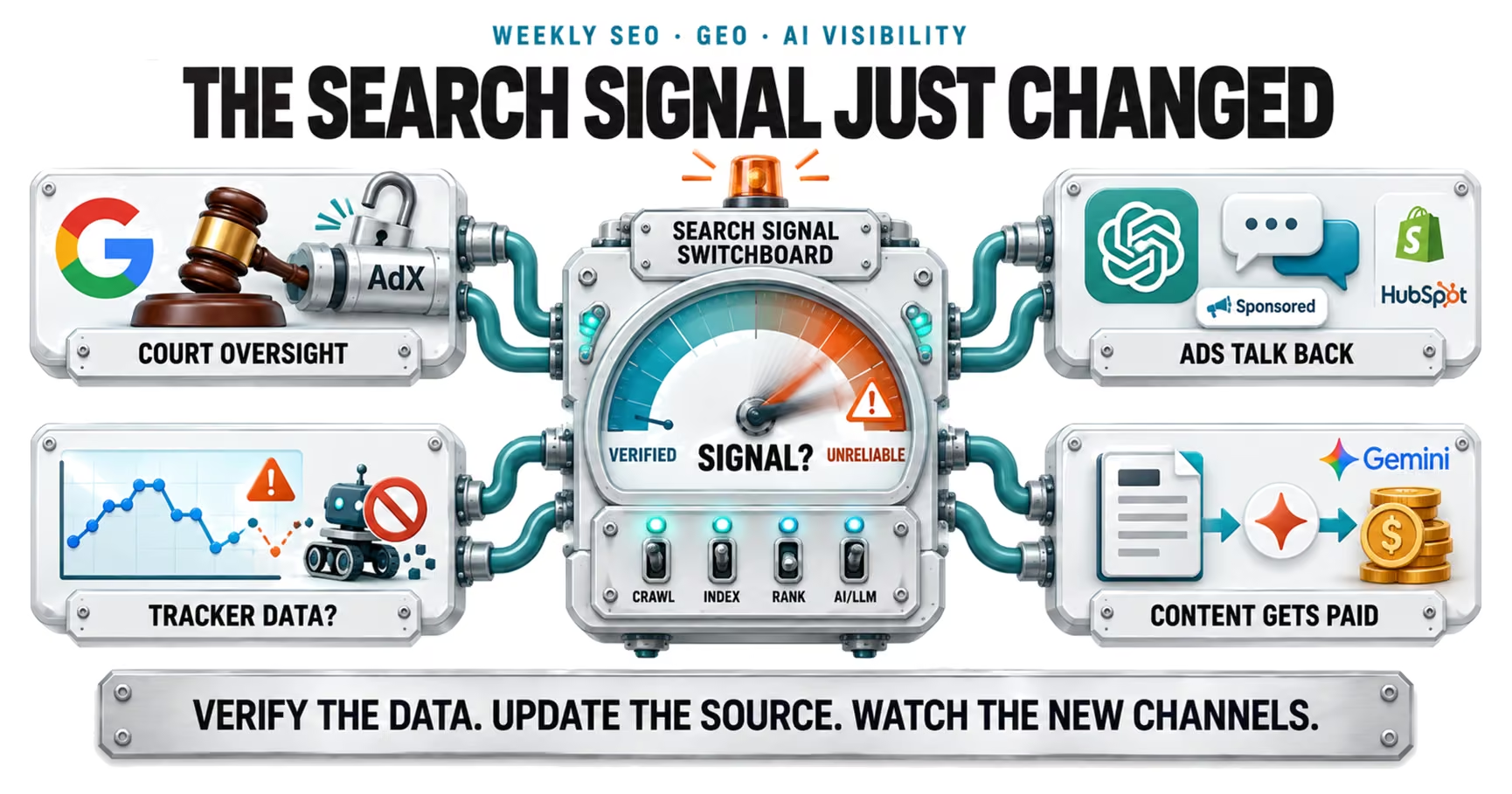
Most weeks in search news split cleanly into "an algorithm thing happened" and "a business thing happened." This week refused to sit still in either lane. A federal judge decided the fate of Google's ad exchange business on the same days that Google quietly expanded how it pays publishers for AI answers, OpenAI turned ChatGPT ads into two way conversations, and rank trackers across the industry started reporting numbers that even the people running them did not fully trust.
None of these stories are isolated. The ad tech ruling changes who controls the pipes that publisher revenue flows through. The AI Contribution pilot changes who gets paid when a chatbot, not a blue link, answers the query. Sponsored Agents changes what an "ad click" even means when the ad itself can hold a conversation. And the ranking volatility, whatever is actually causing it, is a reminder that the index everyone is trying to optimize for is not holding still long enough to give anyone a clean baseline.
| When | What happened | What it means for you |
|---|---|---|
| Tue, Sep 15 | Ranking volatility spikes, on top of September 4 and September 12 instability; no confirmed update | Cross check any sensor reading against Search Console before calling a drop |
| This week | Google appears to be blocking the scrapers rank trackers rely on; Nozzle reports an 80 percent drop in data collected | Some of the "chaos" may be broken measurement, not ranking change |
| Wed, Sep 16 | OpenAI announces Sponsored Agents for ChatGPT ads, with Shopify and HubSpot integrations | An ad click can now become a conversation; product data must hold up unattended |
| Thu, Sep 17 | Judge Brinkema declines an ad tech breakup, orders six years of oversight and AdX data access for rivals | Nothing changes Monday; revisit with programmatic partners once compliance steps publish |
| Thu, Sep 17 | Google details the AI Contribution pilot paying publishers for content used in AI answers | Check eligibility now, while the program is small |
| Thu, Sep 17 | Local knowledge panels labeled as AI Overviews with a chat interface; AI Mode button tested on results pages | Your website copy, not just your Business Profile, is what the AI describes |
We take each of these in turn, then get practical about what a marketing leader should actually do with all of it before Monday.
Google's ad tech empire survives, but it is on a six year leash
The biggest institutional story of the week landed on September 17, 2026, when U.S. District Judge Leonie Brinkema issued her remedies ruling in the government's ad tech antitrust case against Google. Prosecutors had asked for Google to divest its publisher ad server (DFP) and its ad exchange (AdX). Brinkema declined, concluding that a structural breakup was "neither realistic nor needed," and instead ordered a package of behavioral remedies paired with six years of court supervision, well short of the fifteen years the government wanted, according to Search Engine Land's coverage of the ruling.
The behavioral rules matter more than the headline. Google must give rival publisher ad servers access to AdX's real time bidding data, can no longer require publishers who use its ad server to also route their inventory through AdX, and has to comply with new data sharing requirements meant to stop it from locking publishers into a single Google owned stack end to end. An independent compliance monitor will watch all of it for six years.
Why it matters. This is the second major U.S. antitrust remedies decision to hit Google's core businesses in under two years, and the second time a court has chosen oversight over dismantlement. We covered the first, the September 2 decision on the same case, in the week Google dodged a breakup. For marketers and publishers, the practical effect is not immediate. Nothing about your ad stack changes on Monday morning. But the ruling does open a real path for competing publisher ad servers to plug into AdX's bidding data, which over six years could loosen Google's grip on programmatic yield management, one of the areas publishers have complained about longest. If you run programmatic revenue for a publisher or content business, this is worth watching closely over the next year as the specific compliance requirements get implemented, not just read once and filed away.
Something is off in the index, and your rank tracker might be lying to you
Search Engine Roundtable's Barry Schwartz flagged a sharp spike in ranking volatility on the morning of September 15, 2026, writing that he was "seeing a huge spike in chatter in the past few hours," on top of instability the community had already been tracking since reversals on September 4 and September 12. Sensor tools including Mozcast, Semrush Sensor, AccuRanker's Grump, and Zutrix's Tension all registered elevated movement, and SEOs reported wholesale keyword set changes, with pages that used to rank dropping out in favor of a different set of URLs entirely, per Search Engine Roundtable's report on the September 15 volatility.
Google has not confirmed a named update, and Schwartz was blunt about his own doubts that it will: "hopefully one Google will confirm soon but I doubt it." What makes this week different from a typical unconfirmed update is a second, related story. Search Engine Roundtable also reported that Google appears to have gotten significantly better at blocking the scrapers and tracking tools that SEO platforms rely on to collect ranking data, with Nozzle reporting an 80 percent drop in the data it could retrieve and Sistrix confirming its own collection was "running at a reduced rate," a pattern the report ties directly to the same September 4, September 12, and September 15 window, according to Search Engine Roundtable's coverage of the scraper blocking.
- Sensor tools can only report what they can fetch. When Google throttles the scrapers behind Mozcast, Semrush Sensor and the rest, a collection failure looks like a ranking earthquake on the chart.
- Two things happened in the same window. Real instability since September 4 and a data collection drop since about September 13 overlap, so no single tool can tell you how much of this week's movement is real.
- A page that "dropped" in one tool may not have moved. Until you have checked Search Console impressions and real sessions, you have a sensor reading, not a finding.
Why it matters. This is not a normal "did Google roll out an update" week. Some of what tools are showing as dramatic ranking chaos may be real algorithmic movement, and some of it may be an artifact of Google choking off the pipes those same tools use to measure rankings in the first place. Schwartz's own advice is the right one for marketers right now: "just be careful when looking at the data from these tools, they might be wrong." Before you tell a client or your CMO that a page tanked, cross check the sensor reading against Google Search Console impressions and clicks, and against actual session data, not just one rank tracker's dashboard. If your agency's weekly report leans on a single tool's volatility score, this is the week to ask what that tool is actually able to see right now. It is also the argument we made in the SEO metrics executives actually need: position was always a proxy, and this week the proxy broke.
ChatGPT starts selling conversations, not just clicks
OpenAI announced Sponsored Agents on September 16, 2026, a ChatGPT ad format that lets a user click a labeled ad and then have an actual back and forth conversation with a business sponsored AI agent before ever leaving the chat. In OpenAI's own words, "after seeing a relevant ad, a user can choose to start a clearly labeled conversation with a business sponsored agent in ChatGPT," and the company was careful to note that "the conversation with a Sponsored Agent is distinct from ChatGPT's independent answers and separate from the original conversation," according to OpenAI's announcement post.
The feature is currently testing with a small set of U.S. advertisers, with Shopify and HubSpot as the first named integration partners. Shopify merchants can connect a product catalog and track performance directly, and HubSpot users can build and manage the ads without leaving HubSpot's own interface, as Search Engine Roundtable's report on the rollout detailed. OpenAI paired the launch with a broader set of ads manager upgrades, including AI assisted ad creation, flexible attribution windows, and more granular targeting.
| Before Sponsored Agents | With Sponsored Agents |
|---|---|
| A sponsored link beneath the answer | A labeled ad that opens a conversation |
| The click leaves ChatGPT for your site | Follow up questions are answered by your agent first, then handed to your site |
| Your product data is read once | Your product data is interrogated, so every claim has to hold up unattended |
| Set up in OpenAI's ads manager | Shopify catalogs connect directly; HubSpot users build ads without leaving HubSpot |
Why it matters. This is OpenAI moving ChatGPT ads from "a sponsored link at the bottom of an answer" toward something closer to a branded sub chatbot living inside the main chat. For brands, it raises the same question Google's AI Overviews already forced on the industry: your product information needs to be structured and accurate enough that an AI agent, whether it is built by you or by a platform, can represent you correctly without a human checking every claim. That is the same shift toward product data we traced in the ChatGPT citation crash recovered, the rules did not. The Shopify and HubSpot integrations also matter for any ecommerce or SMB focused client, since they lower the technical bar to test this the moment it opens beyond the pilot advertiser list.
Google will pay you when your content shows up in its AI answers
Google gave the industry a clearer look this week at its AI Contribution pilot, a program that pays participating publishers when their content "meaningfully contributes to an AI generated response" inside products like AI Overviews, AI Mode, and Gemini. Reporting on September 17, 2026 confirmed the mechanics run through a dedicated panel inside Google Search Console, where enrolled publishers can see a running earnings total and payment history, with funds transferring to a linked bank account, according to 9to5Google's coverage of the pilot.
Google originally described the effort in June 2026 as "piloting a new way to partner with websites whose content meaningfully contributes to the freshness and factuality of generative AI responses." The current group skews toward small and mid sized publishers rather than major news brands, spans industries well beyond news, and Google is reportedly holding weekly calls with some participants. Publishers involved describe the information Google gives them as still fairly basic, but see real significance in Google setting any precedent at all for direct compensation tied to AI usage of content.
Why it matters. For years, the working assumption in SEO and content strategy has been that showing up in an AI Overview costs you a click with nothing in return. This pilot is Google testing whether it can turn that relationship into a paid one, at least for some publishers. It is small and early, dozens of participants rather than thousands, and the payout mechanics are not public. But paired with the same week's news that Google Search Console's AI position and impression reporting will keep evolving, the direction of travel is clear: Google is slowly building the measurement and payment plumbing to treat AI visibility as its own tracked, and in some cases compensated, channel. Last week John Mueller said the old position 1 to 10 is hard to map for AI features; this week the replacement plumbing got a payment rail. If you run content for a publisher, it is worth checking whether you are eligible for the pilot rather than assuming it is invite only for major outlets.
Your local listing is turning into a chatbot
Two related changes showed Google pushing AI Mode further into the core search experience. Reporting on September 17, 2026 showed some local knowledge panels and Google Business Profile listings now carrying an "AI Overview" label with a "Show more" button that opens a full AI Mode style chat interface describing the business, a pattern Search Engine Roundtable documented after a business owner first flagged it on LinkedIn. The AI generated description pulls from the business's existing web presence rather than only the Google Business Profile fields the owner controls directly, which means outdated website copy can end up shaping how the business gets described.
Separately, Google began testing an AI Mode entry point directly on the search results page itself, not just the homepage, according to Search Engine Roundtable's report on the AI Mode button test, continuing a months long push to make AI Mode a default rather than opt in surface.
Why it matters. For local businesses, the shift means Google is increasingly willing to let an AI system speak on a business's behalf, drawing from whatever text it can find on the web, rather than treating the business's own submitted profile data as the final word. That raises the stakes on keeping your website's own "about" and service pages accurate and current, since that is the material an AI summary is likely to lean on, which is the whole argument of why your website is now the data layer AI builds on. Combined with the AI Mode button now surfacing inside results pages, it is another data point that Google is not slowing down its push toward conversational, AI mediated answers as the default search experience, not a side feature you can opt out of.
How to act on this
- Start with measurement hygiene before you start with strategy. Given the scraper blocking and the unconfirmed volatility spike, this is a bad week to make a client facing call based on a single rank tracker. Pull Google Search Console data and real traffic numbers before you say a page "dropped," and if you manage multiple tools, compare them against each other rather than trusting whichever one has the scariest looking chart.
- Treat your website as the source of truth an AI will summarize. Google's local AI Overview experiment appears to draw from general web content, not just your Business Profile fields. If you have not updated your "about" and service pages in a year, do it now, before an AI writes a version of them you do not control.
- Check whether you can join the AI Contribution pilot. If you run content for a publisher of any size, ask your Google contacts or look in Search Console. The numbers are reportedly modest, but being enrolled when Google expands the program beats trying to get in once it is a mature channel.
- Watch Sponsored Agents if you manage ecommerce or SMB paid media. Especially for clients already on Shopify or HubSpot, where the integration work will be lighter than building a ChatGPT ads presence from scratch.
- Park the ad tech ruling for Q1 planning. Nothing changes in your ad stack this week, but the six year oversight period and the new AdX data access rules are worth revisiting with your programmatic partners once Google publishes its required compliance steps.
Frequently Asked Questions
Common questions about GEO, SEO, and AI-driven search visibility.
No. On September 17, 2026, U.S. District Judge Leonie Brinkema ruled that Google will not be forced to divest its ad server or ad exchange. Instead, Google faces six years of court oversight, a compliance monitor, and behavioral rules such as giving rival ad servers access to AdX's real time bids and ending the practice of tying publishers to Google's own ad exchange.
It is a test program, reported in detail on September 17, 2026, that pays participating publishers when their content meaningfully contributes to AI generated responses in products like AI Overviews, AI Mode, and Gemini. Publishers track a running earnings figure inside a dedicated panel in Google Search Console, and payments are sent to a linked bank account.
Sponsored Agents is a ChatGPT advertising format OpenAI announced on September 16, 2026. After clicking a labeled ad, a user can start a conversation with a business sponsored AI agent that answers follow up questions before handing them to the advertiser's website. OpenAI says the sponsored conversation is kept separate from ChatGPT's own independent answers, and Shopify and HubSpot are early integration partners.
Search Engine Roundtable tracked a sharp spike in ranking movement beginning September 15, 2026, following earlier instability on September 4 and September 12. Google has not confirmed a named update. The volatility overlapped with reports that Google had sharply reduced how much data rank tracking tools like Nozzle and Sistrix could pull from search results, which means some of what looked like ranking chaos may partly reflect broken measurement rather than actual reshuffling.
Yes. Reporting on September 17, 2026 showed Google labeling some local knowledge panels and Google Business Profile listings with an AI Overview tag and a Show more button that opens an AI Mode style chat interface describing the business. Google also began testing an AI Mode button directly on search results pages that week, not just on the homepage.
Treat it with caution. Multiple tools, including Nozzle and Sistrix, reported large drops in the data they could collect from Google starting around September 13, 2026, which Search Engine Roundtable tied to Google restricting scraper and tracking tool access. Cross check any alarming volatility reading against Google Search Console data and actual traffic before reacting to a single tool's sensor.
Sources
- Search Engine Land: Google faces six years of court oversight in ad tech antitrust case (opens in a new tab)
- 9to5Google: Google AI contribution pilot tests paying websites when they're used in AI results (opens in a new tab)
- OpenAI: Reimagining advertising with AI (opens in a new tab)
- Search Engine Roundtable: OpenAI Testing Sponsored Agents For ChatGPT Ads (opens in a new tab)
- Search Engine Roundtable: Google Search Ranking Volatility Heats Up This Morning, September 15th (opens in a new tab)
- Search Engine Roundtable: Google May Be More Successful In Blocking Scrapers & Tracking Tools (opens in a new tab)
- Search Engine Roundtable: Google Local Knowledge Panel As An AI Overview (opens in a new tab)
- Search Engine Roundtable: Google Search Bar Results Page Testing AI Mode Button (opens in a new tab)
- Search Engine Roundtable: Google Search Console AI Position Reporting Will Evolve Over Time (opens in a new tab)