
The ChatGPT Citation Crash Recovered. The Rules Did Not.
 Preferred source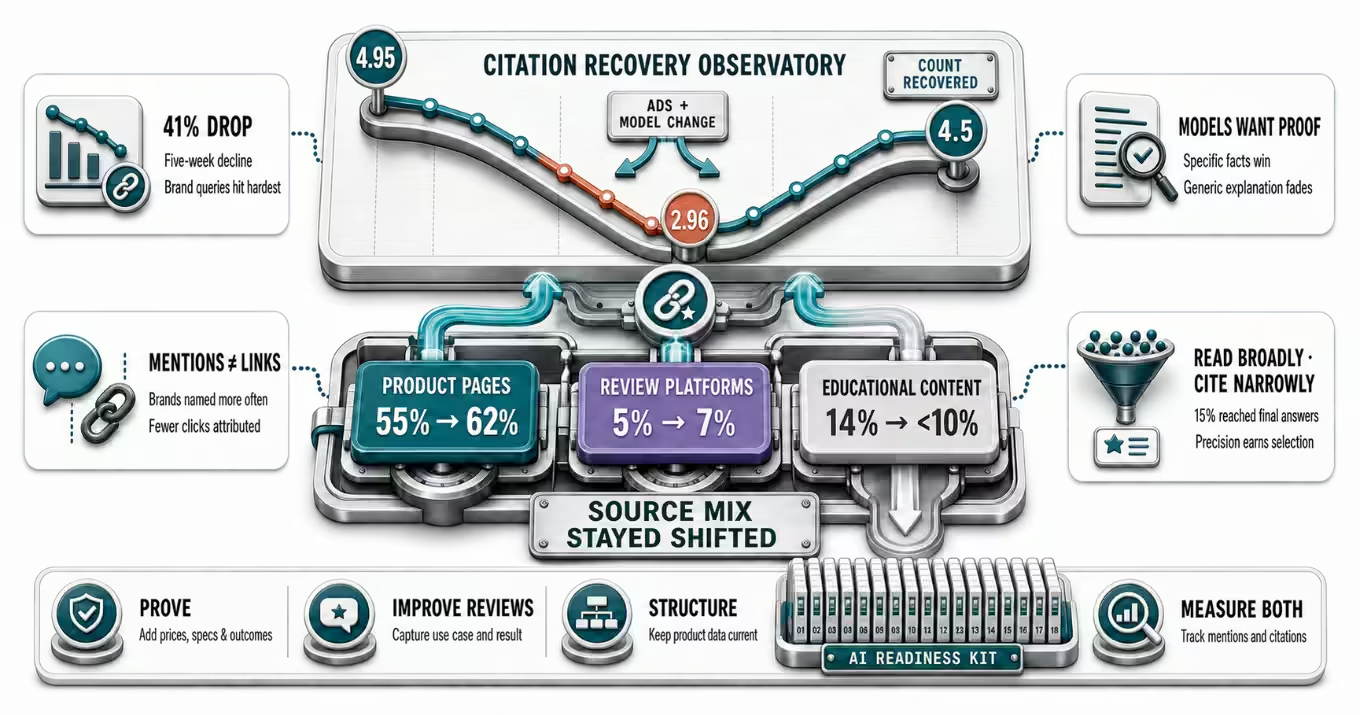
In February, citations on brand queries inside ChatGPT fell 41 percent in five weeks. By late March they were back to roughly 90 percent of where they started. Most of the marketing industry treated that as a story with a clean three-act structure: a scare, a panic, a resolution.
The resolution is the part worth questioning. The count recovered. The kind of page earning those citations did not go back to what it was, and months later it still has not. Product pages absorbed the difference. Educational content gave up ground. Review platforms picked up share. None of that shows up on a dashboard that reports a single citation number.
This is a composition problem disguised as a volume problem, and composition is where buying decisions get made. Here is what the data shows, what can and cannot be attributed to advertising, and what actually changes about the work.
What Happened to Citation Counts
On January 16, 2026, OpenAI published its approach to advertising in ChatGPT, confirming plans to test ads in the United States on the free and Go tiers. The pilot went live on February 9, 2026, with ads appearing as clearly labeled sponsored placements below the answer.
The commercial ramp was fast. PPC Land documented that the pilot crossed $100 million in annualized revenue within six weeks, that the platform opened to all US businesses with no minimum spend on May 5, and that conversion-optimized campaigns began rolling out June 5. Six significant product additions landed in 26 days. Whatever else it is, this is not an experiment being run slowly.
What happened to organic citations over the same window was measured at scale. Research published on Built In by Alex Halliday, drawing on AirOps monitoring data, tracked AI search responses for roughly 3,000 brands from December 8, 2025 through March 30, 2026. That produced more than 170 million AI answers containing over 500 million individual citation records. To rule out distortion from brands joining the tracked set mid-window, the findings were validated against a same-store cohort of about 800 brands monitored continuously across all 16 weeks.
The headline numbers:
- Brand query citations per answer fell from 4.95 to 2.96 between mid-January and early March, a 41 percent decline in five weeks
- Category query citations fell from 7.3 to 6.1 in the same window, a milder 16 percent decline
- By late March, brand queries recovered to about 4.5 per answer, roughly 90 percent of the December baseline
- Category queries returned to about 7.0, effectively a full recovery
If the story ended at counts, this was a temporary disruption. It does not end at counts.
The Source Mix Moved, and It Stayed Moved
Underneath the recovering total, the categories of domain earning brand query citations reshuffled. Unlike the dip, that reshuffle persisted.
Company and product domains gained. They went from 55 percent of all brand query citations in December to 63 percent at the trough, holding around 62 percent through late March. When someone asks about a product now, the model is meaningfully more likely to cite that product's own site than third-party content about it.
Educational content lost ground. Explainer and definitional pages, the "what is a CRM" and "how marketing automation works" category that content teams have funded for a decade, dropped from 14 percent to under 10 percent of brand query citations. The model is increasingly synthesizing that explanation itself instead of linking to someone who wrote it down.
Review platforms gained. G2, Capterra, and TrustRadius were among the few third-party categories to grow share during the dip and keep it, climbing from 5 percent to roughly 7 percent.
Read those three movements together and a pattern emerges that has nothing to do with advertising. On a question close to a purchase, the model is favoring sources that constitute evidence over sources that constitute explanation. A product page with a real price and real specifications is evidence. A customer review describing an outcome is evidence. A 2,000-word post defining a category is context the model can now generate on its own.
Ads Are Not the Only Variable, and That Matters
The temptation is to draw a straight line from the ads launch to the citation drop. The data does not support drawing it cleanly, and the reason is worth understanding rather than skipping past.
The deepest point in the citation data came roughly three weeks after the ads launch, which coincided with the release of GPT-5.3 Instant, a model OpenAI described as designed to synthesize information rather than list source URLs. Two changes, one window. OpenAI's published ads principles state plainly that "ads do not influence the answers ChatGPT gives you," and that answers are optimized on helpfulness while ads stay separate and labeled.
Take that at face value and the picture is still coherent: a model built to synthesize rather than enumerate would produce exactly this pattern, fewer links overall and a bias toward sources that settle a factual question rather than explain a concept. The commercial incentive arriving in the same quarter is a real fact about the platform and worth watching. It is not required to explain the observed behavior.
This distinction has practical value. If you believe the shift is purely an ads artifact, you wait for it to normalize. If you understand it as a change in how the model decides what deserves a link, you start working on the pages that now carry the weight.
More Mentions, Fewer Links
The second finding in that research is the one most teams have not internalized: brand mentions per answer increased over the same period that citation links shifted away from third-party content. Models are talking about brands more and linking to them less.
That decouples two things marketers have always measured together. Being named in an answer is real visibility, and it now happens without producing a session, a referrer, or anything an analytics platform will attribute. A separate strand of the same research, covering 548,534 retrieved pages across 15,000 prompts, found that only 15 percent of pages ChatGPT retrieved made it into a final response. The model reads broadly and cites narrowly, filtering on title alignment, specificity, and clarity.
Two consequences follow. First, your content can be read and used without ever being credited, which means citation counts undercount influence. Second, the gap between retrieved and cited is a quality filter you can actually act on, because the filter is looking for precision.
Traditional rankings still matter inside all of this. The same research found pages ranking first on Google were cited by ChatGPT at 3.5 times the rate of pages outside the top 20. That is consistent with Google's own position in its official guidance on optimizing for generative AI features, which states that from Google Search's perspective, optimizing for generative AI search is still SEO. We covered that guidance and its implications in more depth in Google published its AI search playbook, and the broader case that the answer layer sits on search fundamentals in AI visibility is built on SEO.
What This Changes About the Work
The instinct after reading citation data is usually to publish more. That is the wrong response to this particular shift, because the shift is not about volume.
- Treat product and pricing pages as citation assets, not just conversion assets. These pages now carry a larger share of brand query citations than anything else, and most of them were written to persuade rather than to be quoted. Named outcomes, current pricing, actual specifications, clear comparison language, and a visible last-updated signal all make a page easier to extract a verifiable fact from.
- Invest in review specificity, not just review volume. A five-star rating carries almost no extractable information. A six-sentence review naming a use case, a timeframe, and a result does. Changing when and how you ask customers for reviews changes what they write, and what they write is what gets read.
- Get your structured product data in order if you sell things. OpenAI publishes a product feed specification for agentic commerce that lets merchants push catalog data directly rather than waiting to be crawled, with support for frequent updates so pricing and availability stay current. This is unglamorous, fully automatable, and entirely inside your control.
- Measure mentions and citations as separate lines. If mentions are rising while links shift, a report that tracks only one of them will describe a world that no longer exists. Run the same set of buyer questions across platforms on a schedule and record what kind of page earns the citation, not just whether you appeared.
The Part That Is Not Automatable
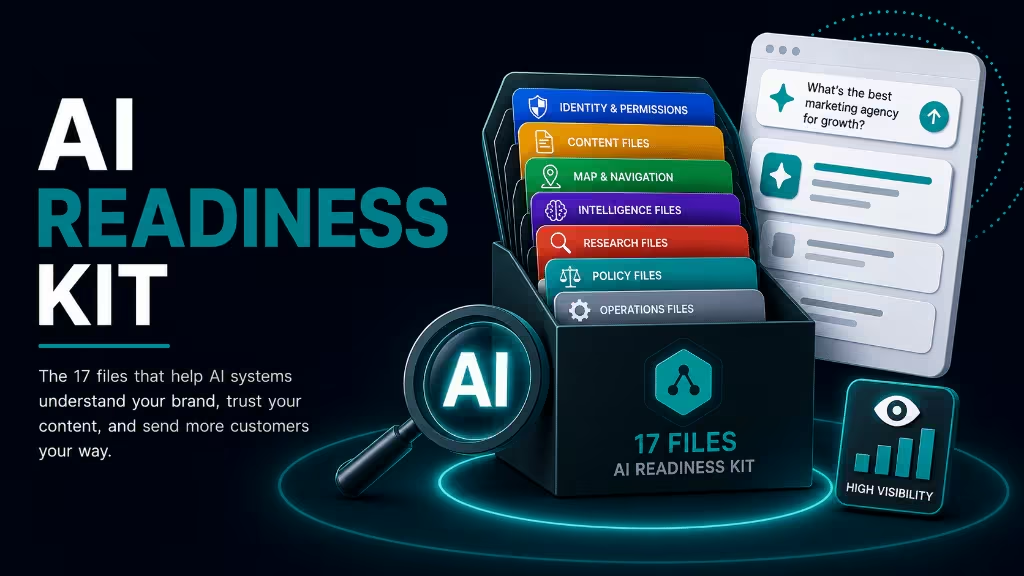
Most of the above is plumbing. Machine-readable files, clean structure, crawler access, accurate and parseable facts, current feeds. This is the layer that should be automated, and it is exactly what the Silverback AI Readiness Kit handles: 18 files deployed to your site root that hand every major AI platform a direct, structured, first-party account of your business, so the models are not assembling your identity from stale directory listings and competitor comparison pages. It is free, it takes about an afternoon, and it does not replace vendors, agencies, or people. It was never meant to.
What it cannot do is the part that decides whether any of it works. A model that now prefers proof over explanation is, in its own mechanical way, asking the same question a skeptical buyer has always asked: show me it works, do not just tell me what it is. Answering that requires knowing which claim your company can actually defend, which outcome a real customer would recognize as meaningful, and how to say it in language that reads as credible rather than promotional. No system generates that. It comes from having sat across the table from enough customers to know what they ask before they buy.
That has always been the harder thing to fake, long before any of this had a name. Our SEO and GEO work is built around that split: automate the boring layer completely, keep human judgment on the layer that decides the answer.
Where to Start This Week
Pull the last month of brand query results for your category across ChatGPT and at least one other platform. Do not stop at whether you appeared or how many links the answer carried. Record what kind of page earned each citation: your product page, a review platform, an explainer, a competitor comparison, a forum thread.
If the answer is mostly explainers you wrote in 2023, you are visible in a category the model has started handling itself. If it is mostly review platforms and product pages you have never audited for extractable facts, you know exactly which pages are doing the work, and which ones deserve the next hour of attention.
Frequently Asked Questions
Common questions about GEO, SEO, and AI-driven search visibility.
The timing lines up, but the causation is not established. Citation counts on brand queries fell sharply in the five weeks after the February 9, 2026 ads launch, and the deepest point in the data came roughly three weeks after launch, coinciding with the release of GPT-5.3 Instant, a model OpenAI described as designed to synthesize information rather than list source URLs. OpenAI's published ads principles state that ads do not influence the answers ChatGPT gives. The honest read is that a product change and a model change landed in the same window, and the observable data cannot separate them.
Average citations per answer on brand queries fell from 4.95 to 2.96 between mid-January and early March 2026, a 41 percent decline over five weeks. Category queries fell less severely over the same window, from 7.3 to 6.1, a 16 percent decline. The figures come from an analysis of more than 170 million AI answers across roughly 3,000 tracked brands, published on Built In.
Yes. By late March 2026, brand queries had climbed back to about 4.5 citations per answer, roughly 90 percent of the December 2025 baseline, and category queries returned to about 7.0, essentially fully recovered. The count recovered. The composition of sources earning those citations did not return to its prior mix.
Company and product websites went from 55 percent of all brand query citations in December 2025 to about 62 percent through late March 2026. Review platforms including G2, Capterra, and TrustRadius climbed from 5 percent to roughly 7 percent. Educational domains, meaning explainer and definitional content, fell from 14 percent to under 10 percent over the same window.
It matters, but its role has narrowed. On brand queries specifically, the return on explainer content for earning citations is declining because the model increasingly synthesizes that information itself rather than linking to a source for it. Educational content still supports category-level visibility, topical authority, and traditional search rankings, which continue to correlate with AI citation rates.
Review platforms were one of the few third-party source categories to gain citation share during and after the early 2026 shift. Structured, outcome-specific review content reads as high-signal evidence on brand queries in a way that self-authored marketing copy does not, because the claims come from customers rather than from the company making them.
Track brand mentions alongside citations, because they are now separate outcomes. Over the same period that brand query citation links shifted toward product and review domains, brand mentions per answer increased, meaning models discuss brands more while linking to them less. That produces awareness without clicks, which most analytics setups are not built to capture.
Sources
- OpenAI: Our approach to advertising and expanding access to ChatGPT (opens in a new tab)
- Built In: How to Make Brand Content More Visible in AI Search (opens in a new tab)
- PPC Land: ChatGPT goes performance, conversion ads and AI citations (opens in a new tab)
- OpenAI Developers: Product feeds for agentic commerce (opens in a new tab)
- Google Search Central: Optimizing your website for generative AI features (opens in a new tab)
- Silverback AI Readiness Kit (opens in a new tab)