




Google Dodges a Breakup, Then Loses the Links: The Week in SEO, GEO, and AI Visibility August 31 to September 4, 2026
 Preferred source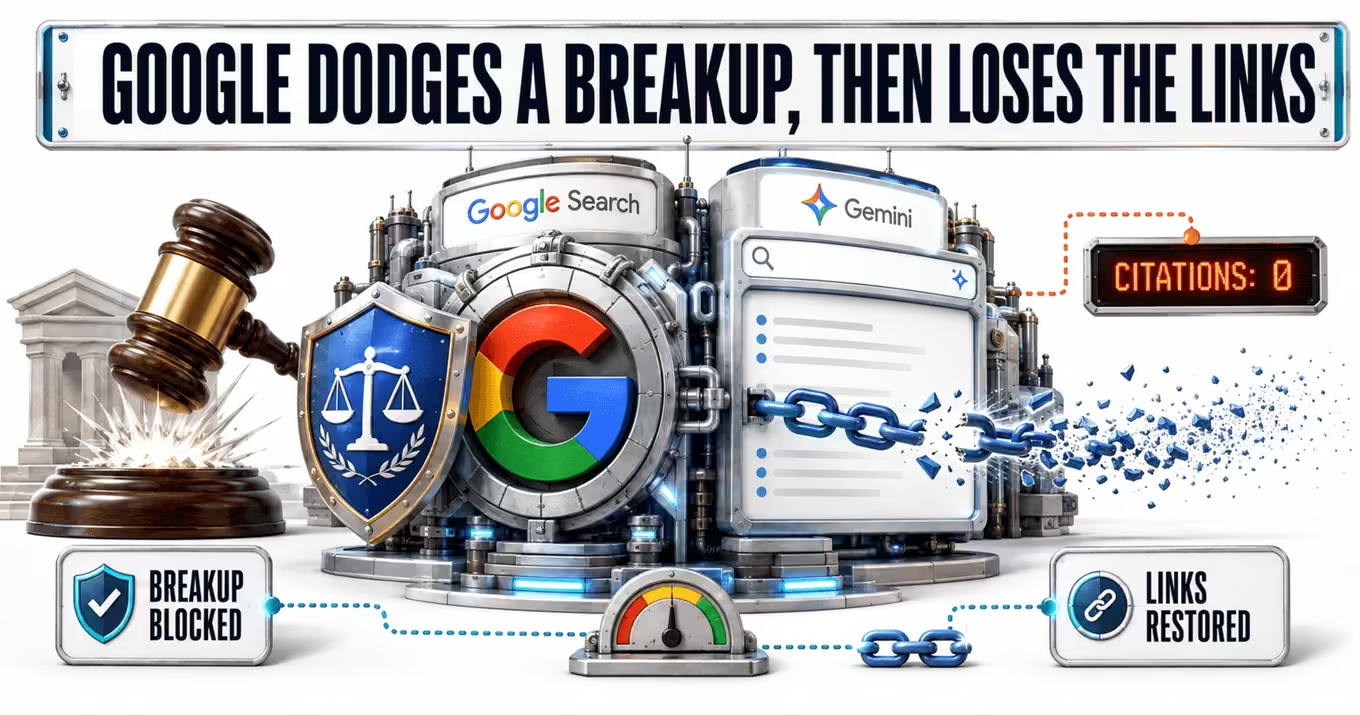
The week the link became a setting
Two things happened this week that tell you almost everything about where search is heading.
On Wednesday, a federal judge decided Google gets to keep its ad tech business intact. On Thursday, SEOs discovered that Google's newest AI model had quietly stopped citing anyone at all. One of those stories got the headlines. The other one is the one that should have you checking your analytics.
The connective tissue across the week: AI surfaces are getting bigger and more autonomous, the measurement tooling is finally catching up, and the link, the thing our whole industry is built on, is becoming a variable Google can turn down without telling anyone.
| Day | What happened | What it means for you |
|---|---|---|
| Mon | Search Console AI performance report and AI opt-out control reach every site worldwide | Pull a baseline now; leave the toggle alone |
| Mon | CNBC: OpenAI ads hit a one billion dollar annualized run rate | ChatGPT Ads is a 2027 line item, not an experiment |
| Mon | Google posts eligibility for the EU search dataset licensing program | Google ranking and click data can now flow to rival engines and AI chatbots |
| Wed | Judge Brinkema declines to force the sale of AdX | Behavioral remedies only; stop planning around a breakup |
| Wed | Gemini 3.8 Flash lands in AI Mode | A model swap shipped under three weeks after the last one |
| Thu | AI Mode on 3.8 Flash returns almost no citations | Citation volume is a product setting; monitor weekly, not quarterly |
| Thu | Articles vanish from the Google News tab for most of the day | Check the All tab before tearing apart your setup |
| Fri | Stein confirms the citation bug; links return. OpenAI ships ChatGPT Ads updates and feed-gated shopping | Product feeds are now an AI visibility requirement |
Google avoids an ad tech breakup for the second time
On Wednesday, September 2, U.S. District Judge Leonie Brinkema in Alexandria, Virginia declined to force Google to sell AdX, its ad exchange. The Wall Street Journal reported that this marks the second time Google has fended off the threat of divestiture after being found to have illegally maintained a monopoly. Reuters noted that publishers pay Google roughly a 20 percent fee to sell ads through AdX auctions that run the instant a user loads a page.
Brinkema did not publish her full opinion right away. According to the New York Times, she previewed it in a short docket filing, saying she had granted most of the behavioral changes both sides proposed, including requirements that Google share more information with publishers.
Why it matters. If your media plan assumed Google's ad stack would be forced open in the next 18 months, rebuild it. Behavioral remedies mean Google keeps the same integrated auction and adds disclosure obligations on top. More transparency into how AdX prices inventory is useful for publishers, but transparency does not change take rate. Diversify your ad tech for margin and audience reasons, not in anticipation of a court-ordered fire sale that keeps not happening.
Gemini 3.8 Flash landed in AI Mode, and the citations went with it
Robby Stein, VP of Product at Google Search, announced on September 2 that "Gemini 3.8 Flash has landed in Search." It rolled out globally to Google AI Pro and Ultra subscribers, selectable from the model dropdown in AI Mode. Google describes 3.8 Flash as its most intelligent workhorse model, with improvements over 3.7 Flash across software engineering, agentic tasks, and multi-step reasoning. Nick Fox, a head of Google Search, noted that it arrived less than three weeks after 3.7 Flash.
Then it got interesting. On September 3, Gagan Ghotra posted a series of AI Mode searches run on 3.8 Flash for top-of-funnel queries, and none returned links or citations. Glenn Gabe replicated it with side-by-side comparisons of the default model and 3.8 Flash on the same query, the newer model showing dramatically fewer sources. Stein responded on September 4:
Hey, thanks for flagging. This isn't working as intended, and we'll roll out a fix soon.
Search Engine Land covered Google's commitment to fix the citation bug, and by Friday morning Gabe confirmed the links were back.
Why it matters. Treat this as a fire drill you got for free. A model swap shipped in under three weeks silently zeroed out citation behavior across an entire class of queries for roughly 24 hours. Google fixed it quickly. The concern is what it proves: the number of citations an AI surface shows is a product decision that can change between Tuesday and Wednesday, and nobody sends you an email about it.
That argues for two things. Monitor AI citations continuously rather than quarterly, so you can tell a bug apart from a trend. And do not let AI citation volume become a single point of failure in your demand model. The brands that shrugged this week did so because AI Mode was one of six or seven ways people found them, which is the whole argument of the straight line to number one is gone.
AI Overviews are expanding by default, pushing the blue links further down
This one broke on August 28, just before our window, but it drove the conversation all week. Chris Long spotted that Google had begun revealing the AI Mode prompt box by default on some queries, skipping the "Show more" click entirely. The AI Overview loads as a full AI Mode style answer, with the "Ask anything" follow-up box already open.
Google confirmed it. A spokesperson said:
For some queries, AI Overviews may dynamically expand for topics where our systems determine it's most useful for people. Our research has shown that with this dynamic experience, users find Search more helpful and engage deeper in follow-up exploration.
Robby Stein added that if a user has already started scrolling, the expansion is cancelled so they do not lose their place.
Why it matters. Google's framing and the practitioner read do not agree here, and it is worth saying so plainly. Google describes users finding Search more helpful. What the change mechanically does is push the ten organic results substantially further down the page on affected queries, converting a two-step interaction, read snippet then click, into a conversational session that stays inside Google. Both can be true. Users probably do get answers faster. Publishers probably do get fewer clicks.
If impressions hold steady while click-through rate erodes on informational queries, this is a likely cause, and it is a surface change rather than a ranking problem. Content rewrites will not fix it.
Search Console's AI performance report finished its global rollout
Google's help documentation now states that as of August 31, 2026, the control has rolled out to all websites worldwide, closing out a staged release that started in the first week of June and was first announced on the Search Central blog.
The report appears as an expandable tab under the main performance report in Search Console. It gives you impressions, which URLs appeared in AI features, country breakdowns, device data for Search results, and date granularity from hourly to monthly. It does not give you click data or query data. Alongside it, Google rolled out a toggle letting site owners block their content from appearing in or around AI features including AI Overviews, AI Mode, and AI Overviews in Discover, either as links or for grounding. Search Engine Land covered the global rollout of both features on September 1. We walked through both, including the inheritance trap in the opt-out setting, when Google published its AI search playbook.
Why it matters. This is the most useful thing to happen to GEO measurement all year, and the most easily over-interpreted. Impressions in AI features is a real signal that Google is retrieving and surfacing your pages inside generative answers. But without clicks or queries, you cannot calculate an AI click-through rate or tie visibility to a specific prompt. Anyone selling you a precise AI ROI figure from this report is filling gaps with assumptions.
Use it for direction, not attribution. Pull a baseline now, segment by page type, and watch which content clusters Google actually reaches for. On the opt-out toggle, be careful: blocking your content from AI features blocks it from the surface absorbing an increasing share of informational demand. That may be right for a subscription publisher protecting paid content. For almost everyone else, it removes you from the answer while competitors stay in it.
Publishers watched content vanish from the Google News tab
Starting around September 2, publishers reported that articles crawled, indexed, and ranking in the main Google Search results were missing from the News tab, sometimes reappearing hours later. Barry Schwartz replicated it across large and small publishers, including a Bloomberg piece showing in the All tab but absent from News, and eventually on Search Engine Roundtable's own content. He asked Google publicly on Bluesky and got no response. By around 4pm Eastern on September 3, the missing content began showing up again. No pattern emerged, and Schwartz noted it felt different from previous Google News visibility and serving issues.
Why it matters. If you publish news or time-sensitive content, News tab presence and web index presence are separate systems with separate failure modes. Before you tear apart your technical setup over a News tab drop, check whether the same URLs rank normally in the All tab. If they do, this is a serving issue on Google's side. It is also why News tab traffic deserves its own line in reporting rather than being blended into organic.
OpenAI had the loudest commercial week in AI search
Three things landed inside five days.
On August 31, CNBC reported that OpenAI's ad business hit a one billion dollar annualized revenue run rate, describing the growth as blistering. For scale, CNBC had reported in March 2026 that the ads pilot passed 100 million dollars in annualized revenue in under two months.
On September 3, OpenAI released GPT-6 Astra, which president Greg Brockman called the company's "most intelligent and, also very importantly, our most aligned model yet." TechCrunch reported it went first to customers on OpenAI's Daybreak cybersecurity program, with paid plans and the API following within a week.
On September 4, OpenAI shipped a batch of ChatGPT Ads updates: an Ads Manager plugin that builds and troubleshoots campaigns conversationally from ChatGPT or Codex, expanded custom audience controls, new conversion matching fields, carousel card reporting, budget pacing, and an ads rollout into select countries across Europe, India, the Middle East, and North Africa. In the same news cycle, analyst Juozas Kaziukenas reported that ChatGPT shopping results now come only from brands that submit product feeds.
Why it matters. The product feed detail is the one to act on. If ChatGPT shopping is feed-gated, organic AI visibility and commerce visibility have split into two games with two different entry requirements. You can be the most cited brand in ChatGPT's text answers and entirely absent from its shopping surface because you never submitted a feed. Unglamorous plumbing work, fixable this month. It is the same shift toward product pages and feeds we traced in the ChatGPT citation crash recovered, the rules did not.
The run rate matters differently. A one billion dollar annualized ad business inside an assistant with roughly a billion weekly users means the paid layer of AI search is no longer theoretical. Budget conversations for 2027 should treat ChatGPT Ads as a line item, not an experiment.
Google published the details of its European search dataset licensing program
On August 31, Google updated its European Search Dataset Licensing Program page with a refreshed overview, eligibility criteria, and application details, logging the change in its Search Central updates feed. This flows from Google's gatekeeper designation under the EU's Digital Markets Act. On July 16, 2026, the European Commission adopted measures specifying how Google must comply with Article 6(11) by making a defined search dataset available to qualifying recipients.
The dataset covers ranking, query, click, and view data from Google Search in the European Economic Area, for both free and paid results. Eligibility is tight: applicants must be search engine providers operating in the EEA, cannot be controlled by non-EEA state actors or sanctioned entities, and need either two consecutive years of EU operation or more than 50 million euros in capital investment, plus at least 50,000 monthly average EU users. Access runs on FRAND terms with strict anonymization requirements. Notably, eligible recipients include AI chatbots with search engine functionality.
Why it matters. This is the slowest-moving story of the week and possibly the most consequential. Ranking, query, and click data from Google Search flowing to AI chatbots under regulated pricing is the raw material a credible Google competitor would need. Nothing changes for your campaigns this quarter. But if you are making three-year bets about which surfaces matter, a legally mandated data pipe from Google to rival engines quietly reshapes the map.
Also worth knowing
John Mueller said Google does not penalize sites for old outbound links to domains that later changed hands and now host shady content. Google clarified again that the disavow tool does have real effects, so it is not the placebo some SEOs treat it as. Google Analytics dropped September 1 data for many properties, and AdSense announced a move to begin-to-render impression measurement.
This week's checklist
- Start with measurement, because the tooling just improved. Pull your Search Console generative AI performance report and save a baseline segmented by content cluster. It will not tell you about clicks or queries, so do not build a revenue model on it, but it will tell you which content Google actually reaches for when constructing an answer.
- Build a citation tripwire. The Gemini 3.8 Flash episode showed AI citation volume can collapse and recover inside 48 hours because of a model swap. A weekly check on twenty or thirty priority prompts is enough to tell a temporary bug from a structural decline. Watch whether you disappeared alone or whether everyone did.
- If you sell products, go check your feeds. Feed hygiene has become an AI visibility requirement, not just a Shopping ads requirement, and it is a two-week project with a clear finish line. That makes it more valuable than most of what is on your GEO roadmap.
- Leave the AI opt-out toggle alone unless you have a specific, defensible reason. For most brands it is unilateral disarmament.
Frequently Asked Questions
Common questions about GEO, SEO, and AI-driven search visibility.
No. On September 2, 2026, U.S. District Judge Leonie Brinkema in Alexandria, Virginia rejected the Justice Department's request to force Google to sell its ad exchange, AdX. She instead granted most of the behavioral remedies proposed by both sides, including requirements that Google share more information with web publishers and end practices that depress publisher ad rates. It was the second time Google avoided a court-ordered divestiture after being found to have illegally maintained a monopoly. Reuters reported that publishers currently pay Google roughly a 20 percent fee to sell ads through AdX auctions.
It was a bug tied to the rollout of Gemini 3.8 Flash, which Google shipped into AI Mode for AI Pro and Ultra subscribers on September 2, 2026. On September 3, Gagan Ghotra and Glenn Gabe documented that the new model returned answers with almost no links or citations on top-of-funnel queries compared with the previous default model. Google's Robby Stein, VP of Product at Google Search, responded on September 4 saying it was not working as intended and a fix was coming. Gabe confirmed later that morning that links had returned. The episode lasted roughly 24 hours but showed that citation volume in AI Mode can change with a model swap and no advance notice.
The report includes impressions showing how often your URLs appeared in generative AI features in Search and Discover, the specific pages that appeared, country-level breakdowns, device data for Search results, and date granularity from hourly through monthly. It does not include click data or query data, so you cannot calculate an AI click-through rate or tie visibility to a specific prompt. Google completed the global rollout on August 31, 2026, after a staged release that began in early June 2026. It appears as an expandable tab beneath the main performance report in Search Console.
Yes. As of August 31, 2026, Google rolled out a Search generative AI control globally that lets site owners block their content from appearing in or around AI features including AI Overviews, AI Mode, and AI Overviews in Discover, either as links or as grounding material. The toggle lives in Google Search Console. For most sites this is a poor trade, because opting out removes you from the surface capturing a growing share of informational demand while competitors remain visible there. It is more defensible for publishers protecting subscription content.
According to analyst Juozas Kaziukenas, whose finding was reported by Search Engine Roundtable on September 4, 2026, ChatGPT shopping results now come only from brands that submit product feeds to OpenAI. This surfaced alongside OpenAI's September 4 batch of ChatGPT Ads updates. If accurate, product feed submission is now a prerequisite for appearing in ChatGPT's commerce surface, regardless of how often your brand is cited in its text answers. Ecommerce brands should treat feed hygiene as an AI visibility task, not solely a paid shopping task.
CNBC reported on August 31, 2026 that OpenAI's ad business reached a one billion dollar annualized revenue run rate. For context, CNBC reported in March 2026 that the ads pilot had passed 100 million dollars in annualized revenue in under two months after its United States launch. On September 4, 2026, OpenAI expanded ChatGPT Ads into select countries across Europe, India, the Middle East, and North Africa, and shipped an Ads Manager plugin for building campaigns conversationally through ChatGPT or Codex.
Sources
- Search Engine Roundtable: Judge Rules Google Ad Tech Business Won't Be Broken Up (opens in a new tab)
- The Wall Street Journal: Google Avoids Breakup of Dominant Ad-Tech Business (opens in a new tab)
- Reuters: Google defeats US bid to force ad tech sale (opens in a new tab)
- The New York Times: Google Ad Tech Remedies (opens in a new tab)
- Search Engine Roundtable: Google Search Using Gemini 3.8 Flash In AI Mode (opens in a new tab)
- Google: Gemini 3.8 Flash and 3.8 Flash Cyber (opens in a new tab)
- Search Engine Roundtable: Google AI Mode Gemini 3.8 Flash Not Link or Citation Friendly? (opens in a new tab)
- Search Engine Land: Google to fix citation bug with Gemini 3.8 Flash in AI Mode (opens in a new tab)
- Search Engine Roundtable: Google AI Overviews Pushing Searchers Into AI Mode, Drops Show More Button (opens in a new tab)
- Search Engine Roundtable: Global Google Search Console AI Performance Report and AI Control (opens in a new tab)
- Google Search Console Help: Generative AI features report (opens in a new tab)
- Google: New controls for website owners (opens in a new tab)
- Google Search Central: Generative AI performance reports (opens in a new tab)
- Search Engine Land: Google Search Console AI performance reports and Search generative AI control rolling out globally (opens in a new tab)
- Search Engine Roundtable: Publishers Noticing Google News Tab Content Disappearing (opens in a new tab)
- CNBC: OpenAI's ad business shows blistering growth, hits $1 billion annualized revenue run rate (opens in a new tab)
- CNBC: OpenAI ads pilot tops $100 million in annualized revenue in under 2 months (opens in a new tab)
- Search Engine Roundtable: ChatGPT Ads Manager Plugin, Audience Updates, Product Feeds and More (opens in a new tab)
- TechCrunch: OpenAI launches Astra, its powerful (and controversial) new model (opens in a new tab)
- OpenAI: GPT-6 Astra, a new generation of intelligence (opens in a new tab)
- Search Engine Roundtable: Google European Search Dataset Licensing Program Details (opens in a new tab)
- Google Search Central: Search updates (opens in a new tab)
- European Commission: DMA Article 6(11) specification measures for Google (opens in a new tab)
- Search Engine Roundtable: Google Says It Does Not Penalize For Old Outbound Links With Shady Content (opens in a new tab)
- Search Engine Roundtable: Google Says The Disavow Tool Does Have Effects (opens in a new tab)
- Search Engine Roundtable: Google Analytics September 1 Data Missing (opens in a new tab)
- Search Engine Roundtable: Google AdSense Begin-to-Render Impression Measurement Coming (opens in a new tab)