


SEO, AIO, AEO, GEO, LLMO: Five Acronyms, One Job, Two Readers
 Preferred source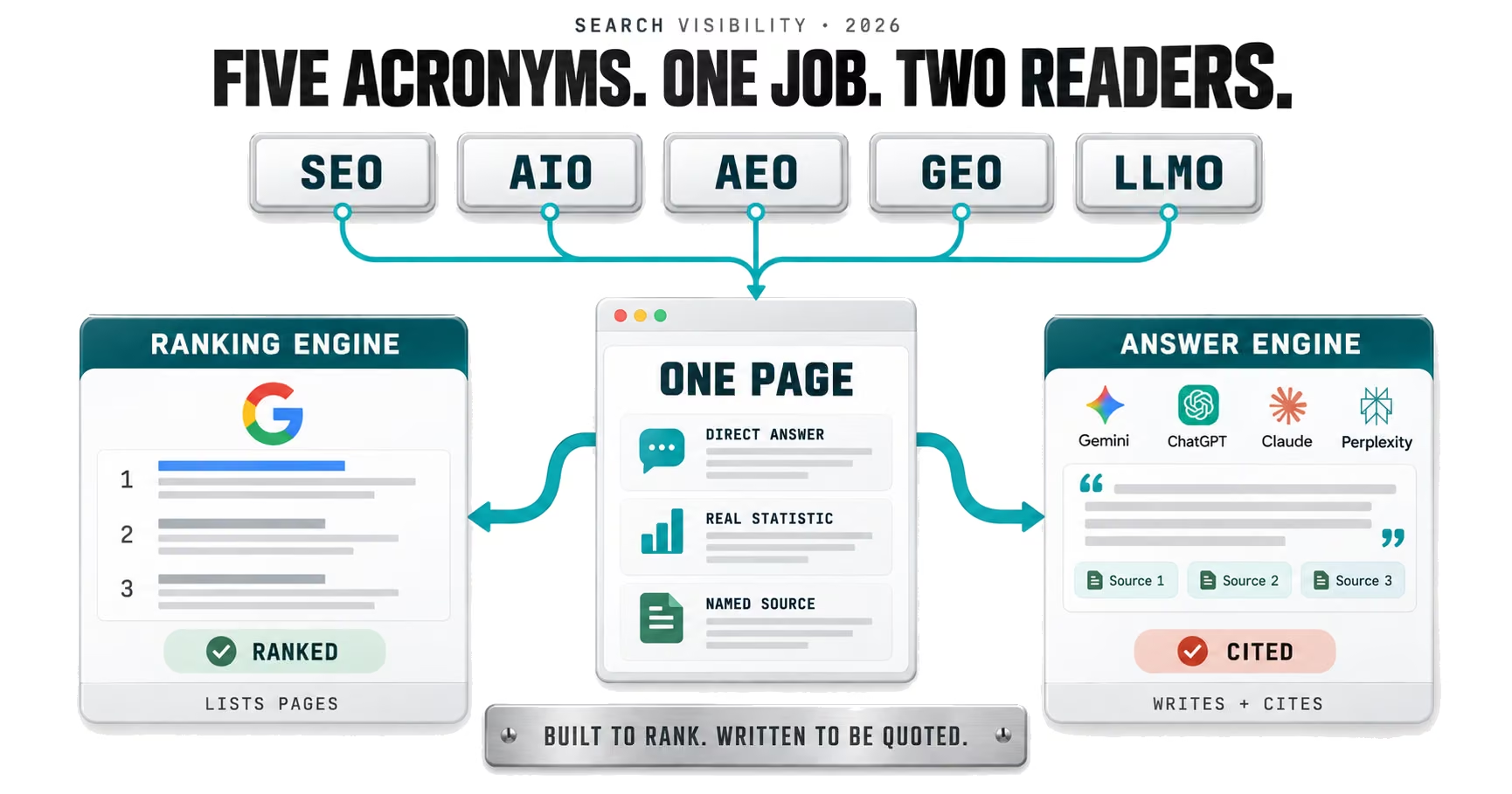
Why the acronyms multiplied
Every time a new surface started answering questions, someone named the work of getting into it. Featured snippets produced "answer engine optimization." AI Overviews produced "AIO." A research paper produced "GEO." The monitoring tools that sell citation tracking produced "LLMO" and "AI visibility." Rand Fishkin got tired enough of it to write a post in May 2025 titled, in part, "Seriously, please stop with the new acronyms," crediting Ashley Liddell of Deviation with the alternative he now uses: Search Everywhere Optimization, where the acronym stays SEO and the definition expands to cover YouTube, Reddit, LinkedIn and LLMs.
He has a point, and so do the people inventing terms. The labels are confusing, but the shift underneath them is real and the buyer data proves it. So rather than pick a side, this guide does two things. First, it defines each term precisely, with where it came from, so you can hold your own in a meeting. Second, it collapses them into the model that actually matters for writing: two readers, one page.
The five terms, defined
| Term | Stands for | Where it came from | The reader it targets | Measured by |
|---|---|---|---|---|
| SEO | Search engine optimization | Late 1990s, the original discipline | Ranking engine | Position and clicks |
| AIO | AI Overviews (or AI optimization) | Google's generated summary above results | Answer engine, Google only | Inclusion and citation |
| AEO | Answer engine optimization | Featured snippets, then AI summaries and chatbots | Answer engine | Being the answer |
| GEO | Generative engine optimization | A November 2023 Princeton paper, KDD 2024 | Answer engine | Citation in a generated answer |
| LLMO | Large language model optimization | AI visibility monitoring vendors | Answer engine | Brand mentions per prompt |
SEO, search engine optimization. Getting a page discovered, indexed and ranked in a results list on Google, Bing or another search engine. The term dates to the late 1990s, and it remains the foundation of everything below, because every answer engine on this list draws from pages that were crawlable and readable first. Google's own AI features documentation states there are "no additional requirements to appear in AI Overviews or AI Mode, nor other special optimizations necessary," and that the pages used must be indexed and eligible for a normal snippet. That sentence is the whole argument for why SEO is still the first reader.
AIO, AI Overviews (or AI optimization). Most often AIO refers to Google's AI Overviews, the generated summary that sits above the results for a growing share of queries. Google put its reach at more than 2.5 billion monthly active users in a June 2026 post that also introduced a Search Console toggle for opting out. The term is also used as shorthand for "AI optimization," the work of being included. Treat it as Google specific: AIO is the answer engine that lives inside the search engine. We covered every change to it this year in AI Overviews in 2026.
AEO, answer engine optimization. Being the answer itself, rather than a link to it. AEO predates generative AI; it started with featured snippets, and Google's featured snippets documentation is blunt about how much control you have:
You can't. Google systems determine whether a page would make a good featured snippet for a user's search request, and if so, elevates it.
The term has since stretched to cover AI summaries, ChatGPT and Perplexity, because the core discipline, structuring a direct answer a machine can lift, is identical.
GEO, generative engine optimization. Getting cited inside a generated answer. Unlike the others, GEO has a birth certificate: the paper GEO: Generative Engine Optimization by Aggarwal and colleagues, first posted November 2023 and accepted at KDD 2024, which built a 10,000 query benchmark and tested which content changes made a page more likely to be used in a generated response. Adding quotations improved visibility by roughly 40 percent, adding statistics by 30 to 40 percent and citing sources by about 30 percent, while keyword stuffing did nothing or hurt. GEO and AEO target the same box. GEO simply arrived with data.
LLMO, large language model optimization. Search Engine Land defines LLMO as "optimizing your content, website, and brand presence to appear in AI generated responses from tools like ChatGPT Search, Google's AI Overviews, and Perplexity." In practice it is the term the monitoring tools favor, along with "AI visibility" and "AI citations," because what they sell is a score: how often an answer names you. Same target as GEO. Different vocabulary, because it comes from a different vendor category.
A few more phrases round out the set, and you will hear them in the same meetings:
- AI search
- Search everywhere
- AI visibility
- AI citations
- Answer engines
- Zero click
"AI search" is the plain umbrella for every answer engine and AI summary, and it is the one we use with clients because nobody has to look it up. "Search everywhere" is the reminder that buyers now ask inside LinkedIn, YouTube, Reddit and chat tools before they get to Google, if they get to Google at all.
Terms two through five are close to interchangeable. If a proposal uses all four as separate line items, that is a billing strategy, not a marketing one.
The buyer data that makes this urgent
The reason a definitions post matters in 2026 is that the second reader has started deciding who gets a meeting.
| Source | Figure | What it tells you |
|---|---|---|
| G2, April 2026 | 51 percent of B2B software buyers start research with an AI chatbot more than Google, up from 29 percent | The first query happens in a chatbot |
| G2, April 2026 | 54 percent name AI chatbots the top source shaping shortlists, ahead of review sites at 43 percent and vendor sites at 36 percent | Your site is the third input |
| G2, April 2026 | 69 percent changed vendor because of an AI answer; 33 percent bought from one they had never heard of | AI answers create and remove candidates |
| G2, April 2026 | 45 percent say a review site citation is the most confidence inspiring signal in an AI answer | Third party evidence carries the answer |
| 6sense, 2025 | The winning vendor was on the day one shortlist 95 percent of the time | Being named early is close to the whole game |
| 6sense, 2025 | 94 percent of buyers used LLMs in the process; first contact at 61 percent of the journey | The chatbot phase happens before you know the deal exists |
G2's "The Answer Economy" report, based on a March 2026 survey of 1,076 B2B software buyers and released on April 15, 2026, found that 51 percent now start their research with an AI chatbot more than with Google, up from 29 percent in April 2025. Seventy one percent rely on chatbots for software research, 69 percent chose a different vendor than they had planned because of what an AI told them, and 33 percent bought from a vendor they had never heard of before the chatbot named it. In the full report, generative AI chatbots rank as the top source shaping shortlists at 54 percent, ahead of review sites at 43 percent and vendor websites at 36 percent, and 45 percent of buyers say a review site citation is the most confidence inspiring signal inside an AI answer.
6sense's 2025 B2B Buyer Experience Report, drawing on just under 4,800 responses across its main and companion surveys, found that 95 percent of the time the winning vendor was already on the buyer's day one shortlist, that four in five deals go to the pre contact favorite, and that 94 percent of buyers used LLMs somewhere in the process. Buyers now make first contact with a seller about 61 percent of the way through their journey.
- G2 sells review site listings. Read the figure about review citations being the most trusted signal with the source in mind. The direction is consistent with everything else, though.
- 6sense sells account intelligence. Its report argues buyers decide early, which is also the case for its product. The 95 percent shortlist finding has held across three years of its surveys.
- Both are software buyers. Neither study covers retail, local services or consumer categories, where the chatbot share of first queries is likely lower today and growing from a smaller base.
Put those together and the sequence is clear. A buyer opens a chatbot, asks who does what they need, gets a shortlist, and the company that wins is almost always on it. Your website's ranking for the category keyword is one input to that shortlist. It is no longer the input.
Two readers, one page
Here is the model that replaces the acronyms.
| Ranking engine | Answer engine | |
|---|---|---|
| Reads | Your page | Many pages, including ones about you |
| Produces | A list of ten links | One answer with a handful of citations |
| Rewards | Relevance, accessibility, trust signals | The same, plus a passage it can lift |
| Sends | A click | A mention, sometimes a click |
| You measure | Position and traffic | Whether you were cited |
A ranking engine reads your page and places it in a list of ten. It rewards relevance to the query, technical accessibility, and signals that other sites trust you. It sends a click, and you measure it in positions and traffic.
An answer engine reads many pages, writes one answer and cites a handful. It also rewards relevance and accessibility and trust, which is why the fundamentals are shared. But it consumes the page differently, and that produces three practical differences.
It lifts passages, not pages. An answer engine is looking for a sentence or short paragraph it can quote or paraphrase, ideally with a number and a source attached. That is why the GEO study found quotations and statistics were the strongest levers. Answer shaped writing, where the direct answer sits at the top of the section and the supporting detail follows, wins with the second reader and costs nothing with the first.
It cites third party places heavily. Pew Research found Wikipedia, YouTube and Reddit were the most frequently cited sources in Google's AI summaries, and that .gov sites appeared three times as often in AI summaries as in traditional results. G2's buyers trust review site citations above vendor claims. A generated answer about your category is assembled from the places where your category is discussed, and your own site is one of those places, not the privileged one.
You measure it by citation, not rank. There is no position three in a generated answer. Either your brand or your page is named, or it is not. Google's new Search Console reporting, monitoring tools and manual prompt testing all measure some version of the same thing: did the answer include you.
Which reader reads what
| Channel | Ranking engine | Answer engine | What that means |
|---|---|---|---|
| Your website | Yes | Yes | The only asset you control; every claim lives here first |
| LinkedIn and X | Rarely for commercial queries | Yes | A founder's sourced post can be cited when the blog is not |
| YouTube | Yes, the video page | Yes, the transcript | What is said on camera is content |
| Review sites, forums, Reddit | Sometimes | Yes, as evidence | Where trust gets verified |
Your website is read by both. It is the only asset you fully control, and it is where the ranking engine needs the page to live. Every important claim, definition and figure should exist here first, on a crawlable page with a clear author and date.
LinkedIn and X are read almost only by the answer engine. Public posts are technically indexable, but they rarely rank for commercial queries in traditional search. Answer engines do read them, particularly for questions about what practitioners think or which vendors people recommend. A founder's post that states a specific, sourced claim can end up in a generated answer that the company's own blog missed.
YouTube is read by both, through the transcript. Google indexes video pages and Pew found YouTube among the top three sources cited in AI summaries. An answer engine cannot watch a video, but it can read what was said in one, which means the words in a talking head video are content in every sense that matters.
Review sites, forums and Reddit are read by the answer engine as evidence. They are where trust gets verified, which is why G2's buyers weight review citations so heavily and why a category with no independent discussion of your brand is a category where AI has nothing to cite.
What to do with this on Monday
- Write every important piece for both readers. One page on your site, structured so the answer comes first, carrying at least one real statistic with a linked source and one quotable sentence a machine could lift intact. We wrote up the page level version of this as a three part test, can it rank, can it answer, can it be cited, in our piece on how SEO picked up two more jobs.
- Then echo it. Take the same claim, the same figure and the same source and put a version on the founder's LinkedIn, in a short video with a transcript, and anywhere your category is discussed. You are not duplicating content. You are placing the same evidence where each reader looks for it.
- Then measure the second reader directly. Pick the ten prompts a buyer would actually type into a chatbot about your category and run them monthly across ChatGPT, Gemini, Perplexity and Google AI Mode. Record whether you are named and what gets cited when you are not. That list of what beat you is the most useful content brief you will get this year.
- Stop paying for the acronyms separately. If your SEO, GEO and content work are running as three engagements with three vendors, you are paying three times to reach the same two readers.
Our SEO and GEO service exists because the work is one workflow: pages built to rank, written to be quoted, and distributed where AI reads. Whatever you call it, that is the job.
Frequently Asked Questions
Common questions about GEO, SEO, and AI-driven search visibility.
SEO (search engine optimization) is getting a page found and ranked in a results list on Google or Bing. AEO (answer engine optimization) is being lifted as the direct answer, which started with featured snippets and now includes AI summaries and chatbots. GEO (generative engine optimization) is getting cited inside an AI generated answer, a term coined in a November 2023 paper from Princeton and collaborators. AEO and GEO target the same answer box; the different names mostly reflect who coined them.
AIO has two meanings. Most often it refers to Google's AI Overviews, the AI generated summary at the top of a results page, which Google says reaches more than 2.5 billion monthly users. It is also used as shorthand for AI optimization, the work of getting content included in those overviews. Google's own documentation says there are no special requirements or schema to appear in AI Overviews beyond being indexed and snippet eligible.
LLMO stands for large language model optimization: optimizing content and brand presence to appear in responses from conversational AI tools like ChatGPT, Claude, Gemini and Perplexity. In practice it targets the same outcome as GEO and AEO, being cited or named in a generated answer. The term is most common in AI visibility monitoring tools, where the score is how often an answer mentions your brand.
Because the shortlist is being built before anyone visits your site. G2's April 2026 survey of 1,076 B2B software buyers found 51 percent now start research with AI chatbots more than Google, up from 29 percent a year earlier, and 54 percent named chatbots the top source shaping their shortlist. 6sense's 2025 report of nearly 4,800 buyers found the winning vendor was already on the day one shortlist 95 percent of the time. If AI answers do not name you, you are rarely in the running.
Yes, and often more than a brand's own site. Pew Research found Wikipedia, YouTube and Reddit were the most cited sources in Google AI summaries, and G2 found 45 percent of B2B buyers consider review site citations the most confidence inspiring signal in an AI answer. Public LinkedIn posts and YouTube transcripts are read by answer engines even when they rarely rank for commercial queries in traditional search, so the same claims should live on your site and on the platforms AI reads.
No. Every AI answer engine draws from pages that are crawlable, indexable and clearly written, which is the core of SEO. Google's AI Overviews and AI Mode only use pages eligible for standard Search, and the Princeton GEO study found the biggest visibility gains came from adding quotations, statistics and cited sources, which are content quality improvements, not tricks. The right move is to write every page for both readers: the ranking engine and the answer engine.
Sources
- PR Newswire: New G2 research, half of B2B software buyers now start their research with AI chatbots (opens in a new tab)
- G2: The Answer Economy, G2's 2026 AI Search Insight Report (opens in a new tab)
- 6sense: The B2B Buyer Experience Report for 2025 (opens in a new tab)
- Google Search Central: AI features and your website (opens in a new tab)
- Google Search Central: Featured snippets and your website (opens in a new tab)
- Google: New opportunities, control and insights for website owners (opens in a new tab)
- arXiv: GEO, Generative Engine Optimization (Aggarwal et al., KDD 2024) (opens in a new tab)
- Search Engine Land: What is LLMO? Optimize content for AI and large language models (opens in a new tab)
- SparkToro: Seriously, please stop with the new acronyms. It's still SEO, Search Everywhere Optimization (opens in a new tab)
- Pew Research Center: Google users are less likely to click on links when an AI summary appears in the results (opens in a new tab)