

 Preferred source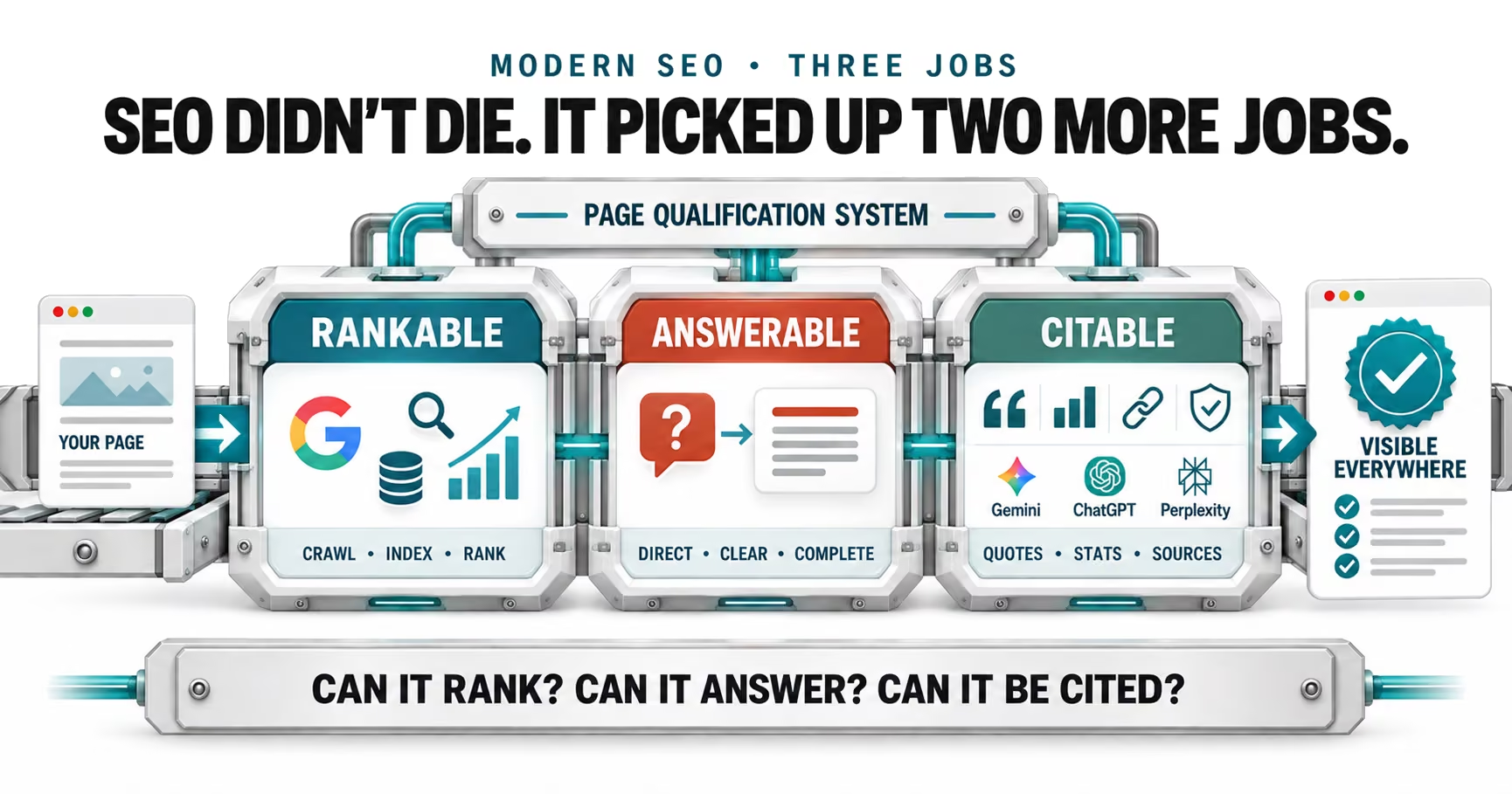
Why the ladder metaphor breaks
Ladders imply order. You do the audit, then keywords, then technical, and somewhere around rung seven you "start doing GEO." That is not how any of this works in practice. A page with a broken canonical tag will not get cited by an AI system no matter how quotable the prose is, because the system never sees it. A page with perfect technical hygiene and vague, unsourced content will rank for a while and get skipped by every answer engine.
- Ladders imply sequence. In practice the three jobs run in parallel on every page, and a failure on the bottom rung silently voids the top ones.
- Several rungs are the same rung. "LLM optimization" and "AI SEO" are labels for the same underlying work as GEO, split in two so the graphic has ten steps.
- Link building at the summit is 2014 thinking. Google's Gary Illyes confirmed in April 2024 that Google needs very few links to rank pages, and Google's documentation was edited that year to call links "a factor" rather than "an important factor."
The other problem is that several rungs on the popular version are not really separate disciplines, and putting link building at the summit, as the final step to "SEO success," reflects the SEO of 2014 more than 2026, per Search Engine Journal's report on the Illyes comments. We have made the longer version of this argument before, in nine funerals for SEO since 1997 and in AEO vs GEO vs SEO.
What the ten items actually describe is three overlapping jobs.
| Ladder rungs | Real job | Test |
|---|---|---|
| 1 to 5: audit, keyword research, technical SEO, on page SEO, content optimization | Being rankable | Can this page rank? |
| 6: AEO | Being the answer | Can this page answer? |
| 7 to 10: GEO, "LLM optimization", "AI SEO", link building | Being citable | Can this page be cited? |
The rest of this piece takes them in that order, because that is the order the evidence supports.
Test one: can this page rank?
This is the old job and it is still the foundation. Nothing about AI search removed the requirement that a page be found, fetched, rendered, indexed and judged relevant. Google's AI features documentation is explicit that AI Overviews and AI Mode draw only from pages that are indexed and eligible for a standard snippet, and that the same controls, from robots.txt to nosnippet and max-snippet, govern what those features can use. If you block Googlebot or noindex a page, you have opted out of AI visibility on Google, not just out of the ten blue links.
The first five rungs of the ladder, audit, keyword research, technical SEO, on page SEO and content optimization, are all in service of this one test. The useful update for 2026 is what "rankable" now has to include. Crawl budget matters more when AI crawlers from OpenAI, Anthropic, Perplexity and others are hitting your server alongside Googlebot. Structured data needs to match the visible content exactly, because Google says mismatched markup is a reason for it to ignore the page's data; we covered where that leaves structured data in AI search. Internal linking is how AI systems and crawlers alike discover which page on your site is the canonical answer to a given question, so a topic buried three clicks deep with no inbound internal links is effectively invisible, which is the case we make in internal linking for SEO and AI visibility.
Keyword research has changed the least in mechanics and the most in purpose. Volume still tells you what people type, but intent clusters now tell you what a conversational query will ask next, and AI Mode turns a single search into a multi step session. Mapping the follow up questions, not just the head term, is what earns a page the second and third citation in a long answer.
Test two: can this page answer?
Answer engine optimization got its name from featured snippets and voice assistants, and its core instruction has survived every interface change since: put the answer before the essay. The Pew data explains why this matters more than ever. With AI summaries appearing on roughly one in five searches in Pew's March 2025 sample and the traditional click rate nearly halving when they do, according to Pew Research Center, a page that makes the reader scroll to find the point loses to a page that states it in the first hundred words.
| Pew Research, March 2025 sample | Traditional link click rate |
|---|---|
| Result page with an AI summary | 8 percent of visits |
| Result page without an AI summary | 15 percent of visits |
| Click on a source inside the summary | 1 percent of visits |
At Silverback we build every article around a self contained summary block at the very top, before the intro, precisely because AI systems lift the earliest complete answer on a page. This article does it. The FAQ answers in the frontmatter of our posts are written to stand alone if extracted. None of that is a trick. It is what a good reference page looked like before AI existed, made non negotiable by the fact that an AI system reading the page has no patience for a scene setting anecdote. The practical playbook is in how to optimize content for Google AI Overviews.
The AEO test for any page is simple. Read only the first paragraph under the main heading. Does it answer the question the page targets, with a specific figure, date or name? If not, the page is asking the reader, and the machine, to do work they will not do.
Test three: can this page be cited?
This is the new job, and it is the one where most sites are weakest, because it asks for something SEO never required before: your page has to be worth quoting.
The best evidence for what "worth quoting" means comes from the GEO paper by Aggarwal and colleagues, accepted at KDD 2024, which tested nine content changes across a 10,000 query benchmark and measured how often each version of a page was used in a generative answer.
| Content change tested | Change in visibility in generative answers |
|---|---|
| Adding quotations from credible sources | Up roughly 40 percent |
| Adding statistics | Up 30 to 40 percent |
| Citing sources | Up about 30 percent |
| Making the writing more fluent and easier to understand | Up 15 to 30 percent |
| Keyword stuffing | Negligible or negative |
The paper's authors also note that the strongest methods vary by domain, so the exact numbers will differ for a law firm and a running shoe brand. The direction does not.
Read those results next to the industry's obsession with new file formats and the gap is obvious. Google's John Mueller said in June 2026 that llms.txt is "purely speculative for now," that the file "has existed for years, yet none of the AI systems use it," as reported by Search Engine Journal, and that the most basic agentic optimization is simply this:
Don't block agents.
Meanwhile the thing that measurably works, adding real statistics with real sources, is the thing most content teams skip because it is slow.
Citability also has a trust layer that no content change can fake. Google's helpful content guidance frames it as three questions: is it self evident who wrote this, is it clear how it was produced, and is it obvious why it exists. That "who, how, why" test is the practical form of E-E-A-T, and it is the same thing an AI system is implicitly evaluating when it decides whether to attribute a claim to your page or to Wikipedia. Pew found Wikipedia, YouTube and Reddit were the most cited sources in AI summaries, and that .gov sites made up 6 percent of AI summary sources versus 2 percent of standard results. The machines already prefer sources with obvious provenance. Bylines, dates, methodology and outbound citations are how a commercial site earns the same treatment, which is why we argued that E-E-A-T matters more in AI search.
This is also where links belong on the ladder: not at the top as the final boss, but inside the trust layer. A link from a publication that references your data is a citation in every sense that matters. A hundred links from directories are noise. The goal was always credibility. The volume game is just over.
Where the money is starting to follow
There is a reason to care about the third test beyond visibility. Reporting on September 17, 2026 confirmed that Google's AI Contribution pilot pays participating publishers when their content meaningfully contributes to an AI generated response in AI Overviews, AI Mode or Gemini, with earnings tracked in a dedicated Google Search Console panel. It is small and early, dozens of publishers rather than thousands, and skewed toward small and mid sized sites. But it is the first time the largest search engine has put a dollar figure on being cited rather than clicked. That does not change the strategy. It confirms it.
The zero click numbers point the same way. SparkToro's Rand Fishkin, analyzing Similarweb clickstream data from January to April 2026, found that only about 32 percent of U.S. Google searches produced any click at all, down from 41 percent in 2024, and that 27 percent of the clicks that did happen went to Alphabet properties such as YouTube, Maps and AI Mode, per Search Engine Journal's coverage of the study. Fishkin flags real caveats: the data excludes Google's mobile app, where zero click behavior is more aggressive, and the panels differ across years. Even with those caveats, the trend is not in dispute. Attention is moving into the answer, and being the source of the answer is the only durable position left.
The one page test
Pick your single most important commercial page, not the homepage, and run the three tests in order.
- Rankability. Open the page in Google Search Console's URL Inspection tool and confirm it is indexed, has no canonical conflict, and returns a rendered version that matches what a user sees. Check that any structured data describes content actually visible on the page. Then look at what links to it internally. If the answer is "the nav and nothing else," that is the first fix.
- Answerability. Read only the first paragraph below the H1. If a stranger could not state what the page is for and what it recommends after that paragraph, rewrite the opening as a direct answer with a specific figure or example, and move the story lower. Then check every H2. Each one should be a question a real person would ask or a claim the section proves.
- Citability. Count the sources. If the page makes claims about outcomes, costs, timelines or performance and links to nothing, add primary sources, real numbers and at least one direct quotation from someone with standing. Put a named author with a bio on it. Add the date. Then read it once more as a skeptical journalist and ask whether you would quote it. If the answer is no, an AI system will reach the same conclusion faster.
Do that for one page this week and you will know which of the three jobs your site is worst at. That is more useful than any ladder, because it tells you where to spend the next month. If you want a second set of eyes on the diagnosis, that is exactly what our SEO and GEO work starts with.
Frequently Asked Questions
Common questions about GEO, SEO, and AI-driven search visibility.
No, but its job description changed. Google still handles the overwhelming majority of searches and AI Mode alone passed 1 billion monthly users in May 2026, so ranking still matters. What changed is that ranking is no longer enough. Pew Research found users click a traditional result on only 8 percent of searches that show an AI summary versus 15 percent without one, so a page now also has to work as a direct answer and as a source AI systems will cite.
SEO (search engine optimization) is the work of getting pages crawled, indexed and ranked in search engines. AEO (answer engine optimization) is structuring content so it can be lifted directly as the answer, in featured snippets, voice results or AI summaries. GEO (generative engine optimization) is making content the kind of source that AI systems such as Google AI Overviews, ChatGPT and Perplexity quote and cite. They overlap heavily: the same clear, well sourced page tends to do all three.
According to Google's own AI features documentation, no. Google states there are no additional requirements to appear in AI Overviews or AI Mode and no special schema.org markup needed. The prerequisites are the same as standard Search: the page must be crawlable, indexable and eligible for a snippet, with structured data that matches the visible content. What helps beyond that is the same thing that helps everywhere: clear, specific, well supported answers.
The best controlled evidence is the GEO paper from Princeton and collaborators, accepted at KDD 2024, which tested nine content changes on a 10,000 query benchmark. Adding quotations improved visibility in generative answers by roughly 40 percent, adding statistics by 30 to 40 percent, and citing sources by about 30 percent. Keyword stuffing had negligible or negative effect. In short, evidence and attribution beat keyword density.
Less than it used to, and Google has said so. In April 2024 Google's Gary Illyes confirmed that Google needs very few links to rank pages, and Google's documentation was edited the same year to describe links as a factor rather than an important factor. Links from sources that reference your work still signal trust to both search engines and AI systems, but volume based link building is a poor use of budget compared to fixing technical and content gaps.
It will not hurt, but do not expect it to do anything yet. Google's John Mueller said in 2026 that llms.txt is purely speculative, that the file has existed for years and no AI system uses it, and that the most basic agentic optimization is simply not blocking AI agents. Spend the time on crawlability, structured data and clear page content first.
Sources
- Pew Research Center: Google users are less likely to click on links when an AI summary appears in the results (opens in a new tab)
- Search Engine Journal: Google Search traffic to open web drops to 23%, data shows (reporting SparkToro and Similarweb data) (opens in a new tab)
- Google: 100 things we announced at Google I/O 2026 (opens in a new tab)
- Google Search Central: AI features and your website (opens in a new tab)
- Google Search Central: Creating helpful, reliable, people-first content (opens in a new tab)
- arXiv: GEO, Generative Engine Optimization (Aggarwal et al., KDD 2024) (opens in a new tab)
- Search Engine Journal: Google confirms links are not that important (opens in a new tab)
- Search Engine Journal: Google says llms.txt is purely speculative for now (opens in a new tab)
- 9to5Google: Google AI contribution pilot tests paying websites when they're used in AI results (opens in a new tab)