





How Internal Linking Supports SEO and AI Visibility
 Preferred source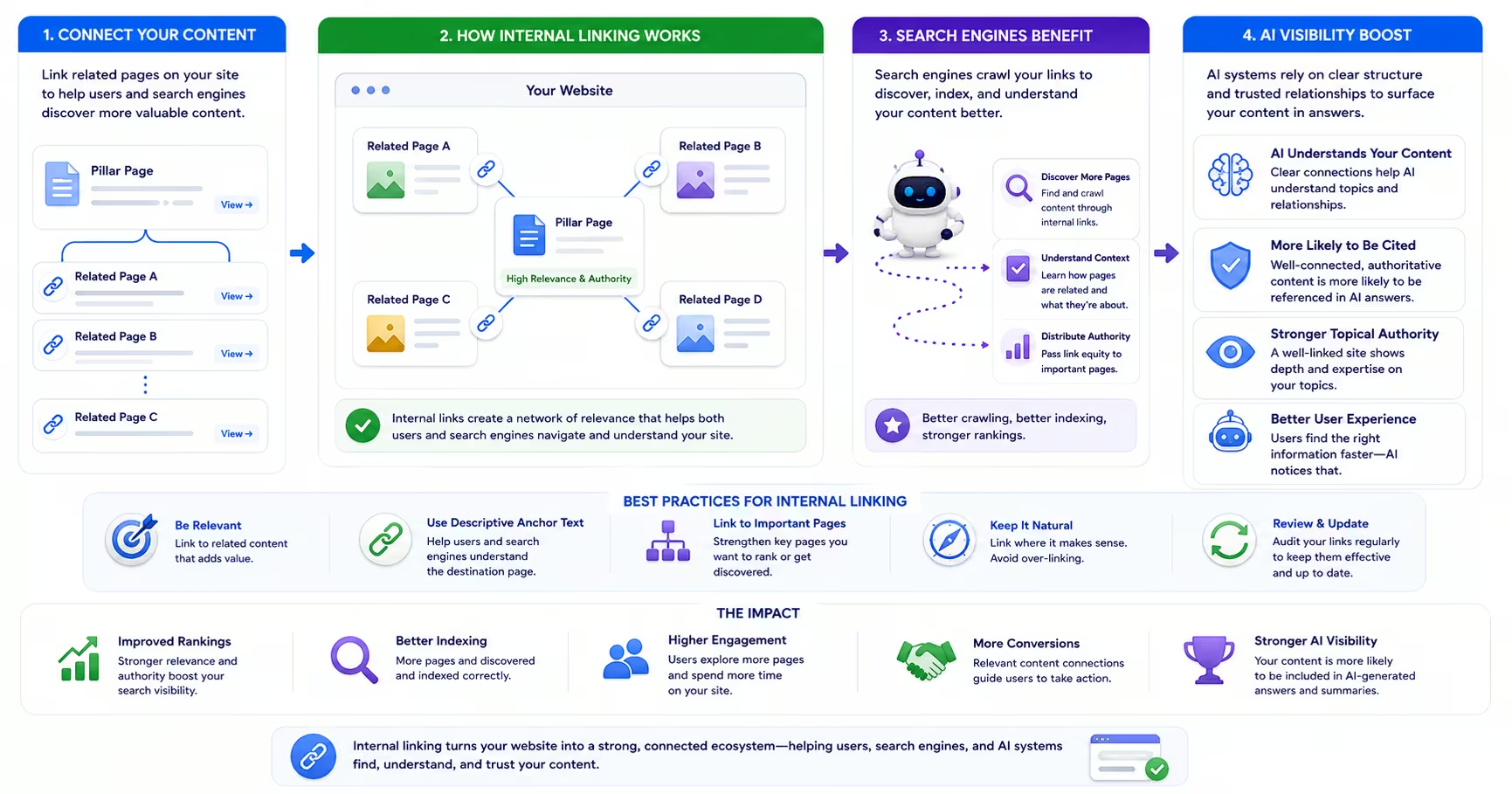
Internal linking is one of the least glamorous activities in digital marketing, and one of the most consistently undervalued. It rarely makes it into strategy decks. It generates no press coverage. It does not have the appeal of a well-crafted content campaign or a sophisticated paid media structure. And yet, internal linking is the architecture through which link equity flows across your site, the map that tells search engines what your site is about and which pages matter most, and increasingly, the signal that AI systems use to determine whether your content represents genuine topical authority.
Most websites treat internal linking reactively: editors add links when they happen to remember a relevant page, and the pattern that emerges is arbitrary rather than strategic. A strategic internal linking program, designed around your site's priority pages and topical clusters, can produce meaningful ranking improvements for existing content with no new page creation, no link building, and no technical changes. It is also one of the most direct levers available for improving your content's probability of being cited in AI-generated answers, something we cover in depth through AI visibility engagements.
How Internal Links Pass Authority
When a page earns an external backlink, that link passes a portion of its authority to the destination page. Internal links work on the same principle: they distribute the authority that has accumulated on your highest-equity pages across the rest of your site. A new piece of content that earns no external backlinks in its first month can still rank better than it otherwise would if high-authority pages on your site link to it contextually.
This is why internal linking strategy should be built around your priority pages, not your navigation structure alone. Your homepage and your most-linked internal pages are your highest-equity nodes. Pages that you want to rank more competitively should receive internal links from those high-equity pages. Pages that you want to deemphasize or eventually remove should receive fewer internal links, which reduces their crawl priority and ranking potential without requiring any meta changes.
Site Architecture and the Three-Click Rule
The practical target for site architecture is to keep all pages you want to rank within three clicks of your homepage. Search engine crawlers allocate their crawl budget based on the depth and internal link signals they encounter as they traverse a site. Pages that are deeply nested and rarely linked to internally receive proportionally fewer crawls, which means they are indexed less frequently and accumulate less crawl-based authority over time.
For growing content sites, this creates a specific maintenance challenge: as the content library expands, older content naturally gets buried deeper in the architecture. A periodic internal linking audit, reviewing which important pages have fallen out of the three-click range and adding shortcut links from high-authority pages directly to deep content, is an efficient way to maintain crawl equity distribution without restructuring the entire site.
Anchor Text Strategy
The text of an internal link, the anchor text, is a signal to search engines about the content and topic of the destination page. Descriptive, varied anchor text that flows naturally within the surrounding content provides useful context signals. Repetitive exact-match keyword anchors on every link to a given page are a manipulation signal that can suppress rather than enhance rankings.
In practice, the best approach is to write anchor text the way you would describe the linked page to a reader who has not seen it: naturally, descriptively, and with enough variation that no single phrase appears on every link to the same destination. If your pillar page on content strategy receives internal links with twelve different anchor text variations, all of which accurately describe what the page covers, that is a strong topical signal. If it receives links where every single anchor says "content strategy," the pattern looks artificial.
Topic Clusters and Pillar Page Architecture
The most effective internal linking architecture for both SEO and AI visibility is a topic cluster model: a pillar page that provides comprehensive coverage of a broad topic, supported by a cluster of more specific pages that address individual subtopics in depth. That structure aligns closely with content strategy built around search intent. Every cluster page links back to the pillar, and the pillar links out to the cluster pages. The network of links between them signals to both search engines and AI systems that your site has deep, organized knowledge on the topic.
Research points the same direction. Zyppy's analysis of AI citation ranking factors scored topic cluster coverage among the strongest predictors of AI citations while rating domain authority far weaker, noting that studies which examined the relationship between domain authority and AI citations often found it weak. This is a striking pattern because it suggests that the structural organization of your content, not just its raw quality or your domain's overall link profile, is what makes AI systems confident in citing you as an authoritative source.
Internal Linking for AI Search Systems
Traditional search engines use internal links primarily as navigation signals, indicators of site structure and page relationships that inform how crawl budget is allocated. AI systems use internal links differently. They read internal link structure as a knowledge graph, a network of related concepts and claims that signals how deeply and coherently a site understands a topic domain. That is one reason GEO and site architecture are tightly linked.
For AI visibility, the implication is to link between content that shares topical relationships, not just pages within the same content category. If your guide on SEO strategy links to your pieces on keyword research, content strategy, technical SEO, and link building, the AI reads those connections as confirmation that you understand SEO holistically rather than in isolated fragments. That coherent network is what earns citation authority in generative answers.
Practical Link Audit Process
A quarterly internal link audit does not need to be elaborate to be effective. The core steps are: run a crawl of your site to identify pages with zero or one inbound internal link, which represent your most underserved content; review your highest-priority pages by organic traffic and ranking potential to confirm they are receiving consistent contextual links from related content; and check that your highest-traffic, highest-equity pages are linking outward to the cluster content they should be supporting. Our SEO & GEO audit checklist gives you a shared template if you want to run that review with other teams.
The output is a prioritized list of linking opportunities: specific page pairs where adding or improving an internal link would benefit either the linking page's topical authority signal or the destination page's equity. Implementing twenty high-quality contextual link additions across a site each quarter is a manageable workload that produces compounding structural improvements over time.
Frequently Asked Questions
Common questions about GEO, SEO, and AI-driven search visibility.
A practical guideline is two to five contextual internal links per 1,000 words of body content, which keeps links frequent enough to support navigation and equity flow without turning paragraphs into link farms. Total page link count, including navigation, footer, and body links, should generally stay under 150, because equity divides across every link on the page and hundreds of links leave each one passing very little. Treat these as guardrails rather than quotas: the right question for any individual link is whether a reader at that point in the content would benefit from the destination. Quality and relevance beat raw quantity every time, and one well-placed link from a strong, topically related page does more for a target page than a dozen links stamped into templates. When auditing, look for both extremes: orphaned pages starving for links and bloated pages diluting everything they touch.
Internal links themselves do not directly affect Core Web Vitals scores, so link work and performance work are largely separate disciplines, but there are two indirect connections worth understanding. First, poor internal link architecture affects crawl efficiency and authority distribution, which influences rankings through entirely different mechanisms than page experience; a fast page that nothing links to still underperforms. Second, extreme link counts can carry a small performance cost: hundreds of anchor elements add DOM nodes, and oversized mega-menus rendered on every page contribute to the DOM bloat that slows parsing and interaction on lower-powered devices. In practice, a page would need pathological link volume before Core Web Vitals noticed. The reason to keep link counts disciplined is equity concentration and usability rather than speed, and the reason to keep performance healthy is that both signals feed the same rankings your linking strategy is trying to lift.
Yes, and making it systematic is one of the cheapest wins in content operations. When you publish something new, review your existing library for pages covering related topics and add contextual links from those pages to the new publication. This does two jobs at once: it immediately passes internal equity from established, already -indexed pages to the newcomer, and it signals to crawlers that the new page belongs to an existing topic cluster rather than standing as an isolated addition. Older pages with strong organic performance are the most valuable sources, since they have the most authority to share and the most consistent crawl attention. The efficient way to find candidates is a site search for your new page's topic terms across your own domain, which surfaces every natural mention that could become a link. Teams that fold this into their publishing checklist consistently see new content index and rank faster than teams that publish and move on.
Yes, though the damage usually arrives as dilution rather than penalty. Manipulative patterns such as stuffing exact-match anchor text across templated links, linking to irrelevant pages for equity reasons, or wiring up circular link schemes send signals that search engines discount, and at scale they degrade trust in the site's link graph overall. More common than manipulation is unintentional harm: footer link blocks pointing at every page equally, which flattens the hierarchy your linking should express, or orphan sections that accumulate because nobody owns link maintenance. The standard to apply is refreshingly simple: would this link help a reader at this point navigate to useful related content? If yes, add it, with anchor text that honestly describes the destination. If the only reason for the link is passing equity, reconsider, because links that exist purely for search engines are precisely the pattern those engines have spent two decades learning to ignore.
Run a full crawl of your site with a tool like Screaming Frog and sort by inbound internal link count, which immediately surfaces the pages your architecture is neglecting, including true orphans that only the sitemap knows about. The list becomes actionable when you cross-reference it against performance data: pull organic impressions and rankings from Search Console and look for pages that show search potential, such as ranking positions six through twenty, while sitting near the bottom of your internal link distribution. Those undersupported, high-potential pages are your priority targets, because internal links are one of the few levers that can move them without new content or new backlinks. Then work the other direction: identify your strongest pages by authority and traffic and audit what they currently link to, since those pages are your distribution engines. Repeating this exercise quarterly keeps link equity flowing toward what matters now rather than what mattered when the site launched.
Yes, meaningfully. Links placed in the main body content carry more weight than links in navigation menus, sidebars, or footers, because search engines treat editorial placement as a stronger endorsement than templated placement. The most valuable pattern is the contextual link: an anchor surrounded by relevant text that describes the destination, sitting inside a passage about the destination's topic, which gives both users and crawlers rich information about the relationship between the two pages. Position within the body matters at the margins too, with links higher in the content generally crawled and weighted more reliably than links buried at the bottom of long pages. The anti-pattern is the footer that links to every page on the site: it feels thorough, but it distributes equity so thinly and so uniformly that it expresses no hierarchy at all, which wastes the one thing internal linking is uniquely positioned to communicate.
They answer different questions and neither substitutes for the other. Your XML sitemap tells search engines which pages exist and when they changed; it is a discovery mechanism, a complete and neutral inventory. Your internal linking tells them which pages matter, how much, and how they relate to each other; it is a priority mechanism, deliberately unequal by design. A page that exists only in the sitemap will usually get discovered and may get indexed, but with no internal links vouching for it, it enters the index as an orphan with minimal authority and inconsistent crawl attention. The reverse gap is smaller but real: solid internal linking without a clean sitemap slows discovery of new and updated pages. Use both, and use their disagreement as an audit signal. Any URL present in the sitemap but absent from the link graph is a page you have published without actually supporting.