



Content Strategy Built Around Search Intent
 Preferred source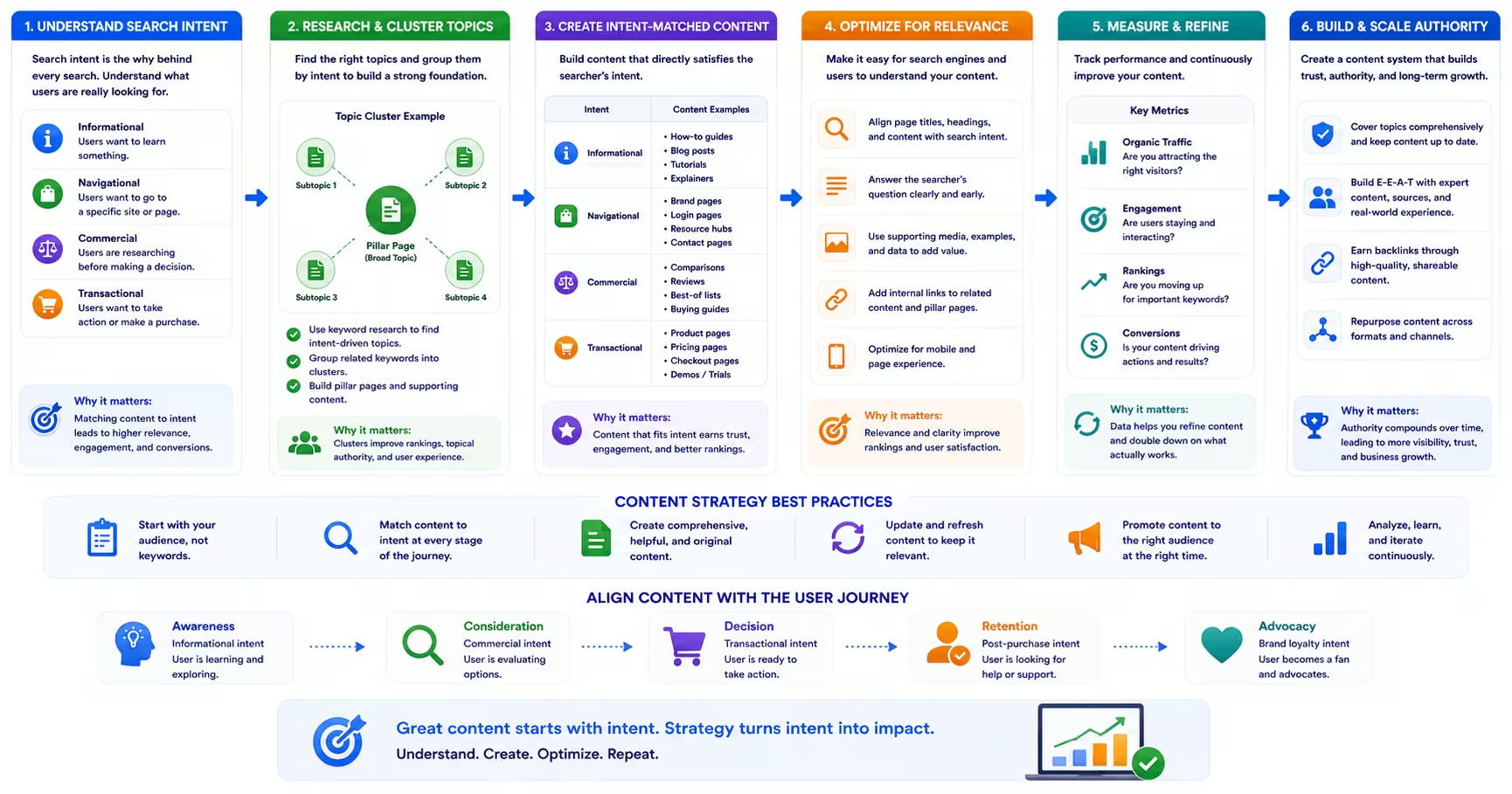
Most content strategies start in the wrong place. They begin with a list of topics the marketing team wants to cover, or a spreadsheet of keywords sorted by monthly search volume, and work outward from there. Content gets written, published, and then measured against traffic goals that have no clear connection to why users were searching in the first place. When the content underperforms, the diagnosis is usually "we need better content," when the real problem is that the content was solving the wrong problem.
Search intent is the actual goal behind a query. It is not the keyword; it is the reason the person typed that keyword into the search bar. Google's ranking systems are now deeply intertwined with intent detection, and content that accurately matches intent consistently outranks content that merely contains the right keywords. Building your content strategy around intent rather than keywords is not a semantic distinction. It is the practical difference between content that earns sustainable rankings and content that struggles to perform regardless of how well it is written. Content strategy at Silverback is built on this intent-first model.
The Four Types of Search Intent
Search intent falls into four primary categories, and understanding which category a query belongs to is the starting point for every content decision. Informational intent covers queries where the user wants to learn something. "What is content marketing?" or "how does schema markup work?" are informational queries. The user is not ready to buy. They are researching, and the content that serves them well at this stage builds the brand awareness and trust that eventually converts to pipeline.
Navigational intent covers queries where the user is trying to reach a specific destination, like searching for a brand name to find its website. Commercial intent covers queries where the user is comparing options before making a decision, such as "best SEO agency for B2B companies." Transactional intent covers queries where the user is ready to take action: "hire an SEO agency," "request a quote," or "buy enterprise marketing software." Each intent type calls for a different content format, different metrics of success, and a different role in the overall funnel.
Why Intent Alignment Outranks Keyword Matching
Google's documentation on how it evaluates content quality makes intent alignment explicit. The search system is designed to identify what users want to accomplish and to surface content that helps them accomplish it, not content that simply repeats the query phrase most often. This is why a page that ranks for "how to reduce customer churn" is likely a guide with practical steps and examples, not a product page for customer retention software, even if both pages target the same keyword.
When your content format mismatches the dominant intent for a query, you are fighting the algorithm. A transactional landing page cannot rank for an informational query no matter how well optimized it is, because Google has determined that users searching that query want education, not a product pitch. Conversely, an educational blog post will struggle to rank for a query where users are clearly ready to purchase, because the format does not serve their intent. The format of the top-ranking results for any query is a reliable signal of what intent Google has identified.
Mapping Intent to Funnel Stage and Content Format
The practical application of intent research is mapping each priority query to the appropriate funnel stage, content format, and success metric before any writing begins. Informational queries at the top of the funnel call for guides, explainers, comparison articles, and how-to content. The success metric is engagement: time on page, pages per session, and return visits that indicate the content is building relationship with an audience over time.
Commercial intent queries in the middle of the funnel call for in-depth comparisons, case studies, and solution-focused content that addresses specific objections and differentiators. The success metric is qualified traffic: users who match your target customer profile and are spending time with decision-stage content. Transactional queries at the bottom of the funnel call for conversion-optimized landing pages with clear value propositions and low-friction CTAs. The success metric is conversion rate and cost per acquisition.
Building a content calendar with intent as the primary organizing principle produces a more balanced, strategically sound content mix than a keyword-volume-only approach. It ensures that every piece of content has a defined role in the customer journey, a measurable success criterion aligned to that role, and a content format that matches what Google has determined users want.
Using SERP Analysis to Confirm Intent
The fastest way to confirm the intent behind a query before investing in content is to analyze the search results for that query manually. The format of the top-ranking results is Google's best guess at what users want, built from billions of clicks and engagement signals. If the top five results are all listicles with numbered tips, a long-form narrative guide will struggle to compete regardless of its quality. If the top results are all video how-tos, a text-only page faces a format disadvantage from the start.
This does not mean you should simply replicate what ranks. It means you should match the intent format while differentiating on depth, accuracy, or originality. The combination of format alignment and content differentiation is what earns sustainable rankings rather than short-lived traffic spikes from novelty.
Intent Research for AI-Powered Search
AI-generated answers in Google AI Overviews are almost exclusively triggered by informational queries. This makes your top-of-funnel, intent-aligned informational content doubly important: it serves as the primary visibility driver for AI search while also building the brand authority that supports commercial and transactional conversions downstream. A content strategy that neglects informational intent produces a thin AI search footprint regardless of how strong the transactional content is.
When auditing existing content for intent alignment, prioritize pages that receive high impressions in Google Search Console but generate low clicks. These pages are generating awareness but failing to convert searchers because the content format or value proposition does not match what the user actually wanted. An intent audit of these underperforming pages, followed by targeted rewrites to match the confirmed intent, is frequently the highest-ROI content investment available to sites with an existing content library.
Frequently Asked Questions
Common questions about GEO, SEO, and AI-driven search visibility.
The most reliable method is manual SERP analysis: search the keyword in a logged-out browser and read what Google chose to rank. The pattern in the results is Google's best available signal of the dominant intent, earned from billions of user interactions. Look at three things specifically. Format tells you what satisfies the query: guides, product pages, comparison lists, or videos. Page type tells you who wins: blogs, vendors, marketplaces, or forums. And SERP features tell you how the intent is being served: an AI Overview or featured snippet signals informational intent, shopping results signal transactional, and a local pack signals location-driven behavior. Keyword research tools also provide intent classifications, and they are useful for sorting large lists quickly, but their labels are inferred rather than observed. Always verify with a live SERP check before committing a content brief, because a mislabeled intent costs you the entire production cycle.
Pages that try to serve multiple conflicting intent types tend to serve none of them well. A page that simultaneously attempts to educate (informational), compare (commercial), and convert (transactional) usually underperforms in all three dimensions, because each intent demands a different structure, depth, and call to action, and the compromises show. Search engines also struggle to classify hybrid pages, which means they rank inconsistently for everything they touch. The exception worth knowing is adjacent intents: a commercial comparison page can carry a soft transactional element, such as a trial offer, because evaluation and purchase sit next to each other in the journey. The better architecture for conflicting intents is separate, intent-specific pages connected with clear [internal links](/internal-linking-seo-ai-visibility) that guide users through the funnel, so each page can be the best possible answer for its one job while the cluster captures the whole journey.
A quarterly intent audit is a practical cadence for most content programs: frequent enough to catch drift before it compounds, light enough to sustain alongside production. Focus each pass on your highest-impression, lowest-performing pages in Search Console, because pages that earn visibility without earning clicks are the clearest symptom of an intent mismatch; Google believes the page is relevant, but the format is not what searchers want when they arrive at the results. For each candidate page, re-run the live SERP for its primary query and compare what ranks now against what your page is. If the results have shifted from articles to product pages, or a new AI Overview now absorbs the simple version of the question, the page needs restructuring rather than more optimization of its current form. Between quarterly passes, an alert on significant CTR drops for priority pages catches the urgent cases early.
Yes, and treating intent as fixed is one of the quieter ways content strategies age badly. Intent for a given query shifts as user behavior evolves, as markets mature, and as new formats emerge. A query that was informational when a category was new often turns commercial as buyers learn the space and start comparing vendors, and seasonal queries can flip intent entirely depending on where the buying cycle sits. Platform changes move intent too: the rise of AI Overviews has already changed how users interact with informational results, with simple questions increasingly answered on the results page while the clicks that remain carry deeper, more specific intent. The practical response is monitoring rather than prediction. Re-check the live SERP for your priority queries quarterly, watch for format changes in what ranks, and treat a shift in the results page as an early instruction about what your content needs to become next.
Absolutely, and arguably more so than in B2C. B2B buyers run longer, more deliberate research processes, often involving multiple stakeholders who each search differently: a practitioner researching how to solve a problem, a manager comparing vendors, and an executive validating a shortlisted choice are all touching search on the same deal. That makes intent mapping the connective tissue of a B2B content strategy. Understanding which queries reflect early problem research versus active vendor evaluation versus purchase readiness lets a content team build for each stage deliberately: educational depth for the practitioner, honest comparison content for the evaluator, and proof, pricing clarity, and implementation answers for the buyer close to a decision. The compounding benefit is qualification. Content matched to late-stage intent attracts fewer visitors but produces conversations sales actually wants, which is the outcome the whole program is funded to deliver.
Manual SERP analysis remains the most reliable starting point, because you are reading Google's actual behavior rather than a model of it. Layer tools on top for scale. Mainstream keyword research platforms such as Semrush and Ahrefs include intent classifications that make sorting thousands of keywords practical, as long as you spot-check their labels against live results before acting on them. Google's own surfaces are underrated intent instruments: People Also Ask boxes reveal the question chains adjacent to your target query, related searches expose how users reformulate, and autocomplete shows the directions demand actually flows. Search Console adds your own evidence, since the queries a page earns impressions for tell you what intent Google currently assigns it. For teams doing this at scale, exporting SERP features by keyword turns intent from an opinion into a dataset you can prioritize against.
Intent alignment is a prerequisite for conversion rate optimization, not a parallel track. A page that attracts users with informational intent but is designed to convert them immediately will produce weak conversion rates no matter how well the CTA is designed, the form is shortened, or the button color is tested, because the visitors were never at the deciding stage. Running CRO experiments on an intent-mismatched page optimizes the wrong variable and usually produces flat, confusing test results. Matching intent means presenting the right next step for the stage: an informational page converts best toward a guide, a tool, or a subscription; a commercial comparison page converts toward a demo or consultation; a transactional page can ask for the sale directly. Fix the intent-to-offer match first, then let CRO refine the execution. Sequenced that way, testing compounds gains instead of fighting the traffic.