





AEO vs GEO vs SEO: What Actually Changes, and What Doesn't
 Preferred source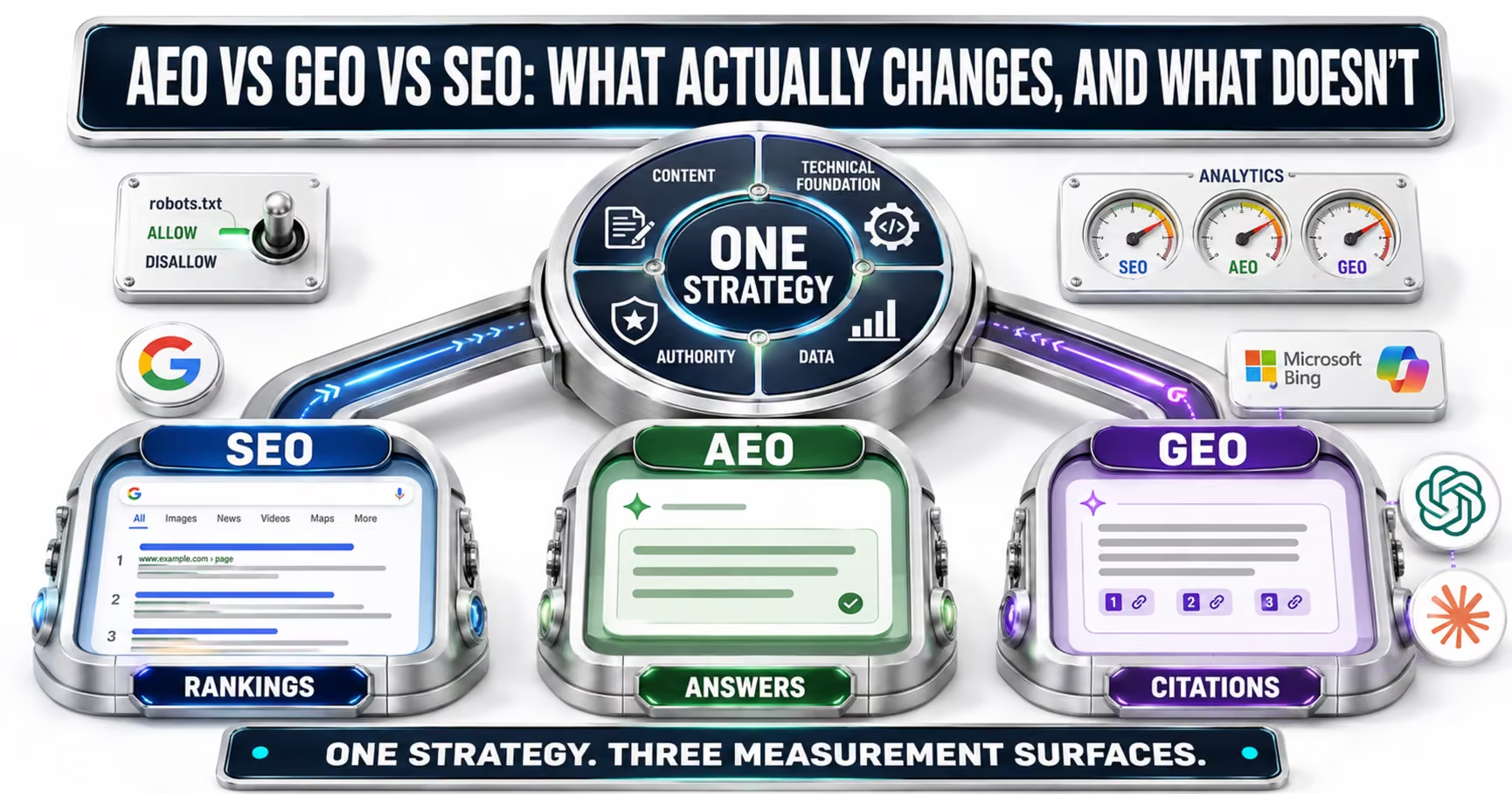
Two engines, two answers, four months apart
If you have sat in a meeting where someone asked whether the company needs a GEO strategy on top of its SEO strategy, you already know the conversation goes nowhere. Half the room thinks it is a rebrand invented to sell retainers. The other half has seen ChatGPT recommend a competitor and wants someone to fix it by Friday.
Both instincts are defensible, which is why the argument never resolves. What is new is that the two largest players have now put their positions in writing, and the positions do not match.
That disagreement is more useful than either answer on its own. It tells you the question is badly formed. "Is GEO different from SEO?" has no single answer because it depends entirely on which engine you mean, and increasingly, which layer of the work you mean.
What each acronym actually means
| Term | What you are optimizing for | Unit of success | Where it came from |
|---|---|---|---|
| SEO | Visibility in the set of results an engine returns | A position in a list | The oldest and broadest discipline |
| AEO | Being the answer a system returns, not one option among ten | The answer, not a result | Featured snippets, position zero, voice search |
| GEO | Being cited inside an AI-generated response | A citation in a synthesized answer | A 2023 Princeton and IIT Delhi paper, accepted to KDD 2024 |
SEO is the oldest and the broadest: earning visibility in a set of results a search engine returns. The unit of success is a position in a list.
AEO, answer engine optimization, is not new either, whatever the current marketing suggests. Its lineage runs directly through featured snippets, the "position zero" chase, and voice search. The unit of success shifts from being a result to being the answer. Anyone who spent 2017 restructuring pages so a definition sat in a clean 40-word paragraph under an H2 was doing AEO before the acronym existed.
GEO, generative engine optimization, has a precise origin that is worth knowing because it is routinely misquoted. The term comes from a 2023 paper by Aggarwal, Murahari, Rajpurohit, Kalyan, Narasimhan and Deshpande, later accepted to KDD 2024. The authors framed the problem honestly: generative engines are black boxes, and "content creators have little to no control over when and how their content is displayed."
The paper's headline finding, that GEO methods "can boost visibility by up to 40%," is the single most abused statistic in this field. Read the abstract carefully. Forty percent is an upper bound, not an average. It was measured on GEO-bench, a purpose-built benchmark, not on live Google. And the authors' own conclusion undercuts any universal playbook: "the efficacy of these strategies varies across domains, underscoring the need for domain-specific optimization methods." Anyone quoting the 40% figure without those three qualifications is selling something.
Google's position is that it is all still SEO
Google published its generative AI optimization guide in May 2026 and has kept it current. It is the most direct statement any engine has made on this question, and it addresses AEO and GEO by name:
From Google Search's perspective, optimizing for generative AI search is optimizing for the search experience, and thus still SEO.
The mechanical reason follows in the same document. Google's AI features run on two techniques layered on the existing index. Retrieval-augmented generation, which Google also calls grounding, "relies on our core Search ranking systems to retrieve relevant, up-to-date web pages from our Search index." Query fan-out generates concurrent related queries to gather more results. Google's worked example: a user asking how to fix a lawn full of weeds triggers fan-out queries like "best herbicides for lawns" and "remove weeds without chemicals."
If retrieval runs on the Search index, then whatever gets you into the Search index is your AI strategy. Google states the eligibility rule explicitly: to appear in generative AI features, a page must be indexed and eligible to be shown in Google Search with a snippet, and the site must not have opted out via the Search generative AI features control in Search Console. We covered that control, including the inheritance trap that can silently exclude a subdomain, when Google published its AI search playbook.
Google also points site owners evaluating GEO vendors toward its guidance on third-party SEO tools and advice, which warns that third-party tools have no access to Google's internal ranking data and cannot guarantee performance. That is not subtle.
The mythbusting section every GEO pitch should have to survive
Google's guide includes a section titled "what you don't need to do." It is worth reading against any GEO proposal on your desk.
- llms.txt and similar files. "You don't need to create new machine readable files, AI text files, markup, or Markdown to appear in Google Search (including its generative AI capabilities), as Google Search itself doesn't use them." Maintaining one for other systems "will neither harm nor help your site's visibility or rankings in Google Search."
- Chunking. "There's no requirement to break your content into tiny pieces for AI to better understand it." Google says its systems handle multiple topics on a page and surface the relevant part.
- Writing for machines. "You don't need to write in a specific way just for generative AI search." Models handle synonyms and intent, so exhaustive long-tail variants are not required.
- Manufactured mentions. Google acknowledges its AI features surface what is said about brands across the web, then warns that "seeking inauthentic 'mentions' across the web isn't as helpful as it might seem."
- Special schema. "Structured data isn't required for generative AI search, and there's no special schema.org markup you need to add." Google still recommends keeping it for rich result eligibility.
The field data on llms.txt is unflattering too. Common Crawl analyzed 584,107 llms.txt files in its July 2026 crawl and found roughly two thirds were generated by a plugin, only about half followed the structure the specification actually defines, and a few contained prompt injections. A standard that mostly gets installed rather than authored, and that half of adopters implement incorrectly, is not yet a standard.
One caution worth flagging: Google is describing Google. Microsoft's guidance in the same period is softer on structure, advising that clear headings, tables, and FAQ sections "help surface key information and make content easier for AI systems to reference accurately." These are not contradictory so much as differently weighted. Structured, well-organized content was already good practice for readers. It just does not need a machine-only version. The wider point, that Google's advice describes one reader among several, is the whole argument of why Google's AI advice does not travel.
Where the three part ways in practice
Now the useful part. Three real divergences exist, and none of them are content tactics.
Crawler permissions are per-engine and not interchangeable
This is the most concrete difference, and it is the one most often skipped. OpenAI documents four user agents with distinct jobs. OAI-SearchBot governs whether you surface in ChatGPT's search features, and OpenAI is blunt about the consequence: "Sites that are opted out of OAI-SearchBot will not be shown in ChatGPT search answers, though can still appear as navigational links." GPTBot governs training. ChatGPT-User handles user-initiated fetches, and OpenAI notes that "because these actions are initiated by a user, robots.txt rules may not apply," and that it "is not used to determine whether content may appear in Search." OAI-AdsBot only visits pages submitted as ads. OpenAI also notes it can take roughly 24 hours for a robots.txt change to propagate to its search systems.
Anthropic separates its crawlers the same way: ClaudeBot for training data, Claude-User for content fetched at a user's direction. Anthropic also warns that IP blocking is not a reliable opt-out because it prevents robots.txt from being read, and that it does not publish IP ranges.
The practical upshot: "block AI crawlers" is not a coherent instruction. Blocking a training crawler is a licensing and IP decision. Blocking a search crawler is a visibility decision that removes you from an answer surface. Plenty of sites have made the second choice by accident while intending the first.
Measurement is per-engine and non-comparable
Google's generative AI performance report in Search Console gives impressions in AI features, the URLs that appeared, countries, devices, and date granularity. It does not give clicks and it does not give queries.
Bing's AI Performance gives almost the inverse emphasis: total citations, average cited pages per day, page-level citation counts, and grounding queries, described as "the key phrases the AI used when retrieving content that was referenced in AI-generated answers." Microsoft notes the grounding query data is a sample.
| Report | What it gives you | What it leaves out |
|---|---|---|
| Google Search Console | Impressions in AI features, the URLs that appeared, countries, devices, hourly to monthly dates | Clicks and queries |
| Bing Webmaster Tools | Total citations, average cited pages per day, page-level citation counts, sampled grounding queries | A comparable impression count |
You cannot add these together. One counts impressions without queries, the other counts citations with sampled queries. Any dashboard presenting a single blended AI visibility score is manufacturing a number that does not exist. Track them as separate surfaces with separate baselines, the same way you would never blend paid and organic into one number and call it traffic.
The economics changed even where the tactics did not
This is the divergence that actually justifies giving the work its own line in a plan.
Pew Research Center found that users who landed on a Google results page with an AI summary clicked a result 8% of the time, versus 15% without one, based on browsing data from 900 US adults in March 2025. Sessions ended entirely on 26% of pages with an AI summary, compared with 16% without. We covered what that does to the old keywords-to-clicks staircase in the straight line to number one is gone.
Cloudflare's 2026 report puts numbers on the supply side. More than 50% of internet traffic is now non-human. As of June 2026, 52% of crawler requests are for AI training, up from 22% in spring 2025. Mixed-use crawlers, which blend search, agent use, and training, account for over 36% of activity, which makes the clean training-versus-discovery distinction above harder to act on than it looks. Cloudflare also reports that some of the most heavily crawled categories have seen human traffic decline as much as 40% in under a year, and that Google still accounts for roughly 88% of referral traffic. Its earlier work introduced the crawl-to-refer ratio, which measures how much a platform crawls relative to how much traffic it sends back.
Nothing in Google's mythbusting list is wrong. It is just answering a narrower question than the one a CMO is asking. "Do I need different content?" is mostly no. "Does the same content now produce fewer visits per unit of visibility?" is measurably yes.
What this means for how you run the work
Treat it as one discipline with three reporting surfaces and one new operational layer.
The content and technical work is shared. Google's advice to create non-commodity content with a first-hand point of view is the same advice that makes a page worth citing in ChatGPT. Google's example of the distinction is unusually concrete: "7 Tips for First-Time Homebuyers" is commodity content anyone could have written, while "Why We Waived the Inspection and Saved Money: A Look Inside the Sewer Line" is not. A model summarizing five interchangeable pages has no reason to name any of them. Note also that mass-producing pages for every query variant runs into Google's scaled content abuse policy, so the volume approach is both ineffective and risky.
What is additive is operational, not editorial: an audited robots.txt where every AI user agent is an explicit, intentional decision; separate baselines in Search Console and Bing Webmaster Tools; IndexNow for freshness on surfaces that reward it; and, for ecommerce, feed submission, since AI shopping surfaces increasingly gate on structured product data rather than page content.
One further layer is arriving. Google's guide now includes a section on agentic experiences, noting that browser agents may access your site by "analyzing visual renderings (like screenshots), inspecting the DOM structure, and interpreting the accessibility tree," and pointing to agent-friendly site best practices and emerging protocols like the Universal Commerce Protocol. If an agent completes a task on your site, the accessibility tree stops being a compliance checkbox and becomes an interface. That is a real change, and notably it is a build concern rather than a content one.
If you want help pressure-testing where you actually stand across these surfaces, that is the shape of our SEO and GEO work.
What to actually change
- Stop budgeting AEO and GEO as separate line items with separate vendors. You will pay twice for the same content and technical work, and Google's own third-party guidance is a reasonable script for the conversation with anyone selling you the second one.
- Audit your robots.txt this month, one AI user agent at a time. Write down, per bot, whether you are making a training decision or a visibility decision. Most teams discover at least one accidental setting, and the
OAI-SearchBotcase is the expensive one because it silently removes you from ChatGPT search answers. - Take two baselines rather than one. Pull the generative AI performance report in Search Console and the AI Performance report in Bing Webmaster Tools, save them separately, and resist every temptation to average them. Bing's grounding queries are the closest thing anyone currently offers to keyword data for AI answers, which makes them worth more attention than Bing's traditional search share would suggest.
- Judge content by a harder standard than you used to. The question is no longer whether a page can rank. It is whether a model summarizing your topic has any reason to name you specifically. First-hand experience, original data, and a real point of view are the only things that survive summarization, because they are the only things a model cannot reconstruct from the other nine results.
- Set expectations honestly upstairs. Visibility and visits have decoupled. Pew's 8% versus 15% gap is not a measurement artifact, and Cloudflare's crawl data suggests the pattern is structural rather than temporary. A plan promising that GEO will restore 2019 click volumes is not a plan. A plan that grows cited, branded presence while the click rate compresses is one you can actually deliver.
Frequently Asked Questions
Common questions about GEO, SEO, and AI-driven search visibility.
SEO is optimizing to rank in a set of search results. AEO, or answer engine optimization, is optimizing to be the single answer a system returns rather than one option in a list, a lineage that runs through featured snippets and voice search. GEO, or generative engine optimization, is a term introduced in a 2023 academic paper by Aggarwal and colleagues at Princeton and IIT Delhi, later accepted to KDD 2024, describing how to improve a source's visibility inside AI-generated responses. In practice all three depend on the same underlying step: your page has to be retrieved before it can be ranked, quoted, or cited.
No. In its official guide to optimizing for generative AI features, last updated on July 10, 2026, Google states that from Google Search's perspective, optimizing for generative AI search is optimizing for the search experience, and thus still SEO. Google explains that AI Overviews and AI Mode are grounded in its core Search ranking systems using retrieval-augmented generation and query fan-out. Google also directs site owners considering third-party AEO or GEO services to its guidance on evaluating third-party SEO advice.
Not for Google. Google's generative AI optimization guide states plainly that you do not need to create machine readable files, AI text files, markup, or Markdown to appear in Google Search including its generative AI capabilities, because Google Search itself does not use them, and that maintaining such files will neither harm nor help your visibility or rankings in Google Search. Common Crawl analyzed 584,107 llms.txt files in its July 2026 crawl and found roughly two thirds were generated by a plugin, only about half followed the structure the specification defines, and a small number contained prompt injections.
Google says no. Its generative AI optimization guide lists overfocusing on structured data among the things you can ignore, stating that structured data is not required for generative AI search and there is no special schema.org markup you need to add. Google still recommends keeping structured data as part of overall SEO because it makes you eligible for rich results. Microsoft takes a softer position, advising in its February 2026 Bing Webmaster Tools announcement that clear headings, tables, and FAQ sections help surface key information and make content easier for AI systems to reference accurately.
Use each engine's own reporting, because no single tool covers all of them. Google's generative AI performance report in Search Console shows impressions in AI features, which pages appeared, countries and devices, but it does not include click data or query data. Bing Webmaster Tools launched AI Performance in public preview on February 10, 2026, and it reports total citations, average cited pages, page-level citation counts, and grounding queries. The two are not comparable, so track them separately rather than blending them into one AI visibility number.
It depends on which crawler, because the opt-outs are not interchangeable. OpenAI documents separate user agents with separate purposes: OAI-SearchBot controls whether you appear in ChatGPT search answers, GPTBot controls whether your content is used to train foundation models, and ChatGPT-User handles user-initiated fetches and is not used to decide Search appearance. Anthropic similarly separates ClaudeBot for training from Claude-User for user-directed retrieval. Blocking a training crawler is a licensing decision. Blocking a search crawler is a visibility decision, and OpenAI notes that sites opted out of OAI-SearchBot will not be shown in ChatGPT search answers.
Sources
- Google Search Central: Optimizing your website for generative AI features on Google Search (opens in a new tab)
- Google Search Central: A new resource for optimizing for generative AI in Google Search (opens in a new tab)
- Google Search Central: AI features and your website (opens in a new tab)
- Google Search Central: Guidance on third-party SEO tools and advice (opens in a new tab)
- Google Search Central: Featured snippets and your website (opens in a new tab)
- Google Search Central: Creating helpful, reliable, people-first content (opens in a new tab)
- Google Search Central: Spam policies for Google web search (opens in a new tab)
- Google Search Central: Introduction to structured data markup (opens in a new tab)
- Google Search Console Help: Generative AI performance report (opens in a new tab)
- Google Search Console Help: Manage inclusion in Search generative AI features (opens in a new tab)
- arXiv: GEO, Generative Engine Optimization (Aggarwal et al., KDD 2024) (opens in a new tab)
- OpenAI: Overview of OpenAI crawlers (opens in a new tab)
- Anthropic: Does Anthropic crawl data from the web, and how can site owners block the crawler? (opens in a new tab)
- Bing Webmaster Blog: Introducing AI Performance in Bing Webmaster Tools public preview (opens in a new tab)
- IndexNow: Instantly index your content (opens in a new tab)
- Pew Research Center: Google users are less likely to click on links when an AI summary appears in the results (opens in a new tab)
- Cloudflare: Content Independence Day, one year on, building the business model for the agentic Internet (opens in a new tab)
- Cloudflare: The crawl before the fall of referrals, understanding AI's impact on content providers (opens in a new tab)
- Common Crawl: A content analysis of llms.txt files from the July 2026 crawl archive (opens in a new tab)
- web.dev: Agent-friendly website best practices (opens in a new tab)
- Universal Commerce Protocol documentation (opens in a new tab)