





AI Overviews in 2026: Bigger, Smarter, and Now Paying Publishers
 Preferred source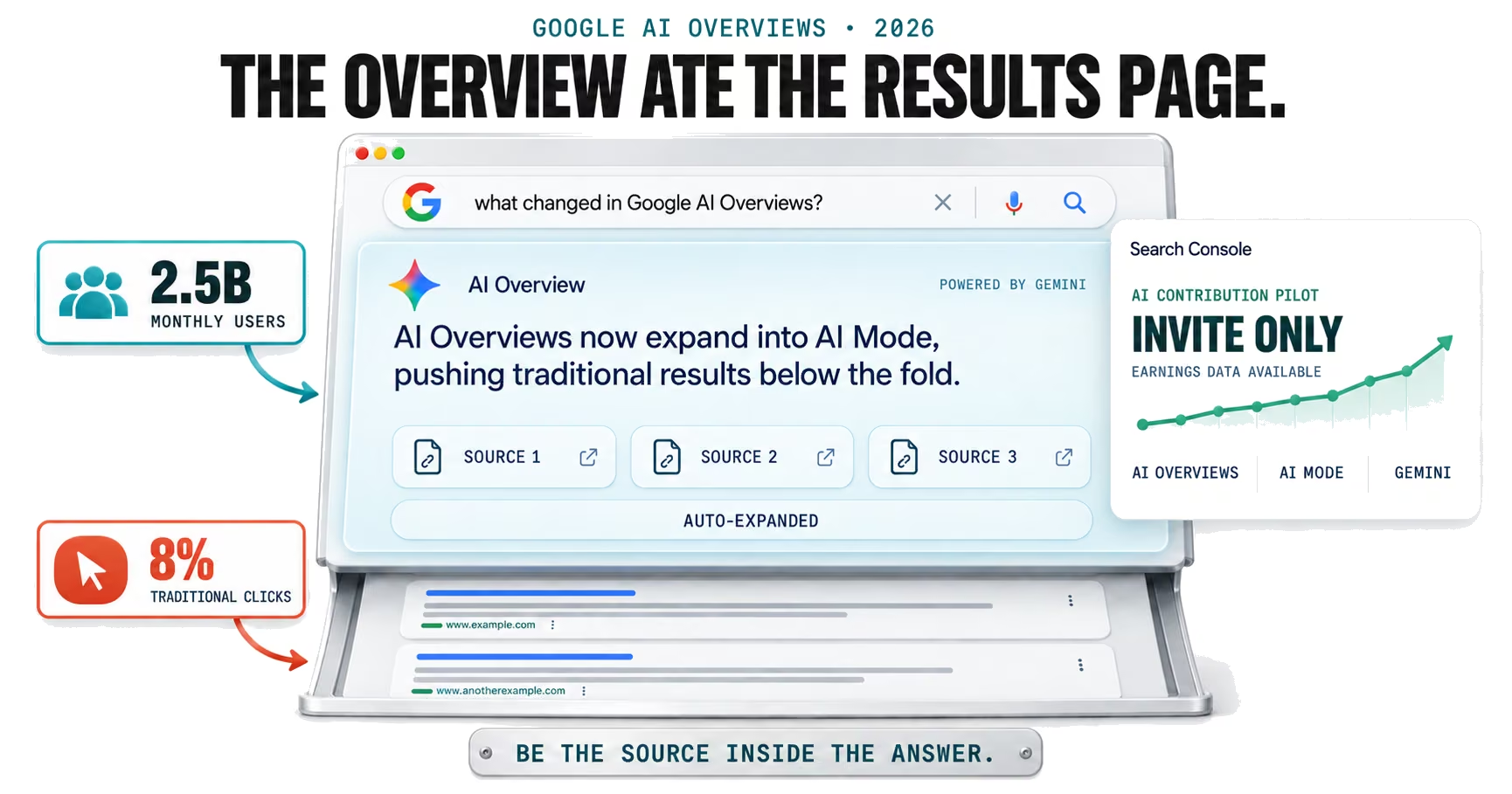
Why this year was different
AI Overviews launched in May 2024 as a box at the top of some results. For most of 2025 the story was about how often the box appeared and how many clicks it cost. In 2026 the box stopped being a box. Google rebuilt the results page around it, gave site owners a formal way to leave, started measuring it in Search Console, put a subscription model inside it, and began paying some of the sites it draws from.
That is a different kind of year, and it needs a different kind of response from marketing teams. The question is no longer "how do I rank above the AI Overview." For a growing share of queries there is nothing above it. The question is how to be inside it, how to measure whether you are, and whether it is worth being there at all. This piece walks through every significant change in order, then gets specific about what to do.
| Date | What Google changed | What it means for you |
|---|---|---|
| May 6 | "Subscribed" labels on links from publications a user pays for | Helps publishers who already have paying readers |
| May 20 | AI Overviews and AI Mode merged into one flow on Gemini 3.5 Flash; AI Mode passes 1 billion users | A single answer session replaces the results list for many queries |
| June 3 | AI Overviews at 2.5 billion users; Search Console opt out switch; AI impression reporting announced | Stay in, and start capturing the baseline now |
| Aug 15 | Gemini 3.7 Flash inside AI Mode for paid subscribers | The model judging your content for inclusion gets more selective every few months |
| Aug 28 | AI Overviews auto expand into full AI Mode answers for some queries | The above the fold is now the overview; be a cited source or be invisible |
| Aug 31 | Opt out and AI reporting reach every site worldwide | Baseline before the methodology changes again |
| Sep 15 to 17 | Text link ads tested inside AI Mode; local panels become AI Overviews; AI Contribution pilot detailed | The commercial layer, and the first payments, arrive inside the answer |
May: AI Overviews and AI Mode become one thing
At I/O on May 20, 2026, Google announced that AI Mode had crossed 1 billion monthly users a year after launch, with queries more than doubling every quarter, and that Gemini 3.5 Flash was now the default model behind it worldwide, according to Google's Search announcements from I/O. The more consequential announcement was structural: AI Overviews and AI Mode were merged into a single flow, so a user reads an overview, asks a follow up, and is carried into a full AI Mode conversation that keeps context throughout. Google also shipped what it called the biggest upgrade to the search box in 25 years, accepting text, images, files, video and open Chrome tabs as inputs.
The same event previewed the next layer. Information Agents, launching for AI Pro and Ultra subscribers over the summer, monitor the web continuously and send synthesized updates. Agentic booking, rolling out in the U.S., has Google call local businesses on the user's behalf for categories like home repair and beauty. Generative UI builds custom tables, graphs and simulations inside an answer, free for everyone. Every one of those is a surface where a business either shows up as a trusted source or does not show up at all. We walked through the whole I/O playbook in Google's AI search optimization guide.
Two weeks earlier, on May 6, Google had made a smaller change with a publisher specific point. AI Overviews and AI Mode now flag links from publications a user subscribes to with a "Subscribed" label, and Google told publishers that early testing showed users were "significantly more likely" to click through to those sources, as Nieman Lab reported. It only works when a reader has linked their subscription to their Google account, so it helps the publishers that already have paying readers more than the ones trying to find them.
June: 2.5 billion users, an opt out switch, and real reporting
On June 3, 2026, Google's Search ecosystem lead Mrinalini Loew published a post that did three things at once. It put AI Overviews at more than 2.5 billion monthly active users and AI Mode at more than 1 billion. It introduced a Search Console control that lets a site owner exclude their content from AI Overviews, AI Mode and AI Overviews in Discover, with the explicit trade off that opted out sites get no traffic or impressions from those features and no change to their ranking elsewhere. And it announced new Search Console insights for generative AI: impressions, which pages appear in AI responses, and geographic breakdowns, with more metrics to follow, per Google's announcement. The controls tested first with UK site owners and expanded globally on August 31, as 9to5Google covered at launch.
The opt out matters less as a tool than as a signal. Google spent two years telling publishers there was no way to be in Search without being in AI Overviews. Now there is, and the framing of the announcement, "new opportunities, control and insights," is an acknowledgment that the ecosystem was demanding both a way out and a way to measure what staying in is worth. For almost every commercial site, staying in is the right call. Giving up a 2.5 billion person surface to protect click through rates on a shrinking traditional results page is not a trade that pencils out.
The reporting is the more useful half. Until June, AI Overviews and AI Mode traffic was folded into the Web search type in the Performance report with no way to separate it, a limitation Google's own AI features documentation still describes. The new insights are the first official view of AI visibility from inside Search Console, and they are the baseline every team should be capturing now. We covered the global rollout, including the inheritance trap in the opt out setting, in the week the link became a setting.
August: the overview eats the page
On August 28, 2026, SEO consultant Chris Long spotted Google automatically expanding some AI Overviews into full AI Mode answers, with the "Show more" button gone and an "Ask anything" prompt loaded by default. Search Engine Roundtable's Barry Schwartz confirmed it and did not soften his read in his report on the change:
This is not good for publishers, not good at all.
Google's statement, carried by 9to5Google on August 31, was that "for some queries, AI Overviews may dynamically expand for topics where our systems determine it's most useful for people," and that users "engage deeper in follow up exploration" as a result. Definitional queries are the clearest example, with the overview filling the entire first screen. Google added one courtesy: if the user has already started scrolling, the expansion stops so it does not yank the page out from under them.
Then on August 15, Google made Gemini 3.7 Flash, which it calls its "most intelligent workhorse model," available inside AI Mode for AI Pro and Ultra subscribers, selectable from a plus icon in the search box, with Google's Robby Stein saying it is "better at following instructions and understanding your intent," per Search Engine Roundtable. The free tier stays on Gemini 3.5 Flash Lite for now. That is a tiered search engine: paying users get a better model for the same query. It also means the answers your content is being judged for inclusion in are getting more capable, and more selective, every few months.
September brought smaller expansions in the same direction. Google began labeling some local knowledge panels as AI Overviews with a chat style "Show more" that describes the business from its web presence rather than only its Business Profile, which Search Engine Roundtable documented on September 17. And on September 15 it was spotted testing text link ads inside AI Mode, sponsored anchor text woven into the answer with a "Sponsored" label. The commercial layer is arriving inside the AI answer, not beside it.
September: Google starts paying for what it quotes
This is the story a lot of people half remember seeing and could not find again. Google's AI Contribution pilot, first spotted in April and described by Google in June as "piloting a new way to partner with websites whose content meaningfully contributes to the freshness and factuality of generative AI responses," got its clearest public description on September 17, 2026. Participating publishers see a dedicated panel inside Google Search Console with a running earnings figure and payment history, and funds are paid to a linked bank account, according to 9to5Google's reporting. Google's support text says publishers "accumulate earnings when your content contributes significantly to AI generated responses in participating products," which include AI Overviews, AI Mode and Gemini.
- It is invite based. Nobody can sign up, and Google has not said how participants are chosen.
- It is small. At least dozens of publishers, not thousands, skewed toward small and mid sized outlets across many industries rather than the big news brands.
- Nobody has published payout rates. Participants describe the information Google shares as basic, and Google's June 3 post about controls and insights does not mention the pilot at all.
Even so, it is a real line in the sand. For two years the working assumption in content strategy was that appearing in an AI Overview cost a click and paid nothing. Google is now testing whether that relationship can be a paid one, and it is doing so through Search Console, the same tool where it just added AI visibility reporting and an opt out switch. Reporting, control and compensation are landing in the same place within four months of each other. That is not a coincidence. It is the shape of a channel being formalized.
What the independent numbers say
Google's figures describe reach. Independent research describes behavior, and the two do not tell the same story.
| Source | Figure | What it measures |
|---|---|---|
| Google, June 3 | More than 2.5 billion monthly active users of AI Overviews | Reach |
| Google, I/O | More than 1 billion monthly users of AI Mode | Reach |
| Pew Research, March 2025 | Traditional result clicks at 8 percent with an AI summary versus 15 percent without; 1 percent click a source inside the summary | Behavior |
| Pew Research, March 2025 | 26 percent end the session after a summary page versus 16 percent | Behavior |
| SparkToro, January to April 2026 | 68 percent of U.S. searches end without a click; 23 percent reach the open web | Behavior |
| SparkToro, January to April 2026 | AI Mode is 0.34 percent of U.S. searches | Query share |
Pew Research Center's analysis of 68,879 real searches by 900 U.S. adults found that users clicked a traditional result on 8 percent of visits that showed an AI summary, versus 15 percent when there was none, and clicked a link inside the summary itself on just 1 percent. Users were also more likely to end their session after a summary page, 26 percent versus 16 percent. That data is from March 2025, before the merge and the auto expansion, so the current effect is almost certainly larger.
SparkToro's Rand Fishkin, using Similarweb clickstream data from January to April 2026, found 68 percent of U.S. Google searches ended without a click and only 23 percent sent a click to the open web. The same study found AI Mode accounted for just 0.34 percent of searches in that window, despite Google reporting a billion monthly users, as Search Engine Journal covered. Fishkin's own caveats apply: the data excludes Google's mobile app, where zero click behavior is more aggressive, and the panels differ across years. But the gap between "a billion people have used it" and "a third of a percent of searches happen there" is the most important context for anyone reading Google's announcements. AI Overviews are everywhere. AI Mode, the conversational product Google is steering everyone toward, is still small in actual query share, which is exactly why Google is auto expanding overviews into it.
Google's own documentation, meanwhile, has not changed its core guidance. The AI features page still says there are no additional requirements to appear in AI Overviews or AI Mode, no special schema, and that the same crawl and snippet controls apply. Google also states that clicks from pages with AI Overviews are "higher quality," meaning users stay longer. There is no independent verification of that claim.
The measurement problem nobody has solved
Every change above lands in Search Console eventually, and Search Console is not ready for it. On September 16, 2026, Google's John Mueller acknowledged on Reddit that position and impression tracking for AI Mode and AI Overviews will "evolve over time," that there are "edge cases" in how citations get counted, and that the goal is useful data rather than absolute precision, as Search Engine Roundtable reported. The open question, whether a page cited three times inside one AI answer counts as one impression at one position or three, remains unclear in the documentation.
The practical consequence is that any AI visibility trend line you build this year will have at least one methodology break in it. Capture the new Search Console AI metrics now, annotate the dates, and treat month over month comparisons across a documentation change as directional rather than exact. If you also use a third party AI citation tracker, expect its numbers and Google's to disagree, and do not spend a meeting reconciling them. They are measuring different things. That is the same discipline we argue for in the SEO metrics executives actually need.
What this changes in practice
- Leave the opt out alone. The one legitimate reason to use it is a licensing or legal position, for example a publisher negotiating a content deal who needs leverage. For a company that sells things, opting out of a 2.5 billion person surface to defend clicks on a results page that is shrinking anyway is a bad trade, and Google has said it will not help your traditional rankings.
- Restructure your ten most important pages for the expanded overview. With definitional and informational queries now filling the first screen with AI generated text, the only way onto that screen is to be a source the overview cites. The pages that get cited are the ones where the direct answer, a specific figure and a named source appear in the first hundred words, where headings match the questions people ask, and where there is a clear author and date. The playbook is in how to optimize content for Google AI Overviews.
- Baseline the new Search Console AI reporting this month. Record impressions, cited pages and geography for your key URLs before the next methodology change, and note that AI Mode is still a fraction of query share so small numbers there are expected.
- Ask about the AI Contribution pilot. It is invite based, but the participant profile, small and mid sized sites across many industries, describes most of the companies reading this. A direct question to your Google contacts or through Search Console feedback costs nothing, and being enrolled before the program matures beats trying to get in once it is a standard channel.
- Watch the ads. Text link ads inside AI Mode are an early test, but they show where paid search is going. When the answer itself carries sponsored anchor text, the boundary between paid and organic visibility gets thinner, and the teams that treat SEO, GEO and paid as one discoverability budget will be the ones ready for it.
Google spent 2026 turning AI Overviews from a feature into the results page. Every announcement, from the merge to the opt out to the pilot payments, is a piece of that same move. The sites that come out ahead are the ones that stopped asking how to rank around it and started asking how to be the source inside it, which is the whole point of SEO's three jobs.
Corrections and coverage
This article has been cited elsewhere as the source for a figure it does not contain: a claim that 11 percent of statements in Google AI Overviews were unsupported by or contradicted their cited sources. That statistic is not from this article or any earlier version of it. It comes from a Washington University in St. Louis audit published September 29, 2026, which checked 98,020 verifiable claims from 55,393 searches made between March 13 and April 21, 2026, found about 89 percent supported by the cited pages, 7 percent not found in them and 4 percent contradicted by them, and found only 41.9 percent of overviews fully grounded. The authors call the 11 percent an upper limit because their pipeline could not fully capture user generated or fast changing sources. The independent figures this article reports are the Pew Research Center click data and SparkToro's Similarweb analysis, both linked in the sections above. If you are citing this piece, those are the numbers it supports. Citations of this article are logged, with their archive links, on our research coverage page. Note added October 2, 2026.
Frequently Asked Questions
Common questions about GEO, SEO, and AI-driven search visibility.
As of September 2026 the biggest changes are structural. Since August 28, 2026 Google automatically expands AI Overviews into full AI Mode answers for some queries, removing the Show more button and pushing organic results down the page. At I/O on May 20, 2026 Google merged AI Overviews and AI Mode into one continuous experience running on Gemini 3.5 Flash, and in August it began offering Gemini 3.7 Flash to paid subscribers inside AI Mode. Google says AI Overviews now reach more than 2.5 billion people a month.
Yes, in a limited pilot. Google's AI Contribution pilot, detailed in reporting on September 17, 2026, pays participating publishers when their content meaningfully contributes to an AI generated response in AI Overviews, AI Mode or Gemini. Earnings appear in a dedicated panel inside Google Search Console and are paid to a linked bank account. The program is invite based, involves dozens of mostly small and mid sized publishers, and Google has not published payout rates.
Yes. On June 3, 2026 Google announced a Search Console toggle that lets site owners exclude their content from AI Overviews, AI Mode and AI Overviews in Discover. It rolled out first in the UK and expanded globally on August 31, 2026. Opting out means you get no traffic or impressions from those features, but Google says it has no effect on ranking in traditional results. Given AI Overviews reach 2.5 billion monthly users, most commercial sites should not opt out.
Google says AI Overviews have more than 2.5 billion monthly active users and AI Mode has more than 1 billion, figures it published on June 3, 2026 and repeated at I/O. Independent data tells a more cautious story: Pew Research found users click a traditional result on only 8 percent of searches that show an AI summary versus 15 percent without, and SparkToro's analysis of Similarweb data found AI Mode accounted for only 0.34 percent of U.S. searches in early 2026 despite the headline user count.
Partly, and it is changing. Google announced in June 2026 that Search Console would add generative AI metrics including impressions, which pages appear in AI responses and geographic breakdowns, alongside the existing Performance report where AI traffic is folded into the Web search type. On September 16, 2026 Google's John Mueller said position and impression tracking for AI Mode and AI Overviews will evolve over time and that there are edge cases in how citations are counted.
Three things. First, do not opt out unless you have a specific legal or licensing reason, because the reach is too large to give up. Second, restructure key pages so the direct answer, a specific figure and a named source sit in the first hundred words, since that is what AI Overviews lift and cite. Third, check whether your site is eligible for the AI Contribution pilot and set up the new Search Console AI metrics now so you have a baseline before the reporting methodology changes again.
Sources
- Google: Google Search's I/O 2026 updates, AI agents and more (opens in a new tab)
- Google: New opportunities, control and insights for website owners (opens in a new tab)
- 9to5Google: Google will let websites opt out of AI Mode and Overviews in Search (opens in a new tab)
- 9to5Google: Google is making AI Overviews even bigger on some search queries (opens in a new tab)
- Search Engine Roundtable: Google AI Overviews pushing searchers into AI Mode responses (opens in a new tab)
- Search Engine Roundtable: Google Search AI Mode now has Gemini 3.7 Flash (opens in a new tab)
- Nieman Lab: Google highlights links from subscribed publications in new AI Overviews update (opens in a new tab)
- 9to5Google: Google AI contribution pilot tests paying websites when they're used in AI results (opens in a new tab)
- Search Engine Roundtable: Google Search Console AI position reporting will evolve over time (opens in a new tab)
- Search Engine Roundtable: Google local knowledge panel as an AI Overview (opens in a new tab)
- Search Engine Roundtable: Google AI Mode tests text link ads (opens in a new tab)
- Google Search Central: AI features and your website (opens in a new tab)
- Pew Research Center: Google users are less likely to click on links when an AI summary appears in the results (opens in a new tab)
- Search Engine Journal: Google Search traffic to open web drops to 23%, data shows (reporting SparkToro and Similarweb data) (opens in a new tab)
- Washington University in St. Louis: WashU research finds gaps in Google AI Overview citations, claims (opens in a new tab)