





Google Now Runs Spam Updates in Three Days. Recovery Still Takes Months.
 Preferred source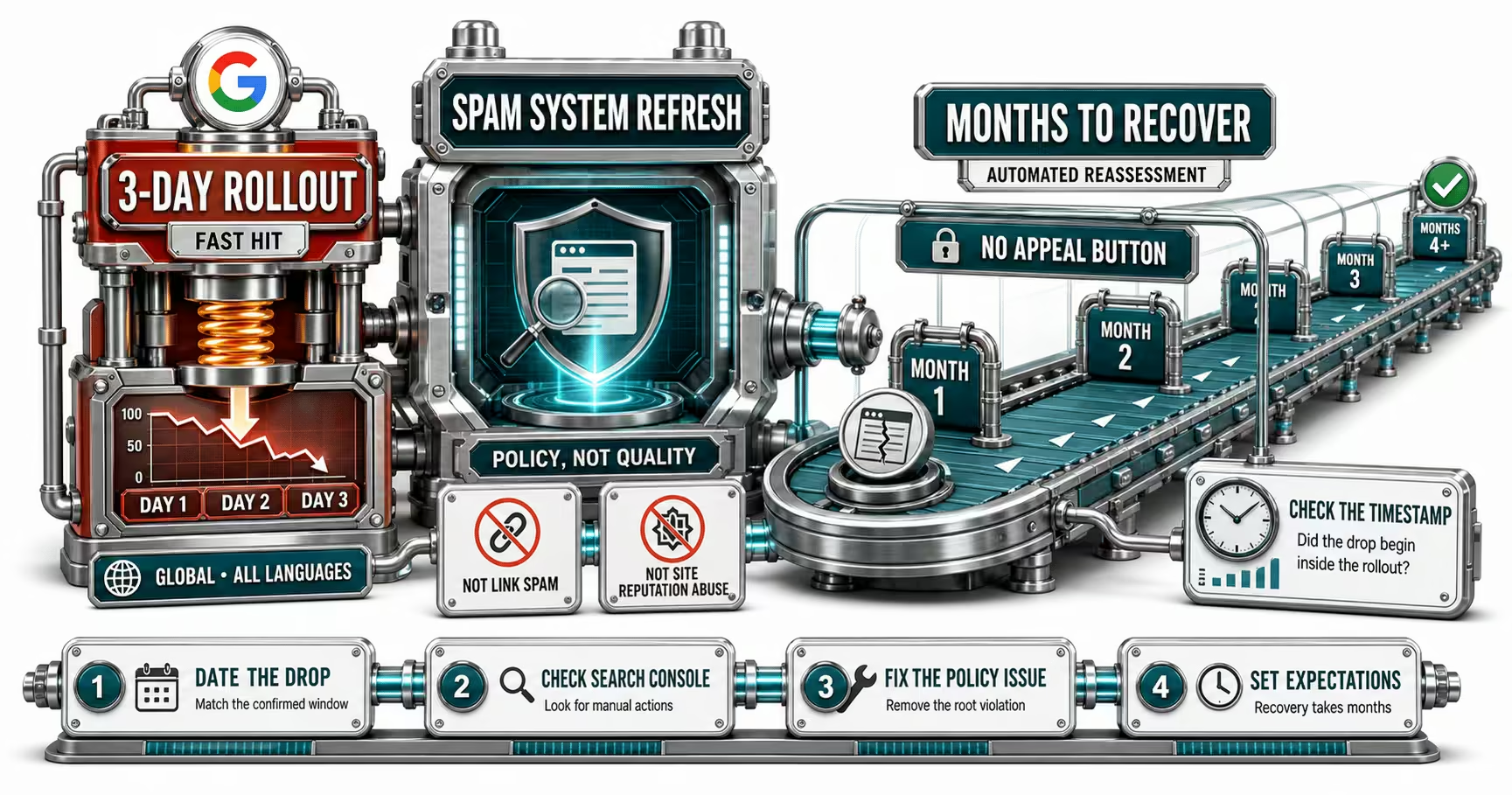
Google's spam updates used to be slow-motion events. You would notice something wrong, argue about it for a week, and the rollout would still be grinding forward when you finally settled on a diagnosis.
That era is over. The August 2026 spam update was announced, executed, and declared complete inside of three days. If you were on holiday, it happened without you.
What has not changed is the other end of the process. Google's documentation still says recovery depends on its automated systems learning, over a period of months, that your site now complies. So the modern spam update is violently asymmetric: the hit arrives in under 72 hours, and the appeal takes two or three quarters. Understanding that gap is more useful than any recovery checklist, because it changes what you should do in the first week.
Here is what actually happened, what these updates target, and what the evidence says about coming back.
What happened in August 2026
Google announced the August 2026 spam update on its Search Status Dashboard on Tuesday, August 18, 2026, at around 12:30 p.m. Eastern. The wording was deliberately unremarkable: "Released the August 2026 spam update, which applies globally and to all languages. The rollout may take a few days to complete."
It completed on Friday, August 21, 2026, at 4:50 a.m. Eastern. Total elapsed time was roughly two days and sixteen hours.
Google added on LinkedIn that "This is a normal spam update, and it will roll out for all languages and locations," and told Search Engine Land there was nothing specifically new with this update outside of Google running it again. When pressed, Google declined to say what percentage of queries or searches were affected, which is standard practice for spam updates and one of the reasons they are so hard to diagnose from the outside.
Three details from the announcement matter more than the headline:
- It was global, covering all regions and languages, so there is no geographic explanation for why you were or were not affected.
- It did not target link spam.
- It did not target the site reputation abuse policy.
Those last two exclusions eliminate a large share of the theories people immediately reach for. If your rankings moved on August 18 and your working hypothesis involves your backlink profile or a third-party content deal, the confirmed scope of this update does not support that.
Spam updates have compressed dramatically
This is the trend almost nobody is tracking, and it changes how you should respond.
| Update | Started | Completed | Duration |
|---|---|---|---|
| July 2021 link spam | Jul 26, 2021 | Aug 24, 2021 | 29 days |
| Dec 2022 link spam | Dec 14, 2022 | Jan 12, 2023 | 19 days |
| October 2023 | Oct 4, 2023 | Oct 20, 2023 | 15 days |
| March 2024 | Mar 5, 2024 | Mar 20, 2024 | 15 days |
| June 2024 | Jun 20, 2024 | Jun 27, 2024 | 7 days |
| December 2024 | Dec 19, 2024 | Dec 26, 2024 | 7 days |
| August 2025 | Aug 26, 2025 | Sep 22, 2025 | 27 days |
| March 2026 | Mar 24, 2026 | Mar 25, 2026 | 1 day |
| June 2026 | Jun 24, 2026 | Jun 26, 2026 | 2 days |
| August 2026 | Aug 18, 2026 | Aug 21, 2026 | ~3 days |
Read the last three rows against the row above them. The August 2025 spam update took 27 days. Every spam update since has finished in under four days.
Two practical consequences follow.
Your diagnostic window collapsed. When a rollout ran for three weeks, you could watch rankings move in stages, correlate them against tracked keywords, and form a confident read before it finished. A 60-hour rollout gives you a step change and nothing else. You are now diagnosing from a before-and-after snapshot rather than a curve.
Cadence is now roughly quarterly. Google ran spam updates in March, June, and August of 2026. If that pattern holds, the next one lands in late 2026, which is also the earliest realistic window for anyone hit in August to see recovery reflected.
One caution worth stating: rollout speed says nothing about severity. A short rollout can still produce enormous ranking movement. Speed changes the observability, not the impact.
What spam updates actually target
A spam update is not a quality update, and conflating the two sends teams down the wrong remediation path for months.
Google's documentation defines it plainly. Its automated systems to detect search spam operate constantly, and occasionally Google makes notable improvements to how they work. When that happens, Google calls it a spam update. The system most often named is SpamBrain, Google's AI-based spam-prevention system.
The behaviors these systems police are enumerated in Google's spam policies: cloaking, doorway pages, hidden text and links, keyword stuffing, scraped content, sneaky redirects, thin affiliate pages, machine-generated traffic, misleading functionality, and user-generated spam, among others. Google's stated consequence is blunt: sites that violate its policies "may rank lower in results or not appear in results at all."
The distinction that trips people up is this. A core update reassesses quality and relevance, which is a judgment about how good your content is. A spam update enforces policy violations, which is a judgment about whether you broke a rule. Thin, unhelpful, mediocre content is a core update problem. Deceptive or manipulative content is a spam update problem.
If you were hit by a spam update, the honest first question is not "how do we improve this page." It is "which policy does Google believe we are violating." Those lead to completely different work.
The recovery asymmetry
Now the part that has not sped up at all.
Google's spam update documentation states that sites seeing a change should review the spam policies to ensure compliance, and that "making changes may help a site improve if our automated systems learn over a period of months that the site complies with our spam policies."
Months. Not days, and not one rollout cycle.
There is no reconsideration request for an algorithmic spam update, because there is no manual action to appeal. You cannot file anything, escalate anything, or ask for a re-review. You fix the violation, wait for Google's systems to recrawl and reassess at their own pace, and typically only see movement when a subsequent spam update or refresh reprocesses your site. Google has confirmed it runs periodic refreshes of spam updates.
Set the expectation accordingly: a site hit on August 18, 2026 is realistically looking at late 2026 at the earliest, and only if the underlying violation was fixed.
Link spam is worse, and permanently so
There is one category where recovery is not slow but effectively impossible, and Google says so directly.
For link spam updates specifically, Google's documentation states that making changes "might not generate an improvement." The explanation follows: when Google's systems remove the effects spammy links may have had, any ranking benefit those links previously generated is lost, and "any potential ranking benefits generated by those links cannot be regained."
Read carefully, that is not a penalty description. It is a devaluation description. Google is not punishing you and then forgiving you. It stopped counting something that was never legitimately yours, and it will not start counting it again. Disavowing, removing, or replacing those links does not restore the position, because the position was borrowed against links that no longer carry value.
This is the single most misunderstood sentence in Google's spam documentation, and it is the reason link cleanup projects so often deliver nothing.
What site owners actually reported
Google's framing and site owners' experience rarely match perfectly, and pretending otherwise makes for useless advice. Here is what surfaced in public discussion during and after the rollout, presented as what it is: unverified reports from affected operators, not measured data.
Several themes recurred. Operators of niche specialist sites described being displaced by large general retailers on queries where the retailer has no particular subject expertise. Multiple publishers reported Discover and Google News traffic disappearing rather than merely declining. Some described News indexing latency stretching from minutes to hours, meaning fresh stories were not being picked up at the usual speed.
Running against that, at least one publisher reported the opposite outcome: a long-standing false positive that had suppressed their site finally lifted, with a visible recovery spike dated August 18.
Both experiences being real at once is exactly what you would expect from a spam system refresh, and it is why aggregate commentary about a spam update "being good" or "being bad" is close to meaningless. The relevant question is always what happened to your specific templates on your specific queries.
The mistake that costs the most time
The most expensive error around any named update is misattribution, and August 2026 produced a textbook case.
A number of site owners saw significant ranking volatility on August 12 and 13, 2026, then saw Google announce a spam update on August 18, and concluded Google had quietly begun rolling out early and only confirmed later. It is an intuitive read. It is also wrong.
Google's John Mueller addressed it directly: "We don't roll them out beforehand. We try to get the announcement as close as possible to the actual 'button-pushing' (which is sometimes challenging due to time-zones)." He added that most Google systems update continuously, and only the bigger, broader changes get announced, while acknowledging it is "sometimes hard to find a good balance between giving some transparency and causing unnecessary worries."
The takeaway is uncomfortable but useful. Google ships unannounced changes constantly. The named updates are a small, self-selected sample of everything that moves your rankings. If your decline started before the confirmed start timestamp, the named update is not your explanation, and a remediation plan built on that assumption will burn a quarter.
Worse, August 2026 was a bad week for measurement generally. Search Console's Generative AI performance report had a data logging issue around August 13, crawl stats were missing two days of data as of August 21, and Google Analytics real time had an outage on August 19. Before you diagnose a ranking problem from a dashboard, confirm the dashboard was working.
Site reputation abuse runs on a different machine
Because it gets folded into spam update conversations constantly, it is worth separating clearly.
Site reputation abuse, widely called parasite SEO, is defined by Google as "the practice of publishing third-party pages on a site in an attempt to abuse search rankings by taking advantage of the host site's ranking signals." Think of a respected publisher renting out a subfolder to a coupon operation or a supplements affiliate.
Three things distinguish it from a spam update:
It is enforced by manual action, not algorithmically. Affected site owners are notified in Search Console, which means you know if this happened to you. And because it is a manual action, there is a reconsideration process, unlike algorithmic spam updates.
Google expanded the policy in November 2024 to close the most common loophole. Chris Nelson of Google's Search Quality team stated: "We're making it clear that using third party content on a site in an attempt to exploit the site's ranking signals is a violation of this policy -- regardless of whether there is first-party involvement or oversight of the content." Google's blog post added that "no amount of first-party involvement alters the fundamental third-party nature of the content."
Google also runs a separate, non-punitive system worth knowing about. It has methods to identify when a section of a site is independent or starkly different from the main content, and treats those sections as standalone. Google is explicit that this is not a penalty: "This doesn't mean that these sub-sections have somehow been demoted or are in violation of our spam policies. It simply means we're measuring them independently."
That distinction matters for anyone running a blog, a resource hub, or an acquired sub-brand under a strong domain. Your subfolder may simply have stopped inheriting site-wide authority, which looks identical to a penalty in your analytics and requires an entirely different response.
How to act on this
Start by timestamping your decline to the hour and comparing it against Google's published rollout window. This one step resolves most misdiagnoses. If your drop predates August 18 at 12:30 p.m. Eastern, stop attributing it to the spam update and start looking for a technical change, a reporting bug, or an unannounced adjustment.
Then check Search Console for a manual action before assuming anything algorithmic. Manual actions are visible, appealable, and fixable on a completely different timeline. Confusing the two wastes months.
If it was the spam update, work the policy list rather than the quality checklist. Read Google's spam policies and identify which specific behavior your site could plausibly be seen as exhibiting. Cloaked content, doorway pages, scaled scraped material, thin affiliate templates, or expired-domain repurposing are the usual candidates. Fix the violation at the root, not the symptom on individual URLs.
Finally, set an honest internal expectation. Recovery is measured in months and typically becomes visible on a subsequent refresh, not on a fixed date you can promise a board. Anyone guaranteeing a faster path is guessing.
- Timestamp before theorizing. Compare your exact drop time against the Search Status Dashboard window, and rule the named update out if the decline started earlier.
- Check for a manual action first. Search Console tells you within minutes whether this is manual or algorithmic, and the two require completely different remediation.
- Work the policy list, not the quality list. A spam update enforces rules, so identify the specific violation rather than broadly improving content.
- Budget quarters, not weeks. Google states its systems need months to learn compliance, and there is no reconsideration path for algorithmic spam updates.
The larger point is that spam updates have become fast, frequent, and quiet, while the consequences of getting caught by one have stayed slow and expensive. That trade favors sites that never have to think about spam policies in the first place, which is presumably the intent.
If you are trying to work out whether an update, a technical fault, or a reporting bug is behind a drop, that separation is the first thing we do in an SEO and GEO engagement, and it is usually the difference between a fix that takes weeks and a project that takes a year. If the drop is in AI surfaces rather than classic results, our AI visibility work covers that side.
Frequently Asked Questions
Common questions about GEO, SEO, and AI-driven search visibility.
Google launched the August 2026 spam update on Tuesday, August 18, 2026, at around 12:30 p.m. Eastern, and confirmed the rollout was complete on Friday, August 21, 2026, at 4:50 a.m. Eastern. Total rollout time was roughly two days and sixteen hours, which Search Engine Land rounded to 2.5 days. Google described it as a normal spam update that applied globally and to all languages, and declined to say what percentage of queries or searches were affected. It was the third spam update Google released in 2026, following updates in March and June.
A spam update is an improvement to Google's automated spam detection systems, most notably SpamBrain, its AI-based spam-prevention system. It targets sites violating Google's published search spam policies, which cover behaviors such as cloaking, doorway pages, hidden text, keyword stuffing, scraped content, sneaky redirects, thin affiliate pages, and user-generated spam. Google's documentation states that sites which violate these policies may rank lower in results or not appear in results at all. Notably, the August 2026 update did not target link spam and did not target the site reputation abuse policy, which are handled by separate systems.
Google's official documentation states that making changes may help a site improve if its automated systems learn over a period of months that the site complies with the spam policies. There is no reconsideration request for algorithmic spam updates, and no way to accelerate the process. Practically, this means a site hit on August 18, 2026 should not expect measurable recovery before late 2026 at the earliest, and possibly not until a subsequent spam update or refresh reprocesses the site. Google runs periodic refreshes of spam updates, which is typically when recovery becomes visible.
Not in the same way. Google's documentation is explicit that in the case of a link spam update, making changes might not generate an improvement. The reason is that when Google's systems remove the effects that spammy links may have had, any ranking benefit those links previously generated is lost, and Google states that any potential ranking benefits generated by those links cannot be regained. In other words, a link spam update does not apply a penalty you can lift. It removes value that was never legitimately earned, and that value does not come back.
No. Many site owners reported heavy ranking volatility on August 12 and 13, 2026, days before Google announced the spam update on August 18. Google's John Mueller addressed this directly on LinkedIn, stating that Google does not roll updates out beforehand and that the company tries to get the announcement as close as possible to the actual button-pushing, which is sometimes challenging due to time zones. Google runs many unannounced ranking changes continuously and announces only the larger, broader ones, so volatility outside an announced window is common and should not be attributed to a named update.
Site reputation abuse, commonly called parasite SEO, is defined by Google as the practice of publishing third-party pages on a site in an attempt to abuse search rankings by taking advantage of the host site's ranking signals. It is enforced separately from spam updates, through manual actions rather than algorithmically, and affected site owners are notified in Google Search Console. Google expanded the policy in November 2024 to cover third-party content regardless of first-party involvement or oversight, with Google Search Quality's Chris Nelson stating that no amount of first-party involvement alters the fundamental third-party nature of the content. The August 2026 spam update did not target this policy.
Substantially. The August 2025 spam update took 27 days to complete, from August 26 to September 22, 2025. All three spam updates Google has run in 2026 finished in under four days: March 2026 completed in about one day, June 2026 in two days, and August 2026 in roughly two days and sixteen hours. Rollout speed does not indicate impact severity, and a short rollout can still produce large ranking changes. What it does change is the diagnostic window, since a compressed rollout means less time to distinguish an update's effect from unrelated fluctuations.
Compare the exact timing of your drop against Google's confirmed rollout window on the Search Status Dashboard, which publishes start and end timestamps for every announced update. If your decline started before the announced start time, the named update is not the explanation. Then check whether the drop is sitewide or concentrated in specific templates, whether Search Console shows a manual action, and whether your reporting data itself was affected, since Search Console had a Generative AI performance report logging issue around August 13, 2026 and crawl stats were missing two days of data as of August 21.
Sources
- Google Search Central: Google Search spam updates and your site (opens in a new tab)
- Google Search Central: Spam policies for Google web search (opens in a new tab)
- Google Search Status Dashboard: August 2026 spam update (opens in a new tab)
- Search Engine Roundtable: Google August 2026 Spam Update Has Been Unleashed (opens in a new tab)
- Search Engine Roundtable: Google August 2026 Spam Update Is Done Rolling Out (opens in a new tab)
- Search Engine Land: Google August 2026 spam update done rolling out (opens in a new tab)
- Search Engine Roundtable: Google: We Do Not Roll Out Updates Prior To The Announcement (opens in a new tab)
- Search Engine Roundtable: Google Site Reputation Abuse Policy Now Includes First Party Involvement (opens in a new tab)
- Google Search Central Blog: An update to our site reputation abuse policy (opens in a new tab)
- Google Search Central: Debug drops in Search traffic (opens in a new tab)