

Zeta Won't Sell Its Data to AI. It Just Bought a GEO Company
 Preferred source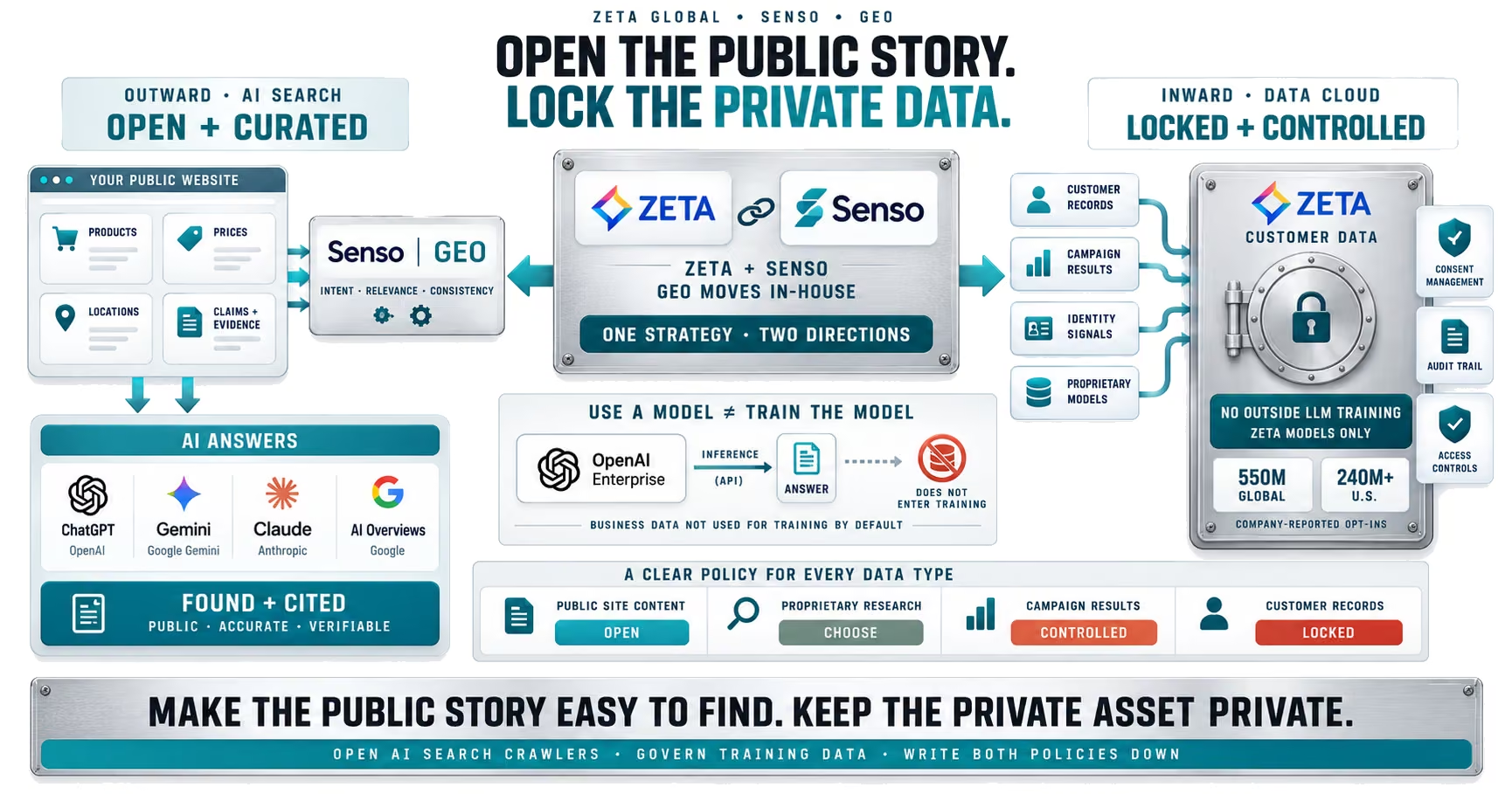
What Steinberg told CNBC
The interview aired on October 6, two days before Zeta's annual Zeta Live conference in New York. Steinberg described Zeta as "an intelligent AI infrastructure company" and said the company made that pivot about six months ago. The anchor noted that Zeta's stock had more than doubled over that period.
The headline line was about data. Steinberg said Zeta has 550 million people opted into its data cloud globally and more than 240 million in the US, and then drew a hard line:
We've never sold our data to anybody at any price at any time.
He added that Zeta has never exposed its data to any large language model and uses it only to train its own models. That is consistent with what Zeta executives said a month earlier at Goldman Sachs' Communacopia conference, where Steinberg called the data "the biggest moat we have in our business" and the company cited more than 525 million opted-in individuals. The figure grew by 25 million in a month, which may reflect growth or simply a different count. Both numbers are Zeta's own.
Steinberg also ran through the partnerships behind the pivot: OpenAI, which he called one of its largest enterprise relationships, Athena, Zeta's voice-enabled agent, going generally available in March, a deal to run natively on Snowflake, and a re-architecture of Zeta's data cloud on Palantir's Foundry with what he described as a seven-year go-to-market partnership. Zeta's Q2 2026 results showed 44% revenue growth and raised full-year guidance to between $1.811 billion and $1.824 billion.
Zeta just bought its way deeper into GEO
The more interesting news for marketers came first. On October 5, Zeta announced it had agreed to acquire Senso, an AI engineering company founded by Saroop Bharwani. Senso's technology already powered Zeta's GEO offering. Zeta says the combined product will help enterprises optimize how their brands appear in AI answers on ChatGPT, Gemini, Claude and Google AI Overviews, and connect that visibility to customer data and marketing results. Terms were not disclosed.
On CNBC, Steinberg called Senso one of the most important platforms in GEO and explained the logic through AI shopping agents. Agents that research and buy on a person's behalf draw on the large frontier models. Senso, he said, helps brands get their information into what those models return, so that when an agent goes out to complete a transaction, Zeta's clients are part of the answer.
A day later Zeta announced a second deal, to acquire Digital Audience, a data infrastructure company that strengthens how Zeta recognizes audiences across digital channels and expands its presence in Europe. On CNBC, Steinberg said the deal would add trillions of signals and that Digital Audience is GDPR compliant in Europe and CCPA compliant in the US. The company's press release does not repeat those compliance claims.
| Date | Zeta move | Why it matters |
|---|---|---|
| Oct 5 | Agrees to buy Senso | GEO moves in-house |
| Oct 6 | Agrees to buy Digital Audience | More identity data, Europe |
| Oct 6 | CEO on CNBC | Data never sold or exposed |
| Oct 8 | Zeta Live in New York | Further announcements promised |
Steinberg's definition of GEO is the right one
The most useful thing Steinberg said for anyone running SEO or GEO was also the simplest. Asked whether an optimization layer feeding AI agents should worry consumers, he pointed out that people have been doing this through search engine optimization for years:
This is simply search engine optimization for large language models.
He followed it with the part that matters most. Information has to be curated correctly, with intent and relevance, because if it is not, he said, the foundation model will reject it.
That framing lines up with the best available evidence. Google says there are no additional requirements or special optimizations needed to appear in AI Overviews or AI Mode, beyond being indexed and eligible for a snippet. In other words, GEO is built on the same base as SEO: crawlable pages, clear and accurate content, and a reason to be the source an answer relies on. We made the same case in why AI visibility is built on SEO.
"Reject" is a useful shorthand, not a literal mechanism. There is no button inside ChatGPT or Gemini that refuses a brand. What happens in practice is that retrieval systems pass over information that is thin, inconsistent or contradicted by other sources, and pick something clearer. The fix is the one Steinberg names: content with a clear purpose that matches what the person is asking.
- Zeta now sells GEO. With Senso in-house, Zeta has a direct commercial interest in persuading brands that GEO needs specialized software. Read its claims about AI visibility with that in mind.
- The data figures are self-reported. The 550 million and 240 million counts, the "never sold" statement and the compliance claims for Digital Audience come from the CEO and have not been independently verified.
- Zeta's data practices have been questioned before. In November 2024 a short seller challenged its consent practices, and Zeta responded the same day that it does not run "so-called consent farms."
One strategy, two directions
Put the two halves of the week together and Zeta's strategy becomes clear. It pushes outward with public information and pulls inward with private data.
Outward, Senso exists to make sure that when ChatGPT, Gemini or an AI shopping agent answers a question, a client's products, prices and claims are in the answer. That information is meant to be public. The more easily AI systems can read and trust it, the better.
Inward, Zeta's customer data never leaves its control. It trains Zeta's own models, and Steinberg says no outside model has ever seen it. That is the asset, and giving it away would make every competitor using the same model smarter.
Most brands have these settings reversed or unset. Some block AI search crawlers from their public marketing pages out of a vague fear of "giving content to AI," which keeps them out of the answers. OpenAI's crawler documentation says sites that opt out of OAI-SearchBot "will not be shown in ChatGPT search answers." At the same time, their customer data flows into vendor tools under terms nobody has read.
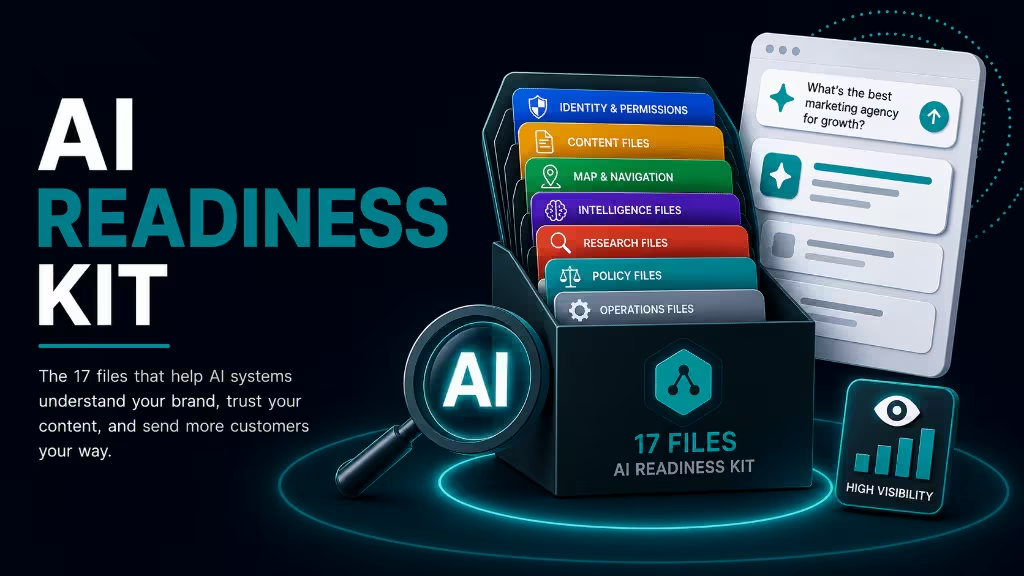
If you want to check your own setup, our free AI Readiness Kit generates a robots.txt with rules for the major AI crawlers and a deployment checklist. It is not gated, and you can inspect exactly what it produces. Start with the crawler rules. Google says files such as llms.txt are not required for its AI features, so treat the rest as optional.
| Data type | Who sees it | Policy |
|---|---|---|
| Public site content | Everyone, including AI search | Open, accurate, consistent |
| Proprietary research | Your choice | Publish to earn citations |
| Campaign results | Team and vetted vendors | Contract controls |
| Customer records | Your team only | Locked, no training |
Reddit made the opposite bet
Zeta's stance is easiest to see next to its mirror image. Reddit decided its content was worth more as a product, and in February 2024 Reuters reported that it had agreed to license that content to Google for AI training in a deal worth about $60 million a year.
Both choices can be rational. Reddit's value to AI companies comes from public conversation at scale. Zeta's value comes from exclusive, consented customer information. Selling exclusive data to a model that serves your competitors turns your advantage into theirs. We looked at how Reddit's licensing strategy has played out in our analysis of Reddit's AI crawler wall.
Using a model is not the same as feeding it
There is a detail that looks like a contradiction and is not. Zeta announced in January that OpenAI models power Athena, and Steinberg told CNBC that Zeta is one of OpenAI's largest enterprise relationships. So Zeta uses a large language model every day.
The difference is training. OpenAI's enterprise privacy page says it does not use business data for training by default, and that API data after March 1, 2023 is not used for training unless a customer opts in. A company can run its data through a model to get an answer without that data becoming part of the model everyone else uses.
That is where most marketing teams are exposed. Every tool in the stack, from email platforms to meeting recorders, has terms on AI training. In 2023, TechCrunch reported on the backlash over AI training language in Zoom's terms of service, which ended with Zoom clarifying it would not use audio, video or chat content to train its models without customer consent. We argued in your website is AI's data layer that public content needs data-style governance. Zeta's stance is the other half: private data needs asset-style protection.
Where to start
- Write down what you want AI to say about you. List your core products, prices, locations and claims, and make every public page, listing and profile say the same thing.
- Open your public pages to AI search crawlers. Allow OAI-SearchBot, Claude-SearchBot and PerplexityBot on marketing pages, and decide separately whether to allow training crawlers such as GPTBot.
- Curate for intent, not volume. Build each page around a question buyers ask, with a clear answer and evidence, rather than producing many thin pages aimed at AI.
- Read the AI training clause in every vendor contract. Find out whether each tool can train on your customer data, whether that is on by default, and how to opt out, in writing.
- Pressure-test any GEO vendor. Ask what it changes on your site, how it measures citations across platforms, and whether it needs access to customer data to do the job.
Zeta's week is a clean demonstration of a strategy most brands need and few have. Make the public story easy for every AI system to find and trust. Keep the private data that makes you different out of everyone else's models. Steinberg is right that GEO is search engine optimization for a new kind of engine, which means the brands that did the fundamentals well are already ahead.
Frequently Asked Questions
Common questions about GEO, SEO, and AI-driven search visibility.
In a CNBC interview on October 6, 2026, Zeta Global CEO David Steinberg said the company has never sold its data to anybody at any price and has never exposed it to any large language model. He said Zeta uses the data only to train its own models, and cited 550 million people opted into its data cloud globally.
Zeta announced on October 5, 2026 that it agreed to acquire Senso, a Y Combinator-backed AI engineering company whose technology already powered Zeta's generative engine optimization offering. Zeta says the deal will help enterprises optimize how their brands appear in AI answers on ChatGPT, Gemini, Claude and Google AI Overviews. Terms were not disclosed.
On CNBC in October 2026, David Steinberg described generative engine optimization as search engine optimization for large language models. He said information has to be curated correctly, with intent and relevance, or the foundation model will reject it. Google's own guidance similarly says no special optimization is needed beyond SEO fundamentals.
It builds on SEO rather than replacing it. Google says there are no additional requirements to appear in AI Overviews or AI Mode beyond being indexed and eligible for a snippet, and Zeta's CEO called GEO search engine optimization for large language models. The difference is the surface and the measurement, not the fundamentals.
Yes. Zeta announced in January 2026 that OpenAI models power its Athena agent, and Steinberg told CNBC Zeta is one of OpenAI's largest enterprise relationships. OpenAI says it does not train on business or API data by default, so using a model is different from supplying data to train it.
Steinberg told CNBC in October 2026 that 550 million people are opted into Zeta's data cloud globally, including more than 240 million in the US. In September 2026 Zeta executives cited more than 525 million at a Goldman Sachs conference. These are company figures and have not been independently verified.
Sources
- CNBC: We never sell our data to other LLMs, we use it to train our own, says Zeta Global CEO (opens in a new tab)
- Zeta Global: Zeta Global to Acquire Senso, Adding AI Engineering and Frontier-Model Connectivity to Its Intelligent AI Infrastructure (opens in a new tab)
- Zeta Global: Zeta Global to Acquire Digital Audience (opens in a new tab)
- Investing.com: Zeta Global at Goldman Sachs Communacopia + Technology Conference 2026 (opens in a new tab)
- Zeta Global: Zeta Global Reports 20th Consecutive Beat and Raise Quarter (opens in a new tab)
- Google Search Central: AI features and your website (opens in a new tab)
- Business Wire: Zeta Global and OpenAI Team Up to Deliver Answer-Driven Marketing with Athena by Zeta (opens in a new tab)
- OpenAI: Enterprise privacy at OpenAI (opens in a new tab)
- Reuters via Nasdaq: Reddit in AI content licensing deal with Google, sources say (opens in a new tab)
- Nasdaq: Zeta Global Responds to Short-Seller Report (opens in a new tab)
- TechCrunch: Zoom knots itself a legal tangle over use of customer data for training AI models (opens in a new tab)
- OpenAI: Overview of OpenAI crawlers (opens in a new tab)
- Silverback Marketing: AI Readiness Kit (opens in a new tab)