



That Viral 2025 vs 2026 AI Tool Chart Is Half Right. Here Is Which Half.
 Preferred source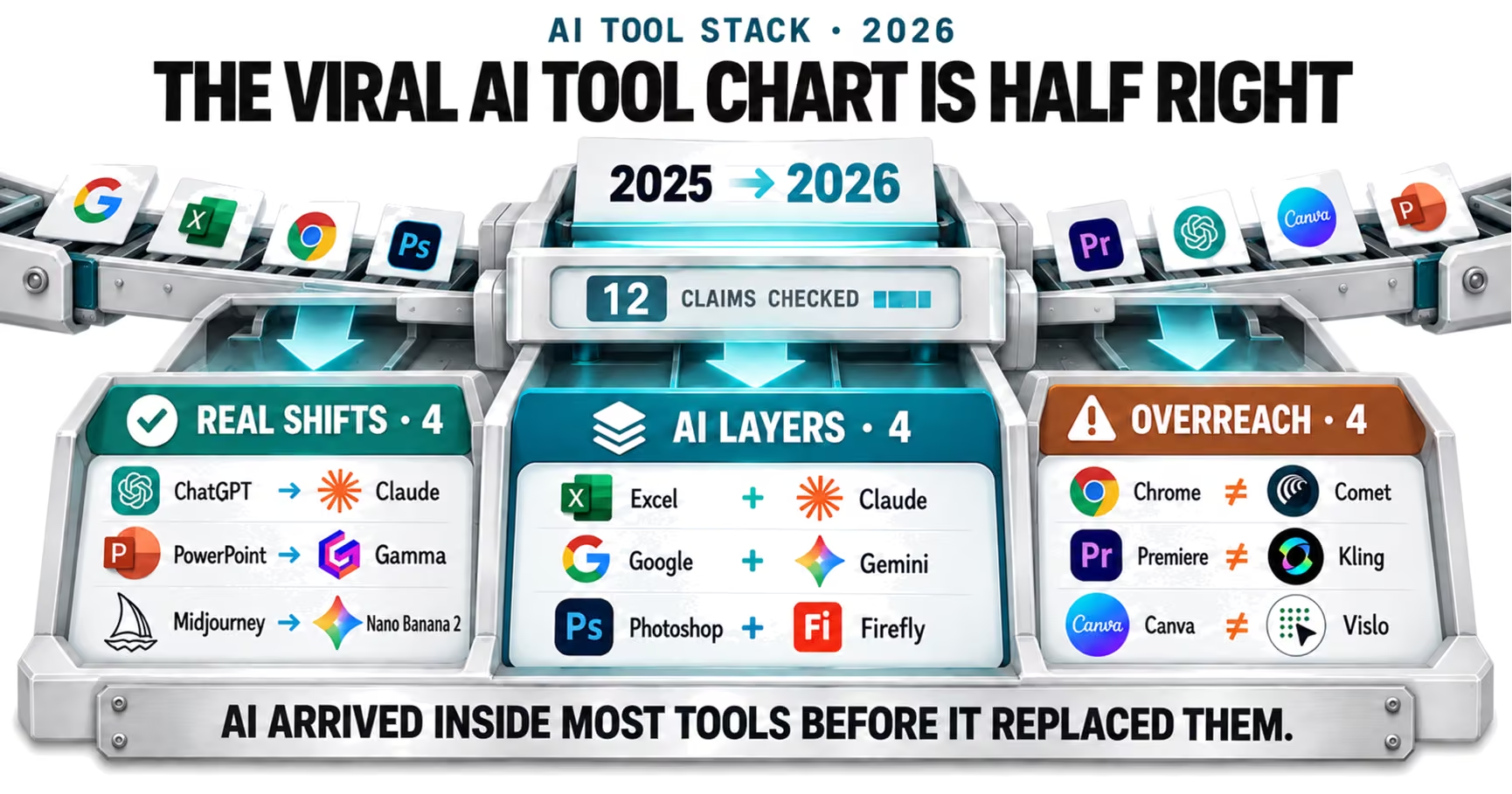
Why a notebook doodle turned into a stack debate
The chart works because it is simple. Twelve rows, twelve arrows, a red X on the left and a green check on the right. It flatters the reader into feeling behind, which is exactly what makes it spread. Nobody shares a chart that says "your tools are fine, turn on the AI features you already pay for."
But marketing leaders get asked about this stuff in budget meetings. A CFO who saw the chart wants to know whether the Adobe renewal is still necessary. A sales director wants to know if the team should be on Perplexity instead of Google. A content lead wonders whether the Canva seats can go. Those are real questions with real dollar amounts attached, and a doodle is not evidence.
So we treated it as a claim to test. For each of the twelve swaps we asked three things: does the 2026 tool actually do the job of the 2025 tool, is there usage or revenue data showing people are switching, and is the old tool standing still or absorbing the same capability. The answers sort neatly into three buckets.
| 2025 tool | On the chart | Verdict | Why |
|---|---|---|---|
| ChatGPT | Claude | Real shift | An AI writing assistant is now standard; which one is a matter of taste |
| Fireflies | Granola | Real shift | No bot joins the call; 125 million dollar raise at a 1.5 billion dollar valuation |
| PowerPoint | Gamma | Real shift | Near 100 million users; wins internal and first draft decks |
| Midjourney | Nano Banana 2 | Real shift | Both shipped major models three weeks apart; generation became a checkbox |
| Excel | Claude in Excel | Addition | It is an add-in that runs inside Excel; Copilot Agent Mode is there too |
| Gmail | Workspace Studio | Addition | An agent builder whose Gmail use cases all run on Gmail |
| Google Search | Gemini | Addition | AI Mode passed 1 billion users inside Google; Google still holds 91.1 percent of search |
| Photoshop | Nano Banana | Addition | Adobe put a Firefly assistant inside Photoshop in June 2026 |
| Chrome | Perplexity Comet | Overreach | Chrome at 69.39 percent of browsers; Comet does not register on the chart |
| Premiere Pro | Kling | Overreach | Kling generates clips; Premiere edits footage; teams use both |
| Canva | Vislo | Overreach | About 20,000 users versus 260 million |
| Perplexity (research) | Overreach | Half credit; AI Mode is now the largest AI research surface |
The four swaps that are happening now
Writing: ChatGPT to Claude. This is the one row where the chart is really a matter of taste, and we will say so plainly since Claude is the model we use most at Silverback. Both ChatGPT and Claude are excellent long form writing assistants, and ChatGPT's scale is not in question: it reached 1 billion monthly active users in June 2026, a figure TechCrunch cited when Gemini matched it two months later. The honest version of this row is not "one chatbot replaces another." It is that an AI writing assistant has become a standing part of the content workflow, the way a spell checker used to be. Which one you pick depends on voice, context window needs and what the rest of your stack connects to.
Note taking: Fireflies to Granola. This swap has real data behind it. Granola raised 125 million dollars in March 2026 at a 1.5 billion dollar valuation, up from 250 million dollars only ten months earlier, according to TechCrunch's report on the round. The reason it caught on is structural rather than cosmetic. Fireflies style tools send a bot into the meeting as a visible participant. Granola runs on your machine, transcribes locally and merges your own typed notes with the transcript, so nothing joins the call. In a sales or client context, that difference matters. Customers at Asana, Gusto, Vanta and Cursor suggest the switch is happening in the kinds of companies marketing teams sell to.
Presentations: PowerPoint to Gamma. Gamma was approaching 100 million users and 100 million dollars in annual recurring revenue when it launched Gamma Imagine in March 2026, on the back of a 2.1 billion dollar valuation set the previous November, per TechCrunch's coverage. That is a serious business, and the product is aimed squarely at the "long tail of knowledge workers" who need to communicate visually without a design team. For internal decks, sales one pagers and webinar slides, an AI first tool that starts from an outline is a real productivity gain. For board decks with brand guidelines and legal review, PowerPoint is not going anywhere, and Microsoft has its own Copilot layer there too.
Image generation: Midjourney to Nano Banana 2. Both sides of this arrow shipped major models within three weeks of each other. Google launched Nano Banana 2, the public name for Gemini 3.1 Flash Image, on February 26, 2026, with output from 512 pixels to 4K, consistent rendering of up to five characters and 14 objects across edits, and real time web knowledge, according to Google's announcement. Midjourney answered with V8 Alpha on March 17, 2026, claiming roughly five times faster generation and better text rendering. The chart is right that Google is now a first tier image generator, and Nano Banana 2 is the more practical choice for marketing teams because it is free inside the Gemini app and available in Google Ads. It is wrong to imply Midjourney is finished. Midjourney still wins on stylized art direction. The real change is that image generation stopped being a specialist tool and became a checkbox in the apps you already use.
The four swaps that are really additions
This is the bucket the chart gets most wrong, because it mistakes "AI arrived in this category" for "this tool got replaced."
Spreadsheets: Excel to Claude in Excel. Read the product name again. Claude for Excel is an add-in that runs inside Excel on the web, Windows and Mac, generally available on Claude Pro, Max, Team and Enterprise plans, according to Anthropic's documentation. It answers questions about the workbook with cell level citations, changes assumptions while keeping formulas intact, debugs errors and builds models. It does not support data tables, macros or VBA, and Anthropic's own docs say not to use it for audit critical calculations without review. Meanwhile Microsoft's Copilot Agent Mode in Excel reached general availability on desktop on January 27, 2026. Excel is not being replaced. Excel is becoming the surface that competing AI agents fight to sit inside.
Email: Gmail to Google Workspace Studio. Workspace Studio is Google's no code agent builder, announced December 3, 2025 and rolled out to all Workspace domains on March 19, 2026, per Google's Workspace Updates blog. Its Gmail use cases are things like drafting weekly updates from your inbox, summarizing unread mail and labeling messages with action items. Every one of those examples runs on Gmail. Putting Workspace Studio in the "replaces Gmail" column is like saying Zapier replaced your CRM.
Search: Google to Gemini. This one is more interesting than the chart makes it. Google announced at I/O on May 20, 2026 that AI Mode had passed 1 billion monthly users and merged AI Overviews and AI Mode into a single flow. In August 2026 the standalone Gemini app also hit 1 billion monthly active users, a figure Google counts separately from Search. So yes, a great deal of search behavior has moved into conversational interfaces. But StatCounter's August 2026 data still shows Google at 91.1 percent of worldwide search engine share, with Bing at 4.5 percent. The shift is not from Google to Gemini. It is from ten blue links to AI answers, most of which are still served by Google, on a Google property, with Google's ads next to them. For anyone whose revenue depends on organic visibility, that distinction is the whole game, and it is the case we make in AI visibility is built on SEO.
Image editing: Photoshop to Nano Banana. Nano Banana's editing is impressive for a chat interface: swap a background, keep the subject consistent, add text in a specific font. For social content and quick mockups it is faster than opening Photoshop. But Adobe did not sit still. On June 18, 2026 Adobe expanded its Creative Agent and put a Firefly AI Assistant inside Photoshop, where you describe an outcome and the assistant executes across the full layered composite with every adjustment left editable. Layers, masks, color management, print output and non destructive edits are still why professionals pay for Photoshop. The right framing is that a marketing team now has two tiers: prompt based editing for volume, Photoshop for anything a client will see at full size.
The four swaps that overreach
- Chrome to Perplexity Comet. Comet went free worldwide on October 2, 2025, and a year later StatCounter still has Chrome at 69.39 percent of browsers with Comet absent from the chart. Google answered agentic browsing from inside Chrome with Gemini 3 auto browse in January 2026.
- Premiere Pro to Kling. Kling 3.0 generates clips up to 15 seconds with native audio; Premiere assembles, syncs, grades and exports footage. A team that generates B roll in Kling still needs an editor to cut the ad.
- Canva to Vislo. Vislo serves about 20,000 creators at 19 dollars a month. Canva reported 260 million monthly users and 3.5 billion dollars in 2025 revenue. That is a mismatch of about four orders of magnitude.
- Google to Perplexity for research. Half credit. Perplexity changed desk research and every AI search product copied its citation format, but Google's AI Mode is now the largest AI research interface by user count.
Browser: Chrome to Perplexity Comet. Comet is a real product with a real following. It launched July 9, 2025 to Perplexity's 200 dollar per month Max subscribers, went free for everyone worldwide on October 2, 2025, and Perplexity says millions of people joined the waitlist in between, as TechCrunch reported at the time. It is also nearly a year old at this point, and StatCounter's August 2026 browser data has Chrome at 69.39 percent, Safari at 15.83 percent, Edge at 5.36 percent and Firefox at 2.98 percent. Comet does not appear as a line item. Agentic browsing is a genuine trend, and Google answered it from inside Chrome: on January 28, 2026 it added Gemini 3 powered auto browse, which fills forms, books appointments and shops on the user's behalf, with purchases gated behind explicit confirmation. A browser swap at the scale the chart implies has not happened.
Video editing: Premiere Pro to Kling. These are different products solving different problems. Kling 3.0, launched February 5, 2026, generates clips up to 15 seconds with native multilingual audio, multi shot storytelling and 2K and 4K image output, and Kuaishou says the platform has served 60 million creators and produced 600 million videos, per the company's launch release. The business is real: Kuaishou reported Kling revenue above RMB 650 million in Q1 2026, growth of more than 300 percent year over year, and a March annualized run rate near 500 million dollars. None of that is video editing. Premiere Pro is a timeline for assembling footage, syncing audio, grading color and exporting to spec, and Adobe's June 2026 update added an assistant for sorting assets and rough assembly. A team that generates B roll in Kling still needs an editor to cut it into a thirty second ad. Generation and editing are complementary, not competing.
Design: Canva to Vislo. This is the weakest row on the chart. Vislo is a focused AI infographic generator, priced at 19 dollars per month, that describes itself as serving 20,000 plus creators and is aimed mostly at LinkedIn visuals. That is a niche tool, and possibly a good one. Canva reported 260 million monthly users and 3.5 billion dollars in revenue for 2025, with AI woven through its Creative Operating System. Putting them in the same row with an arrow between them is not a forecast. It is a mismatch of about four orders of magnitude. If the row is really trying to say "AI infographic generators are a thing now," fine. But that is a feature category, not a reason to cancel the seats of a platform used by 95 percent of the Fortune 500.
Research: Google to Perplexity. Half credit here. Perplexity did change how a lot of professionals do desk research, and its citation first answer format is the one every AI search product has since copied. But Google's own AI Mode is now the largest AI research interface on earth by user count, and it cites sources as well. The honest research stack in 2026 is a mix: Perplexity or an AI Mode session to build the map, then primary sources to verify, because every one of these tools still hallucinates figures often enough that a marketer who publishes numbers without checking will eventually get burned. We would know. It is the whole reason this article links to press releases instead of chart screenshots.
Where the chart's instinct is right
For all the errors, the chart is pointing at something true. Every category on it now has an AI native option that a small team can adopt in an afternoon. Twelve months ago that was not the case for browsers, spreadsheets or video. The direction of travel is correct even when the arrows are drawn between the wrong logos.
The subtler truth is about where the AI is showing up. In eight of the twelve rows, the winning move in 2026 is not a new tool but a new layer inside the tool you already have: Copilot or Claude in Excel, Workspace Studio on Gmail, AI Mode inside Google, Firefly inside Photoshop and Premiere, Gemini inside Chrome, Canva AI inside Canva. Incumbents with distribution are absorbing the capability faster than challengers can build distribution. That pattern is worth remembering the next time a chart tells you the whole stack is about to flip.
What a marketing team should actually do with this
- Adopt the four swaps with real momentum. Make an AI writing assistant a standard part of the content workflow, with a house style guide it can reference. Move meeting notes to a bot free tool like Granola if your team is client facing, because the "who is the robot on this call" moment is a real relationship cost. Give sales and marketing an AI first deck tool for internal and first draft work, and keep PowerPoint or Google Slides for the branded final.
- Standardize image generation on one or two models. Most likely Nano Banana 2 for speed and product accuracy and Midjourney for stylized creative, with a rule about disclosure and rights before anything goes to a client.
- For the four additions, turn on what you already own. Enable Copilot Agent Mode or install Claude for Excel, build one Workspace Studio agent that summarizes your inbox each morning, and get the team comfortable with AI Mode as a research surface, since that is where a growing share of your prospects are reading about you.
- For the four overreaches, watch and spend nothing yet. Test Comet if agentic browsing interests you, treat Kling as a B roll generator that feeds your editor, and ignore any vendor who tells you a 20,000 user tool has replaced a 260 million user one.
Finally, the row that matters most for anyone in our line of work is the one the chart gets most subtly wrong. Search did not move from Google to Gemini. It moved from links to answers, and Google is serving most of those answers. That means the work of being cited, structured and trusted by AI systems is not a side project next to SEO. It is what SEO now is, which is the whole argument of what generative engine optimization actually is.
Frequently Asked Questions
Common questions about GEO, SEO, and AI-driven search visibility.
Partly. Of the twelve swaps in the viral chart, roughly four hold up as genuine category shifts (writing, meeting notes, presentations and image generation), four are additions that run inside the old tool rather than replacements (Excel, Gmail, Google Search and Photoshop), and four overstate a niche product's reach, most clearly Perplexity Comet versus Chrome at 69 percent browser share and Vislo versus Canva at 260 million monthly users.
No. Claude for Excel is an add-in that runs inside Excel on the web, Windows and Mac, and it is generally available on Claude Pro, Max, Team and Enterprise plans. It reads and edits your workbook, explains formulas with cell level citations and builds models, but the spreadsheet itself is still Excel. Microsoft's own Copilot Agent Mode in Excel also reached general availability on desktop in January 2026, so the honest framing is Excel with an AI layer, not Excel replaced.
Not by any measurable standard. Comet became free for everyone on October 2, 2025 after launching in July 2025 to Perplexity's 200 dollar per month Max subscribers, and Perplexity says millions joined the waitlist. StatCounter's August 2026 data still puts Chrome at 69.39 percent of worldwide browser usage, with Safari at 15.83 percent and Edge at 5.36 percent. Comet is an interesting agentic browser, but it does not register on the share charts yet.
Nano Banana 2 is the public name for Google's Gemini 3.1 Flash Image model, launched February 26, 2026. It generates and edits images from 512 pixels up to 4K, keeps up to five characters and 14 objects consistent across edits, renders legible text and pulls in real time web knowledge. It is available in the Gemini app, Google Search, AI Studio, the Gemini API, Vertex AI and Google Ads.
No, they do different jobs. Kling is a video generation model from Kuaishou. Kling 3.0, launched February 5, 2026, produces clips up to 15 seconds with native audio and multi shot storytelling, and Kuaishou reported Kling revenue above RMB 650 million in Q1 2026, up more than 300 percent year over year. Premiere Pro is a timeline editor for assembling footage, and Adobe added a Firefly AI Assistant to Premiere in 2026 for tasks like asset sorting and batch renaming. Most teams will use both.
Focus on the four swaps with real momentum: adopt an AI writing assistant as a standing part of the content workflow, switch to a bot free meeting notetaker like Granola, use an AI first presentation tool such as Gamma for internal and sales decks, and move image generation to Nano Banana 2 or Midjourney V8 depending on style needs. For Excel, Gmail, Photoshop and Google Search, turn on the AI features already inside the tool before paying for a replacement.
Sources
- Google: Nano Banana 2, Google's latest AI image generation model (opens in a new tab)
- Google: 100 things we announced at Google I/O 2026 (opens in a new tab)
- TechCrunch: Google's Gemini app surges to 1 billion users (opens in a new tab)
- StatCounter: Search engine market share worldwide (opens in a new tab)
- StatCounter: Browser market share worldwide (opens in a new tab)
- Claude Docs: Use Claude for Excel (opens in a new tab)
- Microsoft: Agent Mode in Excel is now generally available on desktop (opens in a new tab)
- TechCrunch: Perplexity's Comet AI browser is now free (opens in a new tab)
- Perplexity: Comet is now available to everyone worldwide (opens in a new tab)
- Adobe: Adobe unveils major expansion of Creative Agent across Firefly and Creative Cloud (opens in a new tab)
- Kuaishou Technology: Kling AI launches 3.0 model (opens in a new tab)
- Kuaishou Technology: First quarter 2026 unaudited financial results (opens in a new tab)
- TechCrunch: Granola raises 125M, hits 1.5B valuation (opens in a new tab)
- TechCrunch: Gamma adds AI image generation tools in bid to take on Canva and Adobe (opens in a new tab)
- Vislo: AI infographic generator (opens in a new tab)
- Canva: A transformative year for Canva, 2025 in review (opens in a new tab)
- Google Workspace Updates: Create AI agents to automate work with Google Workspace Studio (opens in a new tab)
- Midjourney: V8 Alpha release notes (opens in a new tab)
- Google: The new era of browsing, putting Gemini to work in Chrome (opens in a new tab)