




ChatGPT Built Its Own Search Index. The Gate Isn't What You Were Sold.
 Preferred source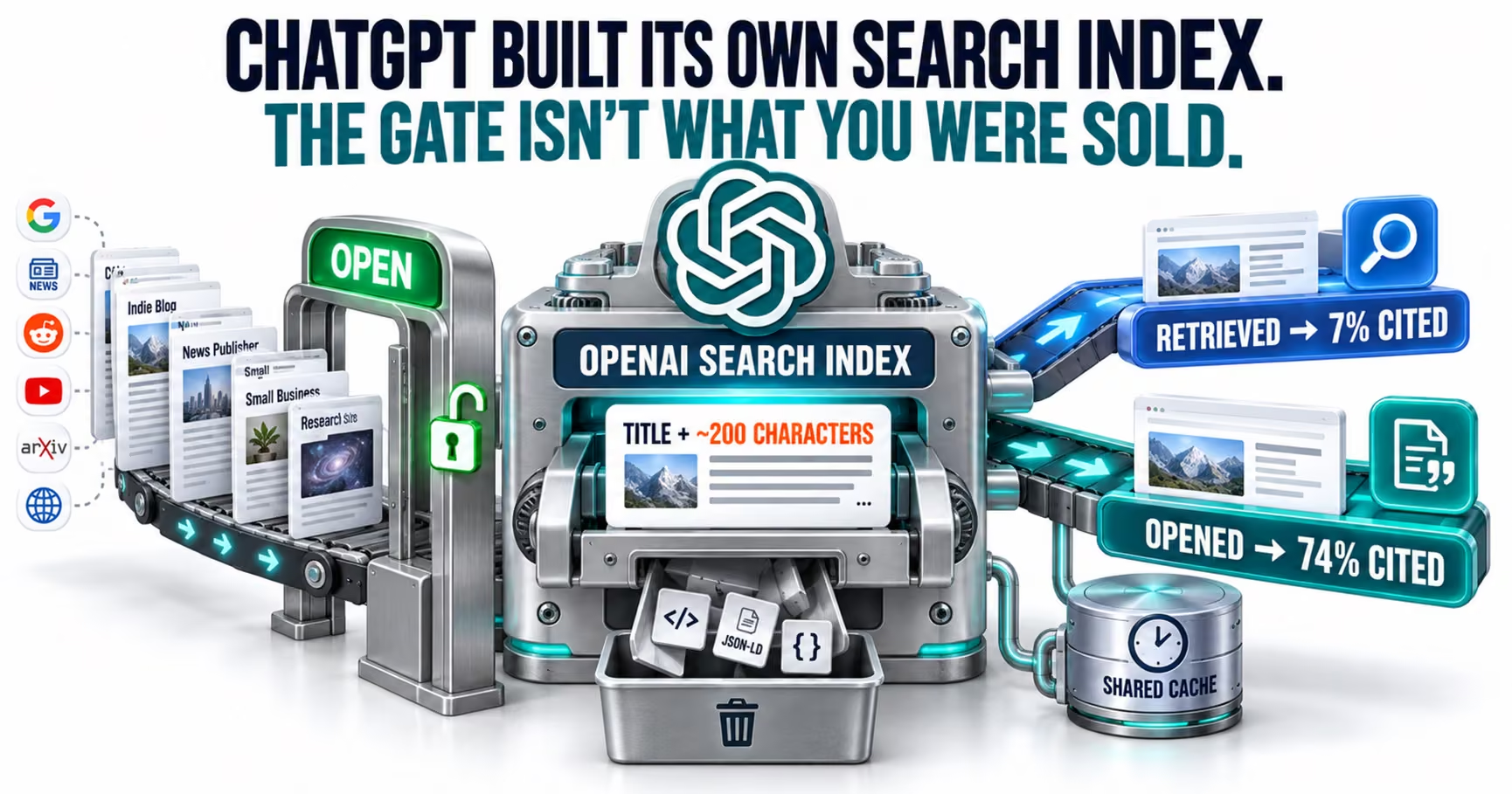
The gate everyone assumed
There is a version of this story circulating that goes: OpenAI built its own index, therefore GEO has a new gatekeeper, therefore you need a new service to get through the gate.
The first clause is true. The rest is worth examining, because the most widely repeated theory about how this index works was publicly withdrawn by the person who proposed it, and the correction travelled far less than the original claim.
What is actually happening is more interesting than a gate, and considerably more useful if you own a website. OpenAI has built something that behaves less like Google's index and more like a very fast, very cheap card catalogue, with rules that would have looked primitive in 2010. Understanding those rules tells you exactly which parts of your page matter and which parts never reach the model at all.
What OpenAI has confirmed, and what it has not
Start with the primary sources, because they are thinner than the discourse suggests.
OpenAI's help centre states that ChatGPT search "leverages third-party search providers, as well as content provided directly by our partners." In a separate document covering HIPAA eligible workspaces, OpenAI writes that when users enable the web search or deep research tool, or when the model retrieves from the web, "it uses information in OpenAI's index." That is the confirmation that an in-house index exists.
OpenAI's crawler documentation covers the access side. OAI-SearchBot is the user agent that governs whether you surface in ChatGPT's search features, and OpenAI is blunt about the consequence of blocking it: sites opted out "will not be shown in ChatGPT search answers, though can still appear as navigational links." GPTBot governs training. ChatGPT-User handles user-initiated fetches, and OpenAI notes that robots.txt rules may not apply to it. We laid out why those three are separate decisions, not one, in AEO vs GEO vs SEO.
What OpenAI has never published is how the index works. Not the pipeline names, not what it stores per page, not the refresh logic, not the relationship between retrieval and citation. As Search Engine Journal noted in August, OpenAI's crawler page "doesn't detail its in-house index or specify what its publisher agreements include."
Everything below that line comes from people reading network traffic. That matters, and I will come back to it.
The licensed-tier theory that got retracted
In June, Suganthan Mohanadasan published a detailed read of ChatGPT's network traffic and described the in-house index as something close to an allowlist, noting it "looks like a licensed tier" and citing domains such as Reuters, The Guardian, the Wall Street Journal and Wikipedia. It was a reasonable inference from what he could see, and it spread quickly, because it confirmed what a lot of people already suspected about AI search consolidating around big publishers.
On July 14 he withdrew it. A reader in Italy using a free account sent captures showing every publisher citation moving through the same pipeline, including small Italian sites. Mohanadasan re-ran his tests and acknowledged in his summary table that he had "over-reached" with the tier claim. The licensing deals are real; the tier reading was an artefact of testing from a single account.
Resoneo, a French SEO consultancy, then ran a much larger test: 1,249 ChatGPT answers captured in July across free and paid accounts, multiple countries and logged-out sessions, with the same prompts replayed across account types. Their finding, reported by Search Engine Journal, was that a licensing deal did not change how a page was served. Same format, same length, same freshness for partners and non-partners alike. Hundreds of outlets with no OpenAI deal were served exactly the way licensed partners were.
The honest conclusion is the opposite of the one being sold. If your worry was that ChatGPT's index is closed to sites without a content deal, the evidence says relax. Publishers may sign deals for revenue, for legal certainty, or for feed-based delivery, but appearing in the index that handles most free-account answers does not appear to be one of the reasons.
What the index actually stores about your page
Here is where it gets useful.
Resoneo compared 534 cited pages against the snippets stored in OpenAI's index. What the index holds is a title and a snippet cut just after 200 characters, and that snippet is usually pulled from the beginning of the page content rather than from your meta description. The Google-scraping pipelines still pick up the meta description roughly one time in three; the in-house index mostly does not.
Of the 463 pages that had an H1, 387 snippets included it. That is 83.6 percent, which means your H1 is very likely the first thing the model reads about your page. The median H1 ran 51 characters, leaving roughly 150 characters of actual content in the budget.
Now consider what most templates print above the first paragraph.
| What the template prints first | How often it appears | What it costs you |
|---|---|---|
| The H1 | 83.6% of snippets include it | A median 51 characters, leaving about 150 |
| A section kicker before the H1 | 29% of pages | About 18 characters |
| A publication date | 11% of pages | About 25 characters |
| The first image's alt text | 9% of pages | Up to 50 characters on its own |
| No H1 at all | One page in seven | The snippet starts with whatever subheading the template supplies |
Writing in Search Engine Land, Resoneo's Olivier de Segonzac called this what it is:
Query-independent snippets are the kind of thing web search left behind about two decades ago, and here they are in 2026, powering one of the world's most-used AI assistants.
The practical translation is unglamorous and immediately actionable. On pages you want cited, the sentence that answers the question needs to sit in the first 200 characters of body content, and everything your template puts above it is spending a budget you did not know you had.
The shared cache nobody is watching
Alongside the index sits a cache, and this is the part that changes how you should read "ChatGPT visited my page."
Working with Jérôme Salomon of Oncrawl, Resoneo found that ChatGPT maintains a cache of every page it has fetched, keyed by URL and shared across all users and all tiers. If a free user in Berlin asks about a page that a paying user in Ohio triggered a fetch on last week, Berlin gets Ohio's copy. Your server sees nothing.
The refresh logic is stale-while-revalidate. A copy is considered fresh for about 30 minutes. Inside that window everyone gets the stored version. Past it, the user still gets the stale copy immediately while a background fetch refreshes it for whoever comes next.
Follow that logic to its conclusion and you get the single most counterintuitive finding in this research: your recrawl schedule is set by exactly one signal, which is how often ChatGPT users ask about your pages. Popular pages stay fresh. Unpopular pages age indefinitely. Salomon documented copies served more than 90 days after the original fetch, with no eviction cap in evidence.
Several things you might expect to control this do not.
Cache-Control: no-storeis ignored. The cached copy is kept and served regardless of what your headers ask for.noindexis ignored. The directive does not keep a fetched page out of the cache or out of answers.- JSON-LD never reaches the model. When a fetched page is converted to Markdown, scripts, iframes and structured data are stripped.
- Hidden text is still read. Text hidden by CSS is extracted, so the robot reads content your human visitors do not see. Image alt text survives too.
That JSON-LD finding lines up with what Google says about its own systems. Google's generative AI optimization guide states that structured data "isn't required for generative AI search, and there's no special schema.org markup you need to add," while still recommending it for rich results. Two very different engines, same conclusion: schema is a classic-search asset, not an AI-answer one.
Retrieval is not citation
The funnel numbers make the stakes concrete.
| Stage | Pages | What it means |
|---|---|---|
| Surfaced into the sources sidebar | 61,332 | Retrieved by the index |
| Became the lead source behind a citation | 5,032 | Credited in the answer |
| Actually opened by ChatGPT | 759 | All in thinking mode |
A page that gets opened ends up cited 74 percent of the time. A page merely retrieved but never opened is cited 7 percent of the time.
Whether you get opened depends on which mode the user is in, and that routing is economic rather than editorial. In instant mode, ChatGPT has a few seconds and no subscription revenue, so it leans on the in-house index and opens nothing: zero pages were opened in 93 percent of captured instant answers. The response is grounded in titles and 200-character snippets, full stop. In paid thinking mode, the expensive tools fire, and roughly 75 percent of search results came from live-purchased Google scraping rather than the in-house index.
Two people asking the same question on different account tiers are therefore querying substantially different systems, which is also why citations shift when the hidden pipelines switch. Resoneo also checked the Bing question three ways and found only 1.5 percent of in-house index URLs appearing in Bing's top 20 for the same fan-outs, with no snippet matches at all. Bing hard-caps titles at 75 characters while 24 percent of in-house index titles run longer, the longest captured at 289.
There is also a measurement trap here. The utm_source=chatgpt.com parameter you see in analytics is appended only to clickable links shown to users. Pages ChatGPT opens on its own in thinking mode carry no such parameter, so the fetches that most strongly predict citation are the ones your analytics cannot see. It is the same read-broadly, cite-narrowly pattern we saw when the ChatGPT citation crash recovered and the rules did not.
The gate that actually matters is volatility
If there is a new gate, this is it, and no vendor can sell you through it.
Around July 21, 2026, OpenAI stopped tagging each search result with the name of the pipeline that fetched it. That field, result_source, was the basis of both investigations described above. It vanished overnight across every monitored account.
Then in August it happened again, faster. On August 16 a ChatGPT web search tool call was JSON. On August 20, on the same account and the same question, it was a compact pipe-delimited query language of OpenAI's own design, and the metadata field that had mirrored the fan-out was gone from the payload entirely. Four days. Mohanadasan, documenting it, noted it was the third format change he had recorded since June, and offered the only durable advice in this whole area:
What was true on a Sunday was gone by Thursday.
The new format is legible, and it says more than the old one. Each line carries a call type, a query, what appears to be a freshness window in days, and sometimes a target domain.
| Query type | Freshness window |
|---|---|
| Stock prices | 2 days |
| Football results | 7 days |
| Commercial product research | 30 days |
| Earnings guidance | 90 days |
Some call types do not return pages at all: product performs a catalogue lookup, business performs a places lookup, and genui_run renders a widget. A stock chart has no link inside it to win. Whole categories of query are quietly moving to surfaces where the citation game does not exist.
One finding deserves its own flag. In a captured conversation about live chat software, 84 of the 221 entries in the retrieval pool were Reddit threads, more than from any other source, and zero of them were credited in the answer. Reddit was fetched for opinion about a candidate set the model had already chosen from memory before searching, then attributed to nobody. Mohanadasan is careful to label the influence as interpretation rather than proof, and Search Engine Journal has covered why Reddit's measured citation drop is not fully explained. The fetching and the zero credits are documented. What they mean is not.
A necessary caveat. Nearly everything in this article after the OpenAI documentation comes from two independent researchers who both run SEO businesses: Resoneo, a consultancy, and Suganthan Mohanadasan, co-founder of an AI SEO agency. Their work is published in Search Engine Land and Search Engine Journal, and it is careful, dated and self-correcting, which is more than most of this field manages. But OpenAI has confirmed none of it, one of its central claims has already been retracted once, and the observability that produced it has since been closed off. Treat these numbers as the best available outside observation of a system whose owner is not commenting. Not as documentation.
What to do about it
- Fix your first 200 characters. On the pages you actually want cited, put the sentence that answers the question at the very top of the body content, and audit what your template prints above it. Kickers, dates and hero image alt text are spending a budget you now know the size of. Check that every one of those pages has an H1, because one page in seven in the sample did not.
- Stop treating structured data as an AI visibility tactic. Keep it for rich results in classic search, where it earns its place, but two separate engines have now independently indicated that it is not what gets you into an AI answer. Reallocate that effort to the top of the page.
- Audit your robots.txt with the crawler distinctions in mind. Blocking
GPTBotis a training and licensing decision. BlockingOAI-SearchBotis a visibility decision that removes you from ChatGPT search answers. Plenty of sites have made the second by accident while intending the first, and the two sit adjacent in the same file. - Measure per engine and stop blending. Google's generative AI performance report gives impressions without queries. Bing's AI Performance gives citations with sampled grounding queries. ChatGPT gives you a
utm_sourceparameter that misses its own most important fetches. Three incompatible instruments, and any single blended AI visibility score is a number somebody invented. - Set the cadence to match the volatility. Three documented format changes in three months, an observability field removed without notice, and a tool language rewritten in four days is not an environment where an annual GEO strategy survives contact. Keep dated snapshots, re-check quarterly at minimum, and be suspicious of any playbook that does not tell you when it was written.
If you want help pressure-testing where you actually stand, that is the shape of our SEO and GEO work.
The durable part has not moved. Crawlable pages, clear titles, and a real answer sitting where an excerpt starts will keep paying off no matter how the plumbing changes underneath.
A note on sourcing: where a finding originates from a commercial SEO consultancy or agency, we credit the researcher by name in the text and link to the independent trade publication that reported it, rather than to the firm's own page.
Frequently Asked Questions
Common questions about GEO, SEO, and AI-driven search visibility.
Yes. OpenAI's own help documentation refers to OpenAI's index, stating that when the model retrieves information from the web it uses information in that index. Independent researchers reading ChatGPT's network traffic in mid 2026 identified four retrieval pipelines, one of which, labelled labrador, is OpenAI's in-house hub covering web results plus news, arXiv, Reddit and YouTube. OpenAI has never publicly documented the pipeline names or how the index works, and describes its stack only as third-party search providers plus content from partners.
No, based on the best available evidence. The French SEO consultancy Resoneo analysed 1,249 ChatGPT answers captured in July 2026 and found no difference in how OpenAI's in-house index served licensed partners and unlicensed sites: same format, same length, same freshness. This backed a correction published on July 14, 2026 by researcher Suganthan Mohanadasan, who had described the index in June as looking like a licensed tier and later said he had over-reached after free-account captures showed small independent sites in the same pipeline.
A title and roughly 200 characters of text. Resoneo reviewed 534 cited pages and found the stored snippet is cut just after 200 characters, usually taken from the beginning of the page content rather than the meta description. Of the 463 pages that had an H1, 387 snippets included it, or 83.6 percent. With a median H1 of 51 characters, that leaves roughly 150 characters of actual content, and section kickers, publication dates and first-image alt text consume part of that budget before your answer begins.
Only as often as ChatGPT users ask about your pages. According to research reported in Search Engine Land, ChatGPT maintains a cache keyed by URL and shared across all users and tiers, using stale-while-revalidate logic where a copy stays fresh for roughly 30 minutes. Past that window users still receive the stale copy immediately while a background fetch refreshes it for the next person. Popular pages stay current and unpopular pages can age indefinitely, with copies documented being served more than 90 days after the original fetch.
Not through the index path. Research reported in Search Engine Land found that when ChatGPT converts a fetched page to Markdown it strips scripts, iframes and JSON-LD, so structured data does not reach the model that way. Image alt text survives, and text hidden by CSS is still extracted. This aligns with Google's own generative AI optimization guide, which states that structured data is not required for generative AI search and there is no special schema.org markup to add, while still recommending it for rich result eligibility in classic search.
Usually not. Across one research corpus, 61,332 URLs were surfaced into the sources sidebar, 5,032 became the lead source behind a citation, and 759 pages were actually opened, all of them in thinking mode. A page that ChatGPT opens ends up cited 74 percent of the time. A page that is merely retrieved but never opened is cited 7 percent of the time. In instant mode, zero pages were opened in 93 percent of captured answers, meaning the response was grounded entirely in titles and 200-character snippets.
Sources
- Search Engine Land: Inside ChatGPT's retrieval stack, the index, cache, and pages it actually reads (opens in a new tab)
- Search Engine Journal: ChatGPT's search index serves small sites too, data shows (opens in a new tab)
- Search Engine Journal: How ChatGPT actually picks sources, I read the network traffic, not the outputs (opens in a new tab)
- Search Engine Journal: ChatGPT rebuilt its search tool, I read the new language it speaks (opens in a new tab)
- Search Engine Journal: ChatGPT already knows who it'll recommend before it searches (opens in a new tab)
- Search Engine Journal: Why Reddit's ChatGPT citation drop isn't fully explained (opens in a new tab)
- Search Engine Land: ChatGPT citations change when hidden search pipelines switch (opens in a new tab)
- OpenAI: Overview of OpenAI crawlers (opens in a new tab)
- OpenAI Help Center: Searching the web with ChatGPT (opens in a new tab)
- OpenAI Help Center: HIPAA eligible products and functionality (opens in a new tab)
- Google Search Central: Optimizing your website for generative AI features on Google Search (opens in a new tab)
- Google Search Console Help: Generative AI performance report (opens in a new tab)
- Bing Webmaster Blog: Introducing AI Performance in Bing Webmaster Tools public preview (opens in a new tab)