

Getting Found vs. Getting Cited: We Fact-Checked the Viral Chart
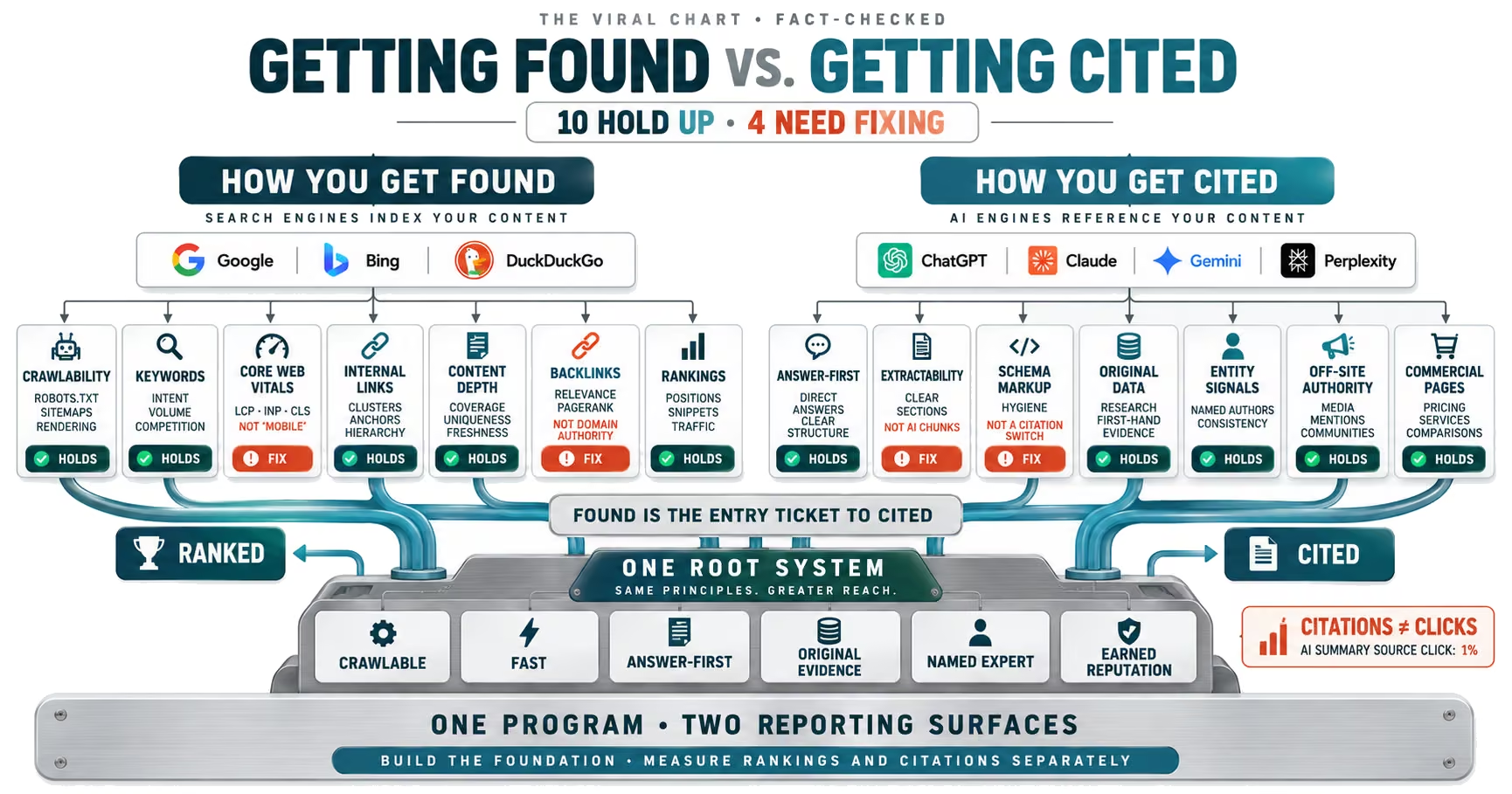
Why this chart deserves a careful read
Most search infographics are either too vague to be wrong or too confident to be right. This one is better than most. It takes the question every marketing leader is asking, whether AI search needs a different playbook, and answers it with fourteen concrete labels. That makes it useful. It also makes it testable.
So we tested it. For each box we asked two questions: does the claim match what the search and AI companies say in their own documentation, and does independent research support it? Where the answer was mixed, we say so. We are not grading the designer, who made a clear and well-structured graphic. We are grading the claims, because brands are already using charts like this to set budgets.
We have done this before with a viral SEO ladder in Rank, answer, cite. The pattern is similar. The instinct is right, and the details need work.
The scorecard
| Box | Verdict | What to know |
|---|---|---|
| Crawlability | Holds | Add AI search bots to the list |
| Keywords | Mostly holds | Difficulty is a tool estimate |
| Core Web Vitals | Needs a fix | Metrics are LCP, INP and CLS |
| Internal links | Holds | Google lists it for AI features too |
| Content depth | Holds | Freshness depends on the query |
| Backlinks | Mostly holds | Google says it ignores domain authority |
| Rankings | Holds | An outcome, not a lever |
| Answer-first | Holds | Backed by the GEO research |
| Extractability | Needs a fix | Google says do not chunk for AI |
| Schema markup | Needs a fix | No measured citation uplift |
| Original data | Holds | Strongest support of any box |
| Entity signals | Holds | Bylines and consistency matter |
| Off-site authority | Holds | Reddit's weight is shifting |
| Commercial pages | Holds | Brand pages gained share |
Ten boxes hold or mostly hold. Four need a fix. Here is the reasoning behind each verdict.
Checking the seven ways you get found
The engine row needs a footnote before the boxes do. Google, Bing and DuckDuckGo look like three engines, but DuckDuckGo says its traditional links are "largely" sourced from Bing, alongside its own crawler. For most brands, that row is two indexes, not three.
Crawlability holds, with a missing line
Robots.txt, sitemaps and rendering are the right three. One clarification: Google says robots.txt "is not a mechanism for keeping a web page out of Google." It manages crawling, not indexing. The missing line is AI search crawlers. OpenAI's crawler documentation says sites that block OAI-SearchBot "will not be shown in ChatGPT search answers," and Anthropic's documentation, reported by Search Engine Journal, warns that blocking Claude-SearchBot may reduce your visibility in Claude's search results. Crawlability belongs in both halves of the chart.
Keywords mostly hold
Intent and volume are sound. Difficulty is a score invented by SEO tool vendors to estimate competition, and every tool calculates it differently, so treat it as a planning aid, not a fact about Google. Keywords also behave differently in AI answers. The Princeton and IIT Delhi GEO study, presented at KDD 2024 and tested on 10,000 queries, found keyword stuffing scored below the unoptimized baseline in generative engines.
Core Web Vitals needs a fix
The box lists load time, mobile and stability. Google's Core Web Vitals are three specific metrics, and mobile is not one of them:
| Metric | Measures | Good score |
|---|---|---|
| LCP | Loading | Under 2.5 seconds |
| INP | Responsiveness | Under 200 ms |
| CLS | Visual stability | Under 0.1 |
Responsiveness is missing from the chart entirely, and it is the metric that measures how quickly a page reacts when someone taps or clicks. Mobile friendliness still matters to page experience, and Google's AI features documentation lists page experience among its best practices for AI Overviews and AI Mode too. Just label it correctly.
Internal links hold
Clusters, anchors and hierarchy are well supported, and Google lists strong internal linking among its recommendations for AI features as well as classic search. We covered why in internal linking for SEO and AI visibility.
Content depth holds
Coverage, uniqueness and freshness all appear in Google's own explanation of ranking. One nuance: freshness is query-dependent. Google says freshness "plays a bigger role" for current news than for dictionary definitions. Updating an evergreen page just to change its date does nothing.
Backlinks mostly hold
Referring domains and relevance are right. Google says one quality factor is whether other prominent websites "link or refer to the content." "Authority" needs care. Google's John Mueller said in 2020 that Google does not use domain authority "at all" in its algorithms, while confirming PageRank is still one of many signals. Domain authority is a vendor metric. Do not buy links to move it.
Rankings hold
Positions, snippets and traffic are outcomes, not inputs. Listing them as a box is fine as long as nobody mistakes the scoreboard for the game.
Checking the seven ways you get cited
The engine row needs a footnote here too, and it is the most important one in the article. These AI tools are not separate from search. OpenAI says ChatGPT search draws on third-party search providers as well as content supplied directly by its partners. Google's Gemini API offers grounding with Google Search, which "connects the Gemini model to real-time web content" and returns citations. TechCrunch reported that Claude's web search appears to run on Brave Search, based on Anthropic's subprocessor list and matching citations, though Anthropic had not confirmed it. Each AI tool retrieves from a search index before it writes. Getting found is the entry ticket to getting cited.
Answer-first holds
Direct answers, clear structure and short paragraphs help readers and machines alike. The research behind GEO supports it. In the GEO study, adding quotations from credible sources was the best single method, improving visibility by about 41% over the baseline, with adding statistics, citing sources and improving fluency close behind.
Extractability needs a fix
Self-contained sections and a clear hierarchy are good writing. "Clean chunks" is where the box drifts. On Google's Search Off the Record podcast in January 2026, Danny Sullivan said of breaking content into bite-sized pieces for large language models: "We don't want you to do that." Write sections that stand on their own because a reader might land mid-page, not because you are trying to feed a model fragments.
Schema markup needs a fix
This box is the most oversold, and two of its three examples are dated. Google says no special schema is required to appear in AI Overviews or AI Mode. FAQ rich results stopped appearing in Google Search on May 7, 2026, and Google has since removed the documentation for the feature.
The citation evidence is weak as well. Search Engine Roundtable reported an Ahrefs study of 1,885 pages that added JSON-LD schema, compared with 4,000 control pages. It found "no major uplift in citations on any platform," and a small, statistically significant decline in AI Overview citations. Ahrefs sells SEO tools, and its own write-up notes the differences were small enough to be noise.
- Schema is not useless. Microsoft's Fabrice Canel said in 2025 that schema markup helps Microsoft's LLMs understand content, and Organization and Article markup still clarify who you are and who wrote what.
- Markup must match the page. Google's AI features guidance says structured data should match visible content. Markup that claims more than the page shows is a liability.
- One study is not the final word. The Ahrefs test covered three platforms over about seven months. Treat schema as hygiene, not a growth lever.
Original data holds, and it is the strongest box
Research, first-hand experience and proprietary numbers have the best support on the whole chart. Google's helpful content guidance asks whether content provides "original information, reporting, research, or analysis" and demonstrates first-hand expertise. The GEO study found statistics addition among the top performing methods. If a brand can only fund one box, fund this one.
Entity signals hold
Named authors and consistent naming are well supported. Google's guidance asks whether pages "carry a byline, where one might be expected" and whether bylines lead to more information about the author. Wikidata deserves a caution: it is a community-edited knowledge base, and an entry for a brand with little independent coverage is unlikely to help. Earn the coverage first.
Off-site authority holds, with a Reddit caveat
Media coverage and mentions have strong correlational support. An Ahrefs study of 75,000 brands found branded web mentions correlated with AI Overview brand visibility at 0.664, compared with 0.218 for backlinks. Ahrefs sells SEO tools, and correlation is not causation, but the gap is large.
Reddit is the shakiest of the three examples. Search Engine Land reported Promptwatch data showing Reddit's share of ChatGPT search citations falling from 3.83% to 0.52% in mid-August 2026, a finding the vendor called provisional. We think Reddit's role in AI answers resembles DMOZ's old role in search, a shortcut that fades as engines get better, and we made that case in Reddit, GEO and the DMOZ lesson. Earn real mentions where your customers talk. Do not try to manufacture them.
Commercial pages hold
Pricing, services and comparison pages answer the questions buyers bring to AI tools. When ChatGPT cut Reddit citations in August, an OtterlyAI analysis of 16 brands found official brand pages gained share in 10 of 15 reports. OtterlyAI sells AI visibility tracking, so read that as one vendor's sample. The direction still favors brands with clear, factual commercial pages.
What the chart leaves out
Three things are missing, and they matter more than any single box.
The first is the overlap. Five of the seven "found" boxes, crawlability, internal links, content depth, backlinks and page experience, are also preconditions for being cited, because AI tools retrieve from search indexes. Splitting them into two charts invites two budgets, two teams and two sets of metrics for what is mostly one job.
The second is measurement. The mug in the chart says "cited and paid, please." Citations and payment are different things. Pew Research found that when a Google result page showed an AI summary, users clicked a traditional result on 8% of visits, against 15% without one, and clicked a link inside the summary on just 1%. Track citations, referral visits and conversions as separate numbers, or you will celebrate visibility that never reaches revenue.
The third is the difference between platforms. The chart treats ChatGPT, Claude, Gemini and Perplexity as one audience. They use different search sources, different crawlers and, as the Reddit data shows, very different source preferences. A brand that only measures one of them is guessing about the rest.
One root system, not two trees
Here is how we would redraw the chart. Put a single foundation at the bottom: crawlable pages, open to both search crawlers and AI search crawlers, fast on the three real Core Web Vitals, and linked into clear topic hierarchies. Above it sits content written answer-first, carrying original data, credible quotations and a named expert. Around it sits reputation: coverage, reviews and mentions you earned. Search rankings and AI citations both grow out of that same base.
That is how we run SEO and GEO at Silverback, as one program with two reporting surfaces rather than two competing budgets. It is also why we do not chase single-box tactics, such as schema sprints, chunked rewrites or manufactured Reddit threads, that promise citations without building the thing citations are supposed to reflect.
How to act on this
- Open your robots.txt to AI search crawlers. Confirm OAI-SearchBot and Claude-SearchBot are allowed, then decide separately whether to allow training crawlers such as GPTBot and ClaudeBot.
- Fix Core Web Vitals by the real metrics. Check LCP, INP and CLS in Search Console's Core Web Vitals report, and add INP to any dashboard that still tracks load time alone.
- Put one original number on every key page. A statistic from your own data, a cited quotation or a first-hand test does more for citations than any markup.
- Add bylines that lead somewhere. Give each expert an author page with credentials, and keep your brand name identical across your site, profiles and listings.
- Keep schema accurate, then stop. Maintain Organization, Article and Product markup that matches the page, and move FAQ markup budgets to better answers.
- Measure both halves separately. Report rankings and organic clicks next to AI citations by platform and AI referral visits, so you can see which half drives revenue.
The chart gets the destination right: brands need to be found and cited. It gets the map slightly wrong by drawing two roads. Build one foundation that search engines can rank and AI systems can trust, and both halves of the chart take care of themselves.
Frequently Asked Questions
Common questions about GEO, SEO, and AI-driven search visibility.
Getting found means a search engine crawls, indexes and ranks your page. Getting cited means an AI system names or links your page inside a generated answer. The two are linked: OpenAI says ChatGPT search uses third-party search providers, and Google's Gemini API grounds answers in Google Search, so a page that cannot be found rarely gets cited.
Not directly, based on current evidence. Google says no special markup is needed to appear in AI Overviews or AI Mode, and Search Engine Roundtable reported an Ahrefs study of 1,885 pages that found adding schema produced no major uplift in AI citations. Schema still helps search engines understand entities, but it is not a citation switch.
Google's Core Web Vitals are Largest Contentful Paint for loading, with a good score under 2.5 seconds, Interaction to Next Paint for responsiveness, under 200 milliseconds, and Cumulative Layout Shift for visual stability, under 0.1. Mobile friendliness matters to page experience but is not one of the three Core Web Vitals.
No. Google's John Mueller said in 2020 that Google does not use domain authority at all in its algorithms, as reported by Search Engine Roundtable. Domain authority is a third-party metric. Google does say it considers whether other prominent websites link to or refer to your content.
Google says no. On the Search Off the Record podcast in January 2026, Google's Danny Sullivan said of chunking content for large language models, we don't want you to do that. Write clear, self-contained sections for readers, but do not fragment pages into bite-sized pieces aimed at AI systems.
Correlation data points that way. An Ahrefs study of 75,000 brands found branded web mentions correlated with AI Overview brand visibility at 0.664, compared with 0.218 for backlinks. Ahrefs sells SEO tools and the study measures correlation, not cause, so treat it as a strong signal rather than proof.
Sources
- DuckDuckGo: Where do DuckDuckGo search results come from? (opens in a new tab)
- Google Search Central: Introduction to robots.txt (opens in a new tab)
- OpenAI: Overview of OpenAI crawlers (opens in a new tab)
- Search Engine Journal: Anthropic's Claude Bots Make Robots.txt Decisions More Granular (opens in a new tab)
- arXiv: GEO: Generative Engine Optimization (opens in a new tab)
- Google Search Central: Understanding Core Web Vitals and Google search results (opens in a new tab)
- Google Search Central: AI features and your website (opens in a new tab)
- Google: How Google Search determines ranking results (opens in a new tab)
- Search Engine Roundtable: Google Still Uses PageRank & No, Google Does Not Use Domain Authority (opens in a new tab)
- OpenAI: Introducing ChatGPT search (opens in a new tab)
- Google AI for Developers: Grounding with Google Search (opens in a new tab)
- TechCrunch: Anthropic appears to be using Brave to power web searches for its Claude chatbot (opens in a new tab)
- Search Engine Roundtable: Google Says Don't Turn Your Content Into Bite-Sized Chunks (opens in a new tab)
- Google Search Central: FAQ (FAQPage) structured data (opens in a new tab)
- Search Engine Roundtable: Study Says Adding Schema Did Not Improve AI Citations (opens in a new tab)
- Search Engine Roundtable: Schema Helps Microsoft's LLMs (Copilot) Understand Your Content (opens in a new tab)
- Google Search Central: Creating helpful, reliable, people-first content (opens in a new tab)
- Ahrefs: An Analysis of AI Overview Brand Visibility Factors (75K Brands Studied) (opens in a new tab)
- Search Engine Land: Reddit's ChatGPT Search citations fell 86% in four days: Report (opens in a new tab)
- OtterlyAI: ChatGPT cut Reddit citations by at least 73% in August 2026 (opens in a new tab)
- Pew Research Center: Google users are less likely to click on links when an AI summary appears in the results (opens in a new tab)