

Ranked #1, Recommended Never: How Products Get Into AI Answers
 Preferred source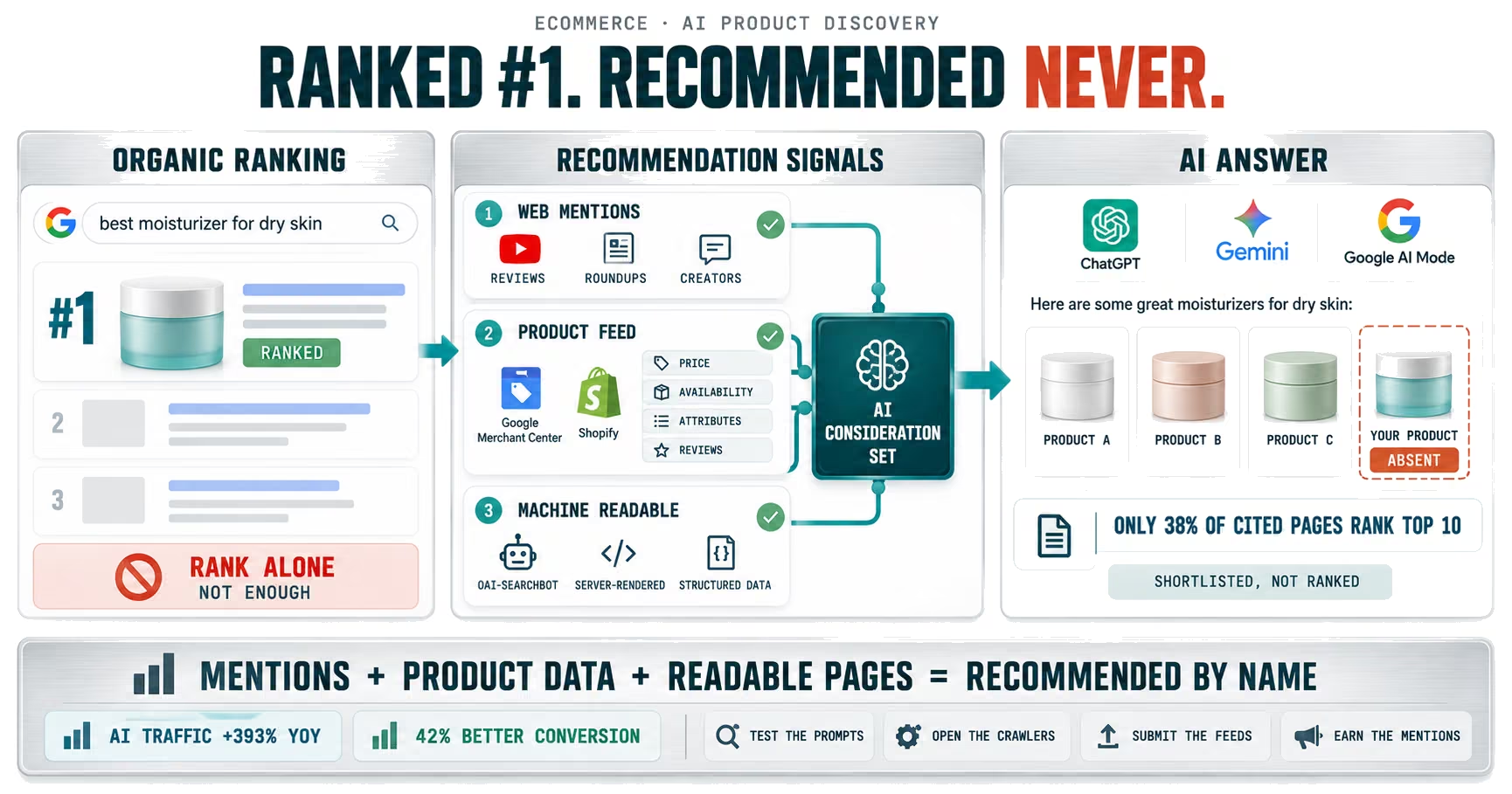
A good LinkedIn post, tested against the data
A version of this argument is making the rounds: there are now three ways to show up in search, SEO, AEO and GEO, and most ecommerce brands only work on the first. Rank higher and win clicks is the old model. Be the answer and get recommended is the new one.
It is a useful framing, and it is also the kind of claim that deserves a stress test before you rebuild a budget around it. We have written about the labels themselves before, including where AEO, GEO and SEO differ. This article does something narrower. It takes each claim in the popular version, checks it against current evidence, and adds what that version leaves out for online stores.
Claim one: ranking no longer guarantees a place in the answer
This one holds up, and the data is stronger than the slogan. Ahrefs, which sells SEO software and so has an interest in how visibility is measured, examined 863,000 keywords and 4 million AI Overview URLs. Search Engine Journal reported that the share of cited pages ranking in the top 10 fell sharply.
| Cited page rank | Share of citations |
|---|---|
| Top 10 (July 2025) | 76% |
| Top 10 (March 2026) | 38% |
| Positions 11 to 100 | 31.2% |
| Outside top 100 | 31.0% |
- Part of the drop may be measurement. Ahrefs said improved parsing since July 2025 may partly explain the change, so treat the size of the swing with care.
- Other studies disagree on the number. Search Engine Journal noted BrightEdge reported roughly 17% top-10 overlap using a different method and dataset.
- Some citations come from search features. Ahrefs noted some cited pages appear in features such as video packs rather than traditional organic listings.
The direction is consistent even where the numbers differ: a ranking is an entry ticket, not a seat. And being cited is not the same as being clicked. Pew Research found people clicked a traditional result in 8% of visits when an AI summary appeared, versus 15% without one.
Claim two: AI recommends products by name, from a short list
Also true, and OpenAI has been unusually specific about how its version works. In ChatGPT, a product appears in the shopping carousel when ChatGPT judges it relevant to the user's intent.
Product results are selected independently by ChatGPT and are not ads, nor influenced by any OpenAI partnerships.
That line comes from OpenAI's help page on shopping in ChatGPT, which says the system considers price, reviews and ease of use, and draws on "structured metadata from first-party and third-party providers" plus other third-party content. Its shopping research feature, launched in November 2025, builds a personalized buyer's guide by reading product pages across retail sites, and OpenAI says the results are organic.
The consideration set really is small. When a shopper asks for a moisturizer for dry skin, they typically see a handful of products, not ten pages of results. If yours is not one of them, you are not ranked lower. You are simply absent.
Claim three: what the web says about you shapes the answer
The popular version says genuine mentions across reviews, Reddit, niche publications and roundups influence AI recommendations. The evidence broadly supports it, with one twist.
Ahrefs studied 75,000 brands across ChatGPT, Google AI Mode and AI Overviews, and The Next Web reported the Spearman correlations with AI brand visibility.
| Signal | Correlation |
|---|---|
| YouTube mentions | 0.737 |
| Branded web mentions | 0.66 to 0.71 |
| Domain rating | 0.266 to 0.326 |
| Page volume | 0.194 |
The twist is that video led, not forums. YouTube mentions beat every other metric, and backlinks correlated only weakly. The researchers were careful to note that correlation does not equal causation: brands people already talk about may simply be the brands that sell well.
Citation data points the same way for retail. Comscore data reported by Search Engine Land found the most cited sources in AI answers for retail searches in June 2026 were YouTube at 23%, Amazon at 14%, Reddit at 12% and Wikipedia at 11%. Reddit matters, as we explored in what Reddit's AI citations teach us about GEO, but it is one voice among several.
The popular version leaves out your product data
For an online store, the most concrete lever is not content or mentions. It is the structured data you hand to the AI platforms directly, and almost every SEO, AEO and GEO explainer skips it.
OpenAI now accepts product feeds from merchants. In March 2026, it said merchants can share product feeds and promotions through its Agentic Commerce Protocol, via third-party providers, or through Shopify Catalog, so their catalogs are fully represented in ChatGPT. Google is doing the same in Merchant Center, where it announced in January 2026 dozens of new data attributes for conversational shopping, such as compatible accessories and substitutes.
Access matters too. OpenAI's crawler documentation says sites that block OAI-SearchBot "will not be shown in ChatGPT search answers." A blanket robots.txt rule meant to keep out AI bots can block OAI-SearchBot along with the training crawlers, and quietly remove you from ChatGPT's answers.
Then there is readability. Adobe scored what AI models can actually read on retail sites and found product pages were the weakest, with only 66% of their content readable, compared with 75% for homepages. Adobe sells analytics and content software, so it has a stake in this problem. The usual culprit is simple: prices, specs and reviews that only appear after scripts run, which many crawlers never execute.
Why this is worth the effort
AI-referred traffic is growing fast, and it converts. Adobe's April 2026 report, based on more than 1 trillion visits to U.S. retail sites, found AI-referred traffic grew 393% year over year in Q1 2026. In March 2026, those visitors converted 42% better than non-AI traffic, a reversal from March 2025, when they converted 38% worse.
The purchase still happens on your site. OpenAI stepped back from in-chat checkout in March 2026 after finding that people researched products in ChatGPT but rarely bought there, repositioning ChatGPT as a discovery layer that sends shoppers to merchants. That makes the recommendation itself the prize. If you are named, the shopper comes to you ready to buy.
Where the three labels help, and where they do not
The SEO, AEO and GEO split is a good way to divide the work. It is a poor way to divide the budget, because the layers share one foundation. Google says there are no additional requirements to appear in AI Overviews or AI Mode beyond sound SEO, and pages that cannot be crawled or indexed are invisible to every layer at once.
| Layer | What it wins | Main lever |
|---|---|---|
| SEO | Rankings and clicks | Crawlable, fast product pages |
| AEO | Place in AI summaries | Direct answers, comparisons |
| GEO | Named recommendations | Mentions, reviews, product feeds |
Think of it as one system with three outputs. Our earlier piece on the three jobs of modern SEO includes a one page test for whether a page can rank, answer and be cited.
What to do this quarter
- Test the prompts your buyers ask. Run your top 20 "best X for Y" questions in ChatGPT, Gemini and Google AI Mode, and record who gets named.
- Check your crawler access. Confirm robots.txt allows OAI-SearchBot and Googlebot, even if you block training bots such as GPTBot.
- Submit your catalog directly. Keep Merchant Center complete, add the new conversational attributes, and apply for ChatGPT product feeds or use Shopify Catalog.
- Make product pages readable. Put price, availability, specs and reviews in server-rendered HTML with matching structured data.
- Earn mentions where buyers look. Prioritize YouTube reviews and creator coverage, then niche publications and genuine community discussion.
- Answer the comparison questions. Publish honest "best X for Y" and head-to-head pages that an AI summary can quote accurately.
The popular post is right that ranking is no longer the whole game. It undersells how concrete the new game is. The brands that get recommended are the ones people talk about, whose products machines can read, and whose catalogs sit inside the AI platforms directly. None of that is mysterious, and all of it is work you can start this quarter.
Frequently Asked Questions
Common questions about GEO, SEO, and AI-driven search visibility.
Yes. Ahrefs data reported by Search Engine Journal in March 2026 found only 38% of pages cited in Google AI Overviews ranked in the top 10 organic results, down from 76% in July 2025, and 31% ranked outside the top 100. Ahrefs noted that better parsing may explain part of the drop, but ranking first clearly no longer guarantees a citation.
OpenAI says a product appears in ChatGPT's shopping results when ChatGPT judges it relevant to the user's intent, taking into account factors such as price, reviews and ease of use. It uses structured metadata from first-party and third-party providers along with other third-party content. OpenAI states that these product results are selected independently and are not ads.
The evidence points that way. An Ahrefs study of 75,000 brands, reported by The Next Web in May 2026, found YouTube mentions had a 0.737 correlation with AI brand visibility and branded web mentions between 0.66 and 0.71, compared with 0.266 to 0.326 for domain rating. Ahrefs notes this is correlation, not proof of cause.
OpenAI says merchants can be included through existing integrations such as Shopify Catalog, or by providing a product feed directly to OpenAI through its merchant application process. Your site should also allow OpenAI's OAI-SearchBot crawler, because OpenAI says sites that opt out of it will not be shown in ChatGPT search answers.
Adobe data suggests it is. Adobe reported in April 2026 that AI-referred traffic to U.S. retail sites grew 393% year over year in Q1 2026, and that in March 2026 it converted 42% better than non-AI traffic, reversing a year earlier when it converted 38% worse.
SEO earns rankings for product and category pages, AEO structures content so answer engines can lift it into AI summaries, and GEO builds the brand signals and product data that lead AI tools to recommend you by name. Google says there are no special requirements to appear in its AI features beyond good SEO, so in practice the three overlap heavily and share one foundation.
Sources
- Search Engine Journal: Google AI Overview Citations From Top-Ranking Pages Drop Sharply (opens in a new tab)
- Pew Research Center: Google users are less likely to click on links when an AI summary appears in the results (opens in a new tab)
- OpenAI Help Center: Shopping with ChatGPT Search (opens in a new tab)
- OpenAI: Introducing shopping research in ChatGPT (opens in a new tab)
- OpenAI: Powering product discovery in ChatGPT (opens in a new tab)
- Retail Gazette: OpenAI pulls back from in-chat shopping as ecommerce reality bites (opens in a new tab)
- The Next Web: YouTube mentions are the top signal for AI brand visibility (opens in a new tab)
- Search Engine Land: Google AI Overviews now appear in 39% of U.S. desktop searches (opens in a new tab)
- Adobe: AI traffic grows but retail sites lag in AI search visibility (opens in a new tab)
- OpenAI: Overview of OpenAI crawlers (opens in a new tab)
- Google Blog: New tech and tools for retailers to succeed in an agentic shopping era (opens in a new tab)
- Google Search Central: AI features and your website (opens in a new tab)