





If One Prompt Replaced Your Agency, the Agency Was the Problem
 Preferred source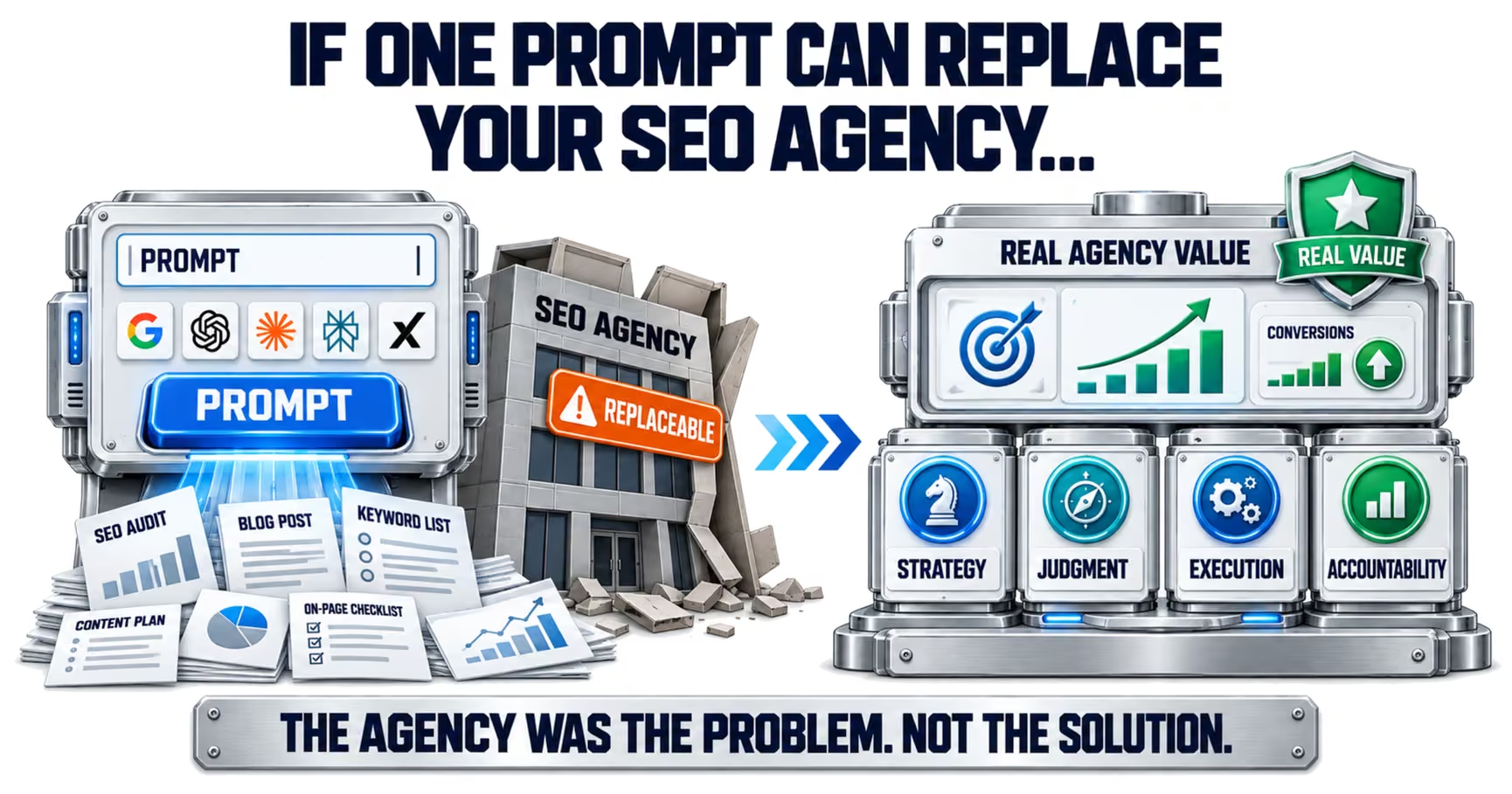
The claim is usually true. That is what makes it damning.
Most agency rebuttals to the one-prompt post are bad, because they start by arguing the claim is false. It generally is not false. If you canceled a retainer, wrote a decent prompt, and got output that looked the same or better, you should believe your own eyes.
The useful question is not whether a prompt matched the output. It is what the output was. A monthly deliverable made of keyword clusters, meta description rewrites, templated briefs and a slide summarizing last month's rankings is a commodity. It was a commodity in 2021 too, it was just expensive to produce, and the expense disguised the commodity. Generative models stripped the disguise off in about eighteen months.
That is the actual content of the flex. It is not evidence that SEO is automatable. It is evidence about what one specific vendor was selling, and the person posting it has usually mistaken the second thing for the first.
Meta is running this experiment from both ends at once
This is the part worth pinning up, because no other company has tested both directions of the argument at this scale in the same year.
| Direction | What Meta did | How it went |
|---|---|---|
| Selling the one prompt | Targeting fully automated ad creation and targeting by the end of 2026: state an objective, connect a bank account, Meta does the rest | Agency holding company shares moved on the news; the pitch is explicitly disintermediation |
| Buying the one prompt | Project OT, an AI-native reorganization drawn up in January 2026 with cuts to some teams of up to 60% | Abandoned by May after major incidents rose 40% and response time rose 70%; a roughly 10% reduction proceeded instead |
| Customers using the product | Media buyers running Advantage+ and Meta's creative AI tools | Advantage+ at 60% to 70% of one agency's Meta spend, but the tools "perform worse" than third-party systems and have "not yet replaced a full account structure" |
On the selling side, Meta wants to be the one prompt. Zuckerberg's framing, quoted by EMARKETER, is that "any business can come to us, say what their objective is, tell us how much they are willing to pay to achieve those results, and then we just deliver as many results as we can." The Wall Street Journal reported the end of 2026 target for fully automated ad creation and targeting. Agency holding company shares moved on the news. The pitch is explicitly disintermediation.
On the buying side, Meta tried to run itself the same way and stopped. We covered Project OT in detail in our piece on firing the SEO team and letting AI run it, so the short version here: an AI-native reorganization drawn up in January 2026, planning cuts to some teams of as much as 60%, abandoned by May. AI-assisted code rose sharply while product improvements reaching users barely moved. Major technical and security incidents climbed 40% year over year and the time spent responding to them rose 70%. Zuckerberg proceeded with a roughly 10% reduction and told remaining staff he did not expect further company-wide layoffs that year.
Then there is a third data point, which is how the product is landing with the people paid to use it. Marketing Brew interviewed media buyers in April 2026 and found the full-automation date is widely considered optimistic. One growth agency founder said Meta's own creative AI tools "perform worse" than the third-party systems he runs, and that repeated testing "consistently see worse results." An SVP at Hawke Media said Advantage+ now accounts for 60% to 70% of the agency's Meta spend but "has not yet replaced a full account structure," that the tools tend to steer spend toward "low-quality placements," and that "there is going to be a level of human interaction needed for brands, in our opinion, for quite some time."
To be fair to Meta, a spokesperson told Marketing Brew that advertisers are not penalized for opting out of AI features, and that changes to its Andromeda retrieval system produced a 14% improvement in ads quality on Facebook. The automation is working in places. It is the end-to-end replacement claim that keeps slipping.
Line those three up and the shape is hard to miss. The company selling you the one-prompt future could not make the one-prompt future work on itself, and its own customers say the product is not there yet.
What the prompt actually replaced
It helps to separate an SEO engagement into two layers, because the flex only ever touches one of them.
| Layer | What it contains | Who should do it in 2026 |
|---|---|---|
| Production | Keyword research and clustering, competitor gap analysis, technical crawl reports, first-draft briefs and outlines, meta descriptions, internal link suggestions, schema generation, monthly reporting | Machines. Defined input, defined output, and they never get bored at item forty |
| Decision | Whether a page should exist, whether a claim is still true, which of three simultaneous changes caused the drop, whether to rewrite or kill the pillar page, what to tell the client when nothing is wrong | A named person. Ambiguous input, and the output is a commitment someone has to sign |
The production layer is everything with a defined input and a defined output. This layer is now better done by machines, which read faster, never get bored at item forty, and do not quietly skip the tedious parts on a Friday afternoon.
The decision layer is everything where the input is ambiguous and the output is a commitment. Should this page exist at all. Is this claim still true in September 2026. Traffic fell 18% this month and a core update, a CDN migration and a new bot rule all landed in the same window, so which one matters. Do we rewrite the pillar page or kill it. What do we tell the client when the honest answer is that nothing is wrong.
A prompt replaces the production layer completely. It cannot touch the decision layer, because the decision layer is not a capability problem, it is an accountability problem. A model cannot be accountable for a call. It can produce the analysis behind one, beautifully, and someone still has to sign it.
If your agency was selling you layer one and calling it layer two, a prompt exposed that. Correctly.
The bill arrives in month six
The one-prompt posts share a tell: they are written in week two. Rankings have not moved yet, the content looks clean, the invoice is gone, and the conclusion feels obvious.
The failure mode in SEO is slow and silent, which is exactly what makes it expensive. Nothing breaks. No alert fires. Then the compounding starts.
Google's John Mueller described the mechanism plainly in September 2026. Writing about a site built by iterating through combinations of attributes, he said programmatic SEO "often leads to a site that's either spam, borderline spam, or low quality," and that Google's "systems have possibly lost faith in your site providing good value to users based on the old pages." On recovery, he was blunt:
Resolving this tends to take time and significant effort to show the value.
Read that as a risk statement rather than a style note. It describes a site-level consequence, which means a section of cheaply generated pages can suppress the parts of the site that were fine. The prompt that produced four hundred pages in an afternoon did not feel like a risk decision at the time. It was one.
None of this makes AI content a policy violation. Google's guidance on generative AI content is explicit that AI assistance is fine and the test is whether the work meets Search Essentials, a point we walked through in does Google penalize AI content. What the spam policies target is scaled content abuse: many pages produced mainly to manipulate rankings without adding value. That is not a description of AI. It is a description of AI with nobody editing it, which is precisely what "I replaced my agency with one prompt" tends to mean in practice.
AI adoption went up. Content results went down.
If the one-prompt thesis were broadly right, we would expect to see performance rising as adoption rose. The opposite happened.
Orbit Media surveyed 1,042 content marketers for its 2026 report. AI adoption hit 92.4%. Only 14% said their blogs delivered strong results, the weakest reading in the survey's 12 year history. Using AI showed no relationship with stronger outcomes in either direction.
The diagnosis inside that data is the part worth quoting. The practices that did correlate with strong results were original research, expert collaboration, keyword research, formal human editing, paid promotion and consistent use of analytics. Every one of those became less common over the year. The industry did not just add AI. It used AI to stop doing the things that were working, and the results followed.
- Orbit Media, 1,042 content marketers. AI adoption at 92.4%, strong blog results at 14%, a 12 year low, and no relationship between the two.
- MIT Project NANDA, enterprise pilots. 95% of generative AI pilots produced no measurable profit and loss impact, with the blame landing on integration and organizational learning rather than the models.
- Klarna, customer service. Replaced the work of 700 agents with an assistant, then reopened human hiring, its CEO conceding cost had become "a too predominant evaluation factor" and the result was "lower quality."
The tools work. The assumption that dropping them into the org chart produces value does not.
What you cannot put in a prompt
There is a reason the failures cluster in the same place. AI absorbs the routine majority of cases and fails unpredictably on the minority that carries the risk, and the minority is where the money is.
Research coordinated by the European Broadcasting Union had professional journalists evaluate more than 3,000 AI assistant responses across 18 countries. Forty-five percent contained at least one significant issue, 31% had serious sourcing problems, and 20% had major accuracy issues including hallucinated and outdated information. That was public service news content, about as clean and well-attributed as source material gets. Your pricing page is not cleaner than that.
The most revealing detail in the whole argument is how Meta staffs its own organic search function. Its SEO Strategy Lead role asks for more than ten years of SEO experience on high-traffic competitive properties, more than three years of people management, and the job is to lead and mentor a team of SEO specialists. In the same period Meta was drafting plans to run itself on AI agents and selling advertisers an end-to-end automation future, nobody there appears to have proposed replacing that role with a prompt library.
Yes, we are an agency making this argument
We should name the conflict rather than pretend it is not sitting there. Silverback sells SEO and GEO services. An article arguing that agencies still have a defensible function is an article arguing you should keep paying people like us. Discount it accordingly, and check every number, all of which are linked.
So here is the version that costs us something.
If your agency is billing hours in 2026 for keyword clustering, meta description writing, first-draft briefs and rank reports, you are being overcharged and you should stop. Those are solved problems, AI does them faster and more consistently than a junior analyst at 4pm, and any agency still pricing them as skilled labor is protecting a margin rather than delivering a service. The person who replaced that with a prompt made a good trade and should be smug about it.
The honest pitch is not that you need the same team you needed in 2021. It is that you need fewer people doing more valuable things, and that the number is not zero. Meta's number is not zero, and Meta had every advantage in getting it to zero.
How to tell which kind of agency you had
You do not need a framework for this. Four questions will do it.
- What did they tell you not to do last quarter, and why?
- Who noticed the last problem before it showed up in the numbers?
- What would they cut from your own site?
- Who signs the call when the data is ambiguous?
Ask what they told you not to do last quarter, and why. A production vendor has no answer, because declining work is not in the business model. A strategic partner will have talked you out of something, and will remember the reasoning.
Ask who noticed the last problem before it showed up in the numbers. If every issue in the relationship surfaced because you asked about it, you were buying reports, not attention.
Ask what they would cut from your own site. Anyone who will only ever recommend making more things is selling volume. The most valuable recommendations in mature SEO programs are usually subtractive, and nobody makes money proposing them.
Ask who signs the call when the data is ambiguous. Not who runs the analysis, who carries it. That is the thing you were actually buying, and it is the one line item a prompt cannot cover.
If those four questions have good answers, a prompt was never going to replace them. If they do not, the post is right about your situation, and the correct response is not to defend the retainer. It is to stop paying for output you can generate yourself, and start paying for judgment, if you need it at all.
- Automate the production layer without apology. Keyword clustering, first-draft briefs, meta descriptions, schema generation and rank reporting are solved problems. If your provider still bills hours for them, that is the line item to cut.
- Keep a named person on the decision layer. Which pages should exist, which claims are still true, and which of three simultaneous changes caused the drop. A model produces the analysis. Someone still signs.
- Judge the prompt in month six, not week two. Site-level trust erodes slowly and silently. Mueller's warning is that recovery takes significant time and effort once Google's systems have lost faith.
- Do not stop the practices that were working. Original research, expert collaboration, keyword research and formal human editing all correlated with strong results in Orbit Media's data, and all became less common the year AI adoption hit 92.4%.
The sequence that holds up under evidence is the same one Meta arrived at the expensive way. Machine finds, human decides. Meta inverted it for four months and its incident rate rose 40%.
Frequently Asked Questions
Common questions about GEO, SEO, and AI-driven search visibility.
It can replace a deliverables vendor, and often does. If the retainer produced keyword lists, meta descriptions, templated briefs and a monthly PDF, a competent prompt matches that output at a fraction of the cost. What it does not replace is the decision layer: which pages should exist, which claims are still true, and who is accountable when a traffic drop has three plausible causes and only one of them matters.
Yes. According to a Reuters special report, Mark Zuckerberg and his leadership team drew up Project OT in January 2026, an AI-native reorganization built on AI agents and smaller teams, with internal planning documents describing cuts to some teams of as much as 60%. The plan lost momentum and the second company-wide layoff wave was abandoned in May 2026 after internal figures showed major technical and security incidents up 40% year over year and time spent responding to them up 70%.
That is the stated goal. The Wall Street Journal reported Meta aims to let brands fully automate ad creation and targeting using AI by the end of 2026, and Zuckerberg has described a future where a business states an objective, connects a bank account, and Meta does the rest. Practitioners interviewed by Marketing Brew in April 2026 said it is likely much further off, with one agency reporting Meta's creative AI tools consistently underperform its own third-party systems.
The correlation is not what most people expect. Orbit Media's 2026 survey of 1,042 content marketers, reported by Search Engine Land, found AI adoption at 92.4% while only 14% said their blogs delivered strong results, a 12 year low. Using AI showed no relationship with stronger results. The practices that did correlate, including original research, expert collaboration, keyword research and formal human editing, all became less common over the year.
Not for using AI, but for what unattended AI tends to produce at volume. Google's spam policies target scaled content abuse, meaning many pages generated mainly to manipulate rankings without adding value. In September 2026 Google's John Mueller warned that programmatic SEO often leads to a site that is spam, borderline spam or low quality, and that Google's systems can lose faith in a site based on those pages, with recovery taking significant time and effort.
Judgment, accountability and the decisions that carry risk, not production. Keyword clustering, first-draft briefs, meta descriptions and rank reporting are solved problems and should be automated. If your provider still bills hours for those, you are being overcharged. The defensible retainer covers prioritization, diagnosis when signals conflict, editorial standards, and a named person who answers for the call.
Sources
- The Wall Street Journal: Meta aims to fully automate ad creation using AI (opens in a new tab)
- EMARKETER: AI-driven ad creation could give Meta more control, decrease need for agencies (opens in a new tab)
- Marketing Brew: How Meta's AI push is changing ad creation (opens in a new tab)
- CTV News (Reuters special report): Mark Zuckerberg had a bold plan to replace Meta staff with AI, here is how it imploded (opens in a new tab)
- CNBC: Meta layoffs starting this week underscore Zuckerberg's AI reality (opens in a new tab)
- Meta job listing: SEO Strategy Lead (opens in a new tab)
- Fortune: Klarna turns back to humans after AI cost focus hurt quality (opens in a new tab)
- Fortune: MIT report finds 95% of generative AI pilots at companies are failing (opens in a new tab)
- Search Engine Land: Content marketing success falls to 12-year low (reporting Orbit Media research) (opens in a new tab)
- Search Engine Roundtable: Google can lose faith in sites based on low value programmatic SEO (opens in a new tab)
- Google Search Central: Spam policies, scaled content abuse (opens in a new tab)
- Google Search Central: Guidance on using generative AI content (opens in a new tab)
- European Broadcasting Union: AI assistants misrepresent news content 45% of the time (opens in a new tab)