





Fire the SEO Team, Let the AI Run It. Meta Tried That in January.
 Preferred source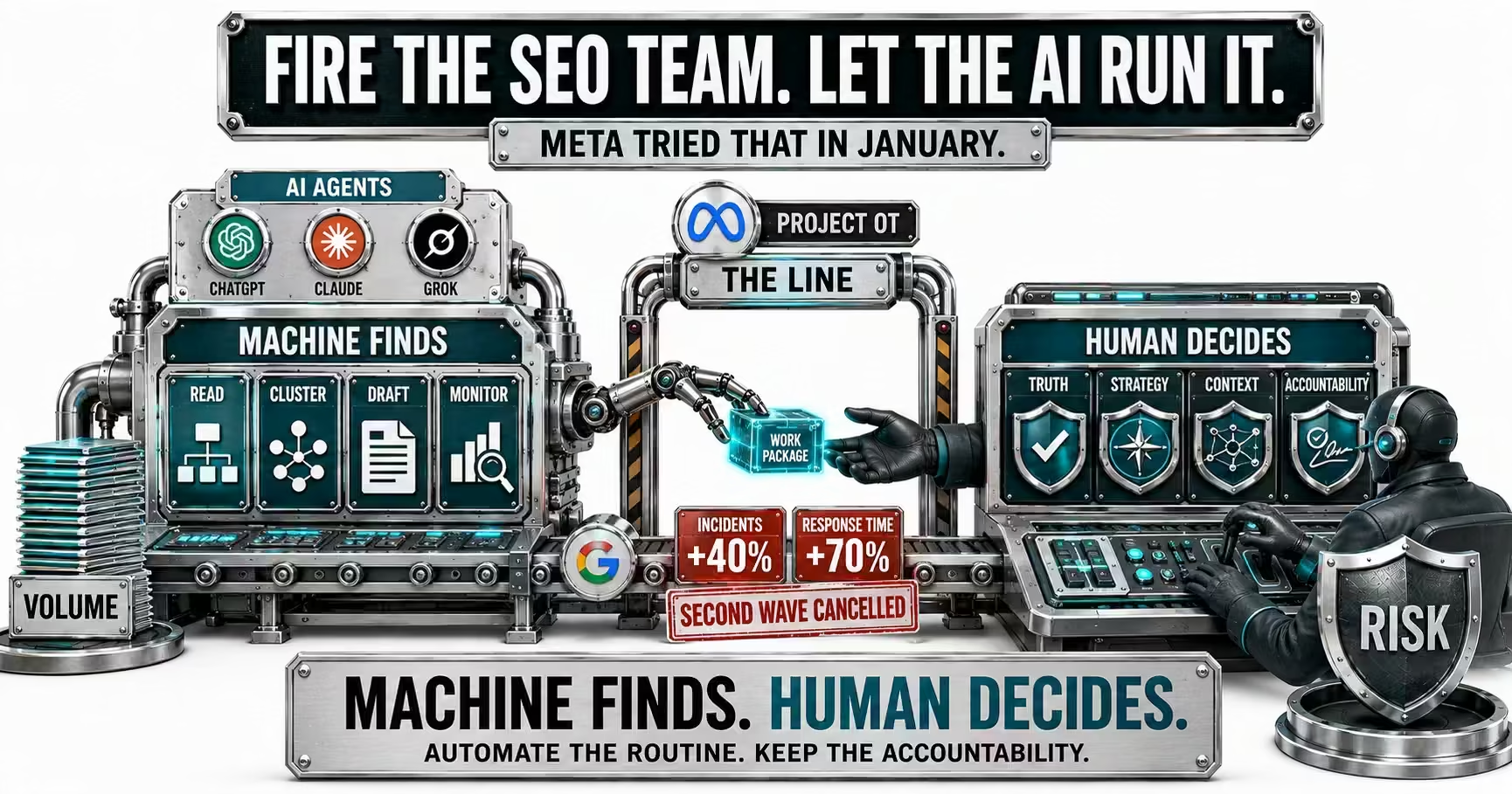
The fantasy is completely reasonable
Let us be fair to the idea before taking it apart, because it is not stupid.
An SEO retainer is expensive. A lot of the work looks automatable: keyword research, briefs, meta descriptions, internal linking suggestions, technical audits, monthly reports that nobody reads past the first chart. Meanwhile the tools have become extraordinary. A model will now read your entire sitemap, cluster your keywords, draft a technical audit and produce a content calendar before you have finished your coffee.
If you are a CFO looking at a line item and a demo, the conclusion is obvious. Cancel the retainer, buy the seats, keep the difference.
Plenty of well-run companies reached exactly that conclusion in the last two years. The interesting question is not whether the logic is appealing. It is what happened to the ones who acted on it.
Meta ran the experiment at a scale you cannot afford
In January 2026, according to a Reuters special report published on 26 August, Mark Zuckerberg and his leadership team met at his Hawaii compound and drew up Project OT, short for Organization Transformation. The plan envisioned an AI-native Meta running on AI agents and much smaller groups of people. Internal planning documents reviewed by Reuters described cutting some teams by as much as 60% through layoffs, hiring freezes and performance exits.
This is the most resourced version of the experiment that will ever be run. Meta has the best available models, effectively unlimited compute, and engineers who build this technology for a living. If replacing people with AI works anywhere, it works there.
It did not work there.
Reuters reported that the plan lost momentum as Meta found its AI tools were not producing the gains executives expected. Internal figures showed a sharp increase in AI-assisted code alongside a much smaller increase in product improvements actually reaching users. In other words: more output, less delivered value. Internal posts said major technical and security incidents had climbed 40% from the prior year, while the time employees spent responding to them increased 70%.
Read those two numbers together, because they are the whole argument. The work did not disappear. It moved. It stopped being visible work that showed up in a roadmap and became invisible work that showed up at two in the morning.
Hours before the first round of layoffs began on 20 May, Zuckerberg abandoned the second company-wide wave, proceeding with a roughly 10% reduction and telling remaining staff he did not expect further company-wide layoffs that year.
It is worth looking at how Meta staffs its own search function, because it is more revealing than any argument we could make. Meta's SEO Strategy Lead role asks for more than ten years of SEO experience on high-traffic competitive properties, more than three years of people management, and the job itself is to lead, mentor and manage a team of SEO specialists. The listed range is $150,000 to $211,000 plus bonus and equity.
To be straight about the timing, that posting predates Project OT rather than following it, so it is not evidence of a post-collapse rehiring spree, and we are not going to pretend otherwise. It is arguably something better. In the same period Meta was drafting plans to run itself on AI agents, its own organic search function was built around a decade-experienced human managing a team of other humans. Nobody at Meta appears to have proposed replacing that with a prompt library.
Klarna got there first, and said the quiet part
Meta was not the first. In February 2024 Klarna announced that its OpenAI-built assistant had done the work of 700 human agents in a single month, handling 2.3 million conversations and cutting average resolution time from 11 minutes to under 2. It was the most-cited AI business case study in the world for about a year.
By May 2025, Klarna was reopening customer service hiring. CEO Sebastian Siemiatkowski's explanation to Bloomberg is worth quoting because executives rarely put it this plainly:
As cost unfortunately seems to have been a too predominant evaluation factor when organizing this, what you end up having is lower quality.
Note what Klarna did not do. It did not switch the AI off. It rebalanced, keeping AI on the high-volume routine tier and bringing people back for the complex tier where quality had slipped. That is the correct lesson, and it is not "AI failed." It is "we drew the line in the wrong place."
Why this keeps happening
MIT's Project NANDA studied the broader pattern in The GenAI Divide: State of AI in Business 2025, drawing on 52 executive interviews, surveys of 153 leaders and analysis of 300 public AI deployments. It found that 95% of enterprise generative AI pilots produced no measurable profit and loss impact.
The important part is the diagnosis. MIT did not blame the models. It pointed at integration and organisational learning. The tools worked. The assumption that dropping them into an org chart would produce value did not.
Line the three cases up and the shape is hard to miss.
| Case | What was tried | What happened |
|---|---|---|
| Meta | Project OT, January 2026: AI agents and smaller teams, with some teams cut by up to 60% | Second layoff wave cancelled; incidents up 40%, response time up 70% |
| Klarna | An assistant doing the work of 700 agents across 2.3 million conversations, from February 2024 | Human hiring reopened by May 2025; the CEO said the cost focus produced lower quality |
| MIT | Project NANDA, 2025: 300 public AI deployments studied, 153 leaders surveyed | 95% of pilots showed no profit and loss impact; integration blamed, not models |
There is a mechanical reason this recurs, and it shows up wherever anyone measures it carefully. AI handles the routine majority of cases well and fails unpredictably on the minority that carries the real risk. Research coordinated by the European Broadcasting Union and led by the BBC had professional journalists evaluate more than 3,000 AI assistant responses across 18 countries. Forty-five percent contained at least one significant issue, 31% had serious sourcing problems and 20% had major accuracy issues including hallucinated and outdated information.
That was news content from public service broadcasters, which is about as clean and well-attributed as source material gets. The failure rate on your product documentation will not be better.
The Reuters Institute's Digital News Report 2026 notes that even across newsrooms embedding AI deeply into workflows and products, the human in the loop principle still holds. These are organisations with standards desks and legal review. If they are not removing the human, a marketing team shipping a pricing page on a Thursday probably should not either.
What this looks like in SEO specifically
The SEO version of the failure is quieter than Meta's, which is exactly what makes it dangerous. Nothing breaks. There is no incident, no alert, no red number in a dashboard. Rankings hold for a while. Then:
- The expired statistic. A figure from 2024 sits in an evergreen guide, still being crawled, still being repeated as current by systems with no way of knowing it expired.
- The three-way pricing contradiction. Three pages describe your pricing three different ways, and a model picks one without telling anybody which.
- The silent crawler lockout. A security team tightens bot rules and quietly locks out the crawlers that feed AI answers, and unlike Googlebot, nothing warns you.
We wrote about the first two failure modes at length in why your website is now the data layer AI builds on. The third is the one almost nobody catches. OpenAI's own crawler documentation is explicit that sites opted out of OAI-SearchBot will not be shown in ChatGPT search answers, which is the sort of thing that is obvious to someone who reads crawler docs for a living and invisible to everyone else. Our AI readiness work exists mostly to catch this category of problem, because it is silent, cheap to fix and expensive to ignore.
None of that shows up in a monthly report. All of it is the kind of thing an experienced person notices in ten minutes and an unattended pipeline never notices at all.
There is also a policy dimension. Google's guidance on generative AI content is explicit that AI assistance is fine and that the test is whether the work meets Search Essentials and the spam policies. What it targets is scaled content abuse: many pages produced mainly to manipulate rankings without adding value. The guidance points readers at quality rater criteria covering content made with little to no effort, little to no originality and little to no added value. That is not a description of AI. It is a description of AI without an editor. We went through those documents line by line in Google sells AI, it is not going to punish you for using it.
Google's people-first content guidance has emphasised first-hand experience and clear authorship for years, and none of that softened when the models arrived. If anything it hardened, because the supply of competent-sounding text with nobody behind it went up roughly a thousandfold.
Yes, we are an agency telling you not to fire your agency
We should name the obvious conflict of interest rather than pretend it is not there.
Silverback sells SEO and GEO services. An article arguing that you should keep paying humans for SEO is, transparently, an article arguing that you should keep paying us. You should discount it accordingly, and you should check every number in it, all of which are linked.
So here is the version that costs us something. A meaningful share of what agencies charged for five years ago should now be automated, and if your provider is still billing hours for keyword clustering, meta description writing, rank reports and first-draft briefs, you are being overcharged. Those are solved problems. AI does them faster and, frankly, more consistently than a junior analyst at 4pm on a Friday.
The honest pitch is not that you need the same team you needed in 2021. It is that you need fewer people doing more valuable things, and that the number is not zero. Meta's is not zero, and they had every possible advantage in getting it to zero.
It is also worth knowing that the shared ground between traditional SEO and AI visibility is larger than most vendors selling you a separate GEO retainer will admit. We put the figure at roughly ninety percent in our piece on why Google's AI advice does not travel. Anyone pitching you a wholly new discipline is selling a replacement, not an extension.
What AI should be running, starting today
Give the machine everything that is high-volume, low-judgment and tedious enough that humans do it badly.
- Reading everything. Every page on a large site, flagging decaying statistics, prices and dates, and finding contradictions between pages.
- Mapping the territory. Clustering keywords, mapping topical coverage, and drafting structure and first passes.
- Watching the logs. Parsing server logs to see which crawlers got what status codes, and monitoring hundreds of competitor pages for changes.
- Summarising the data. Turning a quarter of Search Console data into something a human can interrogate.
These are superhuman capabilities and refusing to use them is its own kind of malpractice. A model will read four hundred articles in an afternoon. No person will ever volunteer for that, and the ones who try get careless around article forty.
What stays with people
Anything that carries accountability. The questions that only a person can put their name to:
- Is this claim still true today?
- Should this page exist at all?
- What does this traffic drop actually mean, when a core update, a CDN migration and a bot rule change all landed this month and only one of them matters?
- Which of this quarter's platform changes affects our business, and which is noise?
- What do we tell the client when the honest answer is that nothing is wrong and they should stop worrying?
Every one of those is a judgment call, and a judgment call is a person putting their name to something. That is not a capability gap that closes with a better model. It is a category difference. A model cannot be accountable, and accountability is most of what you are actually buying.
The sequence that works is simple enough to put on a wall. Machine finds, human decides. Meta inverted it for four months and their incident rate went up 40%.
If you want a straight answer about which half of your SEO programme should be automated and which half will cost you if nobody is watching it, that is what our SEO and GEO work is built around, and it is a conversation worth having before the restructure rather than after. We will also tell you which parts of your current retainer you should stop paying for, which is not a sentence most agencies put in writing.
Frequently Asked Questions
Common questions about GEO, SEO, and AI-driven search visibility.
Not as a full replacement, based on the best available evidence. Meta planned an AI-native reorganisation in January 2026 that internal documents said would cut some teams by as much as 60%, and abandoned the second company-wide layoff wave within months after finding that AI-assisted code rose sharply while product improvements reaching users did not. Major technical and security incidents rose 40% year over year and the time spent responding to them rose 70%. AI reliably absorbs routine execution. It does not absorb judgment, accountability or the ability to notice that something is quietly wrong.
According to a Reuters special report published on 26 August 2026, Meta leadership devised a plan code-named Project OT at a January 2026 retreat, built around AI agents and smaller teams, with internal planning to cut some teams by up to 60%. The plan lost momentum when AI tools did not deliver expected gains. Internal figures showed a sharp increase in AI-assisted code but a much smaller increase in product improvements reaching users, alongside a 40% rise in major technical and security incidents and a 70% rise in time spent responding to them. Zuckerberg cancelled the second company-wide layoff wave hours before the first round began on 20 May 2026.
Yes. In February 2024 Klarna announced its OpenAI-built assistant was doing the work of 700 agents, handling 2.3 million conversations and cutting average resolution time from 11 minutes to under 2. By May 2025 the company was reopening customer service hiring. CEO Sebastian Siemiatkowski said Klarna had focused too much on efficiency and cost, and that the result was lower quality, which was not sustainable. Klarna did not abandon AI. It rebalanced, keeping AI on high-volume queries and bringing humans back for complex ones.
About one in twenty, according to MIT's Project NANDA report The GenAI Divide: State of AI in Business 2025. Drawing on 52 executive interviews, surveys of 153 leaders and analysis of 300 public AI deployments, it found that 95% of enterprise generative AI pilots produced no measurable profit and loss impact. MIT attributed the failures to integration and organisational learning rather than to model quality, which matters: the tools were not the problem.
Google does not penalise content for being AI-assisted. Its published guidance says generative AI can be useful for research and for adding structure to original content, and that the standard is whether the work meets Search Essentials and the spam policies. What Google targets is scaled content abuse, meaning many pages produced mainly to manipulate rankings without adding value. Its guidance points readers at quality rater criteria covering content made with little to no effort, little to no originality and little to no added value, which describes unreviewed output regardless of who or what produced it.
Yes, and at senior level. Meta's SEO Strategy Lead role requires more than 10 years of SEO experience on high-traffic competitive web properties and more than 3 years of people management, with the job being to lead, mentor and manage a team of SEO specialists, at a listed range of $150,000 to $211,000 plus bonus and equity. That listing predates the Project OT plan rather than following it, so it is not evidence of a rehiring reversal. It does show that the company drafting plans to run on AI agents staffed its own organic search function with an experienced human leading a team of humans.
Automate detection, not decisions. AI is superior at reading every page on a large site, flagging decaying statistics, spotting contradictions between pages, clustering keywords, drafting structure and summarising log files. Those are tasks nobody volunteers for and machines never get bored doing. Keep humans on anything that carries accountability: what gets published, whether a claim is currently true, what a traffic drop actually means, and which of this quarter's platform changes matters to your business. Machine finds, human decides.
Sources
- CTV News (Reuters special report): Mark Zuckerberg had a bold plan to replace Meta staff with AI, here is how it imploded (opens in a new tab)
- CNBC: Meta layoffs starting this week stress harsh AI reality inside Zuckerberg's company (opens in a new tab)
- Meta job listing: SEO Strategy Lead, New York (opens in a new tab)
- Fortune: Klarna turns back to humans after AI cost focus hurt quality (opens in a new tab)
- Fortune: MIT report finds 95% of generative AI pilots at companies are failing (opens in a new tab)
- European Broadcasting Union: AI assistants misrepresent news content 45% of the time (opens in a new tab)
- Reuters Institute: Digital News Report 2026 executive summary (opens in a new tab)
- Google Search Central: Guidance on using generative AI content (opens in a new tab)
- Google Search Central: Spam policies, scaled content abuse (opens in a new tab)
- Google Search Central: Creating helpful, reliable, people-first content (opens in a new tab)
- OpenAI: Overview of OpenAI Crawlers (opens in a new tab)