



SEO Fundamentals First: The Build Order for AI Search Visibility
 Preferred source
Every AI answer starts with a retrieval step
The cleanest way to settle the "is SEO dead" debate is to look at how each AI search product decides what it can cite. None of them write answers from nothing. They run searches, pull candidate pages, and then summarize. The rules for getting into that candidate pool look a lot like the rules SEO has followed for twenty years.
| Surface | Entry ticket | Who says so |
|---|---|---|
| Google AI features | Indexed, snippet eligible | Google Search Central |
| ChatGPT search | OAI-SearchBot allowed | OpenAI |
| Bing and Copilot | Crawlable, linked, described | Microsoft Bing |
Google's AI features documentation is blunt about it:
There are no additional requirements to appear in AI Overviews or AI Mode, nor other special optimizations necessary.
The same page says you do not need new machine readable files, AI text files or special schema to appear in Google's features. Microsoft's Krishna Madhavan made the same point for Bing in an October 2025 guide to AI search answers: "Crawlability, metadata, internal linking, and backlinks remain essential for ensuring your content is discoverable."
The research agrees. In the GEO paper by researchers at Princeton University and IIT Delhi, the optimization methods were tested on sources the search step had already returned. Lower-ranked sources gained the most, which is encouraging for smaller brands. But a page outside the retrieved set has nothing to optimize. We made the broader case in why AI visibility is built on SEO. This article is about the practical consequence: the order you do the work in.
The five fundamentals, each with a pass test
A stack only works if you can tell when a layer is finished. Each step below has a pass test. If a step fails, the steps above it are working with a handicap, so fix it before you spend budget higher up.
Step one: audit health, crawl and indexation
Google's technical requirements are three lines long: Googlebot is not blocked, the page returns HTTP 200, and the page has indexable content. Google's AI features page adds one more that catches a lot of teams: crawling must be allowed in robots.txt and by "any CDN or hosting infrastructure." Bot protection that blocks crawlers at the CDN can remove a site from AI answers without anyone touching robots.txt.
The pass test: your money pages return 200, appear as indexed in Search Console, and are not blocked for Googlebot, Bingbot or OAI-SearchBot at robots.txt or the CDN. If you are not sure, a technical SEO audit is the first hour to spend.
Step two: research intent, not keyword lists
Google's SEO Starter Guide still tells site owners to "think about the words that a user might search for," and it warns against repeating them. That warning matters more now. In the GEO paper's benchmark, keyword stuffing scored below the unoptimized baseline on visibility in generative answers.
AI search also widens what "the query" means. Google says AI Overviews and AI Mode can use query fan-out, running several related searches across subtopics. That helps explain why Ahrefs found only 38% of AI Overview citations came from pages ranking in the top 10 for the original query, down from 76% in its July 2025 study, as Search Engine Journal reported. Ahrefs sells SEO tools, and it noted that parsing changes mean the two data sets are not directly comparable.
The pass test: each priority page maps to one primary intent and the five to ten follow-up questions a buyer asks next.
Step three: make the technical layer fast and indexable
Technical SEO is where teams over-invest or under-invest, rarely in between. Google's page experience documentation confirms Core Web Vitals are used by its ranking systems, then adds the line that keeps this in proportion: "Google Search always seeks to show the most relevant content, even if the page experience is sub-par."
So the goal is not a perfect Lighthouse score. It is removing the problems that stop pages from being rendered, indexed and shown: content hidden behind client-side JavaScript, duplicate URLs splitting signals, broken canonicals and slow templates on money pages.
The pass test: key templates render their main content in the HTML, canonicals resolve cleanly, and Core Web Vitals are in the good range for your highest-value page types.
Step four: structure pages so they can be quoted
On-page SEO used to mean title tags and headings for rankings. Now the same structure decides whether a passage can be lifted into an answer. Microsoft's guidance explains why:
AI assistants don't read a page top to bottom like a person would.
Bing describes AI systems breaking pages into sections and ranking those sections, with headings acting "like chapter titles that define clear content slices." A heading that states the question, followed by a direct answer in the first two sentences, serves a skimming person and a retrieval system at the same time. If you use structured data, Google's AI features guidance says it should match the visible text on the page.
The pass test: every priority page answers its main question in the first 100 words under a descriptive heading, and each section can stand alone if quoted.
Step five: publish content that solves the problem
Google's helpful content guidance, which Google last updated on October 5, 2026, says its ranking systems "are designed to prioritize helpful, reliable information that's created to benefit people." Of the E-E-A-T qualities, it says "trust is most important."
In practice this is the step that separates pages AI engines cite from pages they skip. The GEO paper found that adding quotations, statistics and cited sources produced the largest gains, with the best methods improving visibility by up to about 40%. Those are the same things a careful human editor asks for: evidence, specifics and a named source.
The pass test: each priority page contains something a competitor's page does not, such as original data, a worked example, a price, a specification or first-hand experience, and every claim links to its source.
Where the popular stack diagrams get the order wrong
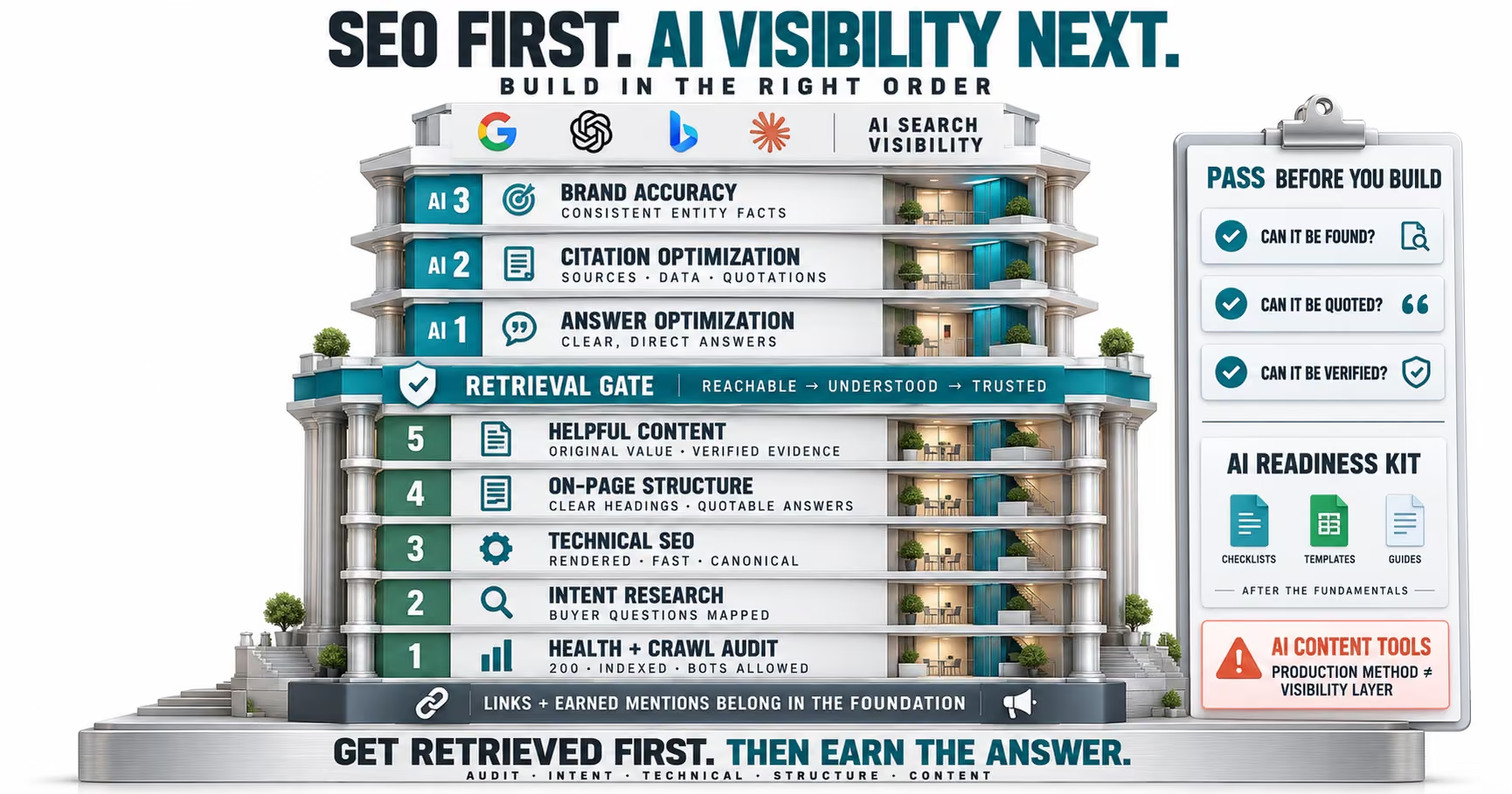
Ten-step stacks that put five SEO fundamentals under five AI layers are a useful way to teach this. Two placements that show up in many versions deserve a correction, because they change where budget goes.
Link building is foundation work, and it is changing shape
Many versions put link building at the top, as the last AI layer. Google's SEO Starter Guide says the opposite about its role: "Google primarily finds pages through links from other pages it already crawled." Bing lists backlinks among the signals that "remain essential." Links belong in the foundation.
What is changing is the type of authority that counts. Ahrefs data reported by Search Engine Journal found branded web mentions had a correlation of about 0.67 with how often a brand appears in AI Overviews, the strongest factor it tested. Ahrefs sells link and brand monitoring tools, the figure came from a podcast rather than a published methodology, and a correlation does not show cause. Still, it points the same way as the GEO research: being discussed by credible third parties matters, linked or not.
AI content tools are a production method, not a layer
"AI SEO" in many diagrams means using AI tools to scale output. That is not a visibility layer. It is a way of producing the content in step five, and it carries the most risk of anything in the stack. Google's spam policies define scaled content abuse as "when many pages are generated for the primary purpose of manipulating search rankings." Its generative AI content guidance, updated October 1, 2026, adds that "generative models don't retrieve facts, but predict a likely sequence of words," and tells site owners to fact-check AI output before publishing.
- Scale without review erodes trust. Google names scaled content abuse as a spam policy violation, and trust is the E-E-A-T quality it weights most.
- Correlation studies are not recipes. The brand mention figure comes from a vendor with a commercial stake and no published method, so treat it as a direction, not a target.
- Benchmarks are not live results. The GEO paper tested generative engines in a research setting in 2023 and 2024, and production systems have changed since.
The AI layers, and the gate before each one
Once the fundamentals pass, the AI layers compound instead of compensating. Answer engine optimization, generative engine optimization and LLM optimization overlap heavily, and the labels matter less than the jobs. For planning, it helps to treat them as three jobs with three gates.
| AI layer | Start when | Measure with |
|---|---|---|
| Answer optimization | Pages indexed, snippet eligible | Search Console AI reports |
| Citation optimization | Content passes step five | Citations in assistants |
| Brand accuracy | Entity facts are consistent | Assistant answer audits |
Answer optimization is the direct answer, featured snippet and AI Overview work: clear question headings, short definitive answers, tables for comparisons. Google's Search Generative AI performance reports, rolled out to all websites on August 31, 2026, show impressions, pages, countries and devices for AI features. They do not show clicks, so pair them with landing page data in your own analytics.
Citation optimization is the GEO work proper: adding statistics, quotations and cited sources, publishing original data, and earning mentions on sites assistants already trust. It also means confirming that OAI-SearchBot and Bingbot can reach the pages you want cited, since OpenAI says opted-out sites will not be shown in ChatGPT search answers.
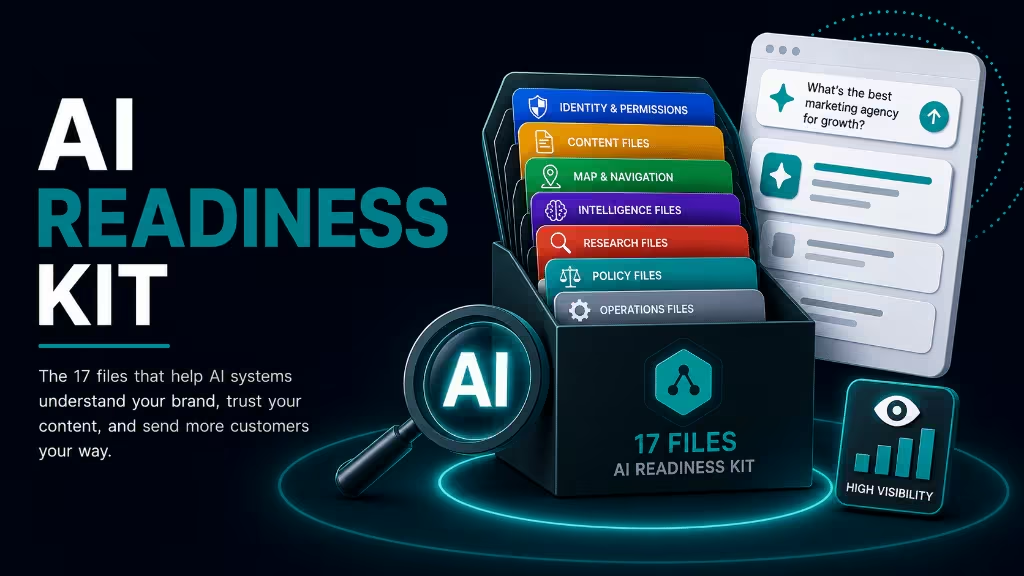
Brand accuracy is the layer most teams skip. Assistants outside Google often describe a business from scattered sources, and they get prices, services and locations wrong. Google says its own features need no special files, so this is not a Google ranking tactic. It is about giving every other assistant a clean, consistent description of who you are. Our AI Readiness Kit generates the files for that job, including robots.txt rules for AI crawlers, llms.txt and an entity file, and our AI visibility service runs the audits that show whether assistants are describing you correctly. Both come after the fundamentals, not instead of them.
Why getting the order right matters more now
The fundamentals decide whether you are in the answer, and being in the answer is increasingly where the click opportunity sits. Pew Research Center tracked 900 U.S. adults in March 2025 and found they clicked a traditional result on 8% of visits when an AI summary appeared, against 15% when one did not. They clicked a link inside the summary on just 1% of visits.
Fewer clicks are on the table, and the ones left go disproportionately to pages the summary cites. A site that skips the foundation to chase AI tactics is competing for that smaller pool with a handicap. A site that fixes the foundation first finds that the AI layers have something to build on.
Where to start
- Run the step one pass test this week. Check that your top 20 money pages return 200, are indexed, and are not blocked for Googlebot, Bingbot or OAI-SearchBot at robots.txt or the CDN.
- Map follow-up questions for each priority page. List the five to ten questions a buyer asks after the main query, and check whether the page answers them in self-contained sections.
- Add evidence before adding pages. Put a statistic, a named source or an original data point on each priority page before commissioning new content.
- Move link building into the foundation budget. Fund digital PR and expert commentary that earn brand mentions, linked or unlinked, on sites your buyers and AI assistants already trust.
- Set a review rule for AI-assisted content. Require a named human fact-check on every AI-assisted page, including titles, structured data and alt text.
- Turn on the measurement you already have. Open the generative AI reports in Search Console and the AI Performance report in Bing Webmaster Tools, and set a baseline before changing anything.
AI search changed how people ask questions and how answers are presented. It did not change what makes a page worth retrieving: it has to be reachable, understood and trusted. Build those five floors first, and every AI layer you add afterward has something solid to stand on.
Frequently Asked Questions
Common questions about GEO, SEO, and AI-driven search visibility.
Yes, because AI search engines retrieve pages before they generate answers. Google's AI features documentation says a page must be indexed and eligible for a snippet to appear in AI Overviews or AI Mode, and OpenAI says sites that opt out of OAI-SearchBot will not be shown in ChatGPT search answers. GEO techniques only help pages that are already in the candidate set.
No. Google Search Central states there are no additional requirements or special optimizations needed to appear in AI Overviews or AI Mode, and no new machine readable files, AI text files or special schema are required. A page needs to be indexed and eligible to be shown with a snippet.
Yes. Microsoft Bing's October 2025 guidance says crawlability, metadata, internal linking and backlinks remain essential for discoverability, and Google's SEO starter guide says it primarily finds pages through links. Ahrefs data reported by Search Engine Journal found branded web mentions had a correlation of about 0.67 with AI Overview appearances, so authority work is shifting toward mentions as well as links.
In the GEO research paper presented at KDD 2024, adding quotations, statistics and cited sources improved visibility in generative engine responses by up to about 40 percent. The Cite Sources method raised visibility by 115.1 percent for a source ranked fifth in search results, while keyword stuffing performed worse than the unoptimized baseline.
You can use AI in production, but Google's generative AI content guidance, updated October 1, 2026, says generating many pages without adding value may violate its scaled content abuse policy. Google also says AI-generated content should be fact-checked and reviewed for accuracy before publishing.
Google launched Search Generative AI performance reports in Search Console in June 2026 and rolled them out to all websites on August 31, 2026. The reports show impressions, pages, countries, devices and dates for AI features, but not clicks, so pair them with landing page data in your own analytics.
Sources
- Google Search Central: AI features and your website (opens in a new tab)
- OpenAI: Overview of OpenAI crawlers (opens in a new tab)
- Microsoft Advertising: Optimizing your content for inclusion in AI search answers (opens in a new tab)
- arXiv: GEO, Generative Engine Optimization (opens in a new tab)
- Google Search Central: Google Search technical requirements (opens in a new tab)
- Google Search Central: SEO Starter Guide (opens in a new tab)
- Search Engine Journal: Google AI Overview citations from top-ranking pages drop sharply (opens in a new tab)
- Google Search Central: Understanding page experience in Google Search results (opens in a new tab)
- Google Search Central: Creating helpful, reliable, people-first content (opens in a new tab)
- Search Engine Journal: Ahrefs data shows brand mentions boost AI search rankings (opens in a new tab)
- Google Search Central: Spam policies for Google web search (opens in a new tab)
- Google Search Central: Guidance on using generative AI content on your website (opens in a new tab)
- Google Search Central Blog: Introducing Search Generative AI performance reports in Search Console (opens in a new tab)
- Pew Research Center: Google users are less likely to click on links when an AI summary appears in the results (opens in a new tab)
- Silverback Marketing: AI Readiness Kit (opens in a new tab)