





One Web, Two Rulebooks: The Week in SEO, GEO, and AI Visibility August 24 to 28, 2026
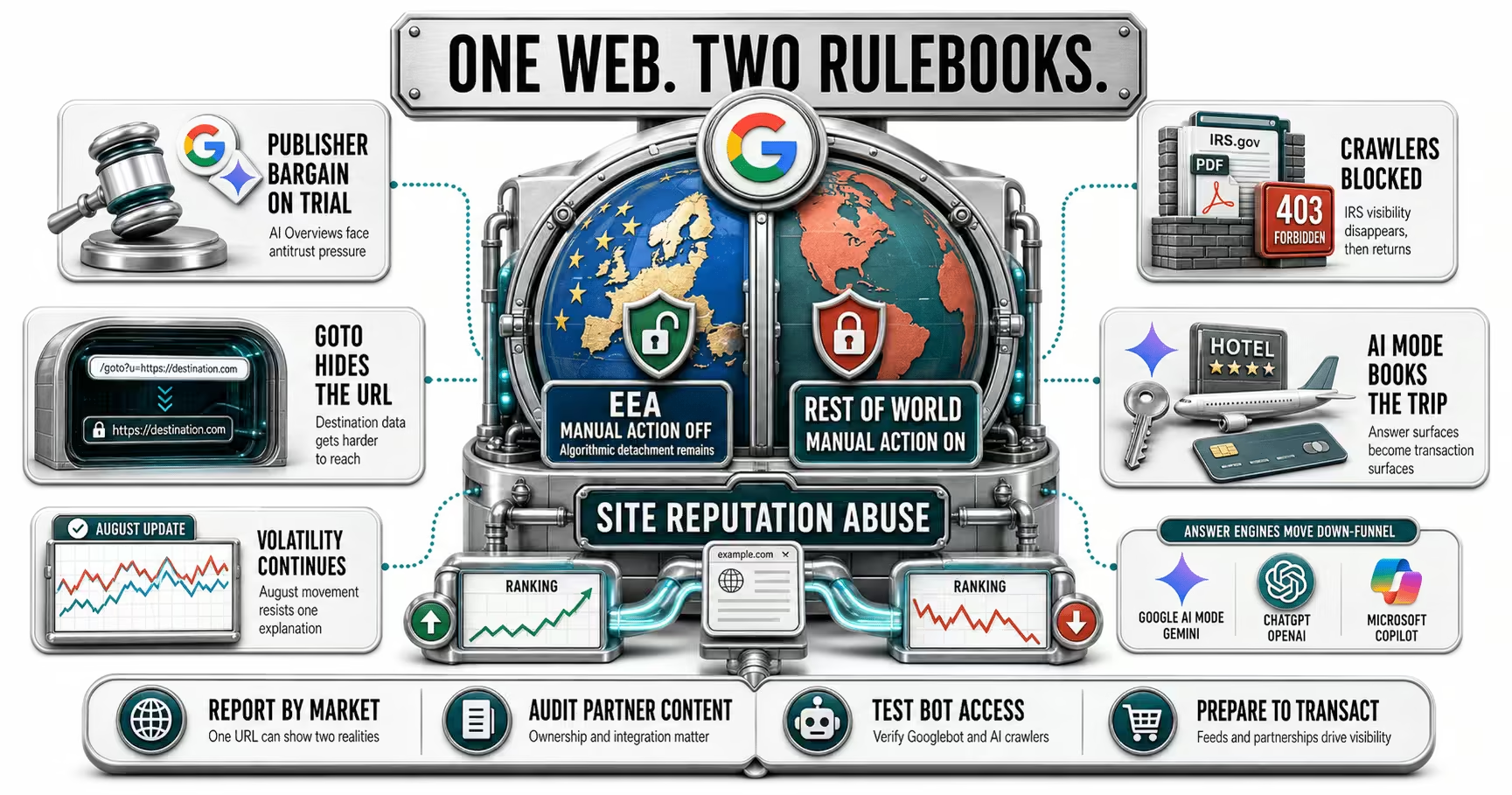
For twenty-something years, the deal with Google was at least consistent. Break a spam policy and you got hit, and it did not matter whether the person searching was in Ohio or Oslo. That ended on Friday. Google announced that starting August 30, manual actions under its site reputation abuse policy will simply stop applying to anyone searching from inside the European Economic Area. Same site, same violation, two different search results depending on where the user is sitting.
That was the headline, but it was not the only thing that happened. A federal judge who already ruled Google an illegal monopolist spent Tuesday poking holes in Google's defense of AI Overviews. Google confirmed it is rewriting every link in its search results to hide the destination URL. The August spam update finished a week ago and rankings still will not settle. And the IRS fell out of Google Search, taking a large chunk of the web's PDFs with it.
Google carves Europe out of its own spam policy
Google published the change on the Search Central blog and Reuters had the regulatory context by Friday morning. From August 30, manual actions issued under the site reputation abuse policy will not affect results shown to users in the 27 EU member states plus Iceland, Norway, and Liechtenstein. Outside that bloc, nothing changes.
The trigger was the European Commission. Publishers complained that Google's policy was demoting legitimate news sites for hosting content from commercial partners, and the Commission opened a DMA investigation. Commission spokesman Thomas Regnier did not mince words about the outcome: "We welcome the repeal of this policy, which unfairly penalised publishers and other business users of Google Search." He added that "thanks to the DMA, Google Search will no longer demote press publications solely for hosting third-party content."
Google's public posture is that it disagrees but complied. A spokesperson told Search Engine Roundtable that "our European users are no less frustrated by parasite SEO and other deceptive, pay-to-play tactics that degrade search results, and we stand by our Site Reputation Policy," while acknowledging the company had "agreed to make changes to our enforcement approach for users in Europe."
Why it matters: this is not a small procedural tweak. Site owners will still receive manual actions in Search Console, and those actions will still suppress the affected pages for everyone outside the EEA. So a UK-facing site with EU traffic now has a split visibility profile from one penalty. If you manage international sites, your reporting needs to account for the possibility that the same URL behaves differently by market for reasons that have nothing to do with hreflang or local relevance.
It also sets a precedent. Once a regulator has forced a jurisdiction-specific carve-out in ranking enforcement, other regulators have a template. This is the first time Google has applied different spam outcomes based on searcher location, and it is reasonable to expect the tactic to be tested again.
There is one important thing the carve-out does not do. Google's algorithmic response remains in play. Inside the EEA, the affected section "may be categorized as separate from the main domain," which means Google stops assuming that section inherits the parent domain's quality and lets it rank on its own merits over time. We covered that independent-measurement machinery in this week's spam update explainer; parasite SEO in Europe is not free. It just stops being a manual penalty and becomes a slower algorithmic detachment.
The same update handed everyone a much clearer parasite SEO rulebook
Buried under the Europe headline, Google rewrote the substance of the policy documentation for all markets, and this part is arguably more useful to most marketers.
Google now names four factors its reviewers weigh when deciding whether third-party content is integrated into a host site: how the content is presented, meaning whether design, formatting, typography, and UX match the host domain; the quality of the content relative to the rest of the domain; stated or implied authorship, meaning whether ownership and editorial responsibility are explicit; and whether the content appears in identical or near-identical form on other sites.
Google was explicit that this is not a checklist you can pass by satisfying three of four. It also stated something that should calm a lot of nerves: human reviews under this policy are rare, and Google "generally applies a presumption that individual pages (including new pages) match the overall quality of other pages on the domain."
The worked examples are the practical gold. A curated coupons and deals section is unlikely to draw action when the publisher organizes it for its own audience, discloses the commercial relationship, takes editorial responsibility, and integrates it into site navigation. Freelance-written affiliate content is unlikely to draw action when the freelancer is credited, the content is original to that publication, and affiliate links are disclosed. What does draw action is the unauthored, undisclosed, unlinked article that duplicates a third-party marketplace's copy and matches nothing about the host site's presentation or quality.
Why it matters: most of the anxiety around parasite SEO has come from ambiguity. Publishers with legitimate partner content have been unsure whether they were exposed. This documentation draws the line where most experienced editors would have drawn it anyway: if a human being at your organization is responsible for the content and a reader can tell, you are on the right side of it. If you have partner sections running on autopilot, this is your specification for fixing them.
A judge calls the publisher bargain "really unfair"
On Tuesday, Judge Amit Mehta heard argument on Google's motion to dismiss Penske Media's antitrust suit over AI Overviews. Mehta is the judge who found Google to hold an illegal search monopoly in the 2024 government case, so his read on this matters.
According to Jason Kint of Digital Content Next, who attended and whose account was reported by Search Engine Journal, Google's attorneys described AI Overviews as a "product improvement" and characterized the decades-old trade of crawling access for traffic as a "vague historical course of dealing." Mehta pushed back, saying the situation "all seems really unfair," noting that publishers lack control over how their content is used, describing the product improvement as built "on the backs of the publishers," and adding that product improvements "are not immune from antitrust scrutiny."
Mehta also picked up on the economics. Penske argued that OpenAI and Perplexity pay for content inputs while Google obtains the same inputs at zero cost by using its search monopoly, which raises rivals' costs. Mehta observed that a market for generative AI inputs is clearly forming.
Why it matters: no ruling yet, and a judge's skeptical questions are not a verdict. But if this case survives dismissal, discovery gets uncomfortable and the theory that AI answer generation is separable from search itself gets a real test. For marketers, the practical read is that the "opt out if you don't like it" answer is now under legal pressure, because opting out of AI Overviews means opting out of the traffic they send. Watch this docket. It is the most consequential open question about how content will be valued in AI search.
Google is now hiding where its links go
Google confirmed on Wednesday that it is rolling out google.com/goto redirect URLs across search results. Hover a result and you no longer see the destination. You see an encoded passthrough.
Derek Perkins of Nozzle reported seeing "nearly a 100% rollout across several residential ip providers," and described what Google has built: anti-bot measures that eliminate client-side links in favor of server-side redirects. His key point is the scaling problem. The goto links cannot be decoded, so any tool that wants the real URL has to follow each redirect, and a single results page carries hundreds of them.
Google's statement was terse: "We have a long history of deploying technical measures against evolving forms of abuse, and we regularly take steps to protect our services and users."
Why it matters: two effects. First, rank tracking and SERP analysis get more expensive to run, which will eventually show up in what your tools cost or how fresh their data is. Google has been suing SerpApi over scraping, and this is the engineering complement to the lawsuit. Second, and more interesting for GEO, this is Google raising the cost for AI companies that use its index as a shortcut to understanding the web. If you have been assuming that AI systems see roughly what Google sees, that assumption gets shakier from here. The paths into an AI answer engine and the paths into Google are diverging, and your measurement should reflect that.
The August spam update finished, and rankings kept moving anyway
Google's August 2026 spam update ran from August 18 to August 21, so it closed before this week began. The volatility did not. Search Engine Roundtable documented continued turbulence across most of the third-party tracking tools on Wednesday, including AWR, Sistrix, Algoroo, Mozcast, Wincher, and SimilarWeb, and Barry Schwartz wrote that "it is like Google is pushing out a new Google ranking update post-spam update and did not announce it."
Site owner chatter matched the tools. One comment quoted in the coverage captured the mood: "It's pointless because you can't build a business on this kind of unpredictability." Glenn Gabe flagged one site with roughly 1.3 million URLs and heavily programmatic content taking a large hit from the spam update itself.
Why it matters: August has been unusually noisy even by Google's standards, with movement around August 1 to 3, August 5, August 13, the August 18 to 21 spam update, and now the days after. If you are reporting on August performance, resist the urge to attribute a change to any single event.
The IRS disappeared from Google, and PDFs went with it
The strangest story of the week started with PDFs. Savanna Gray at Amsive noticed sharp drops in clicks to PDFs in Search Console, Lily Ray amplified it, and others confirmed the pattern. One marketer reported a top-performing PDF going to zero impressions starting August 18. Searches for common IRS forms stopped returning the IRS PDFs and started returning third-party pages instead.
Then it got worse. The IRS site itself tanked in visibility, lost its favicon, and lost its snippet descriptions, which is the classic signature of Google being unable to fetch a page. Lily Ray reported being unable to load the site as a human on desktop. Other government sites showed similar symptoms. Schwartz's read is that federal bot-blocking was configured too aggressively and caught Googlebot alongside the bots it was meant to stop. By early Thursday morning, IRS PDFs were starting to reappear.
Why it matters: this is the cleanest possible reminder that crawlability sits underneath everything else you do. An organization with essentially unbeatable topical authority lost rankings on queries like tax brackets and free tax filing because of an infrastructure decision, not a content or link decision. If your security team has added or tightened bot management this year, and most have, go verify that Googlebot and the AI crawlers you actually want are still getting through. Run live tests rather than trusting the configuration. The same aggressive rules that block scrapers block the crawlers that feed AI answers, and there is no Search Console equivalent to warn you when GPTBot or ClaudeBot gets a 403.
AI Mode keeps moving down the funnel
Google shipped a set of travel features into AI Mode on Thursday. You can now book hotels directly inside AI Mode using Google Pay, with launch partners including Booking.com, Expedia, Hilton, Marriott, IHG, Choice, Priceline, Trip.com, Hotels.com, and Wyndham. Flight price tracking arrived in more than 180 countries, drawing on data from more than 300 partner airlines and travel sites. And AI Mode will now show live rates in points or miles for several airline and hotel loyalty programs.
Google also brought link carousels for developing topics from AI Overviews into AI Mode. Robby Stein framed the goal as making it "easy to connect with original coverage and a range of perspectives." Not everyone bought it. The publisher behind Inspired Taste replied that AI Overviews are being used to directly replace publishers, pointing to a branded recipe query where an AI-generated recipe outranked the actual source.
Elsewhere in the AI surfaces: Microsoft tested renaming the Copilot Search answer box on Bing to "AI Overviews," which is a striking bit of category consolidation given that Google coined the term. OpenAI pinned Shopping to the ChatGPT sidebar with its own landing and search pages. And Google confirmed AI Mode is now live in Chrome in the UK.
Why it matters: the answer surface is becoming a transaction surface. For travel, retail, and local businesses, the strategic question is shifting from "will my page rank" to "am I in the partner set that the assistant can actually book through." Those are different problems with different owners inside a company. Feed hygiene, structured data, booking integrations, and partnership status are becoming visibility work, not just ecommerce work. The link carousels are worth mild optimism: they show that pressure from publishers and regulators produces link surfaces inside AI answers. They do not show that the traffic economics have changed.
Google's official line on GEO has not moved an inch
John Mueller, asked about optimizing for generative AI responses, wrote on Bluesky: "from our POV there's nothing really special you need to do for generative AI responses in search." He later noted he had not fully understood the question, but the statement is consistent with everything Google has said for two years. Microsoft Bing, notably, does not agree and has published advertiser guidance on AEO and GEO.
Why it matters: Google's position is defensible for Google's own surfaces, where AI Overviews and AI Mode run on the same index and quality systems as blue links. It is weaker as advice for the wider landscape, because ChatGPT, Perplexity, Claude, and Copilot each retrieve differently, cite differently, and in some cases run separate crawlers. We published the full evidence for exactly where that claim breaks down this morning. Treat "SEO is enough" as a claim about Google, not about AI visibility generally. Both things are true: the fundamentals carry most of the weight, and non-Google retrieval still needs separate measurement.
Where to spend an hour this week
- Add a market dimension to visibility reporting. The EEA carve-out means one manual action now produces two realities, and publishers running partner content should audit those sections against Google's four factors this week: named author, named editor, disclosed relationship, matching design, linked navigation, no verbatim supplier copy.
- Slow down before blaming the spam update. August had at least four separate volatility events plus a documented PDF and crawlability mess. Timestamp your drop against the confirmed windows before building a remediation plan.
- Verify your crawlers are getting through. The IRS story is what happens when bot management and SEO do not talk. Test Googlebot and the AI user agents you want, from outside your own network, rather than trusting the configuration.
- Reduce dependence on any single SERP data source. The goto rollout will degrade some third-party tracking over the coming months. Lean harder on first-party data.
- Ask what it takes to join the transaction layer. If you sell anything bookable or shippable, find out what membership in AI Mode's and ChatGPT Shopping's partner sets requires. That is business development, which is exactly why it tends not to happen.
Frequently Asked Questions
Common questions about GEO, SEO, and AI-driven search visibility.
On August 28, 2026, Google announced that starting August 30, manual actions issued under its site reputation abuse policy will no longer affect search results shown to users inside the European Economic Area, which covers the 27 EU member states plus Iceland, Norway, and Liechtenstein. Outside the EEA, manual actions continue to work as before and will suppress the affected portion of a site. Google made the change after the European Commission opened a Digital Markets Act investigation into complaints that the policy was demoting publishers for hosting commercial partner content. This is the first time Google has applied different spam policy outcomes based on the searcher's location.
No. Google will still issue manual actions and still notify site owners in Search Console, and the algorithmic side of enforcement remains active inside the EEA. Google's documentation says the affected section of a site may be categorized as separate from the main domain, which means Google stops presuming that section shares the parent domain's quality and lets it rank independently over time. In practice, parasite content in Europe moves from a fast manual penalty to a slower algorithmic detachment from the host domain's reputation. Manual actions also continue to apply in full to everyone searching outside the EEA.
Google's updated documentation, published August 28, 2026, names four factors that reviewers weigh: whether the content's presentation, including graphic design, formatting, typography, and UX, is consistent with the host domain; whether the content has quality issues that do not appear elsewhere on the domain; whether authorship and editorial responsibility are explicitly acknowledged; and whether the same content appears on multiple other sites in identical or near-identical form. Google states these are not a pass-fail checklist and that it assesses the overall situation, and it notes that human reviews under this policy are rare.
It is a server-side redirect that Google confirmed on August 26, 2026 it is rolling out across search results, replacing direct links to destination sites with an encoded passthrough URL. Google began testing it in July 2026 and told Search Engine Roundtable it has a long history of deploying technical measures against evolving forms of abuse. Derek Perkins of Nozzle reported it at nearly a 100 percent rollout across several residential IP providers and noted the links cannot be decoded, so scrapers must follow each redirect individually, which is impractical at the scale of hundreds of links per results page. The move follows Google's ongoing lawsuit against SerpApi over search result scraping.
Between roughly August 25 and August 27, 2026, IRS.gov lost visibility across major queries including tax brackets and free tax filing, and its search listings appeared with a broken favicon and no snippet description, both signs that Google could not fetch the pages. The problem surfaced alongside a broader drop in PDFs appearing in Google Search, first flagged by Savanna Gray at Amsive and amplified by Lily Ray, who reported being unable to load the IRS site as a human user. The likely cause is federal bot-blocking configured aggressively enough to catch Googlebot. IRS PDFs began returning to results early on August 27.
Google's position, restated by John Mueller on August 25, 2026, is that there is nothing really special you need to do for generative AI responses in search. That claim is defensible for Google's own AI Overviews and AI Mode, which are built on the same index and quality systems as traditional results. It is weaker as general advice, because ChatGPT, Perplexity, Claude, and Microsoft Copilot retrieve and cite through different pipelines, and Microsoft Bing has published its own AEO and GEO guidance that departs from Google's stance. Strong technical SEO and useful content do most of the work everywhere, but crawler access and citation performance on non-Google systems need to be measured separately because nothing in Search Console reports on them.
Sources
- Google Search Central Blog: Update to the Site Reputation Policy (opens in a new tab)
- Reuters: Google changes spam policy in EU to avert antitrust fine (opens in a new tab)
- Search Engine Roundtable: Google Won't Enforce Its Site Reputation Policy Manual Actions In Europe (opens in a new tab)
- Search Engine Journal: Google Updates Site Reputation Abuse Policy, Removes Penalties In EEA (opens in a new tab)
- Search Engine Journal: Judge Says Google and Publisher AI Situation Seems Really Unfair (opens in a new tab)
- Search Engine Roundtable: Confirmed, Google Search Rolling Out google.com/goto Tracking Parameters (opens in a new tab)
- Search Engine Roundtable: Google Search Ranking Volatility Continues Post Spam Update (opens in a new tab)
- Search Engine Roundtable: IRS Website Drops Heavily In Google Search (opens in a new tab)
- Search Engine Roundtable: Google Search Showing Fewer PDF Files (opens in a new tab)
- Search Engine Roundtable: Google AI Mode Adds Flight Price Tracking, Mile Rates and Hotel Booking (opens in a new tab)
- Google Blog: Book travel in AI Mode (opens in a new tab)
- Search Engine Roundtable: Google AI Mode Also Gains Link Carousels For Developing Topics (opens in a new tab)
- Search Engine Roundtable: Bing Tests Renaming Copilot Search Answer To AI Overviews (opens in a new tab)
- Search Engine Roundtable: OpenAI Pins Shopping To ChatGPT Sidebar (opens in a new tab)
- Search Engine Roundtable: Google Says There Is Nothing Special To Do For Generative AI Responses In Search (opens in a new tab)