

A Preannounced Core Update and AI Link Rules: Nov 23 to 27, 2026
 Preferred source
A holiday week that changed how Google talks about ranking
Thanksgiving weeks are usually quiet in search. This one was not. In a single day, Google closed out a two week core update, announced another one weeks in advance, and published a cluster of documentation that reads less like advice and more like a compliance filing.
The common thread is accountability. Google wrote down how it ranks, when it will warn you, how to complain, and how its AI answers pick sources. At the same time, the AI surfaces that compete for your visibility kept moving in the other direction, with fewer early links, looser shopping disclosures, and ads that are harder to tell apart from answers. If you read last week's roundup on Google-Agent access and AI coupons, this week is the policy layer sitting on top of those product changes.
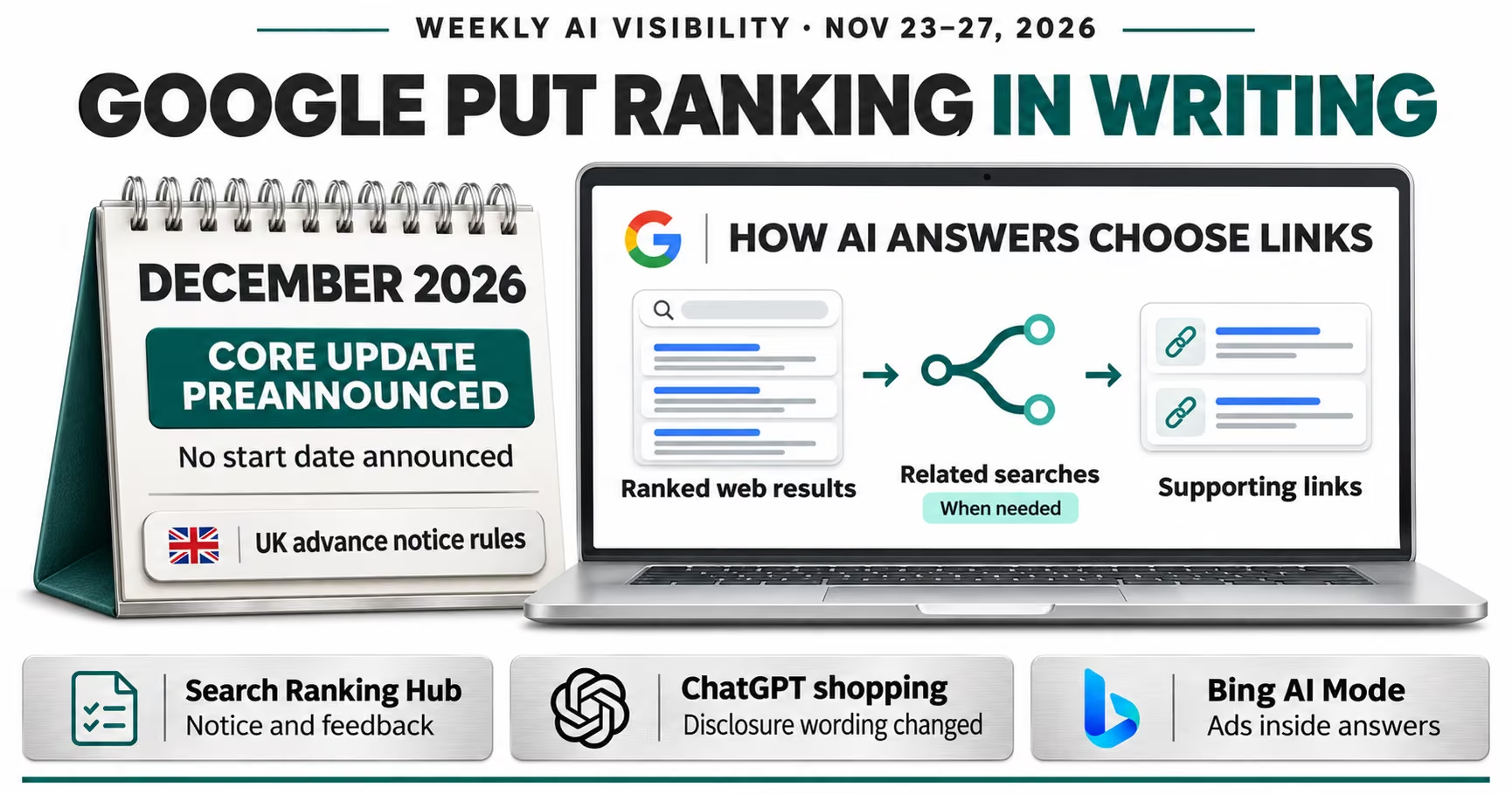
Google preannounced a core update for the first time
The Google Search Status Dashboard entry, posted at 7:03 am Pacific on November 24, reads:
Preannounced the December 2026 core update, which focuses on multiple improvements to how our systems understand and rank relevant content (including for longer and more complex questions), as well as improving personalized results for people who have personalization turned on.
Google added that the update applies to all locations and languages and is "scheduled to be released in December 2026." That is all the timing it gave. A Google spokesperson told Search Engine Roundtable that there is no date yet, that the update is "not imminent," and that Google will announce it the day it starts. Barry Schwartz noted that the dashboard listed the incident as active, and that Google confirmed three times it had not started.
This is a reversal. Search Engine Roundtable points out that Google has said many times it does not preannounce core updates, and once called it impossible.
The announcement landed hours after the November update ended. According to the dashboard entry for that update, the rollout was complete as of November 24, and Search Engine Roundtable's wrap-up puts the finish at about 9:03 am ET after 14 days.
| Date | Event |
|---|---|
| Nov 10 | November update starts |
| Nov 14 | First visible impact |
| Nov 24 | November update ends |
| Nov 24 | December update announced |
| December | December update launches |
Search Engine Roundtable reports that most sites did not feel the November update until around November 14, four days after launch, and that the usual second wave of movement never clearly showed up.
Why it matters. Two core updates within roughly a month means your November data will be contaminated before you finish reading it. Google's own guidance on staying informed tells site owners to wait until an update is marked complete, plus at least a week of post-rollout data, before evaluating traffic. For November, that window closes around December 1. If December launches soon after, you get a short gap to capture a clean baseline. The focus areas are also a signal: longer, complex questions are the queries that trigger AI Overviews and AI Mode, so expect this update to touch AI visibility as much as blue links.
The ranking hub exists because of a UK regulator
Google launched a Search ranking hub in Search Central with three new pages: principles for ranking results, the notice policy, and a page on submitting feedback about ranking changes. The notice page is the important one, and it names its reason:
Additionally, for changes where UK users may experience a significant ranking shift, we provide advance notice to site owners in accordance with CMA's fair ranking conduct requirement for Google.
The CMA imposed that requirement on June 17, 2026, after designating Google as having strategic market status in general search. It requires Google to rank organic results on objective and non-discriminatory criteria, "including in search generative AI features," to give notice of material changes, and to let publishers raise concerns about manual actions and ranking changes.
The feedback page turns that into process. When Google posts a significant ranking change or actionable policy update on the dashboard, verified owners can click Submit Feedback in Search Console and include the update's hashtag, for example #NovemberCoreUpdate2026. Google asks for a performance report snapshot, exact queries and locale, affected and competing URLs, the impact, and before and after data. There is also a field for UK market impact, and a dispute path that includes a UK CMA indexing appeal. Search Engine Roundtable notes the feedback is meant to help engineers triage systemic issues, not to act as an appeal for individual sites.
Why it matters. For years, the answer to "we lost traffic after an update" was to improve your content and wait. Google has now published a structured intake form that asks for specific evidence. That does not mean Google will reverse anything for you. It does mean the teams with clean, query-level before and after data have a channel the others cannot use. The regulator's wording also matters for GEO: fair ranking explicitly covers generative AI features, at least for UK users.
Google explained how AI answers choose links
The most useful page in the batch for AI visibility is Attribution and factuality in Search generative AI features. It lays out the pipeline. For AI Overviews, Google first checks the ranked results for relevance and feeds snippets to the model. The model may run related searches, which Google calls query fan-out, then cites the pages that support the response, a step it calls corroboration. Links are then placed as inline icons, source cards or carousels, balancing ranking signals, layout and source diversity.
Google is direct about the dependency:
Search generative AI features use a customized Gemini model integrated directly with Google's core web ranking, information retrieval, and quality systems.
Before an answer shows, Google says it checks claims against web results, data feeds and the Knowledge Graph, and holds back answers on sensitive Your Money or Your Life topics or thin breaking news when there is no reliable consensus.
A companion page, Control how your content is used for generative AI at Google, separates two uses of your content. Training teaches future Gemini models. Grounding retrieves fresh pages from the Search index at answer time and is what produces links back to your site. Google says the Search generative AI control in Search Console manages grounding and display in AI Overviews and AI Mode, and is not used as a ranking signal for other parts of Search. The new Google-Extended overview restates that using Google-Extended does not remove a site from Search or affect ranking.
Why it matters. Google has now said in writing that AI Overview citations start from the ranked index and pass through the same quality systems. That supports what we tell clients: classic SEO is the entry ticket for AI visibility, not a separate discipline. The training and grounding split also gives legal and editorial teams a cleaner decision. You can decline training without disappearing from AI answers, but if you block grounding, you lose the links. Our explainer on measuring AI Overview clicks in Search Console covers the reporting side.
Links in AI Overviews slid down the page
Google's documentation says it places links "where they're most helpful." Independent tracking says those places are moving lower. Search Engine Roundtable reported data from David Konitzny of Peec AI showing that on September 21, 76.8% of AI Overviews had their first inline link in the first third of the answer. By November 20, that share was 51.8%, a drop of 25 percentage points, with two visible steps around October 9 and October 30.
Peec AI sells AI visibility tracking, so it has a commercial interest in showing that AI surfaces are shifting and need monitoring.
- The method is not public in the coverage. The Search Engine Roundtable report does not give the number of queries, markets or devices behind the figures, so treat the trend as directional.
- Position is not the same as clicks. A link lower in the answer may still be seen; the data measures placement, not traffic.
- Two drops line up with product changes, not proof of intent. The October steps could reflect layout tests, model updates or query mix, and the data alone cannot separate them.
There is a partial offset. Search Engine Roundtable also reported that the Dive deeper links, announced in October, are now live in AI Mode, with thumbnails and descriptions at the end of some answers. Schwartz noted you have to scroll past a lot of AI-generated text to reach them.
Why it matters. If the first link appears later in the answer, the reader has more of their question answered before they ever see your brand. That favors pages cited for something the summary cannot replace: original data, a tool, a price, a booking. Our 2026 AI Overviews update tracker shows the same pattern across the year.
ChatGPT dropped its shopping independence line
OpenAI changed its Shopping with ChatGPT Search help page. As Search Engine Roundtable reported on November 23, the page used to say product results "are selected independently by ChatGPT and are not ads, nor influenced by any OpenAI partnerships." It now says, "Product results are not ads; how products and merchants are selected is described below."
AdExchanger covered the change the next day and flagged a second edit: ChatGPT used to commit to showing links "to sites where you can learn more or purchase," and now only promises to "show available ways to purchase."
OpenAI has not announced a partnership program for organic product results, and the help page still says the results are not ads. What changed is the promise, not a documented practice.
Why it matters. Removing a disclaimer is not the same as selling placement, and nothing published so far shows paid influence. But brands should no longer assume ChatGPT's product picks are a pure relevance contest. The second edit is the one ecommerce teams should watch: "ways to purchase" points toward checkout inside ChatGPT rather than a click to your product page.
Ads inside AI answers are getting harder to spot
Two ad stories pushed the same direction. Search Engine Roundtable reported that ads in Bing's AI Mode results are no longer outlined and now blend further into the organic response, citing examples first posted on Search Engine Watch.
OpenAI, meanwhile, sent a ChatGPT Ads product update, summarized by Search Engine Roundtable. Business Agents are now available to eligible ecommerce and online service businesses outside the U.S., and can run as Sponsored Business Agents. Ads Manager and the Ads API gained Reach and Frequency, plus Click Reach, Unique CTR, Unique CPC and cost per 1,000 reached. Single image ads now show a "Learn more" link by default.
Why it matters. Paid and organic visibility inside AI answers are converging into one surface. If your brand shows up organically in a Bing AI Mode answer, a competitor's blended ad may sit right beside it with little visual separation. Reach and frequency in ChatGPT Ads also make it a standard media buy, so expect paid teams to ask for budget there in 2027 planning.
Google wants your Wallet, Drive and Gemini chats
On November 23, Robby Stein, VP of Product for Google Search, announced on the Google Blog that users can opt in to connect Google Wallet to Personal Intelligence in AI Mode, starting now, with Drive and the Gemini app to follow in the coming weeks. These join Gmail, Calendar and Photos. Google says this brings "context from your spending, documents, and chats directly to Search."
In a podcast interview quoted by Search Engine Roundtable this week, Elizabeth Reid, VP of Search, said:
What we generally see is that people don't want purely AI, they want AI and the web.
She contrasted a page built only to tell you the time zone in Japan, which AI replaces easily, with fashion advice, where readers still want communities, influencers and in-depth research.
Why it matters. The December core update names personalization as a focus, and Google is adding more personal data sources to AI Mode in the same month. Two users typing the same query will see different answers more often. That weakens single-position rank tracking as a measure of visibility, and it rewards the kind of content Reid described: experience and depth a summary cannot reproduce.
Also this week
- Google added an FAQ to its back button hijacking spam policy with five answers, confirming the policy applies to Discover and to browser visits that start from social media, but not to "open in app" behavior.
- Google documented 12 existing crawlers and user-triggered fetchers, including GoogleDocs, Google-Apps-Script and Chrome-Lighthouse, and fixed a missing semicolon in the APIs-Google user agent string. Update any code that matched the old string.
- Google Search Profiles appear to be rolling out globally, with users in Spain, Australia, Singapore and Dubai able to claim them. Claiming requires at least 10,000 followers on TikTok, YouTube, Instagram or X.
- Bing is testing a new "AI-Generated answer" label that differs from its AI Overviews and Copilot Search boxes.
- AI Mode now accepts up to 10 images in a single query.
- John Mueller advised a single product page showing inventory by location rather than separate pages for each geographic area.
Where to spend an hour this week
- Freeze a clean baseline before December. Export query and page level Search Console data for the two weeks after November 24, so you can separate the November and December updates later.
- Prepare a feedback file now. Use the fields Google lists on its feedback page: queries, locale, affected and competing URLs, and before and after data. Having it ready means you can file within days of a December drop.
- Check your Search generative AI setting. Confirm whether your site has opted out of grounding in Search Console, and make sure legal and SEO agree on the difference between training and grounding.
- Audit what your pages offer that a summary cannot. List the original data, tools, prices and bookings on your top AI-cited pages, since later links reward reasons to click.
- Review product feeds for ChatGPT checkout. If you sell online, check how your products appear in ChatGPT shopping results and whether your feed supports purchase inside the answer.
Google spent this week building a paper trail because a regulator told it to. That paper trail only helps brands that keep their own records. The December update will arrive with notice for the first time; the advantage goes to the teams who use that notice to measure, not to guess.
Frequently Asked Questions
Common questions about GEO, SEO, and AI-driven search visibility.
Google has not given a date. Its Search Status Dashboard entry, posted November 24, 2026, says only that the update is scheduled for December 2026, and a Google spokesperson told Search Engine Roundtable it is not imminent and that Google will announce it the day it starts rolling out.
According to the Google Search Status Dashboard, the update focuses on how Google's systems understand and rank relevant content, including longer and more complex questions, and on improving personalized results for people who have personalization turned on. Google says it applies to all locations and languages where Search is available.
Google's new page on staying informed about ranking updates says it gives advance notice where UK users may see a significant ranking shift, in line with the CMA's fair ranking conduct requirement. The UK Competition and Markets Authority imposed that requirement on Google on June 17, 2026.
The November 2026 core update started November 10 and finished November 24, 2026 at about 9:03 am ET, a rollout of 14 days according to the Google Search Status Dashboard and Search Engine Roundtable. Google's own guidance says to wait until an update is marked complete, plus at least a week of data, before judging the impact.
Google's new document on attribution and factuality says AI Overviews start from ranked web results, may run related searches known as query fan-out, then cite pages that support the response, a step Google calls corroboration. Google says these features use a customized Gemini model integrated with its core ranking and quality systems.
Peec AI data reported by Search Engine Roundtable found that 76.8% of AI Overviews had their first inline link in the first third of the answer on September 21, falling to 51.8% by November 20. Peec AI sells AI visibility tracking, and the coverage did not publish its sample size or method.
Sources
- Google Search Status Dashboard: December 2026 core update (opens in a new tab)
- Google Search Status Dashboard: November 2026 core update (opens in a new tab)
- Search Engine Roundtable: Google December 2026 Core Update Preannounced, Complex Queries and Personalization (opens in a new tab)
- Search Engine Roundtable: Google November 2026 Core Update Has Completed Rolling Out (opens in a new tab)
- Google Search Central: How to stay informed on Google Search ranking updates (opens in a new tab)
- GOV.UK: Google search fair ranking conduct requirement (opens in a new tab)
- Google Search Central: Google Search ranking hub (opens in a new tab)
- Google Search Central: Submit feedback about ranking changes in Google Search (opens in a new tab)
- Google Search Central: Our principles for ranking results (opens in a new tab)
- Search Engine Roundtable: New Google Search Ranking Hub, Ranking Principles, Feedback and AI Training Control (opens in a new tab)
- Google Search Central: Attribution and factuality in Search generative AI features (opens in a new tab)
- Google Search Central: Control how your content is used for generative AI at Google (opens in a new tab)
- Google Crawling Infrastructure: Overview of the Google-Extended token (opens in a new tab)
- Search Engine Roundtable: Google Burying Links Deeper Down In AI Overviews (opens in a new tab)
- Search Engine Roundtable: Google AI Mode Dive Deeper Is Now Live (opens in a new tab)
- Search Engine Roundtable: ChatGPT Product Results May Now Be Influenced By OpenAI Partnerships (opens in a new tab)
- AdExchanger: OpenAI's New Shopping Strategy; What Advertisers Are Thankful For (opens in a new tab)
- OpenAI Help Center: Shopping with ChatGPT Search (opens in a new tab)
- Search Engine Roundtable: Bing AI Mode Ads Blending More With Organic Results (opens in a new tab)
- Search Engine Roundtable: ChatGPT Ads New Call-To-Actions, Business Agents Beyond US, More Audience Metrics (opens in a new tab)
- Google Blog: A more tailored Google Search that's uniquely yours (opens in a new tab)
- Search Engine Roundtable: Google, People Don't Just Want AI, They Want AI and The Web (opens in a new tab)
- Google Search Central: Latest documentation updates (opens in a new tab)
- Google Crawling Infrastructure: Changelog (opens in a new tab)
- Search Engine Roundtable: Google Search Profiles Is Rolling Out Globally (opens in a new tab)
- Search Engine Roundtable: Bing AI Generated Answer, Different From AI Overviews and Copilot Search (opens in a new tab)
- Search Engine Roundtable: Google AI Mode Gains Multiple Image Uploads (opens in a new tab)
- Search Engine Roundtable: Google On Inventory Pages Per Geographic Region, Fewer Pages Better (opens in a new tab)