



Core Update, Gemini 4 Search and ChatGPT Clicks: Nov 9 to 13, 2026
 Preferred source
Three baselines moved in the same 72 hours
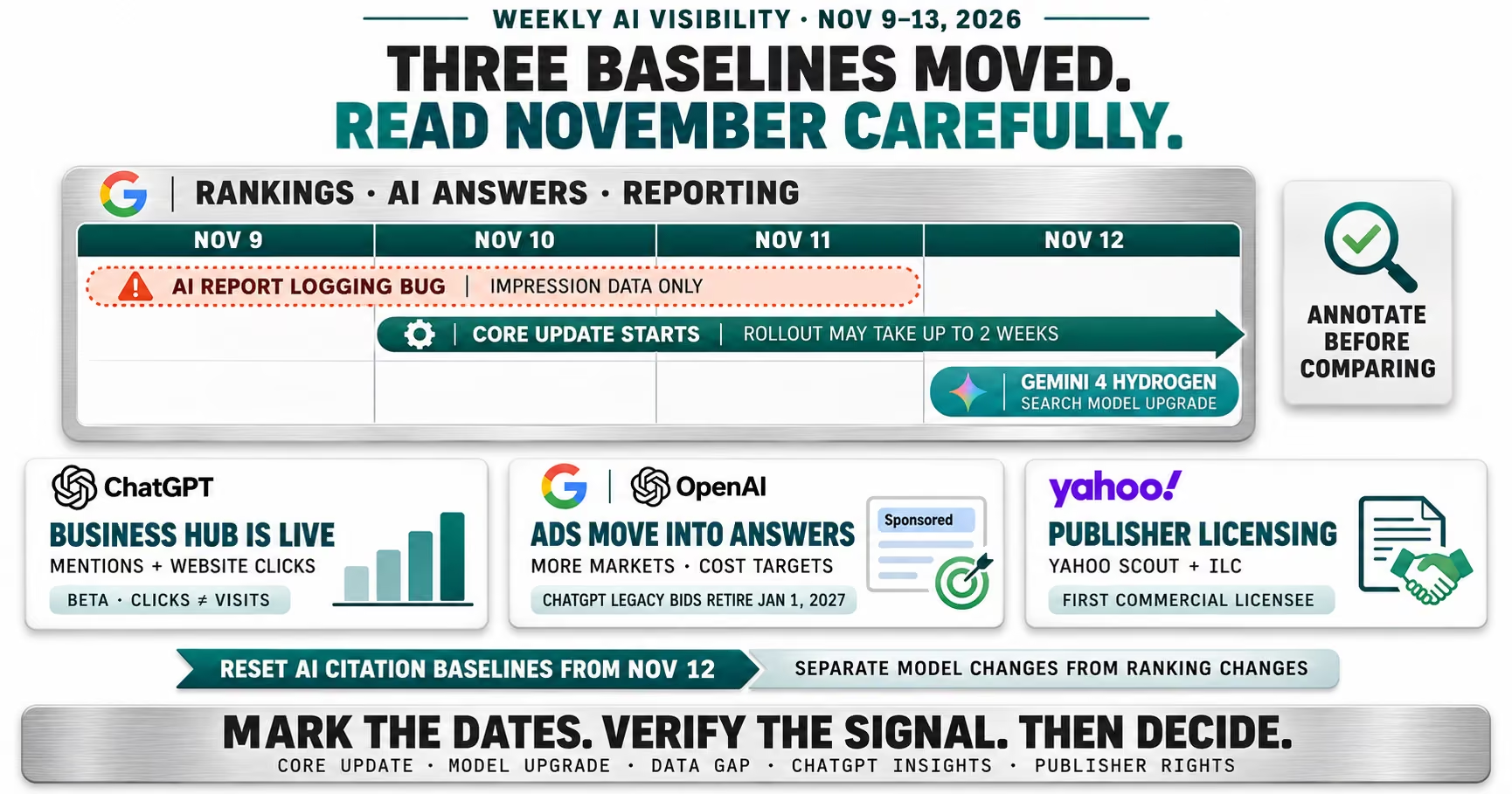
Most weeks bring one big change and a handful of tests. This week brought a ranking update, a new model inside AI Overviews and AI Mode, and a reporting bug in the one Search Console report built for AI features, all between Monday and Thursday. Each would justify a careful read on its own. Together they make any quick before and after comparison close to meaningless until December.
Here is how the week lined up.
| Date | What changed |
|---|---|
| Nov 9 | AI report bug begins |
| Nov 10 | Core update released |
| Nov 10 | ChatGPT Business Hub live |
| Nov 11 | AI report bug ends |
| Nov 12 | Hydrogen powers Search |
| Nov 12 | ILC launches with Yahoo |
The practical lesson sits at the end of this piece, but the headline is simple. Mark the dates in your reporting tool now, before someone forgets why November looks strange.
The November core update arrived before the holiday peak
Google's Search Status Dashboard shows the update was released at 10:07 a.m. Pacific on November 10.
Released the November 2026 core update, which applies globally and to all languages. The rollout may take up to 2 weeks to complete.
Google's Search Central team described it on LinkedIn, as quoted by Search Engine Roundtable, as "a regular update designed to better surface relevant, satisfying content for searchers from all types of sites." It is the third core update of 2026, after the March update (March 27 to April 8) and the May update (May 21 to June 2), according to Search Engine Journal, which estimated a finish around November 24. Search Engine Roundtable had already flagged ranking chatter over the weekend of November 8 and 9, so some sites saw movement before the official start.
Timing is the uncomfortable part. A two week rollout that ends near Thanksgiving means retailers and lead generation sites go into Black Friday with rankings still settling. Google's core updates documentation advises waiting until a rollout is complete, then waiting at least a week more before comparing data, which pushes a clean read into December.
Why it matters. Core updates reward or demote whole sites based on how Google judges overall quality, and there is no quick fix if a site drops. The worst response is a rushed content overhaul in the middle of holiday trading. Note the date, watch your top commercial pages, and hold structural changes until the rollout ends. If you saw a drop in Search Console impressions for AI features between November 9 and 11, read the next section before blaming the update.
Search Console's AI report lost three days of impressions
Google's data anomalies page now says a logging error caused a decrease in impressions in the generative AI performance report from November 9 to 11, 2026. Google says the problem affects data logging only, which means appearances in AI Overviews and AI Mode were not reduced, only under-recorded. Search Engine Roundtable, which reported the note on November 12, pointed out that the window overlaps the first day of the core update.
Why it matters. The generative AI report is the closest thing site owners have to an AI Overviews and AI Mode visibility measure from Google itself. If your November dashboard shows a dip on those three days, it is a logging gap, not a loss of citations. Annotate it, and do not let it get folded into a core update narrative. Our guide to measuring AI Overview clicks in Search Console explains what the report can and cannot tell you.
Gemini 4 Hydrogen is now the model behind Search
On November 12, Google's Robby Stein announced that Gemini 4 Hydrogen had come to Google Search.
This is the biggest model upgrade to Search yet.
Google says Hydrogen is available globally in Search for all users and lists four improvements: better understanding of intent, improved query fan-out and linking, more visual responses, and richer language understanding. Search Engine Journal reported that Hydrogen became the default model in AI Mode for all users worldwide, and that Stein's thread on X said it is also being used for the hardest questions in AI Overviews. The previous default change was Gemini 3.5 Flash at Google I/O in May.
Two days earlier, Google said Gemini 4 Carbon was rolling out to Google AI Ultra subscribers in AI Mode. And on November 13, Search Engine Roundtable found AI-generated images appearing inside AI Overviews again for some users, after Google tested the feature in July and paused it in August. Barry Schwartz suspects a link to the Hydrogen rollout, though Google has not said so.
Why it matters. A model change alters which sources AI Overviews and AI Mode pull, how many links they show and how often they answer without one. Google gave no numbers on links or sources, and it has not described Hydrogen as a ranking change, so the working assumption is that blue link movement this month belongs to the core update. Citation share inside AI answers is a different matter. If you track AI citations, start a fresh baseline from November 12 rather than comparing against October.
ChatGPT now shows businesses their clicks
Last week we covered reports that ChatGPT was building its own Search Console. It is now live. OpenAI introduced Businesses in ChatGPT in beta on November 10, according to Search Engine Roundtable, starting with eligible ecommerce and online service businesses in the US.
The Business Hub reports how often a business is mentioned, how many clicks ChatGPT sends to its website, and discovery topics, described as common themes across conversations where the site is cited. Businesses claim a listing by text or phone call to the main business number, or by DNS verification. OpenAI framed the launch around reach, saying it gives businesses a way to connect with "the 1.2 billion people who use ChatGPT each week." The interface is more modest about its own numbers.
Clicks don't confirm website visits or conversions.
Why it matters. For the first time, a major AI assistant is giving site owners first party data on citations and clicks. That makes AI visibility measurable in the same way Search Console made organic search measurable, with the same caveat that the platform's numbers and your analytics will not match. Claim your profile if you qualify, then compare Business Hub clicks with sessions from chatgpt.com in your analytics. Our Business Hub walkthrough covers the setup.
Ads are moving inside the answer on both platforms
Google and OpenAI each widened advertising inside AI answers this week.
On the Google side, Search Engine Journal reported on November 10 that ads in AI Mode are expanding to more than 10 new countries in English: Australia, Canada, India, Kenya, Malaysia, New Zealand, Nigeria, Pakistan (text ads only), the Philippines and Singapore. Brazil, Mexico and the UK are listed as Q4 2026 plans. Multiturn ads, which can show on follow-up questions, launched in the US. AI Mode performance is folded into standard campaign reporting, with no separate breakout.
On the OpenAI side, Search Engine Roundtable summarized the latest ChatGPT Ads update email. Maximize Results is now called intelligent bidding, new campaigns get Target CPA and Target CPC goals, product feed campaigns can target regions within a country, and product set filters can combine conditions. Search Engine Journal covered the bidding change on November 10.
Max Bid and Max CPC will retire for existing campaigns on January 1, 2027
Microsoft is moving in the same direction. Search Engine Roundtable spotted search and shopping ads above Bing AI Mode results on November 9.
Why it matters. Paid placements inside AI answers compete for the same attention as organic citations, and multiturn ads follow the user deeper into a conversation. Because Google does not report AI Mode separately, advertisers cannot easily see what those placements cost or return. Anyone running ChatGPT ads with Max Bid or Max CPC has until January 1 to move to cost targets.
Publishers are pricing in a smaller search channel
Three pieces of evidence this week pointed the same way.
Ziff Davis CEO Vivek Shah said on the company's November 6 earnings call that the publisher is not planning on a search recovery, as Search Engine Journal reported on November 9. Organic Google referrals fell about 37% year over year in the third quarter, after a roughly 23% fall the year before. Shah also estimated about 2.7 billion AI Overviews and AI Mode impressions in the quarter, nearly 10 times the company's Search clicks. Search Engine Journal cautioned that the ratio compares AI impressions with all Search clicks, so it is not an AI click-through rate.
In the UK, Press Gazette reported on November 10 that more than two-thirds of the biggest UK news sites lost Google visibility over the past year, using the Sistrix Visibility Index. BBC News fell from 41.8 to 20.35, while Substack rose from 13.48 to 27.94. Sistrix sells SEO software, so it has an interest in visibility metrics being seen as the yardstick.
Globally, SparkToro analysis of Similarweb data, reported by Search Engine Journal on November 12, found visits to the top million websites reached 1.970 trillion in Q3 2026, 12.2% below the Q1 2022 peak of 2.243 trillion. Visits per internet user fell 29.2%.
- The SparkToro headline changed. The first version said traffic fell 24%, and Rand Fishkin acknowledged incorrect graph data on November 10 before the figure was revised to 12.2%.
- Both data sources are commercial. SparkToro sells audience research software and Similarweb sells the panel data, so both benefit when traffic decline is a talking point.
- Panel data is browser only. Similarweb's panel does not track app use and the study gives no regional breakdown or causes.
- Sistrix excludes AI surfaces. Press Gazette notes the Visibility Index uses organic results and leaves out Top Stories, AI Overviews and Discover.
Publishers are also building new revenue on the other side. The Internet Licensing Collective launched on November 12 as a nonprofit, publisher-led licensing group, with Yahoo Scout confirmed as its first commercial licensee. The ILC says more than 3,000 media brands, content owners and publishing platforms are behind it, publishers join for free, and royalties are based on the value a publisher's content contributes rather than catalog size. Search Engine Roundtable's coverage quotes Yahoo's Eric Feng saying AI answers are only as good as the sources behind them. No payment amounts were published. Yahoo also launched Pivot Search on November 10, letting users switch between traditional results and a Scout AI answer, and took Scout out of beta.
Why it matters. When a public company tells investors it has stopped planning for search to come back, other content businesses should run their own numbers on the same assumption. The licensing route is still small, and Yahoo's share of search is modest, but a paying licensee with a published allocation model is a template other AI companies may be pushed toward.
Two Google documents worth bookmarking
Google published two practical technical resources this week.
The first is a new page on how to identify Google Search traffic in analytics and logs, updated November 12. It explains that Google Search uses the origin referrer policy, so the Referer header carries only the scheme and host, such as google.com, and not the query. It lists why the header can be blank, including private browsing and privacy extensions, and why analytics and Search Console numbers differ, from blocked scripts to redirects that drop the Referer. The page does not mention AI Mode or AI Overviews.
The second is a Search Central blog post and video, Moving to a CDN without overwhelming your origin, the last in Google's Non-Canonical Cabinet series with Gary Illyes. As Search Engine Roundtable summarized, Googlebot may raise its crawl rate after a CDN move, and an empty cache still sends those requests back to the origin server. Google suggests pre-warming the cache, allowing verified crawlers, blocking malicious bots selectively and using rate limits.
Why it matters. Both documents answer questions that usually land on an SEO's desk after something has gone wrong. If a migration to a CDN is planned before the holidays, read the post first.
Also this week
- The judge in Google's scraping case sided with SerpApi on its motion to dismiss Google's amended scraping complaint, Search Engine Roundtable reported, giving Google until November 30 to amend. The ruling did not say SerpApi's scraping is lawful.
- Google is testing source icons at the bottom of AI Overviews, where hovering shows the full citation list.
- Another test strips action buttons, photos and reviews from the local pack inside AI Overviews.
- John Mueller repeated that a large "Crawled, currently not indexed" count can point to site quality issues.
Where to spend an hour this week
- Annotate November 9 to 12 everywhere. Add notes for the AI report bug, the core update start and the Hydrogen switch in Search Console exports, Looker Studio and GA4, so nobody misreads the month later.
- Hold big changes until the rollout ends. Avoid template, navigation or large content changes on top commercial pages until Google confirms the core update is complete, likely around November 24.
- Claim your ChatGPT business profile. If you are a US ecommerce or online service business, verify through the Business Hub and record your first week of mentions and clicks as a baseline.
- Reset your AI citation baseline. Treat November 12 as day one for AI Overviews and AI Mode citation tracking, since the model behind both changed.
- Move ChatGPT ads to cost targets. If you run Max Bid or Max CPC campaigns, plan the switch to Target CPA or Target CPC well before January 1, 2027.
- Check CDN plans against Google's post. Any pre-holiday infrastructure move should include cache pre-warming and a check that verified Googlebot traffic is allowed.
This was a week to measure carefully rather than react quickly. The sites that come through November well will be the ones that can separate a ranking change from a model change from a reporting gap, and only then decide what to fix.
Frequently Asked Questions
Common questions about GEO, SEO, and AI-driven search visibility.
Google's Search Status Dashboard shows the November 2026 core update was released on November 10, 2026 at 10:07 a.m. Pacific, applies globally to all languages, and may take up to two weeks to complete. Search Engine Journal estimated a finish around November 24, close to Thanksgiving.
Gemini 4 Hydrogen is the Gemini model Google brought to Search on November 12, 2026, which Google's Robby Stein called the biggest model upgrade to Search yet. Google says it is available globally in Search for all users, and Search Engine Journal reported it became the default model in AI Mode.
According to Search Engine Roundtable's coverage of the November 10, 2026 launch, the Business Hub shows how often a business is mentioned, how many clicks ChatGPT sends to its website, and the common themes of conversations where the site is cited. OpenAI's own tooltip says clicks don't confirm website visits or conversions, so the figures should be checked against site analytics.
Not fully. Google's data anomalies page says a logging error caused a decrease in impressions in the generative AI performance report from November 9 to 11, 2026, and that it affects data logging only. Search Engine Roundtable noted the window overlaps the start of the November core update.
Search Engine Journal reported on November 10, 2026 that ads in AI Mode are expanding to more than 10 new countries in English, including Australia, Canada, India, Kenya, Malaysia, New Zealand, Nigeria, Pakistan, the Philippines and Singapore. Brazil, Mexico and the UK were listed as Q4 2026 plans, and multiturn ads on follow-up questions launched in the US.
The Internet Licensing Collective is a nonprofit, publisher-led licensing group that launched on November 12, 2026 with Yahoo Scout as its first commercial licensee, according to the ILC's press release. Publishers join for free, and royalties are based on the value their content contributes rather than catalog size.
Sources
- Google Search Status Dashboard: November 2026 core update (opens in a new tab)
- Search Engine Journal: Google's November 2026 Core Update Starts Rolling Out (opens in a new tab)
- Search Engine Roundtable: Google November 2026 Core Update Is Rolling Out (opens in a new tab)
- Google Search Central: Google Search's core updates (opens in a new tab)
- Search Engine Roundtable: Google Search Console Generative AI Performance Report Data Bug Nov 9 to 11 (opens in a new tab)
- Google Search Console Help: Data anomalies in Search Console (opens in a new tab)
- Google: Google Search gets a major upgrade with Gemini 4 Hydrogen (opens in a new tab)
- Search Engine Journal: Google Makes Gemini 4 Hydrogen The Default Model In AI Mode (opens in a new tab)
- Google: Gemini 4 Carbon is now available (opens in a new tab)
- Search Engine Roundtable: Google AI Overviews AI-Generated Images Have Returned For Some (opens in a new tab)
- Search Engine Roundtable: Businesses in ChatGPT Business Hub Live With Click Data (opens in a new tab)
- Search Engine Journal: Google Ads Now Runs In AI Mode Across 10 More Countries (opens in a new tab)
- Search Engine Roundtable: OpenAI ChatGPT Ads Updates With Intelligent Bidding, New Cost Targets and Product Set Filters (opens in a new tab)
- Search Engine Journal: ChatGPT Ads Is Replacing Max Bid and Max CPC With Cost Targets (opens in a new tab)
- Search Engine Roundtable: Bing Ads At Top Of AI Mode Results (opens in a new tab)
- Search Engine Journal: Ziff Davis CEO, Not Planning On A Search Recovery (opens in a new tab)
- Internet Licensing Collective: The ILC Launches with Yahoo Scout as First Commercial Partner (opens in a new tab)
- Search Engine Roundtable: Yahoo Scout To Pay Publishers Through The ILC For Using Content In AI Answers (opens in a new tab)
- Search Engine Roundtable: Yahoo Search Launches Pivot Search, Yahoo Scout App and More (opens in a new tab)
- Press Gazette: Most major UK news publishers saw Google search visibility fall in 2026 (opens in a new tab)
- Search Engine Journal: Visits To The Top Million Websites Fell 12%, Data Shows (opens in a new tab)
- Google Search Central: Identify Google Search traffic in analytics and logs (opens in a new tab)
- Google Search Central Blog: Moving to a CDN without overwhelming your origin (or blocking Googlebot) (opens in a new tab)
- Search Engine Roundtable: Google, How Moving to a CDN Can Accidentally Overwhelm Your Website (opens in a new tab)
- Search Engine Roundtable: Google Loses Another Round in Legal Battle Against SerpApi Over Search Scraping (opens in a new tab)
- Search Engine Roundtable: Google Placing Source Icons At Bottom Of AI Overviews (opens in a new tab)
- Search Engine Roundtable: Google AI Overview Local Pack Dropping Action Buttons, Photos and Reviews (opens in a new tab)
- Search Engine Roundtable: Google Crawled or Discovered, Currently Not Indexed A Site Quality Issue (opens in a new tab)