


AI Links, Lost ChatGPT Clicks and Poisoned SERPs: Oct 12 to 16, 2026
 Preferred source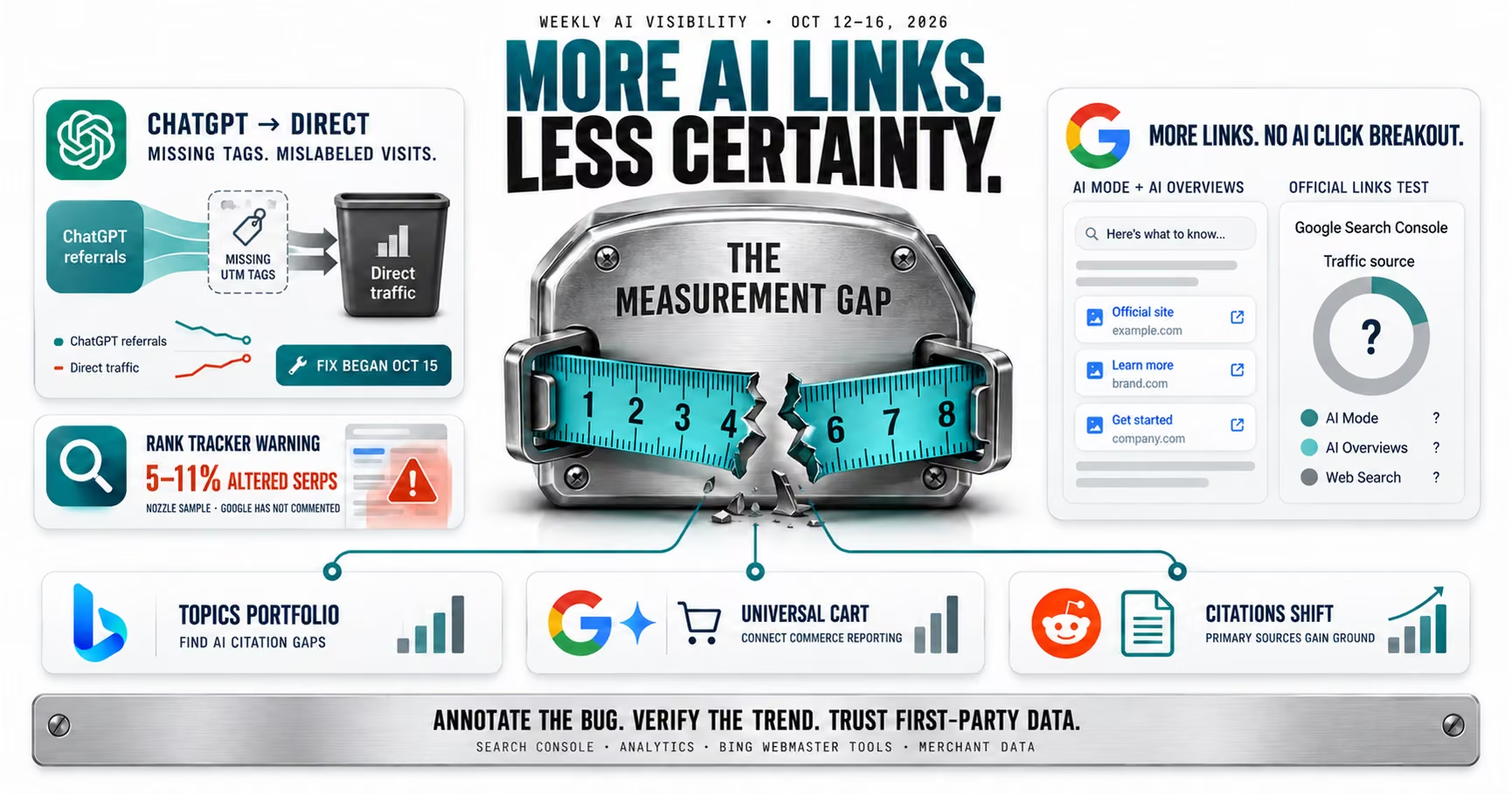
A week when the measuring tape broke
Most weeks in this roundup are about what Google or OpenAI changed. This week the bigger story is how hard it has become to see those changes at all. Three separate measurement systems wobbled within a few days of each other: analytics attribution for ChatGPT, third-party rank tracking for Google, and Google's own reporting for AI surfaces, which still has no click data.
None of these failures is a catastrophe by itself. Together they mean that a marketing leader looking at a dashboard on Friday could see a ChatGPT collapse that did not happen, a ranking drop that may be a tracker artifact, and an AI Overviews traffic picture that nobody outside Google can measure directly. If you read last week's roundup, the September spam update finishing on October 8 adds one more variable to untangle.
ChatGPT traffic did not vanish, the tags did
Starting around October 9, sites that get meaningful traffic from ChatGPT saw it drop hard in Google Analytics 4. Search Engine Roundtable reported on October 14 that ChatGPT links appeared to have lost the chatgpt.com UTM source tag OpenAI added in June. Cedric Huesler of Adobe found that the new behavior opened links with no referrer and no tag, so analytics filed the visit as Direct.
Huesler's numbers made the case. Across about 500 pages where ChatGPT drove at least 5% of visits, comparing October 9 to 13 with the prior week, ChatGPT visits fell by about 31,000 a day while Direct visits on the same pages rose by about 26,000 a day. Direct gained on two out of three pages that lost ChatGPT traffic, against roughly a coin flip the week before.
Search Engine Journal pulled together several other data sets on October 15. Ethan Smith of Graphite saw ChatGPT-attributed GA4 sessions fall 22% to 57% from October 9. LLM Pulse saw ChatGPT sessions about 46% lower on October 9 to 11 while total traffic stayed roughly flat. Profound data showed the share of ChatGPT answers with at least one tagged source link falling from about 98% on October 8 to 66% on October 14. Graphite, LLM Pulse, Profound and Peec AI all sell AI search or SEO services, so each has a stake in how ChatGPT traffic is measured, and the LLM Pulse and Profound posts did not give sample sizes.
| Date | What happened |
|---|---|
| Oct 8 | Last normal tagging day |
| Oct 9 | Tagged ChatGPT sessions drop |
| Oct 14 | OpenAI confirms bug to Huesler |
| Oct 15 | Fix begins rolling out |
According to Huesler, OpenAI confirmed the bug to him on October 14, and a fix began rolling out early October 15, with tagged clicks back to roughly 95% to 100% of the same hour a week earlier on the domains he tracks. Search Engine Journal noted there was no public OpenAI statement and that OpenAI's release notes for October 1 to 15 did not mention link tracking.
- Four days of data is not a trend. Huesler described his findings as early and based on four days of sampled data.
- Relabeled is not the same as recovered. LLM Pulse said it could not separate lost visits from relabeled visits, and it saw no clear rise in Direct because Direct is too large for the shift to show.
- Referrers were already thin. Huesler noted that most ChatGPT clicks still arrive without a referrer, so tag-based counting was always an undercount.
Why it matters. ChatGPT referral traffic is now a line item in a lot of executive dashboards, and this week showed how fragile that line is. A single client-side change on OpenAI's end moved tens of thousands of daily visits into a different channel. If your reporting counts AI traffic by referrer or a single UTM tag, you need a second signal, such as landing page patterns or conversion paths, before you report a swing up or down.
Rank trackers are being fed bad results
The second measurement problem is older but got sharper this week. Search Engine Roundtable reported on October 12 that third-party rank trackers have not been fully reliable for weeks, as Google blocks scrapers more aggressively than it has in years. The headline claim came from Nozzle, an enterprise rank tracking company, which says Google has moved from blocking suspected scrapers to quietly feeding some of them altered results.
Since September 2026, Google has been poisoning the SERPs it serves rank trackers
Search Engine Journal's October 14 analysis laid out Nozzle's figures. Non-standard SERPs first appeared on September 20 and reached up to 25% of results. Since October 1 they have made up 5% to 11% of results per day. Normal results kept 88.5% of the same sites across repeated searches, against 20.7% for poisoned ones. Poisoned pages looked normal but showed fewer AI Overviews, 34.9% against 54.2% at baseline, and more image packs and forum blocks.
Nozzle sells rank tracking, so it has a commercial interest in explaining why tracker data diverges from what users see. The interpretation that Google does this on purpose to deter scraping is Nozzle's view. Google has not commented, and Search Engine Journal framed the claims with "appears" and "may" throughout.
Then on Friday, October 16, Search Engine Roundtable reported a spike in ranking volatility and chatter, with webmasters describing sharp traffic drops and stale stories in News and Discover. Google has not confirmed an update, and Barry Schwartz cautioned that the third-party tools reporting the spike are themselves struggling.
Why it matters. Most agencies and in-house teams still report rankings weekly from a third-party tool. If roughly one in ten tracked results can be altered, and the alteration lasts only one search 80% of the time, single-day drops are noise until something else confirms them. Search Console becomes the primary source for ranking trends, with trackers as a secondary check rather than the other way around.
Google adds more links to AI answers, still no click data
On October 15, Hema Budaraju, VP of Product Management, announced a set of link changes across AI Mode and AI Overviews on the Google blog. Google says it has made "continued and substantial increases" to inline links and will now show them higher in responses more often.
Today, we're announcing updates across AI Search to make exploring the web simpler, more visual, and more engaging.
The other changes:
- A test of a dedicated section at the top of some AI responses that surfaces one or two official links, with context on why each is useful.
- Prominent news carousels for timely articles, rolling out to more locations and languages and highlighting a user's Preferred Sources.
- Related article links at the end of some responses get image thumbnails and a more clickable design.
- A test of clickable creator and publisher names on video results in AI Mode, which link to the creator's Search profile.
Google also said the number of people using Preferred Sources "has grown by more than 7x since the start of the year." Search Engine Roundtable's coverage added that more than 400 publications are now in Google's News AI pilot licensing program, and that when asked about clicks in its AI performance reporting, Google said it is "continuing to work with website owners to understand what insights will be most helpful." It did not commit to click data.
Why it matters. The official links section is the change to watch. For queries where "there are only one or two official places on the web to complete a specific task," in Google's words, the brand that owns that task page could get a prominent placement above the AI summary. That favors clean, canonical, well-structured task pages: the renewal form, the pricing page, the booking flow. Google's framing is that these updates send more traffic to sites. Until Search Console shows AI surface clicks, nobody outside Google can confirm that, so treat it as a claim to test against your own landing page data, not a result.
ChatGPT's citations moved toward primary sources
On October 12, Search Engine Journal reported Ahrefs data on the top 200 domains cited in U.S. ChatGPT answers, comparing 2.4 million answers in March with 3.8 million in September. Ahrefs sells SEO and AI visibility tools, so it has an interest in showing that citation patterns shift enough to need tracking.
The movement was large. PubMed rose from 64th to 4th. WebMD fell from 18th to 79th. Britannica, Investopedia and the New York Post dropped out of the top 200. Reddit went from appearing in 19.1% of U.S. answers to 2.3%, and Wikipedia from 14.1% to 2.9%.
| Domain | March | September |
|---|---|---|
| Reddit share | 19.1% | 2.3% |
| Wikipedia share | 14.1% | 2.9% |
| PubMed rank | 64th | 4th |
| WebMD rank | 18th | 79th |
Ahrefs also looked at query fan-out across 66.6 million free, logged-out responses from August and September. Only 14.4% included a web search, and those that searched averaged about 1.6 fan-out queries. Of roughly 15 million fan-out queries, 6.8% were site: searches, and when those targeted the roughly 160 most-searched domains, 75.9% went to brand websites.
- Citation rank is not traffic. Ahrefs measures the share of answers citing a domain, which does not say how many people clicked.
- One model, one window. The fan-out figures describe a single model in August and September, and patterns can change with the next release, and ChatGPT has shipped a new model since.
- Free usage searches less. Logged-out free use triggers fewer searches than paid or reasoning models, so the 14.4% figure may understate search across all ChatGPT usage.
Why it matters. The decline in Reddit and Wikipedia citations undercuts a lot of GEO advice built in 2025 on seeding forum threads. We wrote about the risks of that approach in our piece on a Reddit GEO experiment that ended in a ban. The site: search finding points the other way: when ChatGPT wants a brand's answer, it mostly goes to the brand's own site. That makes your first-party pages, with clear facts, specs and pricing, the asset to invest in.
Universal Cart goes live in Search and Gemini
Google launched Universal Cart in the U.S. on October 15 across AI Mode in Search and the Gemini app, according to the Google blog post by Suresh Ganapathy. Shoppers can save products from several retailers in one cart, get alerts on price drops and restocks, see relevant promo codes, and check out with Google Pay or move items to the merchant's own cart. Named checkout partners include Nike, Sephora, Target, Ulta Beauty, Walmart, Wayfair and many Shopify merchants, and the cart draws on a Shopping Graph of more than 60 billion listings.
Search Engine Journal explained the merchant side. Merchants choose native checkout or cart transfer in the UCP integration hub in Merchant Center. Cart transfer is one-way in this first release: Google creates the cart on the merchant's system, and updating or syncing it is not supported. For eligible U.S. Shopify stores, Direct Checkout is on by default, and Google Analytics and custom pixels will not fire for purchases made through it.
Why it matters. This adds a measurement gap to commerce. If a share of holiday purchases complete inside Google's cart, your analytics will undercount them unless you pull the UCP Analytics Reporting dashboard and Merchant API data into your reporting. Product data quality in Merchant Center now decides whether you are in the cart at all.
Bing shows where competitors win AI citations
On October 13, Microsoft added Topics Portfolio, a beta feature in the AI Performance report in Bing Webmaster Tools, according to the Bing Webmaster Blog. It groups the grounding queries where a site appears into topic clusters, with columns for topic, topic size, sites cited and queries. A Top Opportunity Queries view shows strong queries where other sites are cited but yours is not, with citation volumes shown as ranges. The feature only appears when there is sufficient data for a site, and there is no click data yet.
Why it matters. Bing is giving site owners first-party data on AI citation gaps by topic, something Google's reporting does not offer. Copilot's audience is smaller than Google's, but the opportunity queries are a free, grounded list of topics where AI systems already trust someone else's content over yours.
Also this week
- Google made Gemini 4 Argon available in AI Mode for AI Pro and Ultra subscribers worldwide on October 13, with Robby Stein citing big improvements on multi-step tasks. Responses include links, unlike an earlier Gemini 3.8 Flash release.
- A Google job listing for a Principal UX lead described turning Discover into a "proactive, hyper-personalized concierge experience" that helps users make progress on their goals while centering human voices and sources.
- The European Commission said on October 14 it is in talks with Google about its response to two July fines totaling about $1 billion, including €460 million for favoring its own services in search, Reuters reported.
- Google updated its Indexing API quota documentation on October 16, removing an outdated quota request form. Search Engine Roundtable noted the default quota of 200 and the advice to prefer the API over sitemaps for short-lived pages were also removed.
- On the Search Off the Record podcast, Martin Splitt and John Mueller explained that Google converts PDFs to HTML for indexing, ranks them with the same systems as web pages, and can use them in AI Overviews.
- Chrome added experimental soft navigation metrics to CrUX, which matters for single-page apps whose route changes were invisible to Core Web Vitals field data.
- Google Ads rolled out channel prioritization and budget allocation controls across Search, Shopping and Performance Max, with Demand Gen to follow.
- Google often shows AI Overviews for typos and queries with no results, Search Engine Roundtable reported on October 12, rather than admitting there is nothing to show.
Where to spend an hour this week
- Annotate October 8 to 15 in every analytics property. Add a note for the ChatGPT tagging bug in GA4 and any client dashboards, and review ChatGPT and Direct side by side for that window before reporting AI traffic.
- Move ranking reports to Search Console first. Use Search Console average position and clicks as the primary trend line, and treat single-day tracker drops as unconfirmed until a second source agrees.
- Audit your official task pages. List the pages where your site is the only place to complete a task, such as account login, renewal or booking, and make sure each is canonical, fast and clearly titled for Google's official links test.
- Pull Bing's Topics Portfolio. Export the Top Opportunity Queries from Bing Webmaster Tools and compare them with your content plan for the quarter.
- Connect UCP reporting before the holidays. If you sell in Merchant Center, check whether native checkout or cart transfer is on, and add UCP Analytics Reporting data to your revenue view so Universal Cart sales are not missing.
The lesson of this week is that AI visibility work is only as credible as the numbers behind it. Platforms will keep changing layouts, tags and access without warning, and the teams that hold their budgets will be the ones with first-party data and annotated reports ready when someone asks what happened. Build that before the holiday quarter, not after the next scare. For more on how ranking, answering and citation now fit together, see how SEO is evolving from rank to answer to cited.
Frequently Asked Questions
Common questions about GEO, SEO, and AI-driven search visibility.
Mostly no. Search Engine Journal reported on October 15, 2026 that ChatGPT-attributed sessions fell sharply from October 9 because links stopped carrying their tracking tags, so visits were filed as Direct. Adobe's Cedric Huesler measured about 31,000 fewer ChatGPT visits a day and about 26,000 more Direct visits on the same pages, and said OpenAI confirmed a bug with a fix rolling out October 15.
Rank tracking vendor Nozzle says so. Its analysis, reported by Search Engine Journal on October 14, 2026, found altered results in 5% to 11% of SERPs per day since October 1, and Search Engine Roundtable reported 8.0% of SERPs poisoned in Nozzle's sample. Google has not commented, and the interpretation that this is deliberate comes from Nozzle.
On October 15, 2026 Google announced more inline links placed higher in AI responses, a test of a top section highlighting one or two official links, news carousels in more locations and languages, and thumbnail designs for related article links. Google also said Preferred Sources usage has grown more than 7x since the start of the year, according to its own blog post.
No. Search Engine Roundtable reported on October 15, 2026 that Google said it will add metrics to its AI reporting over time but did not commit to showing click data. Site owners still have to infer AI surface performance from total Search Console data and their own analytics.
Ahrefs data reported by Search Engine Journal on October 12, 2026 shows PubMed rising from 64th to 4th among the most-cited domains in U.S. ChatGPT answers between March and September. Reddit fell from 19.1% to 2.3% of answers and Wikipedia from 14.1% to 2.9%, though Ahrefs notes this is a snapshot of one model.
Universal Cart is a cross-retailer shopping cart Google launched in the U.S. in Search and the Gemini app on October 15, 2026, according to the Google blog. Shoppers can save items from several stores, get price drop alerts, and check out with Google Pay or send the cart to the merchant's own site through the Universal Commerce Protocol.
Sources
- Search Engine Roundtable: OpenAI Drops UTM Parameters From ChatGPT Results (GPT-6) (opens in a new tab)
- Search Engine Journal: ChatGPT Traffic Drop Appears To Be A Tracking Problem (opens in a new tab)
- Search Engine Roundtable: Third-Party Google Rank Tracking Not Fully Working Now (opens in a new tab)
- Search Engine Journal: Google Is Poisoning Search Results For Rank Trackers (opens in a new tab)
- Search Engine Roundtable: Google Search Ranking Volatility and Chatter October 16 (opens in a new tab)
- Google: Updates across AI Search to make exploring the web simpler (opens in a new tab)
- Search Engine Roundtable: Google Updates Links In AI Mode and AI Overviews Again, Won't Show Click Data (opens in a new tab)
- Search Engine Journal: ChatGPT's Most-Cited Sites Tilt Toward Primary Sources, Data Shows (opens in a new tab)
- Google: An intelligent new shopping cart (opens in a new tab)
- Search Engine Journal: Google's Universal Cart Is Live, How Carts Get To Your Store (opens in a new tab)
- Bing Webmaster Blog: Introducing Topics Portfolio (Beta) in AI Performance (opens in a new tab)
- Search Engine Roundtable: Google Search's AI Mode Gains Gemini 4 Argon (opens in a new tab)
- Search Engine Roundtable: Google Discover, Hyper-Personalized Concierge Experience (opens in a new tab)
- Reuters: EU Commission is in dialogue with Google, spokesperson says (opens in a new tab)
- Google Search Central: Indexing API quota and pricing (opens in a new tab)
- Search Engine Roundtable: Google Updates Indexing API Quota Information (opens in a new tab)
- Search Engine Roundtable: Google Search On PDFs (opens in a new tab)
- web.dev: Experimental soft navigation metrics now available in CrUX (opens in a new tab)
- Search Engine Roundtable: Google Ads Channel Prioritization and Budget Allocation (opens in a new tab)
- Search Engine Roundtable: Google AI Overviews For Typos and No Search Results (opens in a new tab)