


GEO Doubts, Agentic Search and a PHP Emergency: Oct 19 to 23, 2026
 Preferred source
Today's traffic and tomorrow's interface pulled in opposite directions
Last week the measurement tools broke, as we covered in our October 12 to 16 roundup. This week the industry used the data it still trusts to argue about where to spend. Three studies said AI referrals are small. Google's CEO said the search box is turning into an agent. A vendor study said AI Overviews now sit on nearly every commercial query.
You do not have to pick a side. The numbers describe where clicks come from today, and the product roadmap describes where answers will come from next year. The sections below take each in turn, then cover the crawl-rights fights, the PHP emergency and the ChatGPT ads changes that need action before month end.
| Date | What happened |
|---|---|
| Oct 19 | Meta revises crawl clause |
| Oct 20 | ChatGPT Ads creative email |
| Oct 20 to 21 | Ranking volatility spikes |
| Oct 21 | PHP critical patches ship |
| Oct 21 | Haynes traffic data reported |
| Oct 22 | Pichai interview coverage |
| Oct 22 | Semrush AIO study reported |
ChatGPT still sends a sliver of Google's traffic
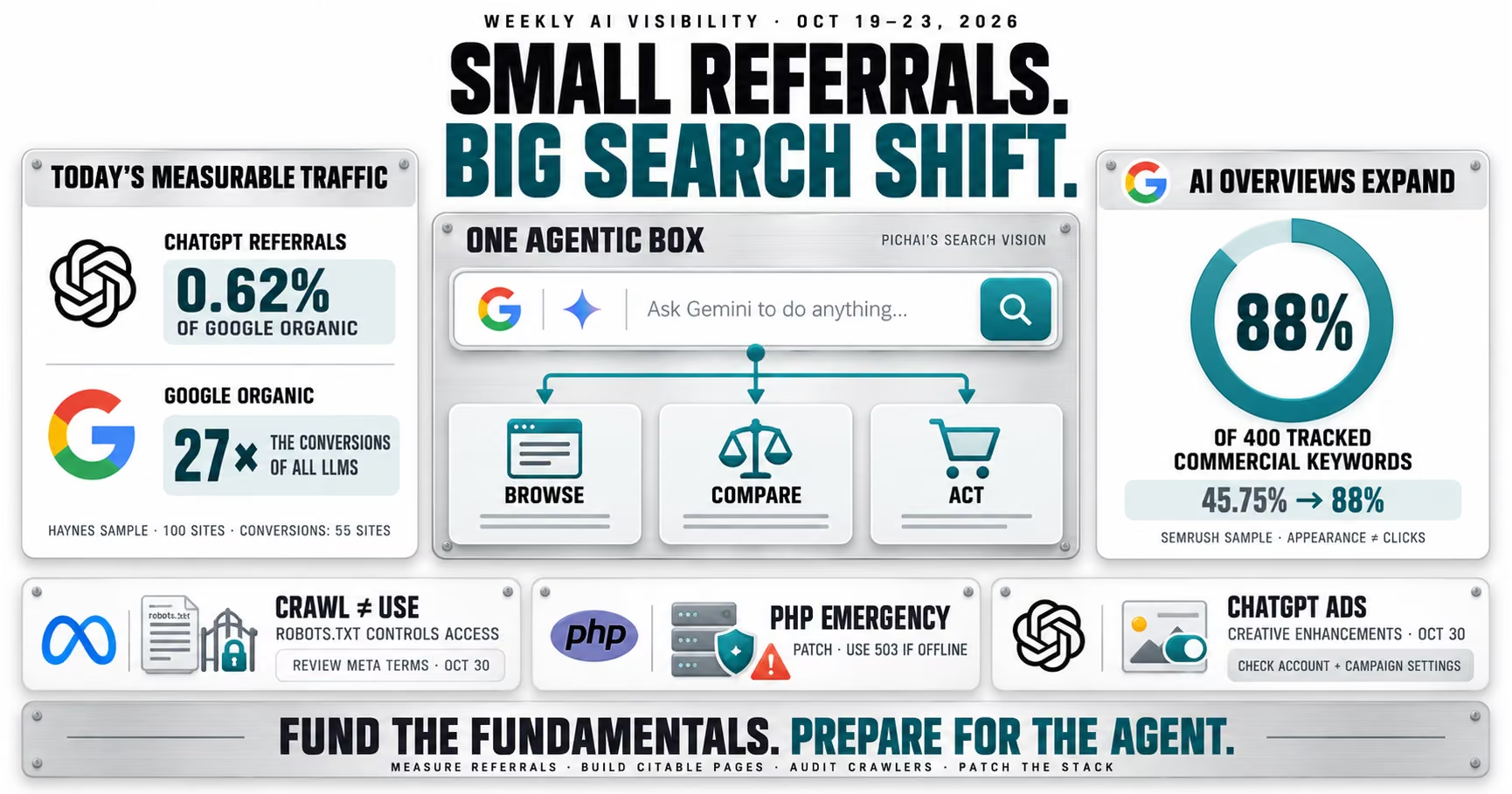
The headline figure comes from Marie Haynes, an SEO consultant, who looked at 12 months of GA4 data across 100 websites and more than 145 million sessions. Search Engine Land reported that ChatGPT referred about 0.62% as many sessions as Google organic search. Adding every other LLM only lifted that to 0.73%, measured against Google organic, not total traffic.
Conversion data, drawn from 55 of the sites, told a more mixed story. ChatGPT visitors converted at 13.8% versus 3.02% for Google organic. Google organic still drove 27 times as many conversions as all LLMs combined. Haynes also reported that ChatGPT referral growth stopped compounding in August 2025 and declined after that. She called GEO "a distraction."
Two more studies landed in the same week, and Search Engine Roundtable grouped all three. UK agency SEO Works found organic search delivered 39 times more traffic than AI assistants, and for every 100 organic conversions, AI referrals delivered 3.2. Consultant Kevin Indig studied 12 sites and could not find a reliable link between AI visibility and branded search or direct traffic, though he said brands with strong AI growth might see one.
All three authors sell SEO or GEO services, so each has a stake in how the result is read. Search Engine Land also flagged the gaps in Haynes' analysis.
- The reporting window is fuzzy. Search Engine Land noted the analysis does not give exact reporting dates or the industry mix of the 100 sites.
- Conversions are undefined. The analysis does not say how conversions were counted, so the 13.8% figure cannot be compared across sites with confidence.
- Google's own trend is missing. The study did not measure how Google organic traffic changed over the same period, which is half of any share calculation.
- Referral is not influence. Indig's sample was 12 sites, and a click from ChatGPT is only the visible part of what an AI answer does to a buyer's shortlist.
Why it matters. If someone in your company is using these numbers to move budget, the honest reading is narrower than the headline. Google organic is still where most measurable revenue starts, so the basics have to stay funded, a point we make in our guide to the SEO build order for AI search. The data does not show that AI answers have no effect. It shows they rarely send a click, and that is a different claim.
Sundar Pichai says the future is one agentic box
On the other side of the ledger, Google's CEO gave an interview to Alex Heath on the Sources podcast. Search Engine Journal reported that Pichai described an "agentic layer" that unifies Search and Gemini rather than merging the two products.
"Our vision in the near future is it's one box."
He said users increasingly type task-focused queries, that Google is bringing agent capabilities to Search "in a pretty deep way," and that Gemini's agent features, now mostly for Ultra and Pro subscribers, will become more widely available over the next few months.
In a second write-up of the same interview, Pichai said agents will reach websites two ways: by browsing pages the way a person does, and through purpose-built protocols such as MCP and Google's own Universal Commerce Protocol. He expects "a chaotic evolution" before standards settle. Asked how ads fit when an agent does the browsing, he said the long-term answer is to put users first, which is not an answer about ads.
Google already documents how its hosted agents fetch pages. Its user-triggered fetchers page says these fetchers generally ignore robots.txt because a person asked for the fetch.
Why it matters. Put this next to the Haynes data and the picture is clear. Click referrals from AI are small now, and Google is building a product where fewer of its own answers end in a click at all. The work that holds value in both worlds is the same: pages an agent can parse and act on, product data that feeds commerce protocols, and brand signals strong enough that an agent picks you. Measure today's traffic, and prepare for a funnel you will see less of.
AI Overviews now sit on most commercial queries
A Semrush study reported by PPC Land tracked 400 US commercial keywords in banking, software and ecommerce, checked monthly from September 2025 to August 2026 on desktop. AI Overview coverage rose from 45.75% to 88% of keywords. Weighted by Semrush's search volume estimates, coverage reached 97.08%.
| Query type | Sept 2025 | Aug 2026 |
|---|---|---|
| Reviews | 30.14% | 89.04% |
| Brand vs brand | 63.41% | 86.59% |
| All tracked | 45.75% | 88% |
Ecommerce terms rose from 32.62% to 85.11%. "Best X for Y" queries reached 96.12% by August. Semrush, now part of Adobe, sells the visibility tracking its recommendations call for, and PPC Land made the same point.
- Appearance is not a click. The study records whether an AI Overview showed, not what users did next.
- Cells are small. Semrush did not disclose cell sizes, and PPC Land estimated 20 to 30 keywords per industry and modifier cell, so one keyword can swing a cell by several points.
- Volumes are estimates. The 97.08% figure relies on Semrush's modeled search volumes, not measured counts.
- One label is wrong. PPC Land found the study's summary mislabels an 82.81% alternatives figure as a brand comparison figure.
Why it matters. Review, comparison and "best for" pages are the bottom of most B2B and ecommerce funnels, and they are now the queries most likely to be answered before the organic results. That does not make those pages worthless. It makes them source material. The page that gets cited inside the Overview is the one with specific, current, checkable claims.
Robots.txt cannot say no to training
Google's Gary Illyes used the second episode of the Non-Canonical Cabinet video series to draw a line many site owners blur. Search Engine Journal quoted him:
"So as defined by RFC 9309, robots.txt is an access preference protocol."
The file, defined in RFC 9309, "doesn't dictate what a system does with the data after it has already crawled it." To keep one AI crawler out, you have to target its user agent token by name. Invented rule names get ignored.
Meta tested that gap the same week. Search Engine Journal reported on October 19 that Meta removed "train" from the crawl clause of its new Commercial Terms, which take effect October 30, while keeping permission to crawl sites associated with a business's products or services. The terms apply to any business using Meta's products, including companies that run a Facebook Page without buying ads. Cornell's James Grimmelmann told Nieman Lab the purposes language is "still broad enough to drive a truck through."
Google, for its part, refreshed its control what you share with Google Search page on October 21. Its documentation changelog says it now gathers existing options, including the robots meta tag, data-nosnippet, X-Robots-Tag and the Search generative AI control. Nothing new, just in one place.
Why it matters. Most sites hold one lever, crawl access, and it works one bot at a time. If your policy is to allow search crawlers and block training crawlers, check each token, then check the terms your team accepts on ad and social platforms. A contract you clicked through can grant what your robots file declines.
The PHP emergency and the 503 rule
On October 21 the PHP project published a critical advisory: versions 8.5.12, 8.4.27, 8.3.36 and 8.2.35 fix two vulnerabilities that can allow unauthenticated remote code execution, tracked as CVE-2026-109618 and CVE-2026-109619. The project's pre-release notice rated both CVSS v4.0 9.2 and urged all users to update immediately. PHP 8.1 and older no longer receive updates from the project.
Some site owners took sites down while they patched. Search Engine Roundtable reported that Reuters found government, school and hospital sites in Europe offline on Wednesday, and that Google's John Mueller posted advice on Bluesky.
"use HTTP 503 instead of letting responses time out / 404 / 500."
Mueller added that the 503 can be served outside PHP, through DNS or a CDN. Google's guide to temporarily pausing a website covers the longer version.
Why it matters. WordPress and most CMS stacks run on PHP, so this one reaches marketing sites directly. Most sites can patch without downtime. If yours cannot, a short 503 tells Google to come back later, while a 404 or a timeout invites it to drop pages. Confirm the patch with your host in writing, then check Search Console crawl stats next week.
ChatGPT Ads explains its auction and starts rewriting your copy
OpenAI published a technical breakdown of how ChatGPT chooses ads, which Search Engine Journal summarized. According to OpenAI's post, a separate "orchestrator" model reads the conversation, turns it into search queries, and finds and vets candidate ads, while a separate auction sets ranking and price. A post-auction relevance check can still block a winner that does not fit. Search Engine Journal's write-up cites a $1 billion annualized run rate reached in under 200 days, a projection rather than collected revenue, and more than 100,000 advertisers since launch. OpenAI did not say how much weight each signal gets.
Then came the email. Search Engine Roundtable reported that OpenAI is turning on creative enhancements for new and existing self-serve campaigns on October 30. Per OpenAI's help article and the email, the system can write new headlines and descriptions, translate text, resize images and point links at a different page on your site.
"When enabled, these ads can run automatically without requiring you to review or approve each version."
Why it matters. The separation of ads from answers is OpenAI's description of its own system, and Search Engine Journal said as much. The creative change is concrete and has a date. If you run regulated, legal or brand-sensitive ads, decide before October 30 whether to opt out at account or campaign level, since campaign settings override account defaults.
Rankings churned again, with no update to point at
Search Engine Roundtable tracked a spike in ranking volatility and forum chatter on October 20 and 21, with most third-party tools showing movement and Google confirming nothing. Glenn Gabe reported sites that dropped out and came back days later.
Treat any single tool with care. A Search Engine Journal survey of rank tracking vendors found Nozzle, which first flagged the problem, counted 8.7% of its first pages as poisoned between September 13 and October 21, against 0.17% from August 20 to September 9. Ahrefs estimated 5% to 20% of results were affected depending on the provider, and AccuRanker described re-fetching pages that do not match recent history. These are vendors describing their own fixes, and none cited independent testing.
Why it matters. A drop in your tracker this week may be real, a Google bug, or bad data. Confirm it in Search Console before you react.
Also this week
- On October 21, Postmedia, Torstar, The Globe and Mail and The Canadian Press sued Anthropic for copyright infringement over Claude's training, according to Press Gazette's tracker.
- Some AI Overviews on desktop showed up without their label starting October 20, and Search Engine Roundtable saw the label back on October 22.
- John Mueller said raw square brackets and their encoded forms are different URLs that Google crawls separately, and advised encoding them, as Search Engine Journal reported.
- Google lightly reworded its guidance on hyphens versus underscores in URLs, which Search Engine Roundtable spotted on October 21. The advice did not change.
- Mueller said JPEG XL is not supported for Google Images or Discover previews, so keep a supported fallback, per Search Engine Journal.
- Google is testing Google Business Home, a Gemini-powered beta hub for Business Profile, Merchant Center, YouTube and Ads, with select US and UK categories, Search Engine Roundtable reported.
What we would do first
- Confirm your PHP version today. Ask your host or developer for the exact version in writing, and if a patch needs downtime, make sure the site serves a 503 for hours, not days.
- Decide on ChatGPT creative enhancements before October 30. If you advertise in ChatGPT, review the setting at account and campaign level and opt out anywhere AI-rewritten copy or swapped landing pages would create risk.
- Audit robots.txt crawler by crawler. List every AI and search user agent you allow or block, check each token against the vendor's documentation, and have someone read the Meta Commercial Terms before they take effect.
- Rewrite one comparison or review page as citable source material. Pick the commercial page with the most impressions and add specific, dated, checkable claims an AI Overview would want to quote.
- Put AI referrals and conversions in the same report as Google organic. Track sessions and conversions side by side so budget decisions rest on your data, not on someone else's 100-site sample.
- Check ranking drops in Search Console before reacting. Compare tracker data for October 20 and 21 against Search Console clicks and impressions before changing any page.
The GEO debate is being framed as a choice between Google and AI, and that is the wrong frame. Google is the AI surface that sends traffic today, and it is turning itself into the agent. The brands that keep winning are the ones whose pages, data and reputation hold up whichever box the question lands in.
Frequently Asked Questions
Common questions about GEO, SEO, and AI-driven search visibility.
Very little so far. Marie Haynes' analysis of 12 months of GA4 data from 100 websites, reported by Search Engine Land on October 21, 2026, found ChatGPT referred about 0.62% as many sessions as Google organic search. Adding every other LLM only raised that to 0.73%.
In one large sample it did, but on tiny volume. Search Engine Land reported that ChatGPT visitors in Marie Haynes' data converted at 13.8% against 3.02% for Google organic, yet Google organic still drove 27 times as many conversions as all LLMs combined. Conversion figures came from 55 of the 100 sites, and the analysis did not define how conversions were counted.
Most of the time, according to Semrush. A Semrush study of 400 US commercial keywords, reported by PPC Land on October 22, 2026, found AI Overview coverage rose from 45.75% to 88% between September 2025 and August 2026. The study tracks whether an AI Overview appeared, not whether anyone clicked, and Semrush sells the tracking tools it recommends.
Not by itself. Google's Gary Illyes said in an October 2026 Search Central video, reported by Search Engine Journal, that robots.txt is an access preference protocol under RFC 9309 and does not dictate what a system does with data after crawling it. To keep a specific AI crawler out, you have to name its user agent token in the file.
Serve an HTTP 503 status code. On October 21, 2026, the PHP project released versions 8.5.12, 8.4.27, 8.3.36 and 8.2.35 to fix two critical remote code execution flaws, and Google's John Mueller advised sites going offline to use a 503 rather than timeouts, 404s or 500s, as reported by Search Engine Roundtable. Keep the downtime to hours, not days.
They let OpenAI rewrite headlines and descriptions, translate ad text, resize images and change destination URLs to fit a conversation. Search Engine Roundtable reported on October 20, 2026 that OpenAI is switching the feature on for new and existing self-serve campaigns on October 30 unless advertisers opt out. OpenAI's email said these ads can run without the advertiser reviewing each version.
Sources
- Search Engine Land: ChatGPT sends less than 1% of Google's traffic: Data (opens in a new tab)
- Search Engine Roundtable: 3 New Studies Suggest AI Visibility & Search Not Worth Investing In (opens in a new tab)
- Search Engine Journal: Google CEO Sundar Pichai Views Search Absorbed Into Agentic Layer (opens in a new tab)
- Search Engine Journal: Pichai Says AI Agents Will Click Through Pages And Use Protocols (opens in a new tab)
- Google for Developers: Universal Commerce Protocol (opens in a new tab)
- Google for Developers: Google user-triggered fetchers (opens in a new tab)
- PPC Land: Google AI Overviews now hit 88% of tracked commercial keywords, Semrush finds (opens in a new tab)
- Search Engine Journal: Google Explains The Limit Of Robots.txt For AI Content Use (opens in a new tab)
- RFC Editor: RFC 9309, Robots Exclusion Protocol (opens in a new tab)
- Search Engine Journal: Meta Drops Training From Its Crawl Clause And Keeps The Crawl (opens in a new tab)
- Nieman Lab: Legal experts warn Meta's new terms still grant broad scraping permissions despite language changes (opens in a new tab)
- Google Search Central: Control what you share with Google Search (opens in a new tab)
- Google Search Central: Latest documentation updates (opens in a new tab)
- PHP: News archive 2026, critical remote code execution security advisory (opens in a new tab)
- Search Engine Roundtable: Google On Taking Sites Down When Fixing The Emergency PHP Exploit (opens in a new tab)
- Google Search Central: Temporarily pause or disable a website (opens in a new tab)
- Search Engine Journal: OpenAI Details How ChatGPT's LLM Ad Stack Selects And Serves Ads (opens in a new tab)
- OpenAI: Building the ChatGPT ad stack (opens in a new tab)
- Search Engine Roundtable: OpenAI Auto Enabling Creative Enhancements In ChatGPT Ads (opens in a new tab)
- OpenAI Help Center: Creative enhancements for ChatGPT Ads (opens in a new tab)
- Search Engine Roundtable: Google Search Ranking Volatility & Chatter Heats Up October 20 & 21 (opens in a new tab)
- Search Engine Journal: How Rank Trackers Say They Handle Suspect Google Results (opens in a new tab)
- Press Gazette: Who's suing AI and who's signing (opens in a new tab)
- Search Engine Roundtable: Google Removes AI Overviews Labels On Some AI Overviews (opens in a new tab)
- Search Engine Journal: Google Crawls Raw And Encoded Bracket URLs Separately (opens in a new tab)
- Search Engine Roundtable: Google Updated Its URL Structure Best Practices For Hyphens In URLs (opens in a new tab)
- Search Engine Journal: Google Images & Discover Previews Don't Support JPEG XL (opens in a new tab)
- Search Engine Roundtable: Google Business Home, New Google Business Profiles Home (opens in a new tab)