





AI Isn't the Bottleneck. Your Operating System Is.
 Preferred source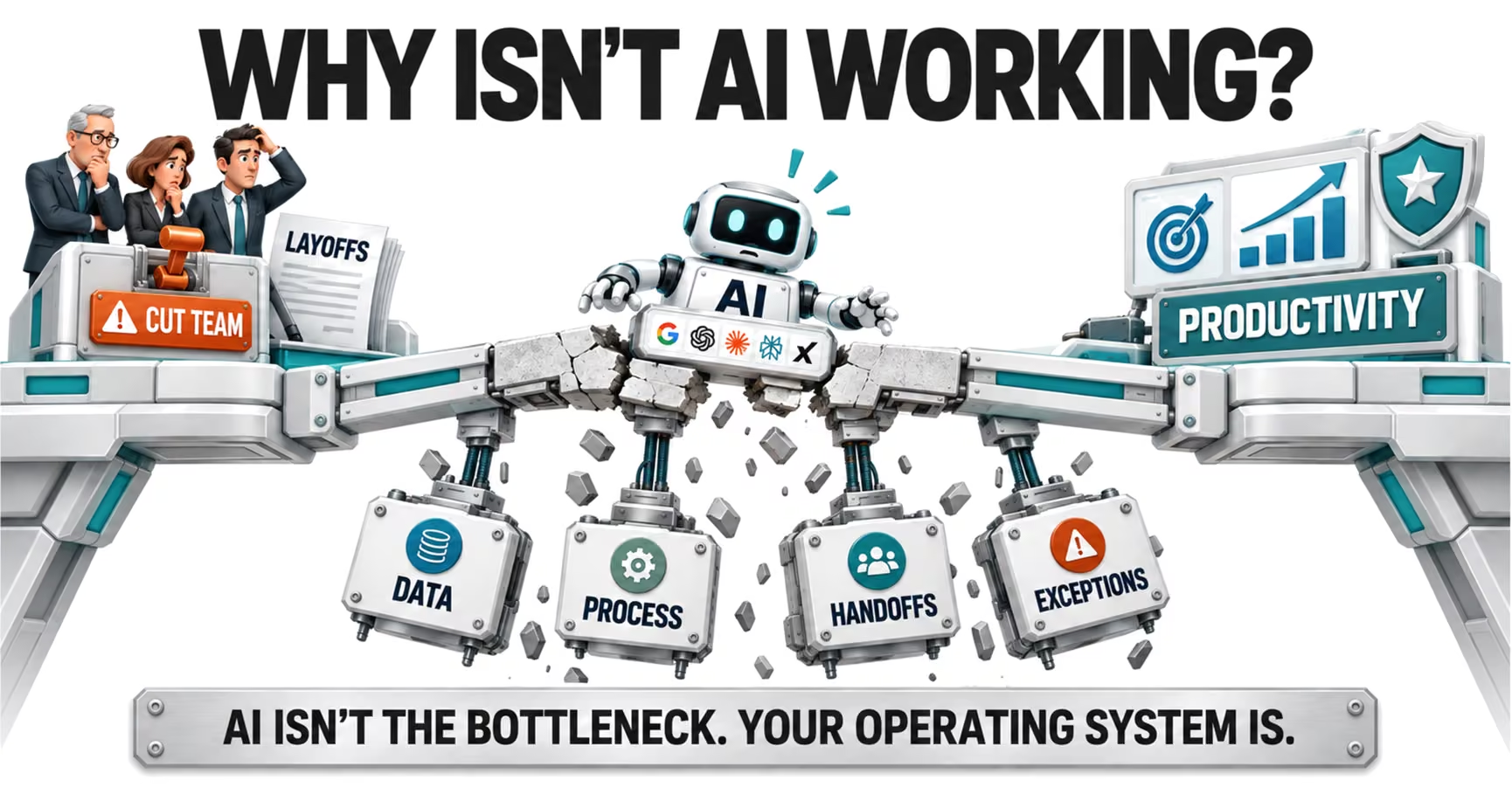
The bridge is the right metaphor
The diagram sets it up well. On one side, executives with a lever marked cut team and a stack of layoff paperwork. On the other, the productivity dashboard everyone was promised. In between, an AI robot stranded over a collapsed span, with four failed supports underneath labeled data, process, handoffs and exceptions.
What makes it more than a joke is that it inverts the usual diagnosis. When AI does not deliver, the reflex is to blame the model, switch vendors, or conclude the technology is overhyped. The diagram says the span failed at the supports, and the supports were load-bearing before AI arrived. Nobody noticed because humans were quietly compensating for all four.
That is the argument worth taking seriously, and the evidence backs it more strongly than most people pushing the graphic realize. It also cuts against the comfortable reading. If your operating system is the constraint, buying a better model does not help you, and neither does cutting the people who were absorbing the failures.
| Support | What it is supposed to carry | How it fails with AI on top |
|---|---|---|
| Data | One consistent version of every claim the business makes | The model inherits every contradiction in your source material and states one of them confidently |
| Process | A workflow with a real decision gate | AI accelerates the workflow you already had, rubber stamp included |
| Handoffs | Output that has been validated before it moves downstream | Polished output offloads the actual thinking onto whoever receives it |
| Exceptions | Someone who catches the edge cases that carry the risk | The edge case surfaces as an incident, late and unplanned |
AI does not remove work. It relocates it.
Here is the mechanic underneath all four supports.
Automation removes work only when the task has a clean boundary: defined input, defined output, verifiable result. Most knowledge work does not have that. It has an ambiguous input, a judgment in the middle, and an output whose quality is only visible later, often to someone else.
Point a model at work like that and the production step does get faster. What happens next is that the surrounding work expands. Someone has to check whether the output is right. Someone has to reconcile it with the three other places the same claim appears. Someone has to notice the case the model handled confidently and wrongly. None of that shows up as a line item, because it was never scheduled.
Read Meta's numbers with that in mind and they stop being surprising. AI-assisted code rose sharply while product improvements reaching users barely moved. Major technical and security incidents climbed 40% year over year and the time spent responding to them rose 70%. The work did not vanish. It left the roadmap and reappeared at two in the morning.
Gartner is forecasting the organizational version of the same thing, predicting that over 40% of agentic AI projects will be canceled by the end of 2027 on escalating costs, unclear business value and inadequate risk controls. Not model failure. Cost, value and controls, which are all operating system properties.
The work moves upstream into data and process
The first two supports fail before anything is generated.
Data. A model inherits whatever contradictions already exist in your source material. In marketing, your website is that source material. If pricing appears three ways across three pages, if an evergreen guide still carries a 2024 statistic, if the product name changed but half the site did not, the model will not flag the conflict. It will pick one and state it confidently, and it will do so in front of customers. We went into this at length in why your website is now the data layer AI builds on, and the short version is that a content audit is now a data integrity exercise.
Process. AI applied to an unchanged workflow accelerates the workflow you already had, including its defects. MIT's diagnosis was precisely this: tools that do not learn, integrate poorly, or fail to match how the work actually runs. If your content process was brief, draft, review, publish, and the review step was already a rubber stamp because everyone was busy, then generating four times the drafts does not produce four times the output. It produces four times the rubber stamping.
Google has a policy view on where that ends up. Its spam policies target scaled content abuse, meaning many pages produced mainly to manipulate rankings without adding value. In September 2026 John Mueller described the consequence directly, saying programmatic SEO often leads to a site that is "spam, borderline spam, or low quality" and that Google's "systems have possibly lost faith in your site providing good value to users based on the old pages."
Resolving this tends to take time and significant effort to show the value.
That is a process failure with a compounding cost, not a content failure with a fixable page. We covered the policy side in does Google penalize AI content.
The work moves onto someone else through handoffs and exceptions
The second two supports fail after generation, which is why they are harder to see.
Handoffs. This is the best-documented failure of the four. The BetterUp Labs and Stanford research published in Harvard Business Review named it workslop: output that looks finished, passes a glance, and offloads the actual thinking onto the next person. Forty-one percent of workers reported receiving it. Each instance cost close to two hours of rework, and the researchers found downstream damage to trust and collaboration on top of the time. The sender books a productivity win. The cost lands on a colleague and never gets attributed back.
- The draft that reads fluently and cites a statistic nobody can source. It passes a glance and fails the first fact-check, usually after publication.
- The brief that lists ten keywords with no view on which matter. The prioritization was the work, and it was skipped.
- The report that summarizes the dashboard without saying what to do. The reader now has to do the analysis the report was supposed to contain.
All of it feels like progress at the point of creation.
Exceptions. AI absorbs the routine majority and fails unpredictably on the minority carrying the risk. Research coordinated by the European Broadcasting Union had professional journalists evaluate more than 3,000 AI assistant responses across 18 countries: 45% contained at least one significant issue, 31% had serious sourcing problems, 20% had major accuracy issues including hallucinated and outdated information. That was public service news content, about as clean and well-attributed as source material gets.
The exception problem is structural. You cannot staff for edge cases you have not enumerated, and AI is specifically bad at telling you when it has hit one. So the exception surfaces as an incident rather than a task, which is exactly the shape of Meta's 70% increase in response time.
The reason nobody sees it in the numbers
This is the part that makes the whole argument hard to act on, and it has the cleanest evidence of anything here.
METR ran a randomized controlled trial, the methodology used for clinical drug trials. Sixteen experienced open-source developers worked on 246 real tasks in their own repositories, many with over a million lines of code, with AI randomly allowed or disallowed per task. Before starting, they forecast AI would speed them up 24%. Afterwards, having done the work, they estimated they had been sped up 20%. Measured, they were 19% slower.
| METR trial, 16 experienced developers, 246 real tasks | Result |
|---|---|
| Forecast before the work | 24% faster with AI |
| Belief after the work | 20% faster with AI |
| Measured | 19% slower with AI |
| Gap between belief and measurement | 39 points, in the wrong direction |
Sit with the size of that. Not a small error, a 39 point gap in the wrong direction, among expert practitioners reporting on their own recent work. These were not people guessing about someone else's productivity. They were wrong about their own. We looked at the same trial from the engineering side in the AI wrote it, nobody read it.
If that gap exists for developers measuring discrete coding tasks, it is worse in marketing, where the feedback loop is months long and attribution is contested even in good conditions. Your team's confident report that AI has made them faster is not evidence. It is the exact signal METR showed to be unreliable.
This also explains the macro picture. Content marketing output has never been higher, yet Orbit Media's 2026 survey of 1,042 marketers, reported by Search Engine Land, found AI adoption at 92.4% with only 14% reporting strong results, a 12 year low, and no relationship between using AI and performing better. Meanwhile US Census Bureau data puts actual AI use among US businesses at 19.8% as of May 2026, with 37% among firms of 250 or more employees. The gap between how universal AI feels and how adopted it measurably is should make anyone cautious about trusting vibes over instrumentation.
What to measure instead
The fix is not complicated, it is just unglamorous, and it starts by measuring the relocation rather than the production.
- Track rework rate, not output volume. For a month, ask anyone who receives work from someone else to log the time spent fixing rather than reviewing. That single number tells you whether your handoff support is holding. If it is above a few percent of received work, you have a workslop problem and your output metrics are lying to you.
- Count exceptions and who caught them. Not incidents, which you already count, but the near misses: the wrong statistic spotted before publication, the contradiction found in review. A program where exceptions are caught late, or only by one senior person, has a support that is already cracked.
- Audit the data layer before the content calendar. Run the contradiction check on your own site. Pick your five highest-value commercial claims and see how many ways each is stated across the properties AI systems read. Fix that before generating anything new, because everything new inherits it.
- Redesign one process before scaling any. Take a single workflow, remove the steps that existed only because production was slow, and put a real decision gate where the rubber stamp was. Then measure it against the old one. MIT's finding was that integration is the constraint, and integration is a design activity, not a purchase.
The layoff question this actually answers
Which brings it back to the lever on the left of the diagram.
The uncomfortable implication of the evidence is not that AI fails. It is that AI's benefits are real but conditional, and the condition is an operating system nobody budgeted to fix. Cutting the team before fixing it removes the people who were absorbing all four failures by hand, which is why the incidents arrive after the reorganization rather than before it.
Meta demonstrated this with resources none of us have, which we covered in what happened when Meta tried to run itself on AI agents. Klarna demonstrated it earlier, replacing the work of 700 support agents and then reopening human hiring, with its CEO conceding that cost had become "a too predominant evaluation factor" and the result was "lower quality." Note that neither company switched the AI off. Both redrew the line.
So the sequence that survives contact with evidence runs in the opposite order to the one most companies use. Fix the data. Redesign the process. Instrument the handoffs. Enumerate the exceptions. Then, and only then, work out what the team should look like, because until those four supports hold you are not measuring AI's contribution at all. You are measuring how much invisible work your people are willing to absorb.
Frequently Asked Questions
Common questions about GEO, SEO, and AI-driven search visibility.
Usually because the work did not disappear, it moved. MIT's NANDA study found 95% of enterprise generative AI pilots produced no measurable profit and loss impact, and blamed brittle workflows and poor integration rather than the models themselves. Output rises while delivered value stays flat, because the effort shifts into verification, rework and exception handling that no dashboard is counting.
Workslop is AI-generated output that looks polished but lacks substance, shifting the real cognitive work onto whoever receives it. Research by BetterUp Labs and Stanford's Social Media Lab, published in Harvard Business Review in September 2025, found 41% of workers had encountered it, with each instance costing roughly two hours of rework plus downstream damage to trust and collaboration.
Not reliably, and people are poor judges of it. In a randomized controlled trial, METR had 16 experienced open-source developers complete 246 real tasks in their own large repositories, randomly allowing or disallowing AI. Developers forecast a 24% speed-up and believed afterwards they had been 20% faster. They were measurably 19% slower. That 39 point gap between perception and measurement is the core reporting problem.
Data, process, handoffs and exceptions. Data means the model inherits whatever contradictions already exist in your source material. Process means AI accelerates a workflow that was never redesigned. Handoffs means output moves downstream before a human has actually validated it. Exceptions means the small share of edge cases that carry most of the risk still lands on a person, usually late and usually unplanned.
Fewer than the discourse suggests. US Census Bureau Business Trends and Outlook Survey data covering December 2025 to May 2026 put overall AI use among US businesses between 17% and 20%, at 19.8% as of 3 May 2026. Adoption skews heavily by size, with 37% of firms of 250 or more employees using AI against under 20% of firms with four or fewer.
The evidence says decide that after the operating system is fixed, not before. Meta drew up an AI-native reorganization in January 2026 planning cuts to some teams of up to 60%, abandoned the second layoff wave by May, and saw major technical and security incidents rise 40% year over year with response time up 70%. Klarna replaced the work of 700 support agents, then reopened human hiring with its CEO conceding the cost focus produced lower quality.
Sources
- METR: Measuring the impact of early-2025 AI on experienced open-source developer productivity (opens in a new tab)
- arXiv: Measuring the impact of early-2025 AI on experienced open-source developer productivity (opens in a new tab)
- Harvard Business Review: AI-generated workslop is destroying productivity (opens in a new tab)
- Gartner: Over 40% of agentic AI projects will be canceled by end of 2027 (opens in a new tab)
- US Census Bureau: Large firms with at least 20 employees biggest AI users (opens in a new tab)
- Fortune: MIT report finds 95% of generative AI pilots at companies are failing (opens in a new tab)
- CTV News (Reuters special report): Mark Zuckerberg had a bold plan to replace Meta staff with AI, here is how it imploded (opens in a new tab)
- Fortune: Klarna turns back to humans after AI cost focus hurt quality (opens in a new tab)
- European Broadcasting Union: AI assistants misrepresent news content 45% of the time (opens in a new tab)
- Search Engine Land: Content marketing success falls to 12-year low (reporting Orbit Media research) (opens in a new tab)
- Search Engine Roundtable: Google can lose faith in sites based on low value programmatic SEO (opens in a new tab)
- Google Search Central: Spam policies, scaled content abuse (opens in a new tab)